

1. ISRO conducts crucial safety test on main parachutes for Gaganyaan crew
GS paper III -Science and technology
Why in News
The Indian Space Research Organisation (ISRO) conducted a crucial safety test of main parachutes for the Gaganyaan Crew Module on November 3, 2025, at the Babina Field Firing Range (BFFR) in Uttar Pradesh. This test is part of a series of important qualification trials to ensure astronaut safety during descent and landing.
Background: About Gaganyaan Mission
- India’s first human spaceflight program aiming to send Indian astronauts into space safely.
- The mission includes launching a Crew Module that will return astronauts to Earth by descending through the atmosphere.
- Ensuring the safe touchdown of the Crew Module is vital for crew survival.
Why Parachute Tests are Crucial
- Parachutes slow down the Crew Module’s descent to ensure a safe and controlled landing.
- They verify the performance of parachutes under different conditions and stresses.
- Validating the parachute system’s safety, redundancy, and operation under extreme scenarios is essential to protect astronauts.
About the Recent Test (November 3, 2025)
- Conducted at BFFR, Uttar Pradesh, as part of Integrated Main Parachute Airdrop Tests (IMAT).
- A simulated mass equivalent to the Crew Module was dropped from 2.5 km altitude using an IL-76 aircraft.
- Tested “disreefing delay” — a delay in the transition from partial to full parachute inflation — under real conditions.
- Successfully proved system resilience and parachute deployment sequence.
Parachute System: Structure and Sequence of Stages
| Stage | Description |
| Apex Cover Parachutes | Two parachutes that separate the cover protecting the system. |
| Drogue Parachutes | Two parachutes deployed to stabilize and decelerate the module. |
| Pilot Parachutes | Three deployed to extract the main parachutes. |
| Main Parachutes | Three parachutes that slow down the Crew Module for landing. |
Types of Parachutes and Their Functions
| Parachute Type | Function |
| Apex Cover | Removes protective cover for system deployment. |
| Drogue | Stabilizes and slows down the ascent module after cover separation. |
| Pilot | Extracts the main parachutes by pulling them out from the compartment. |
| Main | Slows down the Crew Module for a safe touchdown on the ground. |
Red Inflation Process: Main Parachute Deployment
- The parachute first opens partially (reeving phase).
- After a predetermined time, it fully opens (disreefing phase).
- This staged inflation controls shock loads and ensures stable descent.
- The process uses pyrotechnic devices to control timing and transitions.
What Was Tested in this Event
- The delay between partial (reeving) and full (disreefing) opening of two main parachutes.
- The performance of parachutes under maximum design conditions.
- The flawless operation of the entire deployment sequence from cover separation to module touchdown.
Significance of the Test
- Validates parachute system reliability under extreme and delay conditions.
- Confirms safety mechanisms ensuring redundancy—the use of two main parachutes is sufficient for safe landing.
- Enhances confidence in astronaut safety for the upcoming Gaganyaan mission crewed flight.
- Demonstrates India’s growing capability in human spaceflight technology.
This test is a critical milestone in the qualification of parachutes that will aid in the safe return of Indian astronauts from space missions.
2. ASI restricts entry of visitors to ‘Nata Mandap’ of Konark Sun Temple:
GS paper I -History, Arts & Culture
Context: The Archaeological Survey of India (ASI) has restricted tourist entry into the Nata Mandap (Hall of Dance) at the Konark Sun Temple, Odisha, due to structural safety concerns identified during a recent inspection.
About Konark Sun Temple
- Location: Around 64 km from Bhubaneswar, Odisha.
- Period: Built in the 13th century (circa 1250 CE) under King Narasimhadeva I of the Eastern Ganga Dynasty.
- Deity: Dedicated to Surya, the Sun God.
- Design Concept: Constructed as a colossal chariot with seven horses and 24 intricately carved wheels.
- Material Used: Built from Khondalite stone, renowned for its strength and fine carvings.
- Present Condition: The main sanctum (deul) and the assembly hall (jagamohan) have partially collapsed over time.
Historical Importance
- The Konark Wheel, depicted on India’s currency (old ₹20 and new ₹10 notes), stands as a cultural emblem of Odisha and India.
- Demonstrates the 13th-century expertise in time measurement and astronomy through its sundial design.
- Symbolizes the eternal cycle of life and devotion to the Sun God.
- Serves as a prime example of the Kalinga architectural tradition and showcases the grandeur of the Eastern Ganga Dynasty.
Architectural Highlights
- Concept: Represents Surya’s chariot, driven by seven horses and set on 24 elaborately carved wheels.
- Dimensions: Each wheel measures about 9 feet 9 inches in diameter.
- Structure Details: Each wheel has 8 broad and 8 narrow spokes denoting the eight prahars (three-hour divisions) of a day.
- Symbolism:
- Seven horses correspond to the seven days of the week.
- Twelve pairs of wheels denote the twelve months.
- Twenty-four wheels represent the 24-hour cycle in a day.
- Functionality: Two of the wheels work as sundials, marking time by tracing the shadow of the axles.
- Artwork: Adorned with detailed carvings of flora, fauna, celestial beings, musicians, and dancers, reflecting the temple’s artistic excellence and intricate stone craftsmanship.
3. SC Judge: Imported ideas may not save endangered species
GS PAPER III-ENEVRIOMENT AND ECOLOGY
Context: Supreme Court judge Justice P.S. Narasimha recently observed that environmental law principles imported from the West, such as “inter-generational equity,” may have limited utility in saving India’s endangered species. This was stated during a hearing concerning the conservation of the Great Indian Bustard and Lesser Florican.
Background: Species in Focus
- Great Indian Bustard: Critically endangered bird; breeding projects underway in captivity, with around 70 in captivity and 150 in the wild.
- Lesser Florican: Endangered grassland bird; has shown little success with captive breeding, with only about 70 individuals remaining.
Legal Case and Concern
- Petition by M.K. Ranjit Sinh requested urgent action for the conservation of the Great Indian Bustard and Lesser Florican.
- The hearing highlighted survival challenges despite breeding efforts, and questioned the effectiveness of legal doctrines rooted in Western environmental law.
Justice Narasimha’s Observation: Core Idea
- Principles like “inter-generational equity” are anthropocentric, focusing on human interests, and may not suit India’s biodiversity needs.
- Emphasized an ecocentric (nature-centered) legal approach that values creatures for their “intrinsic worth” over their utility to humans.
Comparison Table: Approaches in Environmental Law
| Approach | Meaning | Example/Focus |
| Anthropocentric | Human-centered; values nature for human use | Inter-generational equity (for human benefit) |
| Ecocentric | Nature-centered; inherent value in all life | Supreme Court’s focus on compassion for all species |
Reference to Red Sanders Case (2012)
- In the red sanders conservation case, the Supreme Court had considered intrinsic worth of endangered species, beyond their usefulness to humans.
- Justice Narasimha advocated for ecocentrism in biodiversity law, echoing previous judgments to protect species for their own sake.
Why Does This Matter?
- India’s unique biodiversity may not be adequately protected by borrowed legal principles alone.
- Justice Narasimha asserts the need for laws that obligate citizens to respect and protect all living beings, supporting stronger and more context-specific conservation efforts.
4. A celebration of India -Bhutan ties
GS paper II-IR India & Its Neighborhood – Relations
Context: Former King Jigme Singye Wangchuck of Bhutan celebrated his 70th birthday on November 11, 2025. Prime Minister Narendra Modi’s presence in Thimphu on this occasion highlighted India’s continued commitment to Bhutan under its Neighbourhood First Policy and reaffirmed the deep-rooted India–Bhutan friendship.
Legacy of King Jigme Singye Wangchuck
- Visionary Monarch: Led Bhutan’s transition to modernity by blending economic growth with cultural and environmental preservation.
- Gross National Happiness: Introduced the globally acclaimed concept centered on holistic well-being and spiritual development.
- Democratic Transition: Voluntarily abdicated in 2006, paving the way for Bhutan’s constitutional monarchy and parliamentary democracy.
- Spiritual Reverence: Revered as a Bodhisattva King for his compassionate leadership rooted in Buddhist values.
India–Bhutan Partnership: Pillar of Neighbourhood Diplomacy
- Neighbourhood First Emphasis: Bhutan was PM Modi’s first overseas visit in 2014, underscoring its prime role in India’s regional strategy.
- Cultural and Spiritual Bonds: The relationship is sustained by shared Buddhist values and mutual trust.
- Symbolic Celebration: Modi’s participation in the King’s 70th birthday reaffirmed the enduring India–Bhutan friendship.
Hydropower Cooperation: Foundation of Economic Ties
- Energy Collaboration: Bhutan’s river-based hydropower projects export clean electricity to India, forming the core of bilateral economic ties.
- Major Projects: Punasangchhu-I and II significantly enhance Bhutan’s GDP and India’s renewable energy goals.
- Inclusive Growth: Hydropower revenues uplift Bhutan’s rural and urban economies through jobs and infrastructure.
- Emerging Trends: Increasing private sector participation promises deeper energy cooperation.
Strategic and Security Cooperation
- Advisory Leadership: The former King continues to guide Bhutan on national security and foreign affairs as part of K4.
- Defence Partnership: The Royal Bhutan Army collaborates closely with India’s defence forces to ensure stability along shared borders.
- Operation All Clear (2003): Joint success in eliminating insurgent camps marked a milestone in bilateral security trust.
- Regional Balance: Bhutan maintains prudent diplomacy with China while relying on India’s support for sovereignty protection.
India’s Developmental Engagement
- Hydropower Partnership: India remains Bhutan’s main hydropower ally, ensuring shared energy security.
- Humanitarian Cooperation: India’s aid encompasses education, healthcare, and cultural infrastructure.
- Connectivity Initiatives: Road and trade infrastructure under the BBIN (Bangladesh-Bhutan-India-Nepal) framework boosts regional integration.
Conclusion
King Jigme Singye Wangchuck’s 70th birthday marks not only a celebration of a visionary monarch but also a reaffirmation of the India–Bhutan partnership rooted in trust, equality, and shared progress. The relationship continues to exemplify how two Himalayan neighbours can thrive through cooperation, mutual respect, and a shared commitment to sustainable and spiritual development.
5. Don’t use Cop 30 to change deal artchitexture:India
GS paper III- Environment and Ecology
CONTEXT: India, at COP30 in Belem, Brazil, has called for preserving the core “architecture” of the Paris Agreement and stressed that the focus must remain on climate adaptation, climate finance, and equity. India urged that COP30 should not be used to renegotiate or dilute the principles underpinning the 2015 Paris climate deal.
Background
- The Paris Agreement was adopted in 2015 to address climate change globally through nationally determined actions.
- 2025 marks the 10th anniversary of the Agreement, and COP30 is seen as a moment to assess progress and reaffirm or revise strategies.
What Does Paris Agreement ‘Architecture’ Mean?
- Refers to foundational principles and structure, especially “common but differentiated responsibilities and respective capabilities” (CBDR-RC).
- Ensures all countries contribute to climate action, with developed nations expected to take greater responsibility, given their historical emissions and greater capability.
Key Principle: CBDR–RC (Common But Differentiated Responsibilities – Respective Capabilities)
- Recognizes that developed and developing nations have different historical roles and capacities in contributing to climate change.
- Developed nations must lead emission reductions and finance, while developing nations balance mitigation with economic growth and adaptation needs.
India’s Key Points at COP30
- Don’t change Paris Agreement architecture: Uphold CBDR-RC and equity as non-negotiable principles.
- Emphasize adaptation, not just mitigation: Call for a greater focus on adaptation strategies for climate resilience.
- Highlight developed countries’ failure on climate finance: Criticized the unmet promise of mobilizing $100 billion annually and shortfalls in “climate finance.”
- Responsibility of developed nations: Stressed that wealthy nations must deliver on finance and technology transfers to the developing world.
- Political balance at COP30: Warned against shifting core commitments as a result of political pressures.
Involved Groups, Membership, and Focus
| Group | Members | Focus |
| Like-Minded Developing Countries (LMDC) | India, China, Indonesia, Pakistan, Bangladesh, Cuba, Egypt, etc. | Defending CBDR-RC, equity, and climate finance |
| BASIC | Brazil, South Africa, India, China | Prioritizing fairness, adaptation, and support for developing countries |
| Developed Countries | US, EU, etc. | Advocating for deeper emission cuts, net-zero targets |
India’s Broader Position in Climate Negotiations
- Equity and National Priorities: Opposes one-size-fits-all targets; emphasizes local priorities and capacities.
- Demand for Adequate Finance and Technology: Seeks actual delivery on climate finance and accessible tech solutions from the developed world.
- Climate Adaptation: Emphasizes balance between emissions cuts and adaptive measures to protect vulnerable populations.
India’s View – Position
| Aspect | India’s Position |
| Paris Agreement Structure | Must retain CBDR-RC and equity principles |
| Finance | Developed countries must fulfill past pledges |
| Adaptation vs Mitigation | Adaptation to be given equal, if not greater, priority |
| National Interests | Climate actions aligned with sustainable development |
| Accountability | Greater responsibility on developed nations |
6. India recorded the highest greenhouse gas emissions for 2024
GS paper III-Environment and ecology
Context: India’s greenhouse gas (GHG) emissions in 2024 reached a record 5.7 billion metric tons CO2e, surpassing China’s emissions temporarily, as highlighted in UNEP’s Emissions Gap Report. The report warns about the widening gap between climate pledges and needed cuts.
Key Data Highlights from Report
| Indicator | Value/Observation | UPSC Relevance |
| Total GHG Emissions (2024) | 5.7 billion metric tons CO2e | India’s rising global share (~17%) in GS-3 Environment |
| Absolute Increase (2023-24) | +3% or 166 million metric tons CO2e | Highlights growth vs decline in developed countries, relevant for sustainable development topics |
| Per Capita Emissions (2024) | 1.9 metric tons CO2e | Lower than global average (4.7 t); reflects equity in GS-2 (IR & Environment) |
| Sectoral Contribution | Energy (63%), Industry (11%), Transport (5%) | Links to India’s NDCs and energy policy, useful for prelims and mains |
| Cumulative Emissions (1990-24) | 37 billion metric tons CO2e | India’s position as 3rd largest historically, key for global comparative analysis in mains |
Global Emissions by Source (2024)
| Source | Share of GHGs | Description |
| Fossil CO2 | 69% | Mostly from coal/oil combustion in power & industry |
| Methane (CH4) | 16% | Agriculture-related and fossil fuel leaks |
| Nitrous Oxide (N2O) | 6% | Agricultural fertilizers and industrial processes |
| Fluorinated Gases | 3% | Synthetic gases from refrigeration/AC systems |
| Land Use & Forestry | 6% | Includes emissions/sinks from deforestation and land use |
India Case: Contradictions Explained
- Absolute emissions have surged, driven by 7-8% GDP growth and coal-reliant energy sector.
- Per capita emissions remain low due to a large population (1.9 t vs global 4.7 t).
- Fast growth interrupts India’s stable ranking; pressures elaborate coal phase-down plans.
India’s Efforts and Commitments
| Initiative | Description |
| National Action Plan on Climate Change (NAPCC) | Eight missions targeting 40% non-fossil electricity by 2030 |
| Updated NDCs (2022) | Target peak emissions by 2030 and 50% renewable energy share |
| International Solar Alliance (ISA) | Mobilizes $1 trillion for global solar projects |
| Green Hydrogen Mission | Target 5M tons production by 2030 to reduce fossil fuel import |
| Lifestyle for Environment (LiFE) | Global campaign promoting sustainable living |
Environmental and Developmental Implications
- Positives: Renewable energy expansion improves access for 300 million; forest programs increase carbon sinks.
- Concerns: Coal pollution worsens air quality; water stress threatens agriculture in rain-fed regions.
India’s Global Role & Diplomacy
- Champions CBDR principles at UNFCCC and pushes for climate finance delivery.
- Leads Global South bloc advocating for equity in climate actions.
- Hosts 2025 climate summit promoting fairness and technology transfer.
This comprehensive perspective highlights India’s complex position balancing development, equity, and climate action responsibilities.
7. Alter magnetism
GS paper III-science and technology
CONTEXT: Scientists experimentally confirmed a new type of magnetism called altermagnetism in 2024, which c
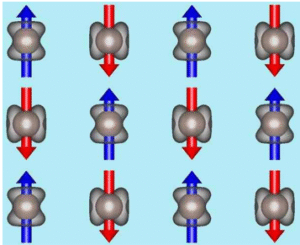
ombin
es features of ferromagnetism and antiferromagnetism, opening avenues for advanced electronics and quantum computing.
Understanding Altermagnetism
- Concept: A novel magnetism form identified theoretically in 2019 and confirmed experimentally in 2024.
- Mechanism: Atoms have antiparallel spins like antiferromagnetism but arranged with mirror or rotational symmetry, producing spin-polarized currents without an external magnetic field.
- Discovery: Verified in manganese telluride (MnTe) using advanced electron microscopy and X-ray techniques.
How It Differs from Other Magnetisms
| Magnetism Type | Spin Alignment | Magnetic Field Presence | Key Feature |
| Ferromagnetism | Parallel (all spins same direction) | Strong external field | Used in traditional magnets |
| Antiferromagnetism | Antiparallel (spins opposite, equal) | No net external field | Spins cancel out completely |
| Altermagnetism | Antiparallel with mirror symmetry | No external field | Spin-polarised currents, internal asymmetry |
Unique Properties
- Zero external magnetism but with strong internal spin asymmetry.
- Can carry magnetic-like electric currents without generating stray fields.
- Operates in ultrafast terahertz (THz) frequency range, far faster than conventional magnetic devices.
- Stable magnetic order even under varying conditions.
- Magnetism arising from crystal atomic arrangements rather than external alignment.
Potential Applications
- Spintronics: More energy-efficient, compact data storage and logic devices.
- Quantum Computing: Materials providing magnetically quiet environments stable for qubits.
- High-Speed Electronics: Ultrafast processors functioning at THz frequencies.
- Advanced Sensors: Precise, low-noise magnetic detection for scientific and industrial use.
This discovery marks a breakthrough in physics and materials science with broad technological implications.