

1. High -Intensity explosion in capital kills at least 9
GS II: Governance, Constitution, Polity, Social Justice and International Relations
GS III: Security and Disaster Management
Context: Major explosion outside Red Fort, central Delhi.
- At least 9 killed, over 20 injured.
- Sparked probe by central agencies, nationwide alert.
- Location: high-security, symbolic venue.
Immediate Response: Agencies and Actions
| Agency/Authority | Role/Action Taken |
| Delhi Police | Immediate cordoning off site, initial rescue, launched probe |
| Forensic Sciences Laboratory (FSL) | Collected and started analyzing blast site samples |
| National Investigation Agency (NIA) | Joined probe, examining possible terrorism angle |
| Union Home Ministry (Amit Shah) | Ordered multi-agency probe, “all possibilities” being explored |
| Delhi Fire Services | Attended site, rescued injured, provided initial report |
| State Police (Haryana, Punjab, U.P.) | Placed on high alert, increased local vigilance |
Official Statements
- Amit Shah (Union Home Minister):
- All possibilities being explored, multi-agency and thorough probe, “We do not rule out anything”; nationwide alert issued.
- Satish Golcha (Delhi Police):
- Confirmed explosion near Red Fort, slow-moving car; investigation underway from all angles.
- Prime Minister Narendra Modi:
- Expressed condolences, urged quick recovery, stated authorities are ensuring best care for injured.
Possible Angles Under Investigation
- Terrorist attack or security breach
- Explosives/method used (forensic analysis ongoing)
- Origin of vehicle, possible links to extremist groups
- Role of people detained (vehicle owner being questioned)
- Surveillance gaps or local support
Why This Incident Matters?
National Security Angle
- Happened near Red Fort: highly symbolic, historic, and sensitive site.
- Reflects ongoing vulnerabilities in urban public spaces.
- Can influence future deployment and surveillance policies.
Forensics and Intelligence
- Utilization of FSL, NIA for multidisciplinary probe.
- Event tests India’s capacity for rapid forensic and intelligence coordination.
- Outcome shapes preparedness for similar incidents elsewhere.
Institutional and Legal Framework
| Aspect | Framework/Laws | Purpose/Significance |
| National Security | National Security Act (NSA); Unlawful Activities Prevention Act (UAPA) | Enable state to detain, investigate; curb terrorism, maintain public order |
| Counter-Terrorism | NIA Act, 2008 | Empowers NIA to investigate terror-related cases anywhere in India |
| Forensics/Police Investigation | Code of Criminal Procedure (CrPC); Indian Evidence Act, 1872 | Prescribes procedure for investigation, collection and admissibility of evidence |
| Compensation/Support for Victims | National Disaster Management Act; Delhi Victim Compensation Scheme | Provides compensation, support, rehabilitation to blast victims |
| Surveillance & Monitoring | Information Technology Act, 2000; citywide CCTV under police regulations | Permits evidence collection, online data tracking, and surveillance for preventive policing |
| Intelligence Coordination | Multi-agency Centre (MAC), Intelligence Bureau (IB), State Police Special Branches | Inter-agency intelligence sharing and |
2. Story of India’s withdrawal from overseas airbase in Tajikistan
GS paper -II: International Relations
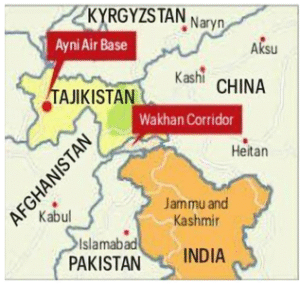
Context: India ended its presence at the Ayni airbase in Tajikistan in 2022 after the lease was not renewed, reportedly because Tajikistan faced pressure from Russia and China.
Background: The Ayni Airbase
- Location: Situated near Dushanbe, the capital of Tajikistan.
- Historical Significance: Initially used to support the Northern Alliance in Afghanistan during the 1990s and later for evacuating Indians after the Taliban’s resurgence in 2021.
- Development: The base, originally built during the Soviet era, was in disrepair. India invested approximately $80 million in its renovation under a 2002 agreement with the Tajik government. The Border Roads Organisation played a significant role in the renovation.
- Personnel and Assets: At its peak, the base housed up to 200 Indian military personnel, primarily from the Army and Air Force, along with Sukhoi 30 MKI jets.
Strategic Importance:
- Provided India a military foothold in Central Asia a region of high strategic interest.
- Enabled surveillance and operational reach over Pakistan and Afghanistan.
- Located near the Wakhan Corridor, it offered India leverage in regional security and counter-terror operations.
- Strengthened India’s role as a security partner in Central Asia amid growing China-Pakistan proximity.
India’s exit from the Ayni airbase ends a key Central Asian foothold, driven by regional pressures and rising Russian-Chinese influence. It also reflects India’s shift toward strengthening its maritime presence, while continued diplomatic and security engagement will be vital to retain influence in Central Asia.
3. Air quality beyond AQI: The case for measuring indoor pollutants
GS paper -III, Environment and Ecology.
Context: Researchers at BITS Pilani Hyderabad developed India’s first customized Indoor Air Quality (IAQ) scale to address indoor pollution, which can be 2-5 times worse than outdoor air due to trapped pollutants and poor ventilation.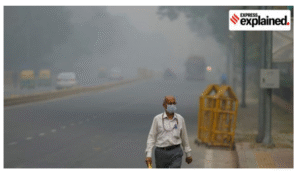
Key Features of the New IAQ Scale Developed by BITS Pilani
- More comprehensive than commercial air purifiers Purifiers normally measure only PM levels and humidity.
- The proposed IAQ device measures all critical indoor pollutants required for accurate assessment.
- First India-specific indoor air scale other countries (US, UK, EU) have IAQ standards, but India does not.
- Scale is customised for India’s: Climate, Housing patterns, Dense urban living and Economic constraints.
The New IAQ Scale
The data was refined and used to develop a learning model, resulting in a scale based on four weighted parameters:
- Pollution Concentration (59.5%): This is the most significant factor, reflecting the levels of various pollutants in the air.
- Exposure Time (25.9%): The duration of exposure to the pollutants is a crucial determinant of health risks.
- Ventilation Efficiency (9.8%): The effectiveness of ventilation in removing pollutants from the indoor environment.
- Enclosure Size (4.4%): The size of the indoor space affects the concentration of pollutants.
- The weighting reflects India’s dense urban living, housing sizes, and ventilation challenges. The scale ranges from 22 to 100, with 22 representing the most severe air quality and 100 representing the best.
Key Pollutants of Concern: The study identified several key pollutants of concern:
- Benzene: Considered the most dangerous pollutant, benzene exposure is associated with adverse health effects and diseases such as cancer, according to the World Health Organization (WHO).
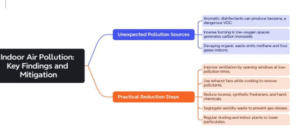 Exposure can occur through the use of benzene-containing petroleum products, including motor fuels and solvents.
- Carbon Monoxide: This poisonous gas is produced by many household items, including gas- and oil-burning furnaces and charcoal grills. It is also associated with machinery burning fossil fuels, such as cars.
- Particulate Matter (PM2.5 and PM10): Fine particulate matter can rise above safe exposure limits during routine activities like cooking and cleaning.
Indoor air pollution is a silent but severe health threat in India. Incorporating IAQ standards into building codes, smart city planning, and household practices will be essential for creating healthier indoor environments.
4. Exercise Malabar 2025
Context: INS Sahyadri has docked at Guam to join Exercise Malabar 2025, a key Quad (India, US, Japan, Australia) naval drill, highlighting India’s role in regional maritime security.
Overview: Exercise Malabar
- Multilateral naval exercise involving India, US, Japan, Australia (the Quad).
- Aims to boost cooperation, interoperability, and operational readiness for Indo-Pacific security.
- Launched in 1992 (India-US), expanded over the years; now a Quad event.
Strategic Venue: Guam in 2025
- Guam, a major US Pacific territory, is strategically located between Hawaii and the Philippines.
- Serves as a key military base, underlining the exercise’s Indo-Pacific significance.
India’s Participation and Self-Reliance
- INS Sahyadri, an indigenously built Shivalik-class stealth frigate, represents India.
- Participation aligns with Aatmanirbhar Bharat (self-reliant India) in defense manufacturing.
Objectives and Operational Scope
- Features joint naval drills, planning, anti-submarine warfare, gunnery, and aerial missions.
- Seeks to strengthen interoperable capabilities and coordinated maritime responses among Quad navies.
Significance for Indo-Pacific
- Reinforces the Quad’s united stance for a free, open, rule-based Indo-Pacific order.
- Enhances India’s engagement in multilateral maritime security efforts.
5. Why Access to Knowledge is Crucial for Innovation
General Studies Paper III- Economy – Growth, Development and Employment; Science & Technology
context: Nobel Prize in Economics awarded to Daron Acemoglu, Simon Johnson, and James Robinson for studying institutions and economic growth.
- Focus on how knowledge access drives innovation, contrasting historical models with modern challenges in India.
What was Mokyr’s model?
- Distinguishes propositional knowledge (theoretical/scientific) and prescriptive knowledge (techniques of application).
- Economic growth occurs when both kinds of knowledge increase and interact effectively.
What is Mokyr’s message?
- Societies need not just knowledge but meaningful access for majority to apply it.
- Free markets don’t automatically ensure knowledge spread; state intervention may be needed.
- Restricting information flow directly hampers innovation and growth.
Does the caste system stop growth?
- Caste in India restricts knowledge access through social norms and violence.
- Independence-era policies introduced reservations to reduce inequality.
- High-quality education access remains limited, especially in public sector.
What about automation?
- Labour markets face disruption from AI and automation.
- Job polarisation rising: routine tasks automated, humans in high-skill or service roles.
- Knowledge of modern techniques spreads slowly due to long training periods.
In this regard
- Breaking caste barriers and improving education access critical for growth.
- Slow rise in private universities; population lacks quality education access.
- Automation can boost productivity but risks job loss if knowledge access restricted
6. Cop 30: beginners guide on what to expect from the climate summit
GS PAPER III-environment and ecology
Context: The 30th Conference of the Parties (COP30) to the UNFCCC has commenced in Belém, Brazil, marking a decade since the Paris Agreement. The summit aims to move global climate commitments towards concrete implementation, emphasizing finance, adaptation, and equitable climate action.
Overview of COP30
- COP30 is the annual UN Climate Change Conference where countries assess progress on the Paris Agreement, update emissions targets, and negotiate climate finance and adaptation frameworks.
- Hosted by Brazil in Belém, an Amazonian city symbolizing climate vulnerability and potential.
Objectives of COP30
- To transform climate pledges into measurable, inclusive, and just implementation aligned with CBDR-RC principles.
- Conduct the first Global Stocktake (GST) reviewing global climate mitigation and adaptation progress.
- Establish a New Collective Quantified Goal (NCQG) to increase annual climate finance from $100 billion to $300 billion by 2035, with a roadmap to mobilize $1.3 trillion annually.
- Develop the Global Goal on Adaptation (GGA) to set measurable targets and funding for resilience.
- Operationalize the Baku-to-Belém Climate Finance Roadmap for predictable funds to developing nations.
- Launch the Tropical Forests Forever Facility (TFFF), a Brazil-led fund incentivizing tropical forest conservation.
- Integrate climate and biodiversity agendas through restoration of forests, oceans, and soils.
Significance of COP30
- Marks 10 years since Paris Agreement, shifting focus from ambition to action and implementation.
- Highlights the priorities of the Global South, emphasizing finance, technology transfer, and capacity building.
- Stresses just transition pathways in energy, industry, and transport for developing economies.
7. Burden of proof: On electoral integrity
GS PAPER II: polity, Representation of People’s Act
Context: Rahul Gandhi publicly alleged that up to 25 lakh fake voters—or 12.5% of Haryana’s rolls—compromised the credibility of the 2024 Assembly election.
- Claims included mass duplication of entries and institutional lapses within the Election Commission of India (ECI).
The Heart of Democratic Legitimacy
- Elections anchor Indian democracy, but integrity relies on robust and transparent electoral rolls.
- Recent allegations reignite debate on systemic gaps and institutional responsibility.
Scale and Nature of Allegations
- Accusations of up to 25 lakh fake or duplicate entries, including cases of mass photo duplication across booths.
- Institutional manipulation allegedly favored the ruling party and targeted Opposition voters.
- Highlights structural problems, moving beyond isolated incidents.
ECI’s Response and Procedural Posture
- ECI offered technical defenses, citing rules for complaint timelines and election petitions.
- Relied on privacy arguments to avoid sharing detailed electoral data, fueling skepticism.
- Has not initiated prompt, public-facing verification.
Transparency Versus Secrecy
- ECI’s reluctance to publish booth-level details or video records intensifies doubts.
- Editorial emphasizes that secrecy should protect the act of voting, not the process or audit trail.
- Lack of openness amplifies public anxiety over fairness.
Consequences for Democracy and Institutions
- Erosion of trust in ECI’s independence and moral authority.
- Procedural correctness does not suffice without transparency and proactive communication.
- India’s global democratic reputation is at stake due to these controversies.
Recommended Actions
- Advocate for full disclosure of verifiable, booth-level polling records.
- Ensure process transparency while protecting vote secrecy.
- Independent third-party audits (such as Special Intensive Revision exercises) suggested for validation.
Conclusion
- The integrity of democracy depends not merely on the act of voting, but on demonstrable fairness and open processes.
- Restoring faith in the electoral system necessitates public access to verifiable data, transparency from institutional actors, and robust external scrutiny.