1. Aditya -L1 gets a close look at eruptions from the sun
GS Paper III- Science and technology
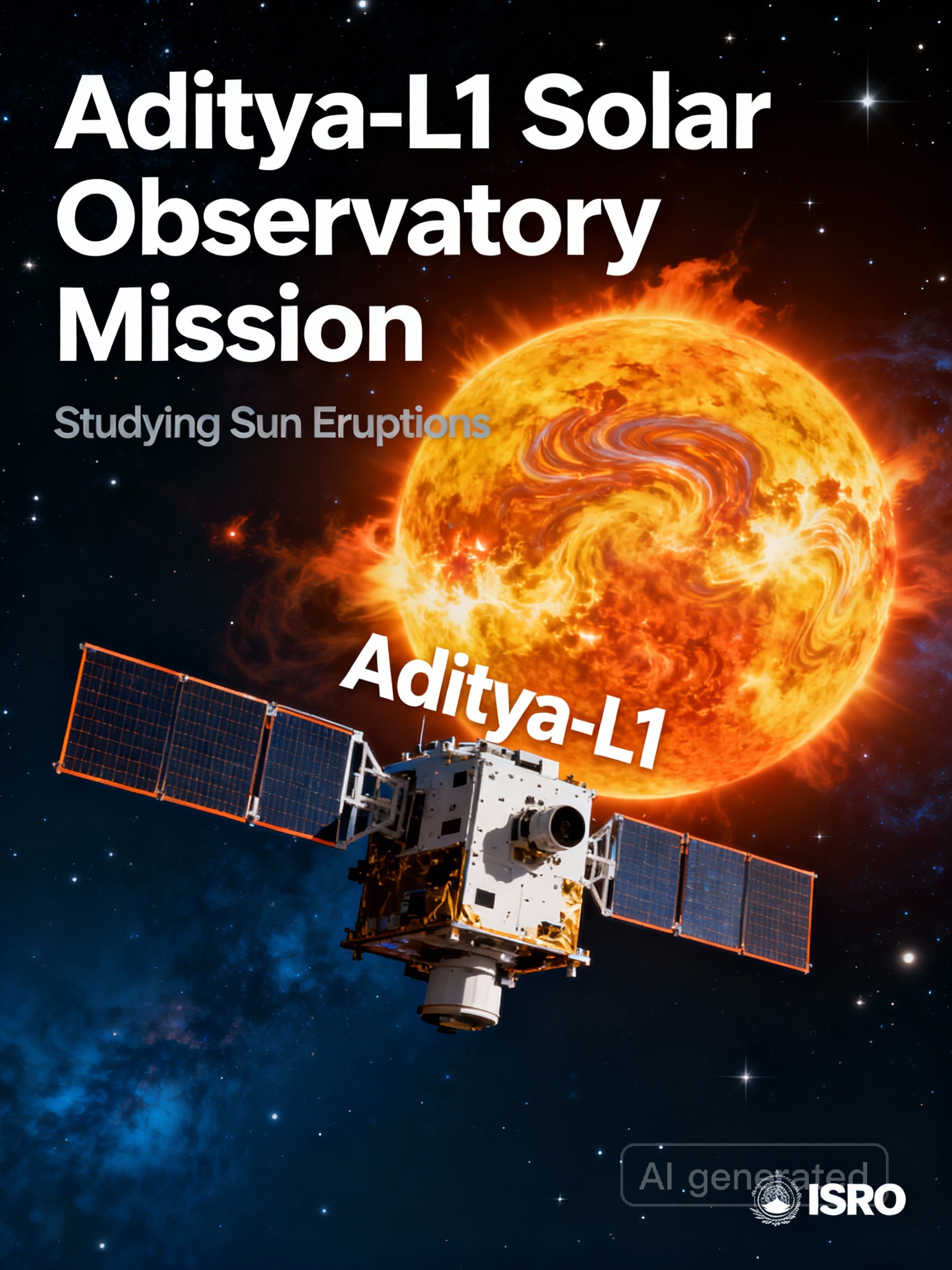
Context: First spectroscopic CME observations near the Sun’s surface by Aditya-L1.
- Scientists from IIA and NASA estimated CME parameters: electron density, energy, mass, speed, and temperature.
- Mission’s continuous solar monitoring will support reliable space-weather prediction.
Aditya-L1 Mission: Features & Details
| Feature | Details |
| Objective | Study Sun’s corona, chromosphere, photosphere, solar wind, flares, CME |
| Orbit | Halo orbit at Sun–Earth Lagrange point L1 (1.5 million km from Earth) |
| Launch | PSLV-C57, Sriharikota, Sept 2023 |
| Payloads | Seven (including VELC, SUIT, SoLEXS, HEL1OS, ASPEX, PAPA, MAG) |
| Significance | First Indian solar mission; real-time space weather data; global relevance |
What is VELC?
- VELC (Visible Emission Line Coronagraph) observes the Sun’s corona and measures CME parameters close to their origin.
- Main parameters: electron density, energy, mass, temperature, speed.
- Features: Multi-line spectroscopy, high-field imaging (radius 1.05–3 solar radii), variable cadence, spectropolarimetry at 10747 Å.
Coronal Mass Ejection (CME):
- CME is a massive release of plasma (mainly electrons and protons) and magnetic field from the Sun’s corona into space.
- Characteristics: Low-density cavity, dense core, bright leading edge.
- Capable of ejecting billions of tonnes of material at high speeds; causes geomagnetic storms, aurorae, can disrupt power and satellites.
Key VELC Findings
| Parameter | VELC Measurement | Comparison |
| Electron density | ~370 million/cm³ CME; 10–100 million/cm³ non-CME | CME density far greater than background |
| CME Mass | Nearly 270 million tonnes | Titanic iceberg ~1.5 million tonnes |
| Energy | ~9.4 × 10²¹ joules | CME energy extremely high |
| Speed | 264 km/s initial | Comparable to fastest solar eruptions |
| Temperature | 1.8 million Kelvin | Corona much hotter than Sun’s surface |
Importance of These Observations
- Directly links CME parameters with their energetic impact on space weather.
- Improves space weather models, helps prepare for solar disruptions affecting satellites, power grids, communication.
- Unique data from Sun’s visible surface enhances understanding of solar heating, CME origins, and potential forecasting.
Challenges
| Challenge/Aspect | Explanation |
| Data volume | Managing continuous, high-resolution solar data |
| Instrument calibration | High accuracy for sensitive spectroscopic readings |
| Remote operation (L1) | Communication lag, limited corrective access |
| Predictive accuracy | Linking CME parameters to terrestrial impacts remains complex |
Conclusion
Aditya-L1’s VELC payload has enabled India’s first spectroscopic view of CMEs close to the Sun, providing vital physical parameters and strengthening global solar research. These observations are vital for understanding solar impacts on technology and daily life, marking a major advance in India’s space science capabilitiesities.
2. How is AI going to be regulated in India?
GS paper III- science and technology
Context: The Ministry of Electronics and Information Technology (MeitY) released the India AI Governance Guidelines on November 5, 2025, under the IndiaAI Mission.
- The framework aims to ensure safe and inclusive AI adoption ahead of the 2026 AI Impact Summit.
- It promotes a people-first and innovation-friendly approach while addressing global concerns like deepfakes and AI misuse.
The Story So Far
- A subcommittee under the Principal Scientific Adviser was set up in November 2023 to draft AI governance recommendations.
- A public consultation on the draft report was held until February 27, 2025, gathering stakeholder inputs.
- The final guidelines were prepared by a MeitY committee in July 2025 after extensive review.
- The framework aligns with global initiatives like the Bletchley Park Summit (UK) and supports IndiaAI Mission objectives for balanced growth.
What Are the India AI Governance Guidelines?
- A 66-page policy document outlining ethical, legal, and operational principles for responsible AI.
- Built around Seven Sutras:
- Trust
- People First
- Innovation over Restraint
- Fairness & Equity
- Accountability
- Understandable by Design
- Safety, Resilience & Sustainability
- Emphasizes voluntary standards, risk-based oversight, and adaptive regulation over rigid laws.
- Provides practical guidance for industry grievance redressal and periodic regulatory reviews.
Why Have Guidelines Become Necessary?
- India’s multilingual and diverse society heightens risks of bias and misinterpretation in AI systems.
- Rapid AI adoption threatens data privacy, safety, and intellectual property integrity.
- Experiences from the EU AI Act and other regimes show the need for context-specific, innovation-friendly rules.
- Rising deepfake and misinformation incidents call for proactive, balanced governance mechanisms.
Key Thrust of the Guidelines
- Rooted in the “Do No Harm” principle for socially responsible AI use.
- Advocates decentralized, sector-led oversight by regulators like RBI and SEBI instead of centralized control.
- Promotes innovation sandboxes for testing AI solutions safely.
- Introduces content labeling for AI-generated media under proposed IT Act amendments.
- Aims to position India as a global AI governance leader through an adaptive and inclusive framework.
Approach to AI Models for Indian Circumstances
- Suggests risk-tier classification of AI systems, prioritizing oversight for high-impact sectors such as healthcare and finance.
- Focuses on developing localized datasets suited to India’s linguistic and cultural diversity.
- Recommends integrating AI with Digital Public Infrastructure (DPI) like Aadhaar for equitable access.
- Encourages safety audits and low-cost AI tools tailored for underserved communities.
Concerns on AI Usage and Intellectual Property Rights
- Warns of risks from biased or unmonitored AI systems, advocating transparency and disclosure norms.
- Notes intellectual property challenges in AI training data and recommends fair use policies compatible with innovation.
- Highlights foreign AI models’ cultural insensitivity, urging indigenous AI and IP safeguards.
- Calls for accountability in AI supply chains and mechanisms to track copyright or data misuse.
3. Does India need nutritional transformation?
GS Paper III: Science and Technology: Includes biotechnology applications in food, nutrition, functional foods, and smart proteins.
Context: Debate on nutritional security, functional foods, and smart proteins amid rising malnutrition and sustainability concerns.
- Push for alternative proteins and new food technologies due to environmental degradation, rising food demand, and chronic undernutrition across India.
What are Functional Foods?
- Foods providing health benefits beyond basic nutrition.
- Includes bioactive compounds (vitamins, probiotics, antioxidants).
- Cover conventional and fortified types (e.g., vitamin rice, fortified cereals).
- Prevent deficiencies, lower disease risk, improve growth.
- Produced via fortification, nutrigenomics, 3D printing, probiotics.
- Global trend: $275B market (2025); bio-fortified Indian crops lead.
| Aspect | Details |
| Definition | Foods with added health benefits (immune, anti-inflammatory, fortification) |
| Examples | Enriched rice, omega-3 margarine, probiotic yogurt, fiber cereals |
| Health Benefits | Fewer deficiencies, chronic disease prevention, growth support |
| Production Methods | Bio-fortified crops, gene-nutrient science, 3D printing, added probiotics |
| Trends | Rapid growth, preventive health focus, India leads in iron/zinc millet bio-fortification |
What are Smart Proteins?
- Biotech-derived, sustainable proteins mimicking animal nutrition/functions.
- Plant, cultivated (lab-grown), and fermentation-based varieties.
- Improve bioavailability, reduce environmental impact, fill protein gap.
- Examples: pea/soy isolates, precision-fermented casein, cultured meat.
- India: 73 brands, 377 products (2025), focusing on urban markets.
| Aspect | Details |
| Definition | Engineered proteins (plant/cultivated/fermented) with enhanced nutrition or bioactivity |
| Examples | Plant meat, fungi/microbial protein, lab-grown chicken, insect powders |
| Health Benefits | Complete amino acids, high digestibility, less saturated fat, diabetes/anaemia targeted |
| Production Methods | Fermentation, cell culture, plant extraction from by-products |
| Market Trends | $29B market; Indian consumer/brand ecosystem expanding 2025 |
Why Does India Need Nutritional Transformation?
- High stunting (35%), anemia (57%), and child wasting.
- Dual nutrition problem: protein, micronutrient gaps plus obesity rise.
- Diets dominated by rice/wheat; protein, fruit, veg intake low.
- Poor dietary diversity, inequity, and food system inefficiency persist.
| Current Situation/Challenges | Details |
| Malnutrition | 35% child stunting, 57% anemia in women |
| Overnutrition/Obesity | 21% of adults overweight, rapid diabetes surge |
| Food Diversity Gap | Drop in pulses/millets, insufficient fruits/veg |
| Structural Barriers | Urban-rural, gender, hygiene, new food access issues |
| Environmental Pressures | Climate shocks, food loss (40%), income/wage stagnation |
India’s Progress So Far
- Stunting down by 4% (2015–2021); breastfeeding up to 64%.
- Initiatives: Poshan Abhiyaan, BioE3 policy, mandatory fortification.
- Smart protein ecosystem: 73 brands, plant-based innovation/noodles/R&D.
| Initiative/Area | Description |
| Poshan Abhiyaan | Tech-driven flagship, targets stunting/anemia/wasting, uses Anganwadi, reaches 80M+ |
| BioE3 Policy | DBT grants for functional foods, smart protein, biomanufacturing by 2025 |
| Food Fortification | FSSAI mandates iron/folic acid in staple grains, reaching PDS, schools |
| Mid-Day Meals/ICDS | World’s largest, eggs/millets for protein, focus on first 1,000 days |
| Startup Ecosystem | 73 brands, 377 protein products, new foods/tech for millennials/urban families |
Global Scenario
- Japan leads in functional food regulation (FOSHU), started in 1980s.
- EU’s Smart Protein Project, China prioritizes alternative protein, Singapore first approved lab-grown meat.
- US: $29B plant-based market, FDA regulates fortified/probiotic foods.
| Country/Region | Initiative |
| Japan | FOSHU – regulated health claims, 1,000+ products |
| EU | Smart Protein Project (plant/fungi R&D, upcycling) |
| USA | FDA-fortified/probiotic approval, large plant protein market |
| China | Invests in biomanufacturing, fermentation |
| Singapore | First to approve cultivated chicken (Eat Just), incentives for smart proteins |
Challenges for India
- Regulatory lag, FSSAI lacks clear guidance on lab-grown/cultivated proteins.
- Cost, infrastructure, and supply chain capacity gaps for biomanufacturing.
- Low consumer awareness, ‘lab-food’ scepticism, acceptability issues.
- Price/access: First adoption is urban, rural/poor lag behind.
- Scaling without upcycling risks environmental strain.
| Challenge | Details |
| Regulatory Gaps | Delays in guidelines/approval, slows innovation scaling |
| High Cost/Infra Gaps | Fermentation 2-3x cost, limited R&D/commercial units |
| Consumer Trust | Low trial/acceptance of new proteins, flavor/texture hurdles |
| Supply/Equity | Import dependent protein inputs, urban focus |
| Sustainability | Waste, environmental risk if not managed |
Way Forward
- Fast-track FSSAI approval, labeling, safety protocols for smart/functional foods.
- Shift PDS toward nutrient-dense staples, fortified millets, and smart proteins.
- Invest in infra/R&D: Food-tech parks, fermentation scale-ups, crop bio-fortification.
- Run targeted BCC campaigns; engage PRIs, Anganwadis, focus on women/youth.
- Diversify diet, climate-resilient crops, mainstream functional proteins in Poshan 2.0.
- Align food policy (ICRISAT, ICMR, trade) for 2030 SDG targets.
- Monitor outcomes via NFHS-6, set targets (e.g., 20% stunting reduction by 2030) for accountability.
4. Global watch over: CTBO
GS PAPER II-IR
Context: China dismissed President Trump’s recent allegations of conducting secret nuclear tests.
- It reaffirmed its continued commitment to the Comprehensive Nuclear-Test-Ban Treaty (CTBT).
- The development comes as the United States revives discussions about resuming nuclear testing, increasing Cold War–style tensions in global security dynamics.
About the Comprehensive Nuclear-Test-Ban Treaty Organization (CTBTO)
- Establishment: Created in 1996 under the Comprehensive Nuclear-Test-Ban Treaty (CTBT).
- Headquarters: Vienna, Austria.
- Mandate: To ensure compliance with the global ban on nuclear explosions through a robust verification system.
Global Verification and Monitoring System
- Operates the International Monitoring System (IMS) consisting of 337 facilities worldwide.
- Uses seismic, hydroacoustic, infrasound, and radionuclide technologies to detect nuclear tests underground, underwater, or in the atmosphere.
- The International Data Centre (IDC) processes and distributes real-time monitoring data to member states.
- Provides early warnings of nuclear test activities and supports verification of treaty obligations.
Role of the Preparatory Commission
- Functions as an interim body until the CTBT formally enters into force.
- Maintains operational readiness of the verification regime.
- Offers technical support and capacity-building to member states for compliance and monitoring.
Scientific and Civil Applications
- The IMS data also aids tsunami warnings, atmospheric studies, and disaster response operations.
- Enhances international cooperation in scientific and humanitarian fields beyond nuclear disarmament.
Relationship between CTBT and NPT
- Shared Objective: Both aim to curb nuclear proliferation and promote global disarmament.
- Distinct Scope:
- NPT (1970): Prevents spread of nuclear weapons and promotes peaceful nuclear use.
- CTBT (1996): Prohibits all nuclear explosions for any purpose.
- Linkage: CTBT strengthens NPT’s disarmament pillar under Article VI, using a verifiable framework through IMS and IAEA safeguards.
Status and Ratification Gaps
- Adopted: 1996; opened for signature on September 24, 1996.
- Membership: 187 signatories; 178 ratifications as of 2025.
- Pending Ratifications: Treaty requires 44 specific “Annex 2” countries to ratify for enforcement.
- Non-Ratifying States:
- Signatories but unratified:China, Egypt, Iran, Israel, United States
- Non-signatories:India, Pakistan, North Korea
- Recent Setback: Russia withdrew its ratification in 2023 but continues observing a moratorium on testing.
- Global Compliance: Despite incomplete ratification, a global testing moratorium has prevailed since the 1990s, except for North Korea’s tests (since 2006).
Significance
- Serves as a cornerstone of nuclear non-proliferation and disarmament efforts.
- Enhances transparency, trust, and verification capabilities among nations.
- The CTBTO’s monitoring network deters potential violators and sustains global stability even in the absence of full legal enforcement.
5. What’s the plan to relocate forest tribes?
GS PAPER III-ENVIRONEMNT AND ECOLOGY
Context: The Ministry of Tribal Affairs has drafted a new policy titled “Reconciling Conservation and Community Rights”.
- It aims to ensure that forest-dwelling communities are relocated from tiger reserves only with their free consent and in accordance with the Forest Rights Act (FRA), 2006.
- The policy responds to rising complaints from tribal communities about forced relocations and poor post-relocation monitoring, despite FRA protections.
Key Objectives and Significance
- Institutional Reform: Proposes a unified National Framework for Community-Centric Conservation and Relocation involving both the Tribal Affairs and Environment Ministries.
- Integrated Governance: Suggests joint procedures, timelines, and accountability mechanisms between MoTA and MoEFCC.
- Central Data Management: Recommends creation of a National Database on Conservation-Community Interface (NDCCI) to track relocations, compensation, and outcomes.
- Independent Oversight: Calls for annual audits by third-party agencies to ensure voluntary relocation and FRA compliance.
Rationale Behind the Move
- Implementation Gaps: Persistent reports of disregard for FRA provisions during relocations from tiger reserves.
- Rights Violations: Allegations of coercion against tribal families despite their legal right to inhabit traditional forests.
- Weak Monitoring: Absence of reliable data on relocated families and their rehabilitation status.
- Scale of Impact: Over 1,566 villages (around 55,000 families) relocated since 2007; approximately 94,000 families still reside within reserves.
Proposed Safeguards
- Voluntary Relocation: Requires consent from both Gram Sabha and individual households.
- Right to Stay: Reaffirms that communities cannot be displaced without exercising their FRA-recognized rights.
- Scientific Justification: Relocation permitted only when backed by documented ecological necessity.
- Ethical Resettlement: Ensures relocations are voluntary, scientifically validated, and dignity-based, monitored by NDCCI and independent auditors.
Mechanism for Inter-Ministerial Coordination
- Joint Mechanism: Establishes cooperation between MoEFCC and MoTA for approval, implementation, and review.
- Shared Accountability: Both ministries jointly responsible for rights protection and grievance redressal.
- State Role: States to appoint nodal officers to verify FRA compliance before any relocation begins.
Continuing Challenges
- Administrative Resistance: Some state agencies bypass FRA obligations citing wildlife protection priorities.
- Flawed Consent Process: Incomplete or manipulated consent at the Gram Sabha level.
- Livelihood Risks: Compensation delays and inadequate support post-relocation.
- Social Displacement: Ongoing distress among tribal groups such as Jenu Kuruba in Karnataka, alleging forced evictions.
Policy Alignment with India’s Conservation Vision
- Balancing Goals: Seeks harmony between tiger preservation and tribal rights.
- Legal Coherence: Aligns provisions of FRA (2006) with Wildlife Protection Act (1972) and NTCA guidelines.
- Participatory Approach: Promotes ethical and inclusive conservation by engaging local communities as partners rather than subjects.
Conclusion
The new framework represents a shift toward rights-based conservation, emphasizing participation, transparency, and accountability. Its effectiveness will depend on genuine community involvement, strict adherence to FRA safeguards, and rigorous inter-ministerial coordination.
6. Centre notifies rules for deep-sea fishing
GS paper III: economics – Energy, Ports, Roads, Airports, Railways Etc.
Context: The Government of India has notified new Deep-Sea Fishing Rules for operations within India’s Exclusive Economic Zone (EEZ).
- The move aims to promote sustainable fishing, enhance digital traceability, and strengthen fisher welfare and exports.
- The new regime focuses on reducing pressure on near-shore fisheries while boosting India’s presence in deep-sea waters using modern, eco-friendly practices.
Key Objectives
- Facilitate transition from near-shore fishing to deep-sea operations within the EEZ.
- Improve marine sustainability, export competitiveness, and livelihood opportunities.
- Integrate digital governance for transparent monitoring and traceability.
Main Features of the New Rules
- Domestic Priority: Fishermen Cooperatives and Fish Farmer Producer Organisations (FFPOs) get first operational rights for advanced deep-sea vessels.
- Mother-and-Child Vessel Model: Large “mother” vessels supported by smaller “child” crafts for mid-sea transshipment—vital for the Andaman & Nicobar and Lakshadweep Islands, which cover almost 49% of India’s EEZ.
- Digital Monitoring: All mechanised vessels require Access Passes through the ReALCraft Portal, integrated with MPEDA and EIC for sanitary certification, traceability, and eco-labelling.
- Foreign Vessel Ban: Complete prohibition on the operation of foreign fishing vessels in Indian waters to protect small-scale and domestic fishers.
- Ban on Destructive Practices: Activities like LED-light fishing, pair trawling, and bull trawling are banned. Each coastal state will develop Fisheries Management Plans (FMPs) defining legal catch sizes.
- Origin Recognition: Fish caught from India’s EEZ beyond the contiguous zone will be declared as of “Indian origin” for customs purposes, avoiding import classification.
- Capacity Building: Skill development, processing, and export support integrated with PM Matsya Sampada Yojana (PMMSY) and the Fisheries and Aquaculture Infrastructure Development Fund (FIDF).
- Safety and Surveillance: All vessels must have transponders, QR-coded Fisher IDs, and Nabhmitra satellite devices for navigation and distress response; monitored by the Indian Coast Guard and Navy.
Background: Exclusive Economic Zone (EEZ)
- Definition: As per the 1982 UN Convention on the Law of the Sea (UNCLOS), an EEZ extends up to 200 nautical miles (≈370 km) from the coastline.
- Sovereign Rights: Coastal states can explore, extract, and manage marine resources while ensuring environmental protection and marine research.
- Difference from Territorial Sea: The territorial sea (12 nautical miles) gives full sovereignty, whereas the EEZ provides resource rights while permitting free navigation and overflight by other nations.
- India’s EEZ: Covers about 2.3 million sq km, among the world’s largest, rich in fisheries, hydrocarbons, and seabed minerals.
- Legal Basis: Managed under The Territorial Waters, Continental Shelf, EEZ and Other Maritime Zones Act, 1976, defining India’s jurisdiction and management structure.
7. National Social Assistance Programme (NSAP)
Why in News
- PIB released a progress update for the National Social Assistance Programme (NSAP).
- Recent data highlights expanded digital initiatives, fund disbursal, and beneficiary coverage under NSAP.
- Launch of Digital Life Certificate (DLC) mobile app in July 2025 for easier Aadhaar-based verification.
- Budget allocation for 2025–26 announced, with focus on increasing transparency and timely assistance.
National Social Assistance Programme (NSAP) – Key Details
- Launched in August 1995 as a Centrally Sponsored Scheme overseen by the Ministry of Rural Development.
- Aims to offer financial and food security to BPL (Below Poverty Line) individuals in line with Article 41 of the Constitution.
- Supports elderly, widows, persons with disabilities, and families facing the loss of the main earner.
- Reaches over 3.09 crore beneficiaries in both urban and rural areas across India.
Major Schemes under NSAP
- IGNOAPS: Old age pension for those aged 60+; states may supplement central amounts.
- IGNWPS: Pension to widows aged 40+; enhanced benefits for those above 80 years.
- IGNDPS: Pension for adults with severe disabilities; higher entitlement for those aged 80+.
- NFBS: One-time assistance to BPL families after breadwinner’s death (age 18–59).
- Annapurna: Free food grain supply (10 kg/month) to eligible seniors not covered by IGNOAPS.
Implementation and Monitoring Highlights
- Beneficiaries identified by Gram Panchayats and Urban Local Bodies.
- 94% funds disbursed via Direct Benefit Transfer (DBT) into bank or post office accounts.
- Special cases handled through cash-at-doorstep.
- Real-time monitoring via Public Financial Management System (PFMS) and Aadhaar linkage to ensure accuracy and reduce leakage.
- States/UTs must submit progress reports; delays can result in funds being withheld.
Recent Achievements and Financial Progress
- 2024–25: ₹6,143.92 crore (IGNOAPS), ₹2,150.03 crore (IGNWPS), ₹243.74 crore (IGNDPS), ₹394.29 crore (NFBS & Annapurna) disbursed.
- Over 2.5 crore accounts now linked to Aadhaar, strengthening fraud prevention and payment accuracy.
- Budget for 2025–26 set at ₹9,652 crore, with IGNOAPS receiving the highest allocation.
- Introduction of DLC app streamlines life certificate submission for pensioners.
8. 150 Years of Vande Mataram Commemoration
Context: The Prime Minister inaugurated the nationwide year-long celebration commemorating 150 years of the National Song, “Vande Mataram,” in New Delhi on 7 November 2025.
- The event marks the beginning of a nationwide programme (2025–26) celebrating the song’s enduring legacy in India’s freedom movement, unity, and cultural identity.
- A commemorative coin and postage stamp were released to mark the occasion, along with mass singing of the full version of “Vande Mataram” across the country.
About the 150 Years of Vande Mataram Commemoration
- A national initiative (2025–26) celebrating the 150th anniversary of “Vande Mataram.”
- Aims to reconnect citizens, especially the youth, with the patriotic, spiritual, and cultural essence of the composition that inspired the country’s freedom struggle.
Origin of Vande Mataram
- Composed by Bankimchandra Chatterji on 7 November 1875 (Akshaya Navami).
- First published in the literary journal Bangadarshan as part of his novel Anandamath.
- Depicts the Motherland as divine, powerful, and nurturing—embodying India’s timeless civilizational spirit.
Symbolic and Historical Significance
- “Vande Mataram” evolved from a poetic hymn into a national mantra of resistance and unity.
- Rabindranath Tagore publicly sang it at the 1896 Calcutta Congress Session.
- Its verses—describing a fertile and beautiful land—came to symbolize India’s strength, purity, and prosperity.
- The Constituent Assembly in 1950 accorded it equal honour with the National Anthem.
Role in India’s Freedom Struggle
- Became the rallying cry during the Swadeshi Movement (1905) and anti-partition protests in Bengal.
- Banned by the British for its revolutionary fervour, yet echoed across rallies, prisons, and execution grounds.
- Revered by leaders such as Sri Aurobindo, who called it a mantra of awakening, and Mahatma Gandhi, who viewed it as the song of an undivided India.
- Unified people of different faiths and regions under one voice of patriotism—“Vande Mataram.”
Vande Mataram Movement (Gulbarga, 1948)
- A regional freedom movement in the Hyderabad-Karnataka region, inspired by the slogan “Vande Mataram.”
- On 9 November 1948, leaders like Sharanabasappa and Qadeer Dargah led peaceful marches opposing the Nizam’s rule.
- The movement faced brutal repression but ultimately strengthened unity among the people.
- Sardar Vallabhbhai Patel later hailed their courage and integrated the region into the Indian Union.