1. Draft “National Labour & Employment Policy – Shram Shakti Niti 2025”
Context: The Ministry of Labour & Employment has released the Draft National Labour & Employment Policy – Shram Shakti Niti 2025 for public consultation.
What is Shram Shakti Niti 2025?
- India’s first integrated National Labour & Employment Policy for a fair and inclusive world of work.
- Aims to modernise labour governance, ensuring dignity, protection, and opportunities for all workers.
Key Objectives
- Seven core goals: universal social security, occupational safety, gender/youth empowerment, future skills, and green jobs.
- Universal Social Security Account integrating EPFO, ESIC, PM-JAY, and e-Shram for portable coverage.
- National Career Service (NCS) will be India’s digital employment backbone with AI-driven job matching.
- Targets 35% female workforce participation by 2030, with support for flexible work and entrepreneurship.
Governance and Structure
- Launch of single-window digital compliance and risk-based self-certification to reduce paperwork.
- Establishes National, State, and District Labour Missions for layered policy implementation.
- Labour and Employment Stack unifies databases for paperless, portable governance.
Key Features
- AI-enabled workplace safety and upskilling, green job promotion in line with climate goals.
- Dedicated education/outreach for cooperative federalism and tripartite dialogue among government, employers, and workers.
- Annual Labour & Employment Policy Evaluation Index (LEPEI) for performance tracking.
Phased Implementation
- Phase I (2025–27): Set up institutions and launch digital pilots; start social-security integration.
- Phase II (2027–30): Scale universal social security, deploy AI job matching, expand employment facilitation cells.
- Phase III (2030+): Achieve full digital convergence and predictive, data-driven labour governance.
Vision
- Aligns with Viksit Bharat @2047; seeks continuous skilling, sustainability, and inclusion in the future labour landscape
2. Recent floods alter Punjab’s soil texture and profile, triggering questions over fertility: PAU study
GS- paper III: Environment and Ecology, Issue: Floods Impact on soil Health
Context: The recent floods across all 23 districts of Punjab severely affected around two lakh hectares of farmland, raising concerns about soil fertility and the upcoming wheat-sowing season.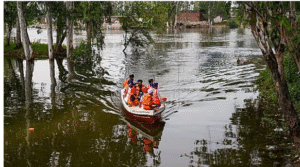
Scientific Assessment and Soil Sampling
Post-flood soil sampling conducted by Punjab Agricultural University (PAU), Ludhiana, across several affected districts, provides grounds for cautious optimism:
- Nutrient Leaching: Waterlogging led to temporary leaching of nutrients like nitrogen and minor imbalance in soil pH.
- Erosion in Some Areas: Fields that suffered topsoil loss showed reduced nutrient content, but experts note this can be restored through targeted fertilization and organic amendments.
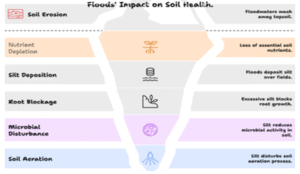 Manageable Impact: Overall, the damage is not irreversible.
- With deep ploughing, soil testing, and balanced fertiliser application, fertility levels can be brought back to normal within one cropping cycle.
Managing Silt and Preparing Fields
The recovery strategy depends on the depth of silt and soil type:
- Light Silt (2–3 inches): Normal ploughing is sufficient to mix silt with native soil.
- Moderate Silt (up to 9 inches in light soils): Deep chiselling helps mix layers effectively.
- To improve soil texture and organic content, the use of compost, green manure, or organic matter is recommended.
- Farmers are also advised to control flood-borne weeds promptly to prevent competition with crops.
- The Punjab government’s “Jisda Khet, Usdi Ret” policy allowing farmers to freely remove or sell silt deposited on their land without seeking environmental clearance is a timely move that enables quicker field restoration.
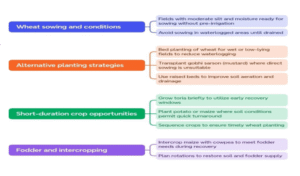
Returning to Normal Cropping Cycles
Punjab’s floods caused temporary nutrient loss but no lasting soil harm. With timely management and soil care, fertility can recover, even improving through nutrient-rich silt.