1. India to launch Red list survey to assess extinction risks to plants and animals
GS Paper III (Environment and Ecology):
What is the Initiative?
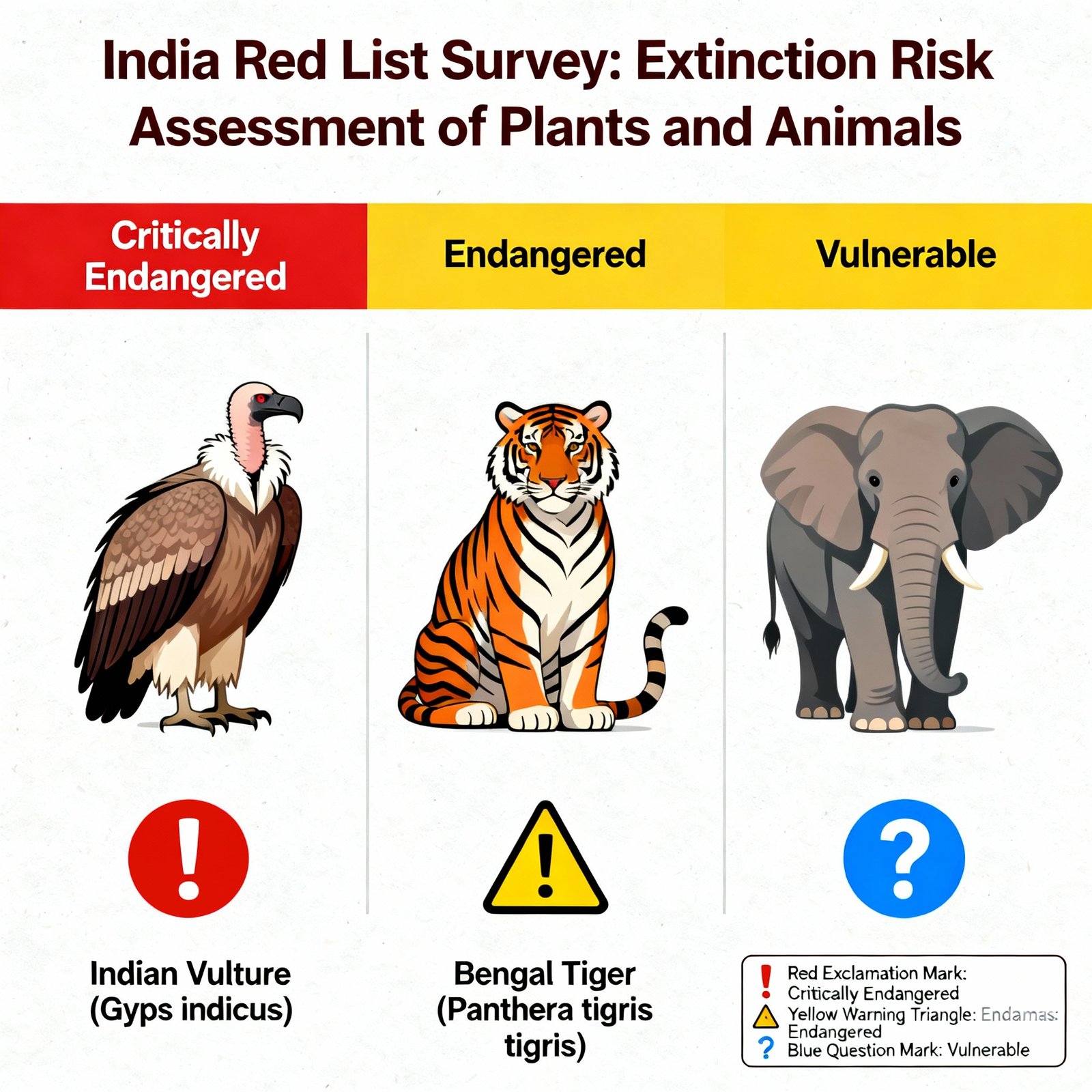
- National Red List Assessment (NRLA) is a MoEFCC-led, nationwide effort to assess extinction risks for 11,000 native species using IUCN Red List methodology.
- Led by BSI (flora) and ZSI (fauna) with support from IUCN India and CSS: India.
- Unveiled at the IUCN Congress, Abu Dhabi, on October 9, 2025.
Objective and Vision
- Establish a coordinated, science-based, participatory Red Listing system for India.
- Support evidence-based policy, conservation, threat mitigation, and sustainable management.
- Envision a shift toward inclusive monitoring and integration of traditional knowledge.
Goals
- Publish 30 National Red Data Books by 2030, including thematic volumes.
- Complete assessments for 11,000 species and build an accessible online database.
- Train 300 Red List assessors, five national trainers; create a National Species Specialist Group.
- Identify Key Biodiversity Areas and track species status via Red List Indices.
Global Context – The IUCN Red List
- The IUCN Red List is the top global standard for species extinction assessment, now covering 169,420 species, with 47,269 threatened as of 2025.
- India’s NRLA data will feed into the global IUCN list, spotlighting underrepresented Global South taxa.
Why is This Needed?
- Only ~7% of Indian species are currently assessed by IUCN, with high data gaps.
- Schedules in Indian law lack scientific detail; science-based lists enable better conservation.
- Responds to urgent biodiversity loss, habitat destruction, and illegal wildlife trade.
- Strengthens evidence for planning and sustainable development in a highly diverse nation.
Challenges
| Challenge | Point |
| Fragmented assessments | Existing lists are scattered, covering ~7% of species. |
| Limited capacity | Shortage of trained assessors and resources. |
| Endemism and pressures | High endemic species face intense threats and climate risks. |
| Data gaps and integration | Multiple sources, need for unified peer review. |
| Funding constraints | ₹95 crore over five years, risk of delays in implementation. |
Legal and International Alignment
Convention on Biological Diversity (CBD)
- NRLA supports CBD’s targets for comprehensive assessments and monitoring, linking Red List results to SDG tracking.
Kunming-Montreal Global Biodiversity Framework (KM-GBF)
- Delivers on post-2020 framework targets, especially area-based protection, species conservation, and RLIs as indicators.
Implementing Details
| Parameter | Details |
| Scope | 11,000 species: 7,000 flora, 4,000 fauna, prioritized by endemism, protection status. |
| Methodology | IUCN guidelines, standardized datasheets, peer review, integrated global database. |
| Collaboration | BSI, ZSI, IUCN India, CSS: India, academic and civil society partners. |
| Timeline | 2025-2030; staged assessments, 30 red data books, online portal. |
| Funding | ₹95 crore total from MoEFCC, IUCN, and global partners. |
Expected Outcomes
| Outcome | Explanation |
| Red Data Books | 30 volumes for conservation planning, peer-reviewed, public database. |
| Capacity building | Train 300 assessors and five national trainers, establish an expert group. |
| Data-driven conservation | Centralized database informs threat mitigation and sustainable development. |
| Global leadership | Align India’s system with IUCN, strengthen international commitment. |
India’s Biodiversity Context
- India is a megadiverse country, 2.4% land area, but 8% global flora, 7.5% fauna—four major hotspots.
- Faces threats from habitat loss, trade, pollution, and climate change; only ~7% assessed globally, 13.4% fauna threatened.
- Legal backbone: Wild Life Protection Act (1972, amended 2022) and scheduled species.
- NRLA fills gaps, emphasizes traditional knowledge and broad collaboration for sustainable outcomes.
2. László Krasznahorkai received the Nobel Prize in Literature
GS Paper I (Indian Heritage and Culture): World literature and cultural developments. Contemporary authors and global literary trends.
GS Paper II (International Relations): India’s global cultural engagement and international personalities.
Context:László Krasznahorkai received the Nobel Prize in Literature for his “compelling and visionary oeuvre” that reaffirms the power of art during apocalyptic times.
Who is László Krasznahorkai?
- Hungarian novelist, short story writer, screenwriter, born January 5, 1954, in Gyula near Romania.
- Studied law at Szeged/Budapest before shifting to journalism, editing, then full-time writing from 1984.
- Known for a reclusive lifestyle and criticism of Hungary’s right-wing government under Viktor Orbán; lived semi-exiled in US, Japan, Germany since 2010s.
- Called “master of the apocalypse” for dense prose; first Hungarian Nobel laureate in Literature since Imre Kertész (2002).
- Father of four, mainly resides in Budapest but travels for research.
About the Nobel Prize in Literature
- Annual award by Swedish Academy for works with “idealistic tendencies” per Alfred Nobel’s will.
- Prize includes medal, diploma, 11 million kronor (~$1 million).
- 2025 announcement on Oct 9, ceremony Dec 10, Stockholm.
- Highlights Central European literature resurgence after recent awards to Jon Fosse, Han Kang.
Why He Won? Nobel Committee Citation
- For “compelling and visionary oeuvre” reaffirming art’s power in apocalyptic peril.
- Cited for epic scope, Kafka’s absurdism, Bernhard’s grotesque excess, irony, social critique, surrealism.
- Explores societal fragility, rebellion against authoritarianism, resilience.
Style and Literary Themes
- Uses long, winding sentences; single-paragraph novels; sparse dialogue.
- Influences: Kafka, Bernhard, East European folklore; prose called “symphonic”.
- Themes: Apocalyptic collapse, resistance, redemptive art, nationalism/fascism critique, cosmic isolation.
Collaboration with Filmmaker Béla Tarr
- Long partnership, screenplays/adaptations: Damnation, Satantango, Werckmeister Harmonies, The Man from London.
- Created “slow cinema” masterpieces with existential, hypnotic themes; Tarr called Krasznahorkai his “literary soulmate”.
- Their works praised globally, screened internationally, influential for world cinema/critics.
Global Recognition
- Won: Best Translated Book Award (US, 2013), Man Booker International Prize (2015), National Book Award (US, 2019).
- Translated into 30+ languages; acclaimed “contemporary master of apocalypse” by NYT.
- Inspired writers, advanced Hungarian literature’s global reputation, studied worldwide.
3. INDIA -U. K RELATIONS
General Studies (GS) Paper II: International Relations: India-UK Bilateral Relations, Regional Groupings, and Agreements involving India
Context: UK PM Keir Starmer visited India for the first time since taking office in July 2024.
- The visit, following Modi’s July 2025 UK trip, focuses on implementing the India–UK Comprehensive Economic and Trade Agreement (CETA).
- Discussions centred on defence, trade, education, and technology under the ‘Vision 2035’
Key Announcements
Strategic Agreements
- Launch of ‘Vision 2035’ for a decade-long partnership in defence, trade, and innovation.
- Deals signed despite global tensions from the Russia–Ukraine and Israel–Palestine conflicts.
Defence Cooperation
- Missile Contract: £350 million deal for Thales-built lightweight multirole missiles (LMM) for India’s army.
- Naval Engines: £250 million collaboration for electric-powered naval engines under joint R&D.
- Builds on the July 2025 Defence Industrial Roadmap promoting co-development of advanced weapons.
Economic and Trade Momentum
Economic Investments
- Indian Investments in UK: £1.3 billion (~₹15,430 crore) from 64 companies in clean energy, construction, and advanced manufacturing.
- Key Contributors: TVS Motor (£250 million EV unit), Muthoot Finance (£100 million expansion), Rolls-Royce (£100 million in semiconductors).
- CETA Benefits: Boosts trade in fintech, consumer goods, and professional services, encouraging post-Brexit recovery.
Job Creation
- UK expects over 7,000 new jobs across defence, engineering, and creative industries.
- Thales missile deal secures 700 jobs in Northern Ireland.
Education and Technology Collaboration
Higher Education
- Universities of Lancaster and Surrey approved to open campuses in India, bringing total UK campuses to nine.
- Expands access to world-class higher education and joint research in AI, clean energy, and fintech.
Innovation and R&D
- New partnerships in semiconductors, EVs, and clean energy technology.
- Starmer and Modi addressed the Global Fintech Fest to boost tech-led cooperation.
People-to-People Ties
- Focus on student exchanges and skills development.
- Trade and education kept separate from migration or visa issues.
Diplomatic and Strategic Engagement
High-Level Talks
- Modi-Starmer meeting at Raj Bhavan, Mumbai, discussed CETA implementation and defence cooperation.
- Reviewed shared strategic priorities under ‘Vision 2035’ for sustainable growth.
Global Issues
- Both leaders addressed Russia–Ukraine and Israel–Palestine conflicts.
- Starmer reaffirmed respect for India’s strategic autonomy and partnership in global peace efforts.
Business Delegation
- UK delegation promoted collaboration in fintech, health, culture, and tourism sectors.
Mutual Benefits
For India
- Strengthened defence capacity through tech transfer and joint production.
- Job creation via expanded trade and investments under CETA.
- Enhanced access to quality education through UK university campuses.
For UK
- Increased exports and industrial orders in defence and tech sectors.
- £1.3 billion Indian investments boost economic recovery post-Brexit.
- Greater influence in Indo-Pacific and expansion of educational outreach.
Challenges Ahead
- Divergent views on Russia–Ukraine and migration remain sensitive.
- Ratification of CETA and alignment on defence and education regulations needed.
- Global slowdown may affect the pace of implementation.
Vision 2035: Future Roadmap
- Time-bound plan for deeper cooperation in defence, trade, climate, and technology.
- Focus on sustainable growth through innovation and green jobs.
- Positions India–UK partnership as a stabilizing global pillar for Viksit Bharat and post-Brexit UK prosperity.
4. IAF Marks 93rd anniversary with ceremonial parade at Hindon Base
GS Paper III (Security and Disaster Management): Role of armed forces in national security.
GS Paper II (Polity & International Relations): India’s defense preparedness and joint exercises.
Context: Indian Air Force (IAF) held its 93rd-anniversary parade at Hindon Base on October 8, 2025.
- Event led by Air Chief Marshal AP Singh, highlighted legacy, innovation, and readiness.
- Major aerial and static displays reflected the IAF’s role in self-reliant defense.
- National attention focused on unity, operational prowess, and indigenous advancements.
Evolution of IAF
- IAF has grown from a 1932 auxiliary force to the world’s fourth-largest air power.
- Progress seen in space surveillance, cyber operations, and integral defense triad roles.
- Parade narrative underscored the journey from colonial support to sovereignty.
Operational Readiness
- Precision “Dhwaj” flypasts and disciplined march showcased combat preparedness.
- Unit citations and military honors signaled high standards in multi-domain operations.
- IAF’s ethos of “Train like we fight” reinforced by top leadership.
Indigenous Capability
- Parade spotlighted indigenously developed Akash missile and Netra AEW&C.
- Emphasized growth in defense manufacturing and reduced foreign reliance.
- Collaboration with DRDO, private sector fueling new tech and resilient capabilities.
IAF Modernisation Drive
- Vision 2047 aims for 42 squadrons, fifth-gen fighters, and AI-enabled upgrades.
- Major investments boost modernization of fleets and networked systems.
- Featured assets like Rafale, Netra, Akash-NG, and Apache helicopters.
Key Systems Showcased
| System Type | Example | Role |
| Multi-Role Fighters | Rafale, Su-30MKI | Air dominance, precision engagements, ground support |
| Airborne Surveillance | Netra Mk1A | Real-time threat detection and battle management |
| Surface-to-Air Missiles | Akash-NG | Layered air defense against diverse threats |
| Heavy Transport | C-17 Globemaster III | Rapid, strategic deployment and humanitarian missions |
| Attack Helicopters | Apache AH-64E | Close air support in high-threat environments |
| UAVs | Heron TP | Persistent ISR and unmanned strike operations |
Historical Background: IAF at a Glance
| Aspect | Details |
| Founding & Motto | Formed Oct 8, 1932; “Touch the sky with glory” |
| Initial Strength | First squadron: 4 Wapiti aircraft, 6 officers, 19 airmen |
| Personnel/Structure | 131,000 active, 5 regional commands, elite Garud force |
| Aircraft Fleet | 1,716 total: 538 fighters, 31 combat squadrons (goal: 42) |
| Milestones | Role in 1971 war, UN ops, women fighter pilots, S-400 intro |
| Global Engagement | 10,000+ UN sorties, Kargil strikes, QUAD exercises |
| Bases/Infra | Over 60 bases; Hindon is the largest, major radar upgrades |
Conclusion
- The 93rd anniversary celebrated heritage, modernization, and future vision.
- IAF’s evolution blends valor with reform, ensuring aerial supremacy for “Viksit Bharat.”
- Modernization readies the force for emerging aerial threats and strengthens national security.
5. Delhi unveils interactive ‘Breathable Art’ installation to promote clean air and sustainable living
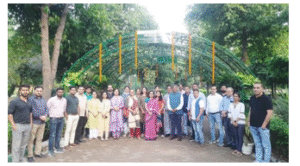
Context: The MoEFCC inaugurated ‘Breathable Art’ — a living art structure made with air-purifying plants to raise awareness about air quality, sustainability, and clean. Urban living
What is ‘Breathable Art’?
- ‘Breathable Art’ is a unique, living art installation that blends environmental science and creative design.
- Made using air-purifying plants and sustainable materials, it aims to improve air quality and promote eco-friendly urban living.
Implementing Agency and Initiative
- Launched by the Ministry of Environment, Forest and Climate Change (MoEFCC).
- Part of the ‘Breath of Change – Clean Air, Blue Skies’ campaign and EIACP programme.
Key Features
- Uses plants like Areca Palm, Money Plant, Spider Plant, Peace Lily, and Bamboo Palm to naturally filter pollutants like formaldehyde and benzene.
- QR codes on-site educate visitors about the plants’ benefits and sustainable practices.
- Serves as an educational hub for students, local communities, and volunteers.
Functions and Purpose
- Acts as a strategic intervention in air pollution hotspots, improving both air quality and urban aesthetics.
- Fosters community engagement and builds public awareness about environmental sustainability.
- Supports behavioral change for eco-friendly lifestyles in cities.
Impact and Outcomes
- Enhances green public spaces and brings nature-based solutions to cities.
- Model for environmental awareness and pollution mitigation in urban India.