1. Leh stir exploades into deadly violence;govt blames activist
GS Paper 1: Indian Polity, Constitution, Governance
Context: Violent protests erupted in Leh, Ladakh, over demands for statehood and enhanced constitutional protections for the region.
- Protesters attacked government properties including the BJP office and Ladakh Hill Council premises, resulting in injury to security personnel and extensive damage.
Government Stance
- Union Home Ministry blamed Sonam Wangchuk’s provocative speeches for inciting violence.
- Government asserts commitment to Ladakh’s constitutional aspirations via high-powered committee talks.
- Highlighted achievements include raising ST reservation from 45% to 84%, women’s reservation, official language recognition.
- Protests labeled as misled unrest, not organically youth-led; warns against spreading provocative videos.
- Ladakh LG alleged conspiracy with external links (Bangladesh, Nepal).
- Preliminary talks with Ladakh leaders planned for Sept 26 in Delhi despite violence.
Wider Issues
- Protests mark a generational shift: largely youth-led demanding urgent action.
- Frustration fueled by unemployment, broken promises of 2019 UT status, delay in granting autonomy.
- Anxiety over demographic changes, land rights, and cultural identity in strategically sensitive region.
- Uncommon unity between Buddhist-majority Leh and Muslim-majority Kargil through LAB-KDA alliance.
- Opposition parties link unrest to larger Jammu & Kashmir grievances.
In-Depth Analysis
Background
- Autonomy demands date back to 1960s-70s over tribal identity erosion and cultural neglect.
- LAB and KDA formed in 2019 to unite statehood and Sixth Schedule demands.
- Multiple hunger strikes and shutdowns since 2020, with growing youth participation.
- Sonam Wangchuk’s latest hunger strike (Sept 10-24) was the fifth, sparking fresh unrest.
Ladakh UT Status 2019
- Bifurcation of Jammu & Kashmir on Aug 5, 2019, created Ladakh UT without legislature.
- LAHDC retains limited powers; Lt Governor holds major control, seen as “remote rule.”
- Initial optimism has turned to perception of betrayal among youth by 2025.
Demands of the Ladakh People
- Full statehood with elected legislature.
- Inclusion under Sixth Schedule for tribal autonomy in governance and land protection.
- Separate Public Service Commission and job/reservation quotas favoring locals.
- Ban on outsider land purchases; environmental protections for fragile Himalayas.
- LAB-KDA unify demands across religious and regional lines.
What is the Sixth Schedule?
Key Features of the Sixth Schedule Legislative Powers
Executive Powers
Judicial Powers Councils can constitute courts to try cases involving tribal members with penalties less than five years. Financial Powers Levy taxes, fees, and tolls on land, animals, vehicles, goods entry, and other local economic activities.
Autonomous District Council (ADC)Governs a tribal district, covering all tribes within it. Provides local governance preserving tribal customs and rights. Autonomous Regional Council (ARC)Covers larger regions encompassing multiple ADCs or specific tribes within an ADC. Delegates some authority to ADCs but exercises regional oversight. |
Role of Sonam Wangchuk
- Led 15-day hunger strike for statehood and Sixth Schedule protections.
- Inspired youth activism, used global protest references (Arab Spring, Gen Z movements).
- Accused by government of inciting violence via provocative statements.
- Called off hunger strike amid violence; shocked by youth “frenzy” and blamed government for forcing unrest.
Government Response
- Engaged in dialogue with Ladakh bodies through high-powered committee since 2023.
- Secured increased tribal reservations, women’s quotas, language official status, and job recruitment drives.
- Imposed curfew and deployed security; police firing led to casualties among protesters and forces.
- Government vows probe into conspiracy and instigators; urges peace and calm.
Security Angle
- Protesters attacked police with stones, set BJP office and police vehicles on fire.
- Police used lathis, tear gas, and live rounds in self-defense.
- Curfew enforced; public assembly restrictions imposed.
- Over 40 police and at least 4 civilians killed or injured.
- Concerns over external influences and border security risks in Himalayan frontier
2. Global south must work together, says Jaishankar
General Studies Paper 2 (GS II) — Governance, Constitution, Polity, Social Justice & International Relations
Context: EAM S. Jaishankar highlighted challenges to multilateralism at a high-level meeting of like-minded Global South countries during the 80th UN General Assembly in New York.
- The meeting focused on global crises including pandemics, conflicts in Ukraine and Gaza, climate change, and trade uncertainties.
- India hosted the meeting to boost cooperation and UN reforms among developing countries.
Jaishankar’s Message
- Multilateralism, the cooperation of multiple countries through international organizations like the UN, is currently “under attack.”
- International organizations face resource shortages and inefficiency, undermining their ability to address global issues.
- The Global South must unify to push for reforms and take leadership in shaping global governance.
- Calls for stronger South-South cooperation in vaccines, digital technology, climate action, education, and sustainable development.
- Emphasized urgent resolution of conflicts affecting food, fertilizer, and energy security.
- Urged digital public infrastructure and fair technology access reflecting Global South priorities.
What is the Global South?
- A group of developing countries primarily in Asia, Africa, Latin America, and the Caribbean.
- These countries often face common developmental challenges like poverty, climate vulnerability, and limited voice in global governance.
- Seek greater agency and representation in global decision-making forums.
Multilateralism Under Attack:
- Meaning: Multilateralism means countries working together through international organizations for common goals.
- Currently faces challenges – such as weakening effectiveness, politicization, lack of funding, and major powers bypassing or criticizing the system.
- Recent conflicts, pandemics, and geopolitical rivalries have stressed global cooperation frameworks.
- Reduced funding and withdrawals by powerful countries impact UN and related bodies’ functionality.
Why Global South Needs Cooperation
- To collectively address crises like climate change, pandemics, conflict spillovers, and economic shocks.
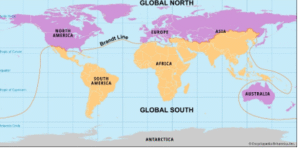
- To gain stronger influence in global governance that traditionally favors developed nations.
- To share resources, expertise, and innovations customized for development needs.
- To promote South-South trade, technology, and investment collaborations for sustainable growth.
India’s Role
- Actively convening Global South countries for a united voice and collective action.
- Advocates for reforming the UN and other multilateral institutions to better reflect developing countries’ interests.
- Promotes initiatives on vaccine production, digital infrastructure, climate justice, and resilient supply chains.
- Positions India as a leader shaping a more equitable global order through strategic South-South cooperation.
Conclusion: The concept of multilateralism as a tool for collective global action is currently challenged by resource constraints and geopolitical pressures. Still, the Global South increasingly looks to these institutions for solutions amid pressing crises. India, through diplomatic engagement and leadership, is fostering unity and collaboration among developing countries, urging urgent reforms to rejuvenate multilateralism and address shared challenges equitably. this united approach aims to create a balanced international order that truly reflects the rights and aspirations of the Global South.
3.Just pinch can resuce and indians salt overload
Context: India is focusing not only on sugar and fats but also on the high salt consumption by its population.
- Indians consume about 8 to 11 grams of salt daily, almost double the WHO recommended 5-6 grams.
- High salt intake is a key contributor to hypertension and cardiovascular diseases (CVD) in India.
Sources of Excess Salt
- About 75% of salt intake comes from home-cooked foods like pickles, papad, and chutneys.
- Cultural habits like keeping salt shakers on dining tables increase salt consumption.
- Eating out and packaged foods also contribute to invisible salt in diets (e.g., breads, cookies, sauces).
Health Impact and Myths
- Excess salt intake leads to hypertension, increasing risks of heart attacks, strokes, and kidney disease.
- Many believe specialty salts (rock salt, black salt, Himalayan salt) are healthier, but all salts contain similar sodium levels causing harm.
- Specialty salts often lack iodine, risking iodine deficiency.
Solutions Needed
- Shift focus from isolated sugar and oil boards to a broad High Fat, Salt, and Sugar (HFSS) strategy.
- Public awareness on gradual salt reduction in cooking and using herbs and spices for flavor.
- Government regulations on salt content in public food programs, processed foods, and mandatory nutritional labels.
- Community initiatives like removing salt shakers from tables at restaurants.
In-Depth Analysis
Why Salt Reduction is Important?
- India’s salt intake is double WHO recommendations.
- High salt intake is directly linked to increased hypertension affecting 28% of adults.
- Reduction in salt can substantially lower the burden of cardiovascular diseases.
Challenges
- Predominance of salt in culturally-preferred home foods.
- Myths about “healthy” specialty salts.
- Lack of comprehensive public education targeting gradual change.
- Regulatory gaps in monitoring salt in meals served in schools, anganwadis, and hospitals.
What Needs to be Done?
Broader HFSS Strategy
- Combine efforts for sugar, fat, and salt reduction under one unified policy.
- Focus on ultra-processed foods which heavily contribute to HFSS intake.
Public Awareness & Behaviour Change
- Promote slow reduction in salt added during cooking.
- Encourage use of herbs and natural flavors instead of salt.
- Discourage salt use in babies and young children to prevent developing taste preferences.
Government Program Reforms
- Implement salt limits in public food scheme menus (schools, Anganwadi, hospitals).
- Train cooks and monitor salt content to improve population health.
Food Labelling & Regulation
- Mandate front-of-package nutritional warnings for high salt content as done in Chile.
- Set salt ceilings in processed food products.
- Restrict advertising of unhealthy HFSS foods to children.
Community & Family Initiatives
- Restaurants to serve salt only on demand.
- Families to review kitchen items for salt, fat, and sugar content weekly.
Policy Integration & International Best Practices
- Integrate salt reduction in National Multisectoral Action Plan for NCDs.
- India to adopt successful global approaches like mandatory salt warnings (Chile) and low sodium salt substitutes.
Conclusion
Excessive salt consumption is a critical but under-addressed public health challenge in India contributing significantly to hypertension and cardiovascular diseases. Salt reduction requires a multi-pronged strategy combining government regulations, public awareness, food labeling reforms, and community-level actions. Integrating salt control within broader health programs and adopting best international practices can effectively reduce India’s salt burden, improve population health outcomes and lower healthcare costs.
4. Konkan Geoglyphs: Potentially 24,000 Years Old
GS paper I: Arts & Culture
CONTEXT: The prehistoric geoglyphs of the Konkan coast are now believed to date back as far as 24,000 years.
- New stratigraphic evidence from Koloshi caves in Maharashtra suggests these rock carvings are among the oldest known in the world.
About Konkan Geoglyphs
Overview
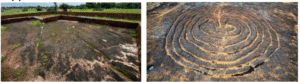
- Prehistoric rock engravings (geoglyphs/petroglyphs) carved on the laterite plateaus of the Konkan coast—spanning Maharashtra, Goa, and southern Karnataka.
- Depict a variety of humans, animals (elephants, tigers, rhinos, stingrays, turtles, peacocks), and abstract patterns.
- Created by techniques such as scooping, etching, and pecking into laterite rock, with grooves 3-5 cm deep and 3-4 cm wide.
- Unique as open-air geoglyphs; different from painted rock shelters like Bhimbetka.
Cultural Significance
- Provide insights into prehistoric ecology, rituals, and the transition from hunter-gatherer to agrarian societies.
- Show long-term continuity of cultural practices, including ritual significance at some sites (e.g., Devi Hasol linked to temple rituals).
Important Sites
- Maharashtra (Ratnagiri–Sindhudurg region): Over 1,500 carvings across 210 sq. km.
- Key sites include Kasheli (giant elephant, sharks, rhinos), Barsu (largest concentration–62 carvings), Rundhye Tali, Devache Gothane, and Devi Hasol.
- Goa: Usgalimal site with carvings of bulls, deer, spirals, and grinding grooves.
History and Antiquity
- Previously dated to around 10,000 years old; new evidence places them as old as 24,000 years.
- Excavations in Koloshi caves show cultural layers up to 38,000 years old.
- This pushes back the timeline and places Konkan geoglyphs among the world’s oldest rock art traditions.
Ecological Record
- Carvings depict animals long extinct in the Konkan region, such as rhinoceroses and hippopotamuses, revealing past fauna and environment.
Global Context
- Geographically smaller but more intricate and ecologically detailed compared to world-famous geoglyphs like the Nazca Lines (Peru), Atacama Giant (Chile), and Blythe Intaglios (USA).
UNESCO Status
- Included on India’s tentative list for UNESCO World Heritage status in 2022.
- Nomination for official inscription is being prepared for the 2027-28 cycle.
5. Delhi may witness its first-ever artificial rain as cloud seeding trials
GS PAPER III SCIENCE AND TECHNOLOGY
CONTEXT: The Delhi government is planning to conduct cloud-seeding trials to trigger artificial rain and reduce air pollution ahead of the winter season.
- The technique aims to provide immediate relief from the severe smog and hazardous air quality in the city, especially during October and November.
About Cloud Seeding
What is Cloud Seeding?
- A weather modification technique designed to alter precipitation patterns by dispersing substances into clouds to stimulate rainfall or snowfall.
- Used to mitigate hail, disperse fog, and induce or prevent precipitation.
Techniques of Cloud Seeding
- Static Cloud Seeding: Chemicals like silver iodide introduced into cold clouds with supercooled water droplets to form ice crystals.
- Hygroscopic Cloud Seeding: Salts sprayed into warm clouds to increase water droplet size.
- Dynamic Cloud Seeding: Enhances vertical air currents to improve moisture transport, resulting in more rain.
Common Chemicals Used
- Silver iodide (AgI) – mimics ice crystals.
- Potassium iodide (KI) – similar to AgI.
- Dry ice (solid CO₂) – rapidly cools clouds.
- Liquid propane – effective in specific warm cloud conditions.
- Sodium chloride and calcium chloride – used in warm cloud seeding.
- Bismuth tri-iodide (BiI₃) – experimental uses.
Dispersion Methods
- Aircraft and ground-based generators.
- Emerging techniques include drones and laser pulses.
Limitations and Concerns
- Potential accumulation of chemical agents in sensitive ecosystems, though current studies suggest negligible impacts.
- Health concerns like iodine poisoning could arise from excessive use of silver iodide, especially in high concentrations.
- Effectiveness dependent on suitable cloud and weather conditions.
Recent Developments in Delhi
- IIT Kanpur, equipped with DGCA-approved aircraft, will conduct cloud seeding trials between October 1 and November 30, 2025.
- Trials postponed earlier due to unsuitable monsoon cloud conditions; new window chosen for retreating monsoon season.
- Trials to cover pollution-prone areas in north Delhi and adjoining regions.
- Aims to wash out airborne pollutants via artificial rain, providing immediate air quality relief.
6. How are courts protecting personality rights ?
General Studies Paper II (GS-II) – Governance, Constitution, Polity, Social Justice, and International Relations
Context: Delhi High Court recently issued orders protecting Bollywood celebrities like Aishwarya Rai Bachchan, Abhishek Bachchan, and Karan Johar from unauthorized commercial use of their images and AI-generated content.
- This marks a growing judicial recognition of personality rights amid digital and AI-related misuse.
Are Personality Rights Protected?
- Protect individuals’ name, image, voice, likeness, and other unique traits from unauthorized commercial exploitation.
- No single law; protection comes from common law doctrines (privacy, defamation, publicity rights) and court rulings.
- Courts grant injunctions, damages, and takedown orders.
- Statutory support includes Copyright Act (performers’ rights) and Trade Marks Act (persona as trademark).
- Rooted in constitutional right to privacy and dignity (Article 21).
What Have Courts Ruled?
- 1994 Supreme Court ruled privacy includes identity protections but allows public record use.
- Madras HC in Rajinikanth case prevented unauthorized use of his name/image/style without proving deception.
- Delhi HC has protected Anil Kapoor, Jackie Shroff, and Arijit Singh against AI misuse and illegal commercial use.
- Courts allow satire and parody under free speech but curb commercial misuse and tarnishment.
Balancing Personality Rights and Free Expression
- Article 19(1)(a) protects free speech, including criticism and parody.
- Courts distinguish fair use from unauthorized commercial exploitation.
- Overprotection risks chilling free speech and limits satire and art.
Concerns
- Lack of comprehensive legislation leads to fragmented judicial responses.
- Need clear exceptions to protect art and parody.
- Non-celebrities, especially women, face threats from deepfakes and misuse.
- Enforcement challenges due to volume and technology speed.
Conclusion
- Courts have increasingly protected personality rights, especially against AI misuse, while balancing free expression.
- Comprehensive laws are needed for clarity, inclusivity, and enforcement.
- Ethical AI use and public awareness can safeguard dignity without curbing creativity.
7. What made Super Typhoon Ragasa so intense?
GS-paper I: Geography, Issue: Typhoon Ragasa
Context: Super Typhoon Ragasa, the most intense tropical cyclone recorded globally in 2025, unleashed devastating winds and heavy rains across East and Southeast Asia, including Hong Kong, southern China, Taiwan, and the northern Philippines.
- At its peak, Ragasa’s sustained winds reached a staggering 280 kmph, making it a Category 5 super typhoon close to the upper limits of storm intensity on Earth.
- The typhoon’s ferocity forced millions to evacuate and caused widespread destruction, including a significant storm surge that raised coastal waters more than 3 meters in Hong Kong
Super Typhoon (Cyclone)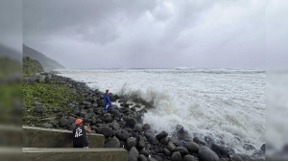
- About: A super typhoon (cyclone) is a very strong storm, like a Category 5 hurricane, with winds of around 253 km/h. These storms usually form in the West Pacific, near China, Japan, and the Philippines.
- Category: The criteria below has been formulated by the Indian Meteorological Department (IMD), which classifies the low-pressure systems in the Bay of Bengal and the Arabian Sea based on their capacity to damage, a system adopted by the WMO CYCLONE around a low-pressure area. Cyclones are rapid inward air circulation
Cyclone v/s Anticyclone
| Pressure System | Pressure Condition at the Center Pattern | Pattern of Wind Derection | |
| Northern Hemisphere | Southern Hemisphere | ||
| Cyclone | Low | Anticlockwise | Clockwise |
| Anticyclone | High | Clockwise | Anticlockwise |
Classification:
- TROPICAL CYCLONE: Tropical Cyclones; originate between the Tropics of Capricorn and Cancer
- Extra Tropical/Temperate Cyclones; originate in the Polar Regions
Conditions for Formation
- Large sea surface with temperature >27° C.
- Presence of the Coriolis force
- Small variations in the vertical wind speed
- A pre-existing weak low-pressure area
- Upper divergence above the sea level system
Nomenclature
- Nodal Authority: World Meteorological Organization (WMO)
- Indian Ocean Region: Bangladesh, India, Maldives, Myanmar, Oman, Pakistan, Sri Lanka and Thailand contribute to naming cyclones that occur in this region.
Different Names for Tropical Cyclones:
- Typhoons: Southeast Asia and China
- Hurricanes: North Atlantic and eastern Pacific Tornados – West Africa and southern USA
- Willy-willies: Northwest Australia
- Tropical Cyclones: Southwest Pacific and Indian Ocean
Cyclones in India
- Bi-annual Cyclone Season: March to May and October to December
- Recent Cyclones: Tauktae, Vayu, Nisarga and Mekanu (in Arabian Sea) and Asani, Amphan, Fani, Nivar, Bulbul, Titli, Yaas and Sitrang (in Bay of Bengal)