1.Trade pact a launched for growth :U.K.PM
General Studies Paper II (GS-II) : International Relations – Bilateral Relations, Trade, and Diplomacy
Context: UK PM Keir Starmer is visiting India in October 2025 to advance the recently signed India-UK Free Trade Agreement, now positioned as a pillar of the wider Comprehensive Strategic Partnership.
- Amid global economic shifts and post-Brexit priorities, Starmer’s visit marks a significant diplomatic push to strengthen bilateral trade, investment, technology, and security ties.
- The agreement is being promoted as a “launchpad for growth,” with India aiming to become the world’s third-largest economy by 2028.
Key Highlights of the Visit
Diplomatic Engagements
- PM Starmer meets PM Narendra Modi to review the FTA progress and the comprehensive strategic roadmap.
- They jointly address the Global Fintech Festival in Mumbai, emphasizing economic collaboration.
- Interactions include key entrepreneurs, university leaders, and representatives from civil society.
Trade and Economic Focus
- UK offers immediate duty-free access on 99% of tariff lines.
- Target: Increase bilateral trade by £25.5 billion annually.
- Focuses on expanding ties in trade, investment, technology, defense, and innovation.
Cultural and Symbolic Gestures
- Starmer visits Yash Raj Films (YRF) and engages in Bollywood-UK collaborations.
- Visa issues for Indian talent are discussed, with assurances of no disruption to business or cultural flow.
- The visit is marked by festive welcomes, cultural events, and youth engagement.
Future-Oriented Discussions
- The leaders review progress and set a 10-year Vision 2035 roadmap, covering education, clean energy, and people-to-people ties.
- Exchange of views on regional, global, and sectoral issues such as climate, health, and security.
India-UK Comprehensive Economic and Trade Agreement (CETPA)
- CETPA (also CEPA/CETA), signed in July 2025, is a wide-ranging economic agreement fostering integration beyond mere trade.
- Aims to boost trade, reduce tariffs, support mutual investment, and cover strategic sectors.
Main Features
Duty-Free Access
- UK grants immediate duty-free access to 99% of tariffs for Indian goods.
- Major beneficiaries: textiles, whisky, cars, and other manufactured goods.
Tariff Reduction
- Gradual or immediate reduction on 90%+ of traded goods.
- Focus on lowering barriers for agriculture, pharmaceuticals, engineering, and more.
Trade Boost
- Projected increase in bilateral trade by £25.5 billion each year.
- Improves market access and enhances supply chain integration.
Strategic Sectors Covered
- Technology & Innovation: Joint work on AI, fintech, clean energy.
- Defense & Security: Cooperation in advanced manufacturing, counter-terrorism.
- Education & Skills: Visa facilitation, student exchanges, mutual qualification recognition.
- Health & Pharma: Joint vaccine production and shared research.
- Environment & Sustainability: Collaboration for net-zero goals, with focus on green hydrogen and electric vehicles.
Why This Deal Matters?
| Perspective | For India | For the UK |
| Economic Growth | Enables India’s goal of becoming world’s 3rd largest economy by 2028; adds £25.5B in exports; new jobs in manufacturing/services. | Post-Brexit market diversification; boosts UK exports (whisky, cars); adds £25.5B to UK GDP. |
| Investment & Innovation | Attracts FDI in tech hubs; supports startups with better IP and venture funding. | Opens up India’s large market; strengthens EV/renewable supply chains. |
| Strategic Autonomy | Reduces reliance on China; enhances defense tech cooperation. | Builds alliances in Indo-Pacific; ensures reliable India-based sourcing. |
| People Relations | Ease’s student/professional visas; encourages Bollywood-UK projects and diaspora engagement. | Addresses labor shortages in NHS/tech; leverages diaspora for remittance and skill links. |
| Global Challenges | Promotes joint action on climate, green exports, and global challenges. | Supports net-zero and energy security; secures critical minerals. |
Symbolism: Leadership and Cultural Diplomacy
- Keir Starmer: His first India trip as PM is seen as a “reset” for diplomatic relations, favoring pragmatic economic partnership and increased cultural contacts.
- PM Modi: Showcased as the architect of India’s global outreach, using the FTA to enhance India’s position in global forums like the G20 and Quad.
- Cultural Diplomacy: Bollywood and film collaborations serve as bridges for youth, diaspora, and innovative content; initiatives like film festivals and joint productions reinforce people-to-people ties.
Corporate Angle
- UK Business: Rolls-Royce, Tata, Diageo, and Jaguar Land Rover benefit from tariff reductions and easier Indian market entry.
- Indian Enterprises: Conglomerates like Reliance and Adani find increased FDI opportunities, especially in clean tech and pharma.
- Investment Roadmap: Plans are in place for £50B cumulative investments by 2035, with specific protections for small businesses via digital trade chapters.
India-UK Vision 2035: 10-Year Roadmap
- Trade & Investment: Aim to grow bilateral trade to £100B by 2035, with annual London-Delhi summits.
- Innovation & Tech: 50 new joint R&D centres (AI, quantum, space); large-scale talent mobility.
- Sustainable Development: Net-zero initiatives, including a £5B green fund, focus on solar and EVs.
- Défense & Security: Joint development of drones, submarines; yearly strategic dialogues.
- Education & Society: Doubling student exchanges and health partnerships.
- Monitoring Mechanism: Biannual reviews by a Joint Commission for flexibility and accountability in emerging sectors.
2.NOBEL PRIZE IN CHEMISTRY
General Studies Paper 3: Subject: Science & Technology
Context: Three scientists were awarded the Nobel Prize in Chemistry for discovering and developing Metal-Organic Frameworks (MOFs), a new class of materials that integrates metallic and organic components.
- MOFs are significant for their versatility, stability, and applications in environmental protection, medicine, and energy.
- The prize money is 11 million Swedish kronor (about ₹1 crore), shared among the three scientists.
Scientists, Nationality, Institution, Contribution
| Scientist | Nationality | Institution | Contribution Summary |
| Richard Robson | Australian | University of Melbourne | Initial conception of MOFs; combined copper ions with organic molecules to create porous crystals. |
| Susumu Kitagawa | Japanese | Kyoto University | Developed soft and flexible MOFs, materials that change shape with water or gas absorption. |
| Omar M. Yaghi | Jordanian-American | University of California, Berkeley | Created a variety of flexible and functional MOFs for applications like water harvesting from desert air. |
What Are Metal-Organic Frameworks and How Were They Developed?
- MOFs are crystalline materials composed of metallic ions or clusters coordinated to organic molecules forming porous structures.
- They unite the properties of metals (stability and catalytic activity) with organic molecules (flexibility, functional versatility).
- The concept began in the 1970s with Robson’s work on copper and organic arms forming porous crystals.
- Kitagawa and Yaghi expanded the concept by creating flexible MOFs and applying them to water vapor capture, pollution reduction, and drug delivery.
Simplified Development Timeline of MOFs
| Period | Scientist(s) | Discovery/Contribution |
| Mid-1970s | Richard Robson | Conceptualized framework by combining metal ions with organic molecules forming porous crystals. |
| 1990s-2003 | Kitagawa & Yaghi | Developed flexible and functional MOFs; demonstrated applications in gas absorption, water vapor control. |
| 2000s-Present | OMAR Yaghi | Designed MOFs with tailored properties; applications in environmental, pharmaceutical, and energy sectors. |
Why MOFs Are Revolutionary: Applications and Global Importance
- MOFs provide ultra-high surface area and tunable porosity, enabling gas storage, separation, and catalysis.
- Applications include capturing toxic chemicals, reducing environmental pollutants, drug delivery, carbon capture, water harvesting from air.
- MOFs’ modularity allows creating materials with specific properties for clean energy and sustainable technologies.
- They offer advantages over traditional porous materials by being flexible, stable, and customizable.
Analogy for Easy Understanding
- MOFs are like a “molecular sponge” or “scaffold” – a structure with many tiny cavities that can trap and release molecules like gases or water vapor.
- Similar to how a sponge soaks up water but can be squeezed to release it, MOFs can absorb gases and release them under controlled conditions.
Difference Between MOFs and Zeolites
| Feature | Zeolites | MOFs |
| Composition | Fully inorganic (aluminosilicate minerals) | Hybrid organic-inorganic frameworks |
| Flexibility | Rigid and hard | Flexible and tunable; can change shape |
| Porosity | Microporous with fixed pore sizes | Highly porous with adjustable pore sizes |
| Applications | Catalysis, ion-exchange, detergents | Gas storage, separation, drug delivery, sensors |
| Stability | Chemically and thermally stable | Stable but may have enhanced functional properties |
| Synthesis Complexity | Natural materials, well-known synthesis | Designed and synthesized for specific functions |
3.PM -KUSUM SCHEME
General Studies Paper 2: Governance and Social Justice: International Relations: India’s Bilateral and Multilateral Cooperation (International Solar Alliance, South-South Cooperation)
Context: India plans to extend its PM-KUSUM solar pumps scheme to Africa and small island nations through the International Solar Alliance (ISA), announced ahead of the 8th ISA Assembly in New Delhi.
- The initiative was highlighted at a UN General Assembly climate side event to showcase India’s progress in solar agriculture and climate action.
- Scheme deadline extended to March 2026, with revised targets of 348 GW solar capacity and 71% progress on standalone pumps.
About the PM-KUSUM Scheme
- Launched in 2019, PM-KUSUM aims to promote solar energy in agriculture, reduce dependence on diesel, and add decentralized solar capacity through pumps and small solar plants.
- Focus: Empower farmers, support climate goals, and add 34,800 MW by March 2026.
Key Components of PM-KUSUM
| Component | Description | Target (by March 2026) |
| A | Decentralized, grid-connected solar plants (up to 2 MW each) for farmer income | 10,000 MW; ~29% complete |
| B | Standalone solar pumps (3-5 HP) with 70% central subsidy for irrigation | 20 lakh pumps; 71% complete |
| C | Solarization of grid-connected agriculture pumps (including feeder-level retrofits) | 15 lakh pumps; 16-25% done |
Financial Aspects
- Total scheme outlay: ₹34,000 crore.
- Central financial assistance (CFA): ₹28,000 crore (Component B: ₹19,400 crore subsidy).
- Subsidies: 30% CFA for Component A; 50-60% for Component B pumps; 30% for Component C retrofits.
- Farmer contribution: 10-30% via subsidized loans; states support balance.
India’s Plan for Africa & Island Nations
- Through ISA, India will pilot the PM-KUSUM model for rural electrification and irrigation in Africa and island nations.
- Initial pilots in 2025-26, scaling up with ISA and private sector finance support.
- Aligns with UN climate pledges and supports mutual benefits: India exports solar tech, partners gain affordable renewables.
Why Africa & Island Countries?
- Africa faces energy poverty and massive irrigation needs; island nations need resilient, off-grid power solutions.
- High solar potential, food security needs, and vulnerability to climate impacts make these regions strategic for ISA outreach.
PM Surya Ghar: Muft Bijli Yojana
| Feature | Details |
| Objective | Rooftop solar for 1 crore homes by 2027; free power up to 300 units/month |
| System Capacity | 1-3 kW panels; generates 300-600 units/month; net metering |
| Subsidy | Up to ₹78,000/household; 60% for 1 kW, 40% for next 1 kW, 20% for up to 3 kW |
| Eligibility | All households (rural/urban, govt buildings); online portal |
| Financial Aid | Loans up to ₹1.5 lakh; direct subsidy to vendors; states add incentives |
| Implementation | Vendor empanelment, online tracking, fast approvals |
Progress & Challenges
Progress
- ~14 lakh (71%) standalone solar pumps installed.
- Over 5 lakh rooftop installs for Surya Ghar scheme; 100% saturation in some regions.
- 1,000+ MW generated, household savings on bills rising.
Challenges
- Delays in subsidy payments, vendor quality issues, complex approval processes.
- Funding strain to meet large targets, slow uptake in grid-connected segments.
Significance
For India
- Accelerates renewable goals (target: 500 GW by 2030), boosts domestic manufacturing, creates jobs.
- Enhances energy security, reduces emissions, positions India as ISA leader.
For Partner Nations
- Offers affordable, decentralized solutions to energy poverty, climate resilience, and agricultural development.
- Knowledge transfer builds self-reliance, aids SDGs, opens export markets for India, and strengthens diplomatic ties.
Conclusion: India’s initiative to extend PM-KUSUM to Africa and island nations through ISA reflects strong climate diplomacy, making its domestic solar achievements a global model. While the scheme faces hurdles like implementation delays, its expanded targets and a robust ₹75,000 crore ecosystem can spark transformative progress in sustainable agriculture and clean energy. By supporting farmers and rural communities worldwide, this approach aligns with net-zero ambitions and champions an equitable, just energy transition for the Global South.
4.India’s invasive species present a dilemma: document or conserve
General Studies Paper III: – Environmental Ecology, Biodiversity, and Climate Change
Context: Scientists are raising alarms over invasive species destroying local biodiversity in India, urging better documentation before conservation efforts.
- A new study highlights 3,500 alien species, with calls for policy action amid ecological and economic damages.
- The dilemma: introduced for benefits like revegetating land, but now threaten native ecosystems and human livelihoods.
What Is the Main Problem?
- Invasive alien species (non-native) displace local biodiversity, rendering some natives locally or globally extinct.
- They destroy habitats and alter ecosystems, introduced via human activities like trade or ornamentals.
- Dilemma for policymakers: document full impacts or rush to conserve, risking incomplete strategies.
Where It Is Worst
- Water hyacinth (Eichhornia crassipes) is among the world’s worst, choking waterways from paddy fields to lakes.
- Severe in Assam’s Kaziranga National Park, Kerala’s backwaters, and Rajasthan’s wetlands.
- Impacts 1,070 threatened freshwater fishes in Kerala, with rapid spread in tropical India.
How Did This Plant Come to India?
- Water hyacinth introduced in the 19th century as ornamental aquatic plant or fish food in British colonial period.
- Brought from South America via global trade routes, initially for revegetating degraded lands or solving erosion.
- Spread unintentionally through waterways and human transport, establishing in tropical climates by early 20th century.
What Damage Does It Cause?
To Farmers
- Choke’s irrigation canals, reducing water flow and crop yields in rice paddies.
- Increases pest habitats, leading to higher losses and labour for manual removal.
To Fishermen
- Block’s waterways, hindering boat navigation and reducing fish access in lakes/rivers.
- Outcompetes native aquatic plants, crashing fish populations and livelihoods.
To Environment
- Forms dense mats that deplete oxygen, killing aquatic life and altering soil/water chemistry.
- Reduces biodiversity by shading out natives, promoting monocultures and habitat loss.
To Tourism
- Clogs scenic backwaters and wetlands, deterring migratory birds and eco-tourism.
- Degrades visual appeal in areas like Kerala, impacting boat tours and wildlife viewing.
What’s Being Done Right Now
- National Biodiversity Authority mandates conservation plans for invasive species.
- Research by institutions like ATREE documents impacts, with funding for removal pilots.
- Community-led manual harvesting in wetlands, combined with biocontrol agents like weevils.
Why Is the Problem Still Big?
- Over 37,000 species established globally via human activities, with rapid reproduction in India’s tropics.
- Limited funding and research access frustrate scientists, delaying effective policies.
- Economic trade-offs: some invasives provide jobs (e.g., harvesting), slowing eradication efforts.
What’s the Suggested Solution
- Document scientific impacts (ecological/economic) before enacting conservation plans.
- Use frameworks to assess and manage, including siloing communications for targeted action.
- Integrate new thinking: conserve beneficial invasives without native equivalents.
Examples of New Thinking
- Regok Bang suggests conserving species like water hyacinth if they fill ecosystem gaps without native rivals.
- Repurpose invasives: convert lantana into biofuels or handicrafts, turning threat into resource.
- Holistic approach: study cumulative effects on systems, not just individual species.
Final Message of the Article
- This approach can identify high-impact invasives and hotspots, guiding precise management.
- Added step of siloing and communicating ensures equitable, evidence-based policies.
- Balances documentation with action to protect India’s biodiversity amid growing threats.
5.India Mobile Congress (IMC) 2025
Source: PIB
What is IMC?
- Asia’s largest digital communications and technology exhibition, held at Yashobhoomi, New Delhi.
- A platform for governments, industry leaders, startups, and academia to showcase telecom, IT, media, and innovation.
- Jointly organised by Department of Telecommunications (DoT) and Cellular Operators Association of India (COAI), Ministry of Communications.
Theme and Aim
- 2025 Theme: “Innovate to Transform”.
- Showcase India’s achievements in 5G, 6G, AI, semiconductors, and quantum communication.
- Drive global collaboration and investment in digital economy.
- Promote indigenous technology for Digital India and Atmanirbhar Bharat missions.
Features
- Over 1.5 lakh visitors from 150+ countries, 400+ companies participating.
- Display of 1,600+ new use cases in telecom, AI, smart mobility, cybersecurity, and green tech.
- Key focus areas: Optical communications, 6G, quantum tech, semiconductors.
- Delegations from Japan, UK, Russia, Canada, Austria, and Ireland.
Significance
- Digital Leadership: Positions India as a global hub for telecom innovation and next-gen technologies.
- Economic Growth: Attracts investment in digital infrastructure, startups, and manufacturing.
This event is crucial for driving India’s digital transformation, facilitating international partnerships, and cementing India’s role as a leader in the global technology ecosystem.
6.New Findings on the Red Sea
General Studies Paper 1: Geography: Physical Geography
Geological Discovery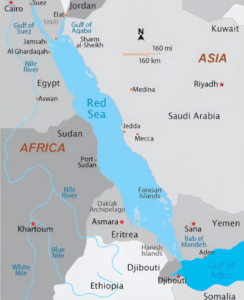
- KAUST scientists discovered that the Red Sea dried up entirely around 6.2 million years ago for nearly 100,000 years.
- It was later refilled by a massive flood from the Indian Ocean, creating the modern sea.
About the Red Sea
Location and Formation
- The Red Sea is a narrow, elongated saltwater body between north-eastern Africa and the Arabian Peninsula.
- It formed about 30 million years ago when the African and Arabian plates began to drift apart, creating a rift valley.
- Extends 1,930 km from Suez (Egypt) to the Bab el-Mandeb Strait, linking to the Arabian Sea.
Bordering Nations
- Egypt, Sudan, Eritrea, Saudi Arabia, and Yemen share its coastline.
Key Features
- Geological Origin: Part of the East African Rift System, sits in a tectonic rift valley.
- Size and Depth: Covers about 450,000 sq km; deepest point reaches 3,040 m.
- Salinity/Temperature: Among the world’s hottest and saltiest seas due to high evaporation and minimal freshwater inflow.
- Marine Life: Renowned for coral reefs, unique brine pools, and rich marine biodiversity.
- Volcanism: Hosts underwater volcanoes and geothermal features, highlighting ongoing tectonic activity.
Importance
- Strategic Route: Forms a crucial maritime link between Europe and Asia through the Suez Canal for global trade.
- Economic Role: Supports shipping, fishing, and tourism, vital for coastal nations’ economies.
7.Indian Radio Software Architecture (IRSA) Standard 1.0
SOUERCE: PIB
What is IRSA?
- IRSA 1.0 is India’s first national software standard for Software Defined Radios (SDRs) used by the Army, Navy, and Air Force.
- Provides a unified framework for secure, flexible, and upgradable military communication systems.
Developed By
- Joint effort of DRDO, Integrated Defence Staff (IDS), and the Tri-Services (Army, Navy, Air Force).
Aims
- Achieve seamless interoperability among SDRs across all defence services.
- Facilitate waveform portability and standardized communication.
Key Features
- Unified Standard: Common architecture for all military SDRs, supporting next-gen technologies.
- Waveform Portability: Enables reuse and transfer of communication waveforms between platforms.
- Scalability: Ready for AI, 5G, and future tech upgrades.
- Interoperability: Ensures cross-service and cross-platform communications.
- Certification Framework: Establishes standards for reliability and security.
Significance
- Strategic Autonomy: Reduces reliance on foreign technologies; boosts indigenous capabilities.
- Operational Synergy: Enhances joint operations across Army, Navy, Air Force.
- Defence Export Potential: Positions India to export IRSA-compliant SDRs globally.
8.Neso lynx banabitanae
General Studies Paper III – Environment and Biodiversity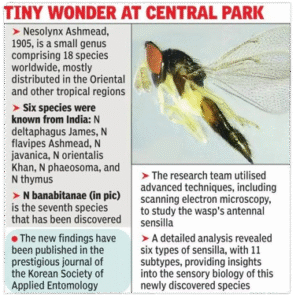
Context: A new wasp species, Neso lynx banabitanae, was found in Central Park (Banabitan), Salt Lake, Kolkata.
- It is only the seventh Neso lynx wasp identified in India, highlighting the country’s unique biodiversity.
About Neso lynx banabitanae
Family and Type
- Belongs to the Eulophid family, known for parasitic and hyper parasitic wasps.
- Neso lynx banabitanae is a hyperparasitoid—it parasitizes other parasitoid wasps, not host insects directly.
Host Interaction
- Targets the ichneumonid parasitoid Charops Aditya, which itself attacks caterpillars of Common Palm fly and Common Castor butterflies.
Naming and Discovery
- Named banabitanae after “Banabitan,” the Bengali name for Central Park, Kolkata, where it was discovered.
- Adds a new layer to the ecology of urban parks by enriching multitrophic interactions.
Significance of Discovery
Ecological Importance
- Contributes to fourth level multitrophic interactions—affecting populations of butterflies and their parasitoids.
- Sheds light on the complexity of urban insect food webs, especially in city parks.
Scientific Relevance
- Enhances knowledge of hyperparasitoid behaviour and insect biodiversity in urban settings.
- SEM mapping of sensory structures offers baseline data for future research in taxonomy and evolutionary studies.
Conservation and Analytical Value
- Underscores the importance of conserving urban green spaces as habitats for rare and new species.
9.Private players to conserve heritage monuments
GS PAPER 1: Arts & Culture
Context: The government has proposed allowing private players to participate in conservation of protected monuments, ending the Archaeological Survey of India’s (ASI) exclusive mandate.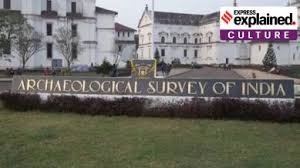
- This aims to strengthen resources and professional expertise for safeguarding India’s cultural heritage.
About Archaeological Survey of India (ASI)
- Established: 1861; under the Ministry of Culture, Government of India.
- Responsibilities: Research, exploration, protection, and management of around 3,700 centrally protected monuments and sites.
- Legal Framework: Enforces the Ancient Monuments and Archaeological Sites and Remains Act (1958) and the Antiquities and Art Treasures Act (1972).
- Structure: 37 regional Circles, and specialist wings such as Science and Horticulture Branches, Temple Survey Projects, and Underwater Archaeology Wing.
- Challenges: Faces staff shortages, funding limitations, and process delays that restrict conservation work nationwide.
New Public–Private Partnership (PPP) Model Explained
- Objective: Supplement ASI’s conservation capacity through private participation.
- Who Can Participate: Corporates, PSUs, and philanthropic bodies can fund, execute, and monitor restoration under ASI supervision?
- Funding: Routed via National Culture Fund (NCF); donations qualify as Corporate Social Responsibility (CSR) with 100% tax exemption.
Implementation Framework
- Conservation architects empanelled by Ministry of Culture through RFPs.
- Donors select architects, who coordinate with experienced restoration agencies for projects on structures over 100 years old.
- Each project requires a Detailed Project Report (DPR) approved by ASI, and must comply with the National Policy for Conservation, 2014.
- Initial phase identifies 250 priority monuments for adoption and conservation efforts.
Key Points of New PPP Policy
- Eligibility: Participants must demonstrate heritage conservation experience and technical compliance.
- Distinction from ‘Adopt a Heritage’ Scheme: Earlier model focused on public amenities (cafés, signage, etc.); current PPP model extends to core conservation and scientific restoration.
- ASI Oversight: ASI retains control over authenticity, ethics, and policy compliance—preventing over-commercialisation and ensuring quality.
Policy Evolution and Significance
- Transition from tourism-focused partnerships to stewardship of monument conservation, harnessing private sector funding and professional expertise.
- Aims to mobilize more resources, address conservation deficits, and accelerate the preservation of India’s diverse heritage.
10.E-NAM (electronic National Agriculture Market) Portal
Source: PIB
Why in the News?
- The Department of Agriculture and Farmers’ Welfare has expanded the National Agriculture Market (e-NAM) by adding 9 new commodities, taking the total tradable items to 247.
About National Agriculture Market (e-NAM)
- Launch & Implementation: Introduced in April 2016 by the Ministry of Agriculture & Farmers’ Welfare, under ISAM; managed by Small Farmers Agribusiness Consortium (SFAC).
- Objective: Unify agricultural markets nationwide by providing farmers and traders a transparent, digital platform for competitive real-time trading and price discovery.
- Legal Framework: Works within state APMC Acts, harmonised via inter-state trading licenses and digital links.
Working Mechanism
- Digital Integration: Mandis linked with e-NAM for online inter-state trading and unified licensing.
- Online Auctions: Produce graded, assayed, weighed, with real-time electronic bidding for quality-linked price discovery.
- Direct Payments: Auction proceeds transferred electronically to farmers’ accounts, reducing intermediaries.
- Unified Licensing: One license lets traders buy from multiple mandis nation-wide.
- Warehouse Trading: e-NAM 2.0 incorporates warehouses, cold storages for stored-produce sales and better logistics.
Coverage (2025)
- Mandis Integrated: 1,522 mandis in 23 States & 4 UTs.
- Commodities: 247 items including cereals, pulses, oilseeds, fruits, spices, and medicinal plants.
- Participants: 1.7 crore farmers, 4,500 FPOs registered.
- Leading States: Tamil Nadu (213 mandis), Rajasthan, Gujarat.
Key Features & Impact
- Pan-India Integration: Fulfils “One Nation, One Market” by connecting mandis and private markets digitally.
- Quality Assurance: Standard parameters ensure grade-based pricing and better incomes.
- Digital Efficiency: Reduces transaction time, increases transparency; e-payments and electronic weighing streamline processes.
- FPO & Warehouse Linkage: Strengthen logistics, storage, and collective farmer bargaining power.
- Scheme Synergy: Complements PM-KISAN, PM-AASHA, and MSP operations via transparent procurement data.
- Data Analytics: Real-time trade and pricing insights assist policy decisions.