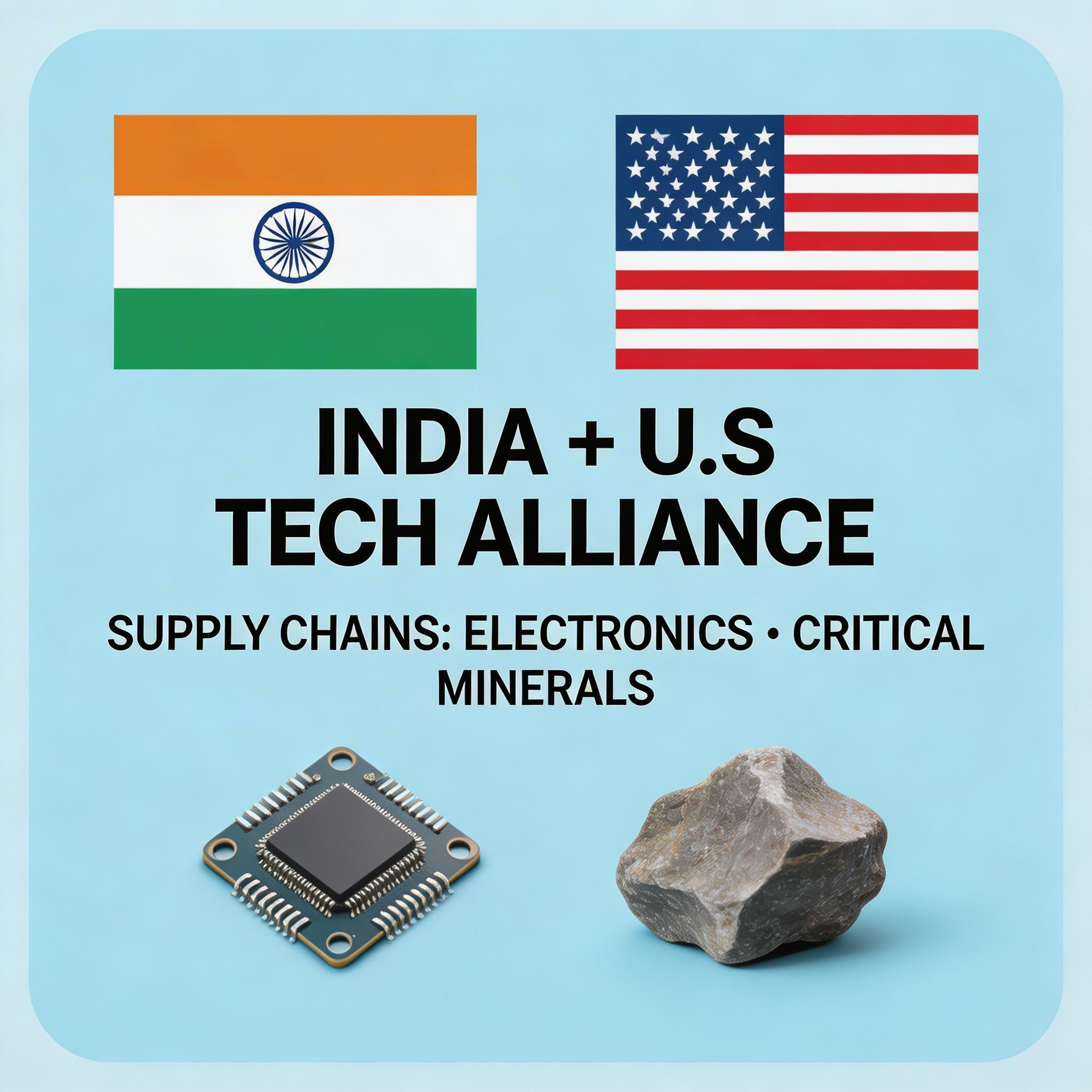
1. India joind U.S led tech alliance to build supply chains for electronics and crtical minerals
GS paper II-IR
Context :India joined the US-led initiative as a co-founder to secure its technology future.
- The move follows an invitation from the US to help build a trusted electronics ecosystem.
- Major tech leaders like Sundar Pichai (Google) and Sam Altman (OpenAI) attended the summit.
- The alliance aims to create a “Silicon Curtain” to reduce reliance on non-aligned nations.
What is Pax Silica?
- Definition: A strategic economic bloc focused on securing the entire AI and semiconductor supply chain.
- “Pax” (Latin for peace/stability) and “Silica” (referencing silicon chips) symbolize a peaceful tech order.
- It covers everything from mineral mining and chip fabrication to data centers and AI software.
- Members: Includes the US, UK, Japan, South Korea, Singapore, Australia, UAE, Qatar, and now India.
Why is this Alliance Important Globally?
- Supply Chain Security: It prevents global disruptions by diversifying the production of chips and electronics.
- Countering Dominance: It acts as a strategic counter to China’s monopoly over critical minerals and manufacturing.
- Standard Setting: Members coordinate on export controls, subsidies, and investment security for sensitive tech.
- Economic Stability: It ensures “trusted” partners control the “commanding heights” of the 21st-century economy.
Why did India Join Pax Silica?
- Semiconductor Hub: It boosts India’s mission to become a global destination for chip manufacturing.
- Tech Investment: Entry unlocks billions in US investments for Indian AI infrastructure and data centers.
- Strategic De-risking: India can now bypass “chokepoints” created by excessive dependence on a single country.
- Talent Export: It positions India’s vast pool of engineers as the backbone of the global AI workforce.
What are Critical Minerals?
- Definition: Non-fuel minerals essential for modern technology that have high supply risk.
- Key Examples: Lithium, Cobalt, Graphite, and Rare Earth Elements (like Neodymium).
- Green Energy: These are the building blocks for Electric Vehicle (EV) batteries and wind turbines.
- Electronics: They provide unique magnetic and conductive properties for smartphones and semiconductors.
- Economic Security: Lack of these minerals can paralyze a nation’s defense and high-tech industries.
2. PAC pulls up ovt for slow implementation of SANKALP Scheme
GS PAPER II-POLITY
Context :The Public Accounts Committee (PAC) recently criticized the Indian government for the “lackadaisical” implementation of the SANKALP scheme.
- The committee flagged a absence of a central monitoring mechanism and significant gaps in due diligence.
- It noted that only 44% of the budgeted provision for the scheme was disbursed between 2017-18 and 2023-24.
- The panel was examining a report by the Comptroller and Auditor General (CAG) that highlighted these financial and physical shortfalls.
What is the PAC?
- It is the oldest financial committee of the Indian Parliament, acting as a watchdog over government spending.
- It examines the accounts showing the appropriation of sums granted by Parliament for the expenditure of the Government of India.
- The committee serves as a critical link between the CAG and the Legislature.
Historical Background
- The committee was first established in 1921 under the provisions of the Government of India Act, 1919.
- Since its inception in the British era, it has evolved into a powerful tool for ensuring executive accountability.
- Post-Independence, its role was formalised to ensure that public money is spent as intended by the Parliament.
Core Purpose of the PAC
- To ensure that the Executive (Government) remains accountable to the Legislature regarding public funds.
- To verify that money spent was legally available for the service or purpose to which it was applied.
- To maintain financial discipline and prevent the waste or “misuse” of taxpayer money.
Key Functions of the PAC
- Audit Review: Examines the annual audit reports of the CAG on the accounts of the Union.
- Legal Compliance: Checks if the money was spent within the scope of the demand granted by Parliament.
- Efficiency Check: Looks into cases of waste, loss, or nugatory expenditure even if the spending is technically legal.
- Technical Examination: Reviews the accounts of autonomous and semi-autonomous bodies audited by the CAG.
Composition of the PAC
- Total Members: The committee consists of 22 members.
- Lok Sabha: 15 members are elected from the Lower House.
- Rajya Sabha: 7 members are elected from the Upper House.
- Election Method: Members are elected through the principle of proportional representation by a single transferable vote.
- Chairperson: Conventionally, the Chairman is appointed by the Speaker from the Opposition party.
Tenure
- The members are elected for a term of one year only.
- A new committee is constituted every year to maintain fresh oversight.
Important Restrictions
- Ministerial Bar: A Minister cannot be elected as a member of the committee.
- Membership Lapse: If a member is appointed as a Minister after joining the committee, they cease to be a member.
- Nature of Recommendations: The findings are advisory and not legally binding on the government.
Types of Parliamentary Financial Committees
- Public Accounts Committee (PAC): Focuses on the expenditure already incurred by the government.
- Estimates Committee: Examines the estimates included in the budget to suggest “economies” in public expenditure.
- Committee on Public Undertakings (CoPU): Examines the reports and accounts of Public Sector Undertakings (PSUs).
3. Govt. announces 7 additional measures under export promotion mission
GS paper III-economy
Context :The government operationalized 10 out of 11 proposed interventions under the ₹25,060 crore Mission.
- Seven additional measures were launched to lower costs and widen trade finance access for small exporters.
- The mission aims to capitalize on India’s double-digit merchandise export growth recorded in early February 2026.
What is the Export Promotion Mission (EPM)?
- A Unified Framework: A strategic shift from fragmented schemes to a single, outcome-based digital platform.
- Funding & Duration: An outlay of ₹25,060 crore for the period from FY 2025–26 to FY 2030–31.
- Integrated Sub-Schemes: It operates via Niryat Protsahan (financial support) and Niryat Disha (non-financial facilitation).
- Nodal Agency: The Directorate General of Foreign Trade (DGFT) implements the mission through an end-to-end digital portal.
Why Focus on MSMEs?
- Economic Backbone: MSMEs contribute nearly 45% of India’s total exports and roughly 27% of its GDP.
- Employment Engine: The sector supports over 11 crore jobs, making it the second-largest employer after agriculture.
- Under-utilized Potential: Sectors like handicrafts and ayurveda have huge global demand but low current export volume.
- Inclusivity: Promoting MSME exports ensures that global trade benefits reach startups and remote districts.
Structural Problems Faced by Exporters
- High Cost of Capital: Indian MSMEs face interest rates of 9–12%, much higher than global competitors like China (3.1%).
- Credit Constraints: Roughly 4 out of 5 MSMEs struggle to provide adequate collateral for traditional bank loans.
- Compliance Burden: Navigating complex international quality standards and testing certifications is costly for small firms.
- Logistics Gaps: High inland transport costs and lack of overseas warehousing hinder timely delivery and competitiveness.
Key Measures Announced (7 New Interventions)
- Direct E-Commerce Credit: Up to ₹50 lakh support with a 90% guarantee for digital-first exporters.
- Overseas Inventory Credit: Up to ₹5 crore facility to help maintain stock in global hubs like Bharat Mart.
- Export Factoring: A 2.75% interest subvention to convert invoices into immediate working capital without loans.
- TRACE Program: Reimburses 60–75% of costs for international testing, inspection, and certification.
- FLOW Initiative: Provides up to 30% financial support for setting up overseas warehousing and fulfillment.
- LIFT Scheme: Mitigates disadvantages for landlocked or remote districts by reimbursing 30% of freight costs.
- INSIGHT Platform: Covers 50–100% of project costs for trade intelligence and district-level market research.
4. National Commission for Scheduled Tribes (NCST)
Context :The National Commission for Scheduled Tribes (NCST) marked its 23rd Foundation Day, reaffirming its mandate to protect tribal rights amid ongoing challenges like land alienation and development gaps.
NCST was created in 2004 via the Constitution (89th Amendment) Act, 2003, inserting Article 338A. It split from the prior joint SC/ST commission (established 1978, constitutionalized in 1992) for specialized tribal focus under the Ministry of Tribal Affairs.
Organizational Structure
Comprises a Chairperson (Cabinet Minister rank), Vice-Chairperson (Minister of State rank), and three Members (Secretary rank), appointed by the President. Includes at least one woman; tenure is three years, max two terms.
Core Responsibilities
- Monitors all constitutional/legal safeguards for STs and assesses their working.
- Probes complaints on rights deprivation, atrocities, or benefit denial.
- Advises on tribal development plans and submits reports to the President.
- Holds civil court-like powers for inquiries (summoning, evidence).
Recent Relevance
The Foundation Day event highlighted NCST’s role in inclusive growth, amid rising tribal grievances reported in 2025-26
5. Vibrant Villages Programme–II (VVP-II)
Government Scheme
Context :Union Home Minister Amit Shah launched Vibrant Villages Programme–II (VVP-II) on February 20, 2026, in Assam’s Cachar district to boost border village development.
Scheme Overview
VVP-II is a Central Sector Scheme (₹6,839 crore outlay till FY 2028-29) targeting 1,954 villages in 15 States and 2 UTs along India’s international land borders (excluding northern borders under VVP-I). It uses a saturation-based, convergence approach integrating schemes like PMGSY-IV, Digital Bharat Nidhi, BIND, and RDSS.
Historical Evolution
Evolved from the 1986-87 Border Area Development Programme (BADP) to address persistent gaps in infrastructure, migration, and livelihoods. VVP-I (2023) covered northern borders (Arunachal Pradesh, etc.); VVP-II extends to Indo-Bangladesh, Indo-Nepal, Indo-Myanmar, etc.
Primary Objectives
- Fill infrastructure deficits in roads, telecom, TV, and power.
- Promote livelihoods via tourism, SHGs, FPOs, skills, and finance.
- Foster secure communities as “eyes and ears” for border forces, curbing crimes and infiltration
6. Gen Z and the Dyanamics of democratic engagement
GS PAPER II-Social Issues
CONTEXT :Recent youth-led protests in Bangladesh (2024) and Nepal (2025) spotlight Generation Z’s evolving role in democracy, prompting analysis of their unique political engagement amid global backsliding.
Global Democratic Shifts
Democratic institutions weaken worldwide with rising authoritarianism, yet Gen Z (born 1997-2012) drives new participation forms. [context] Unlike Arab Spring’s fleeting visibility, their actions prioritize everyday ethics over ideology.
Generational Political Evolution
- Older protest traditions persist subtly in Gen Z’s fluid expressions.
- Perceived as tech-absorbed and disengaged, they instead embed politics in daily moral behavior and emotions.
- Democracy thrives via lived values, not just formal structures.
Core Gen Z Characteristics
- Blends individualism, tolerance, and aversion to prejudice.
- Views “personal is political” without rigid doctrine—acts as exemplars, not advocates.
- Leaderless, episodic protests via digital platforms avoid sustained ideology.
Protest Dynamics Shift
| Aspect | Farmers’ Movement (2020-24) | Gen Z Mobilizations |
| Structure | Led, organized, multi-year | Sudden, leaderless, short-lived |
| Impact | Policy demands | Symbolic, cultural resonance |
| Drivers | Economic grievances | Emotional precarity, hierarchies [context] |
Identity and Influences
- Consumption (e.g., iPhone) and tech redefine identity beyond caste/religion.
- Secular yet nationalist—pride in India’s space/tech amid inequality.
- Mental health openness fuels intense but brief activism.
Emerging Implications
Gen Z adapts democracy to digital uncertainty: individualistic, aware, anxious, and globalized. Their unpredictable style signals evolution, not decline
7. Bhasha matters in India multilingual moment
GS paper II-Governance
CONTEXT :India’s linguistic diversity underscores the need for mother-tongue-based multilingual education (MTB-MLE), highlighted by UNESCO’s State of the Education Report 2025: Bhasha Matters released ahead of International Mother Language Day (February 21
Linguistic Diversity’s Role
India hosts 1,300+ mother tongues and 121 recognized languages, forming cultural identity and knowledge systems. MTB-MLE preserves these while boosting learning equity. Loss of languages erases worldviews. [context]
UNESCO Report Insights
- Bhasha Matters (7th edition) proves MTB-MLE’s effectiveness via research and pilots.
- Recommends 10 policies: multilingual materials, teacher training, digital tools.
- Globally, 250M+ learners face unfamiliar instruction; in India, 44% of kids do.
Learning Barriers Addressed
- Foreign-medium teaching hampers literacy/numeracy, confidence, and raises dropouts.
- NEP 2020/NCFs prioritize mother tongue for early grades. [context]
Successful Initiatives
- Odisha: Multilingual model for 21 tribal languages, 90K children across 17 districts.
- Telangana: DIKSHA for multilingual resources.
- National: PM eVIDYA, Adi Vaani, BHASHINI, AI4Bharat for local content.
Reform Roadmap
- State language policies and multilingual teacher recruitment/training.
- Inclusive assessments, community roles, ethical tech investment.
- Proposed National MTB-MLE Mission for nationwide scaling.
In the News
Report launch aligns with International Mother Language Day 2026, urging youth-led transformation amid NEP implementation.