1. India -France parternsip
GS paper II-IR
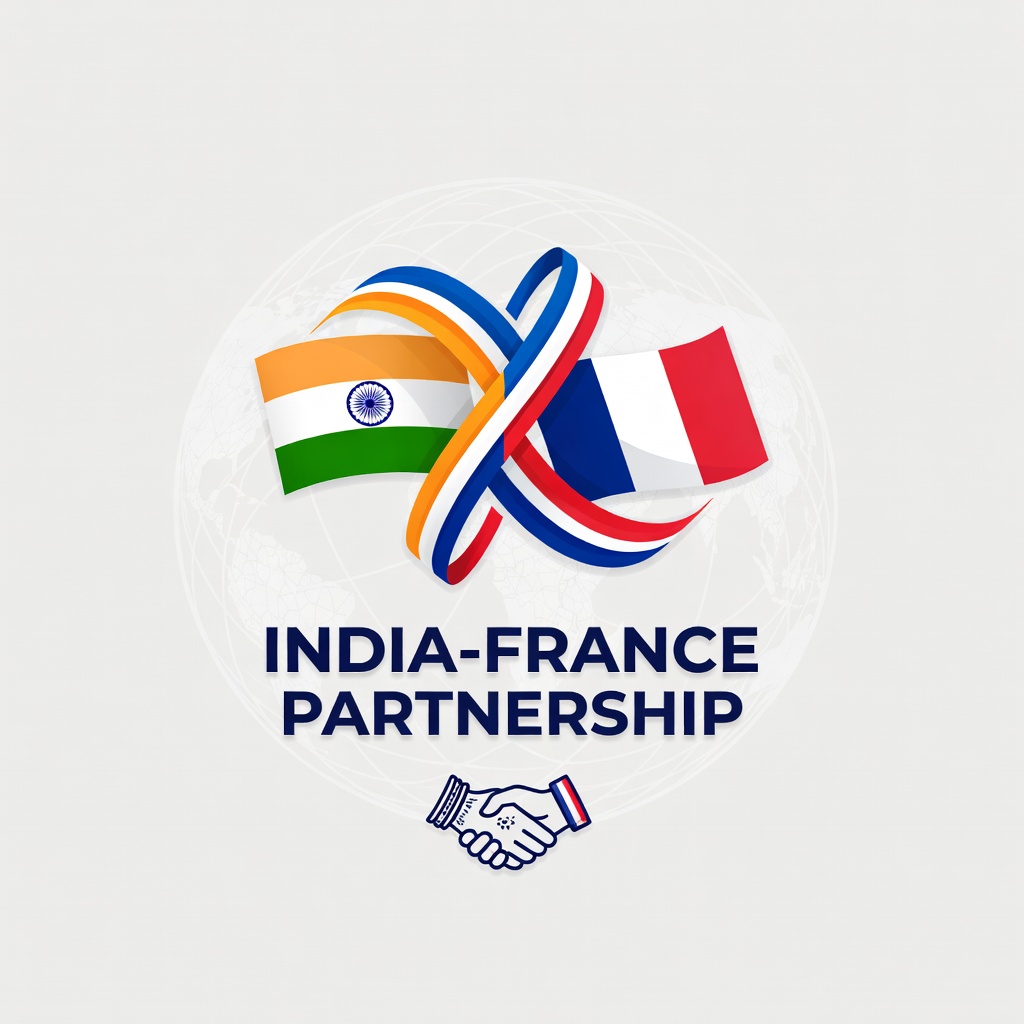
Context : Macron is on an official visit to India (Feb 17-19) to participate in the AI Impact Summit.
- Both nations officially upgraded their relationship to a “Special Global Strategic Partnership.”
- 2026 has been launched as the India-France Year of Innovation to boost tech collaboration.
India-France Strategic Partnership
- Foundational Trust: Established in 1998, it was India’s first strategic partnership with any Western nation.
- Both nations prioritize independent foreign policies and “strategic autonomy” in global affairs.
- A “Third Way”: The partnership offers an alternative to bipolarity, focusing on a free, open, and inclusive Indo-Pacific.
Defence Cooperation
- Inaugurated the Tata-Airbus final assembly line in Karnataka to produce H125 helicopters.
- Signed a deal for joint production of HAMMER missiles in India by BEL and Safran.
- Moving beyond “buyer-seller” to joint research, co-design, and co-production of advanced platforms.
- Rafale & Submarines: Continued momentum on the procurement of 114 Rafale jets and the Scorpene submarine project.
Amendment of Double Tax Avoidance Agreement (DTAA)
- Eliminating Double Tax: Signed an Amending Protocol to prevent businesses and individuals from being taxed in both countries.
- Boosting Investment: The new rules simplify tax compliance for startups, tech firms, and researchers.
- Economic Mobility: Aims to facilitate the movement of professionals and students by providing clearer tax benefits.
Horizon 2047 Roadmap
- A 25-year plan (until India’s 100th independence year) to guide bilateral relations.
- Three Pillars: Focuses on Partnership for Security, Partnership for Planet, and Partnership for People.
- Targets 2047 for the 50th anniversary of the partnership and 100 years of diplomatic ties.
Way Against Hegemony & Geopolitical Significance
- Both leaders explicitly stated they do not want to “submit to any form of hegemony” or coercion.
- The partnership acts as a pillar for a multipolar world order based on the rule of law.
- Jointly securing maritime routes against unilateral expansionism in the Indian and Pacific Oceans.
Cooperation in Critical & Emerging Sectors
- Signed a Joint Declaration of Intent for the exploration, extraction, and recycling of rare earth metals.
- Launched the Indo-French Centre for AI in Health at AIIMS, New Delhi, for medical innovation.
- Established a new research center between India’s DST and France’s CNRS for material science.
- Digital Sovereignty: Collaboration on secure 5G/6G tech and building “trusted” global supply chains.
“A Force for Stability”
- Global Good: PM Modi described the ties as a “force for global stability” amidst rising global conflicts (Ukraine, West Asia).
- Conflict Resolution: Both nations use their unique positions to advocate for dialogue and diplomacy rather than war.
- Their shared vision on climate (Solar Alliance) and counter-terrorism creates a stabilizing global influence.
2. India gets first private sector helicopter
GS paper III-S&T
Context : PM Modi and President Macron launched the H125 helicopter FAL during Macron’s 2026 official visit to India.
- The visit saw bilateral ties elevated to a “Special Global Strategic Partnership”.
- Both leaders designated 2026 as the India-France Year of Innovation.
What is a Final Assembly Line (FAL)?
- A facility where major sub-assemblies like the fuselage, wings, and engines are integrated into a functional aircraft.
- It involves a series of workstations performing specific manual and digital tasks in a precise order.
- Includes the final integration of electrical and mechanical systems followed by critical flight tests.
Location and Institutional Details
- The facility is situated at the Vemagal Industrial Area in Kolar, Karnataka.
- A collaboration between Tata Advanced Systems Limited (TASL) and France’s Airbus Helicopters.
- The program involves an anticipated investment exceeding ₹1,000 crore.
- The first “Made in India” H125 is expected to be delivered by early 2027.
Airbus H125 Helicopter
- It holds the record as the only helicopter to ever land on the summit of Mount Everest.
- Optimized for “hot and high” conditions, making it ideal for the Himalayan terrain and desert regions.
- It is the world’s most popular single-engine helicopter with over 40 million flight hours logged.
- Used for emergency medical services (EMS), disaster relief, law enforcement, and tourism.
Why this Facility is Historic for India
- This is the first time an Indian private company will undertake full assembly of a rotary-wing aircraft.
- It breaks the traditional dominance of state-owned entities in military and civil aircraft manufacturing.
- Establishes a localized supply chain involving over 16,000 MSMEs in the aerospace sector.
Full Life Cycle Liability & Support
- The facility handles everything from manufacturing and integration to testing and maintenance.
- Localised maintenance and lifecycle support maximize helicopter availability for Indian operators.
- TASL will perform structural, mechanical, and electrical system assembly and final flight tests.
Export Potential & Strategic Importance
- The facility aims to make India a rotary-wing manufacturing hub for the entire South Asian region.
- PM Modi noted that these “Made in India” helicopters will eventually be exported to the entire world.
- Airbus projects a regional demand for nearly 500 helicopters of this class over the next 20 years.
Military and Strategic Importance
- H125M Variant: The facility is designed to produce the H125M, a militarized version for reconnaissance and surveillance.
- Force Multiplier: It serves as a high-altitude asset for border patrolling and logistics at remote frontline outposts.
- Sovereignty: Strengthens India’s decision-making autonomy by reducing reliance on foreign-assembled military platforms.
Role of Tata Advanced Systems Limited (TASL)
- Lead Integrator: TASL is the primary Indian partner responsible for the physical assembly and testing of the aircraft.
- Expanding Capability: This is TASL’s second major aircraft plant with Airbus, following the C295 transport aircraft facility.
- Technical Lead: TASL manages the integration of complex systems, ensuring high levels of indigenised technology.
3. Snowball earth
GS paper I-Geography
CONTEXT :A recent study published in Earth and Planetary Science Letters (February 2026) has revealed that even during the “Snowball Earth” period, the climate was not “still” but experienced active, shorter cycles similar to modern climate patterns.
Snowball Earth: Definition and Meaning
- Definition: A hypothesis suggesting that Earth’s surface became entirely or nearly entirely frozen from pole to pole.
- Meaning: Global temperatures plummeted so low that ice sheets reached the equator, encasing the planet in a white “snowball” shell.
Geological Time Scale
- Period: It primarily occurred during the Cryogenian Period.
- Timeline: This period lasted from approximately 720 to 635 million years ago.
- Era: It is the second period of the Neoproterozoic Era.
Why Scientists Call it “Snowball Earth”
- Visual Appearance: From space, the planet would have appeared as a giant, white frozen ball of snow and ice.
- Ice-Albedo Feedback: Once ice reached 30° latitude, it reflected so much sunlight that the cooling became an unstoppable “runaway” effect.
What the New Study Says
- Climate Variability: The study challenges the idea that the climate was “locked” or stagnant during the freeze.
- Pulsing Climate: It found that the climate “pulsed” on timescales of years to centuries rather than remaining frozen in a single state.
Scientific Evidence Used
- Port Askaig Formation: Researchers analyzed rocks in this formation located on the Garvellach Islands, Scotland.
- Sediment Layers: They examined 2,640 thin layers of rock that recorded ancient environmental conditions.
- Thickness Analysis: Measuring the thickness of these layers revealed patterns matching 9–11 year (sunspot) and 60–150 year (Gleissberg) solar cycles.
What are Varves?
- Definition: Annual layers of sediment deposited in a body of water.
- Composition: Each year produces a light, coarse layer (from summer melt/runoff) and a dark, fine layer (when melting stops in winter).
- Data Loggers: They act like a “natural data logger,” allowing scientists to count years and track seasonal changes.
Role of Ocean-Atmosphere Interaction
- Weakened State: Usually, ice blocks the exchange of heat and gases between the ocean and the air.
- Persistence: The study shows that despite the ice, enough interaction remained to drive climate swings like El Niño.
Simulation Results
- Ice Variability: Simulations with different sea ice levels confirmed a 2 to 3-year variability in climate.
- Slushball Potential: Results suggest that some areas of the ocean might have remained ice-free or had “thin ice” to allow these cycles.
Difference Between Snowball Earth and Ice Age
| Feature | Snowball Earth | Standard Ice Age (Glacial Period) |
| Extent | Ice reaches the equator (Global). | Ice covers roughly 8-30% of the globe. |
| Severity | Oceans virtually freeze over entirely. | Oceans remain mostly liquid at low latitudes. |
| Duration | Can last tens of millions of years. | Usually lasts tens of thousands of years. |
4. 100 Years of Ol Chiki
Context :Ministry of Culture inaugurates centenary celebrations (1925–2025) of Ol Chiki script on 16 February 2026 in New Delhi, marking 100 years since its creation for Santhali language.
Ol Chiki Basics
- Official script for Santhali, a key Austroasiatic (Munda branch) tribal language spoken in Jharkhand, Odisha, West Bengal, Assam, Bihar.
- Scientifically crafted to match Santhali phonetics, unlike adapted scripts (Devanagari, Bengali, Roman).
Script Creation Story
- Invented in 1925 by Pandit Raghunath Murmu, hailed as Guru Gomke (Great Teacher) by Santhals.
- Aimed at distinct written identity; first work: High Serena (1936).
Distinctive Script Features
- 30 letters for precise vowel-consonant mapping (one symbol = one sound).
- Includes glottal stops for unique tribal sounds.
- No conjuncts; indigenous design, independent of Brahmi/Roman influences.
Recognition Milestones
- Santhali added to Eighth Schedule via 92nd Amendment (2003).
- Constitution translated into Santhali using Ol Chiki (Dec 2025), boosting linguistic inclusion.
5. Front and Centre
GS paper III-Economy
Context :The Supreme Court of India has recently (February 2026) criticized the Food Safety and Standards Authority of India (FSSAI) for its lack of concrete progress in implementing mandatory Front-of-Package Labelling (FOPL). The Court directed the regulator to file a response within four weeks regarding the introduction of warning labels on packaged foods high in sugar, salt, and saturated fats.
What Exactly Happened?
- The Supreme Court was hearing a Public Interest Litigation (PIL) filed by the NGO 3S and Our Health Society.
- The Bench expressed dissatisfaction with FSSAI’s “inaction,” stating that prior efforts had not yielded any “positive or good result”.
- The Court warned that it might resort to judicial intervention if the regulator failed to protect consumer health over food industry opposition.
What is Front-of-Package Labelling (FOPL)?
- It provides clear, decipherable information about key nutrients on the front panel of pre-packaged foods.
- Unlike the technical “nutrition facts” on the back, FOPL uses symbols or ratings to interpret healthiness at a glance.
- It is designed to help consumers, including those with low literacy, make quick and informed purchasing choices.
Why is FOPL Important?
- Rising NCDs: India faces an epidemic of Non-Communicable Diseases (NCDs), including 101 million people with diabetes.
- Dietary Risks: High consumption of sugar, salt, and saturated fats is a primary driver of hypertension, heart ailments, and obesity.
- Preventive Healthcare: It acts as an essential “prevention” tool, potentially reducing the massive costs associated with treating NCDs.
- Consumer Empowerment: It enables consumers to identify “unhealthy” products within seconds during grocery shopping.
Role of FSSAI
- Statutory Body: FSSAI is responsible under the FSS Act, 2006 for setting science-based standards for food safety and nutrition.
- Regulatory Domain: It has the power to mandate labelling standards, health claims, and food category systems.
- Compliance & Enforcement: FSSAI conducts inspections and can suspend licenses or fine businesses for non-compliance with labelling norms.
Ultra-Processed Food (UPF) Industry Issue
- The industry has reportedly resisted warning labels, preferring less “scary” formats like star ratings.
- The processed food market in India is growing by 24% annually, increasing public exposure to unhealthy ingredients.
- Critics argue that FSSAI’s extensive industry consultations have delayed the implementation of strict public health warnings.
Indian Nutrition Rating (INR)
- FSSAI proposed the INR, which assigns 0.5 to 5 stars based on a product’s overall healthiness.
- It balances “negative” nutrients (sugar, salt, fat) against “positive” components (fiber, protein, nuts).
- Petitioners argue the INR is flawed because “positive” ingredients can mask dangerously high levels of harmful salt or sugar.
Global Practice
- Countries like Chile and Mexico use black octagonal “High In” warning labels, which are proven to reduce unhealthy purchases.
- European countries like France and Portugal use a color-coded A to E scale.
- Australia and New Zealand use star ratings, which influenced the development of India’s INR.
Constitutional and Legal Rights
- The Supreme Court linked FOPL to the Right to Life (Article 21), encompassing the right to health and safe food.
- Article 47 of the Constitution mandates the State to improve public health and raise the level of nutrition.
- FOPL is viewed as a tool to uphold the citizen’s right to know and make informed choices about what they consume.
6. Indias aviation need data driven oversight
GS paper III-S&T
CONTEXT :IndiGo’s December 2025 operational crisis caused nationwide airfare spikes, prompting Ministry of Civil Aviation fare caps and DGCA probes into pricing, exposing gaps in aviation oversight.
Shift from Crisis Fixes to Ongoing Monitoring
- Recent surge offers chance for DGCA to adopt continuous data regulation, inspired by U.S. model.
- U.S. BTS DB1B survey tracks 10% ticket sample quarterly (fares, routes, carriers) since 1995 for pricing insights.
Boosting Transparency to Curb Pricing Power
- Public data prompts airlines to self-check algorithms, cutting surge risks.
- Enables studies like “Southwest Effect”—low-cost entry drops fares, raises traffic.
Spotting Dominance via Data Tools
- Route comparisons flag monopoly high fares.
- Tracks competitor entry/exit fare shifts.
- Monitors peak-demand hikes on dominant routes.
Tackling Airline Pushback
- Claims of proprietary algo sensitivity, reporting costs, collusion fears.
- 10% random sample balances: Reveals actual fares (“what”), hides strategies (“how”).
Practical Benefits of Sampled Data
- Low compliance burden on carriers.
- Quarterly lag prevents real-time rival tracking amid existing price scraping.
- Replaces ad-hoc caps with proactive, competition-friendly oversight.
7. Why Yuvraj mehtas death was not an accident
Context :Death of 27-year-old Yuvraj Mehta in Greater Noida—car plunged into unguarded construction pit—highlights systemic urban infrastructure failures amid rapid city growth.
Challenging the ‘Accident’ Narrative
- Road hazards, open pits, and waterlogging are predictable, repeatedly flagged in civic complaints—not random events.
- NCRB 2023: 1.73 lakh road deaths; urban areas claim 32% share with higher per-lakh fatality rates.
- Citizens self-manage risks (e.g., avoiding floods), bypassing 74th Amendment’s decentralized urban safety mandate.
Skewed Development Focus
- Priority on flashy projects: flyovers, metros gain funds/political gains.
- Neglect of basics: drainage, walkways, wiring create hidden vulnerabilities.
- Example: Karol Bagh (Delhi)—2024 basement drownings despite prior audit warnings; illegal use persisted due to weak enforcement.
Dispersed Accountability Issues
- Post-tragedy blame game: agencies (municipal, contractors, police) deflect full ownership.
- Mehta case: Delayed rescue until SDRF stepped in; inquiries target juniors, ignore systemic gaps.
- Result: Symbolic suspensions, no structural fixes.
Universal Class Impact
- Affects all: Professionals like Mehta, students in basements face equal infrastructural risks.
- Limited outrage as no single culprit emerges; cycle of grief-assurances fades without reform.
Reform Roadmap
- RTI-backed risk logs: Resolve complaints in 30 days.
- Quarterly audits of avoidable deaths for transparency.
- Independent safety commissions with binding municipal powers.