1. India adds more than 50,000MW of power generation capacity
GS paper III-S&T
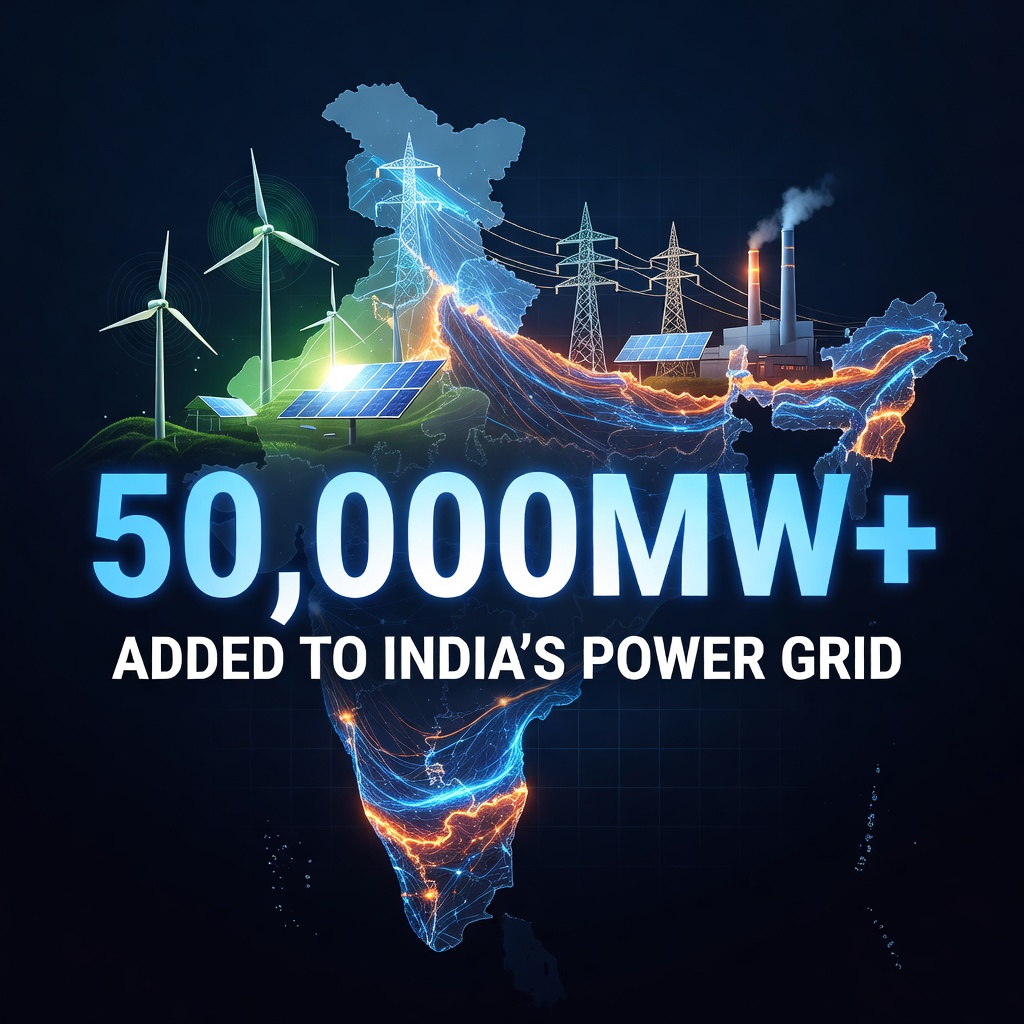
Context :India added a record 52,537 MW of power generation capacity in the first 10 months of FY 2025–26 (up to January 31, 2026).
- This surpasses the previous annual record of 34,054 MW set in FY 2024–25, marking the fastest expansion in the nation’s history.
- For the first time, non-fossil fuel-based capacity has officially overtaken fossil fuel-based capacity in the total mix.
Background
- Target Alignment: This growth is part of India’s “Panchamrit” goals announced at COP26 to achieve 500 GW of non-fossil fuel capacity by 2030.
- Policy Support: Sustained government focus on solar and wind manufacturing, grid modernization, and favorable bidding has accelerated this transition.
- Economic Surge: Rapid capacity addition is essential to meet India’s surging electricity demand, which has been doubling nearly every decade.
What is Power Generation Capacity?
- Definition: It represents the maximum electrical output that power plants can produce under ideal conditions when running at full strength.
- Potential vs. Production: Unlike “generation” (actual energy produced over time), “capacity” is the installed potential of the infrastructure.
- Unit of Measure: It is typically measured in Megawatts (MW) or Gigawatts (GW).
Key Data from the Article
- Total Capacity: India’s total installed power generation capacity reached 520,510.95 MW as of January 31, 2026.
- Growth Rate: The country saw a more than 11% increase in total installed capacity within just 10 months.
- Leading States: Gujarat and Rajasthan lead the nation, with each state contributing roughly 44 GW of renewable power.
Renewable Energy: The Major Contributor
- RE Share in Addition: Out of the 52,537 MW added this fiscal year, 39,657 MW (approx. 75%) came from renewable sources.
- Solar Dominance: Solar power alone contributed 34,955 MW, cementing its role as the backbone of new additions.
- Wind Contribution: Wind energy added 4,613 MW to the national grid during the same period.
- Hydropower: Large hydropower projects contributed an additional 3,370 MW in FY 2025–26.
Current Energy Mix of India (as of Jan 31, 2026)
| Source Category | Installed Capacity (MW) | Percentage Share (%) |
| Non-Fossil Fuel | 271,969.33 | ~52.2% |
| — Renewable Energy | 263,189.33 | ~50.5% |
| — Nuclear Power | 8,780 | ~1.6% |
| Fossil Fuel (Coal, Gas, etc.) | 248,541.62 | ~47.8% |
Why This News is Important
- NDC Achievement: India has achieved its target of 50% non-fossil capacity five years ahead of the 2030 deadline.
- Decarbonization: This rapid shift significantly reduces the carbon intensity of the Indian economy.
- Energy Security: Reduces reliance on imported fossil fuels, shielding the economy from global price volatility.
Strategic Significance
- Global Leadership: Establishes India as a global leader in the clean energy transition, surpassing many developed nations.
- Supply Chain Resilience: The push for domestic manufacturing of modules and batteries builds national self-reliance (Atmanirbharta).
- Climate Security: Demonstrates India’s commitment to “common but differentiated responsibilities” while protecting vulnerable populations from climate risks.
- Grid Stability: The concurrent growth of nuclear and hydropower provides the necessary baseload for a renewable-heavy grid.
2. LHS 1903:a strange system
GS PAPER I-Geography
Context : Astronomers using the CHEOPS telescope identified a fourth planet, LHS 1903e, at the edge of the system.
- “Inside-Out” Order: The system features an “inverted” arrangement of rocky and gaseous planets, which is extremely rare.
- Science Publication: The findings were published in the prestigious journal Science in February 2026.
Background
- LHS 1903 is a cool, faint red M-dwarf star located approximately 116 light-years away.
- Previously, only three planets were suspected; new data confirmed the fourth.
- Most systems follow the Solar System pattern: rocky planets near the star and gas giants farther away.
Detailed Explanation & Structure
- four planets orbit much closer to their star than Mercury does to our Sun.
- The Inverted Sequence: The order of planets is Rocky (inner) – Gaseous – Gaseous – Rocky (outer).
- Stabilized Orbits: Despite the unusual order, dynamical simulations show the current orbits are stable.
Types of Planets in LHS 1903
- Super-Earths (b & e): The innermost (b) and outermost (e) planets are rocky worlds larger than Earth.
- Mini-Neptunes (c & d): The middle two planets are gaseous worlds smaller than Neptune but larger than Earth.
- Dense Outer World: Planet LHS 1903e is small and dense, similar in composition to Venus.
Why this Challenges Planet Formation Theory
- Distance Defiance: Rocky planets usually form near stars where heat prevents gas from accumulating.
- Gas Availability: Traditional models predict that outer planets should be gaseous because they form in cooler, gas-rich regions.
- Paradigm Shift: Finding a small rocky world outside of massive gaseous ones “flips” the standard model.
Scientific Explanation
- Inside-Out Formation: The planets likely formed sequentially (one by one) rather than all at once.
- Gas Depletion: The inner siblings likely “swept up” all available gas before the outer planet finished forming.
- Late Bloomer: Planet ‘e’ is considered a “late bloomer” that emerged in a gas-poor environment.
Technology Used: CHEOPS Telescope
- High Precision: The CHaracterising ExOPlanet Satellite measures planet sizes with extreme accuracy.
- Transit Detection: It detects tiny dips in starlight as planets pass in front of the star.
- Composition Analysis: By combining size data with mass, it helps scientists distinguish between rock and gas.
3. What are bio based chemical and enzymes ?
Gs paper III-biotechnology
Context : India has prioritized bio-based chemicals and enzymes as a core area under the Department of Biotechnology’s BioE3 policy.
- The focus aims to leverage India’s agricultural base and fermentation expertise to scale high-value biomanufacturing.
Background
- Shift from Petrochemicals: There is a global and national move to reduce dependence on fossil-fuel-derived industrial inputs.
- Import Reduction: India seeks to lower its high import bills, such as the roughly $479.8 million spent on acetic acid in 2023.
What are Bio-based Chemicals?
- Biological Origin: These are industrial chemicals produced using biological feedstocks like sugarcane, corn, starch, or biomass residues.
- Production Process: They are typically created through fermentation or specialized enzymatic processes.
- Examples: Common types include organic acids (lactic acid), bio-alcohols, solvents, surfactants, and pharmaceutical intermediates.
What are Enzymes?
- Biological Catalysts: Enzymes are proteins that act as catalysts to speed up chemical reactions.
- Industrial Applications: They are widely used in detergents, food processing, pharmaceuticals, textiles, and pulp and paper.
- Energy Efficiency: They often function at lower temperatures and pressures, significantly reducing energy use and emissions.
Importance of Bio-based Chemicals for India
- Agriculture Markets: Scaling this sector creates new, high-value markets for surplus agricultural produce.
- Sustainable Supply: It positions India as a competitive global supplier of sustainable and green industrial inputs.
- Diversification: It allows for the expansion of the chemicals sector beyond traditional petrochemical-linked manufacturing.
Strengthening the Sector in India
- BioE3 Policy: The government is scaling shared infrastructure, including biofoundries and pilot plants.
- Risk Mitigation: These demonstration facilities are designed to reduce capital risk for private firms.
- Policy Clarity: Clear standards, certifications, and procurement policies are being developed to build investor confidence.
Where Does India Stand Today?
- Leading Firms: Companies like Praj Industries, Godrej Industries, and Godavari Biorefineries are leading the bio-chemical segment.
- Consolidated Market: The India enzymes market is currently consolidated, with top players holding over 75% of the market share.
- Key Enzyme Players: Major contributors include Novozymes India, DuPont, DSM, Advance Enzyme Technologies, and BASF SE.
Global Comparison
- European Union: The EU Bioeconomy Strategy links biomanufacturing to circular economy and waste reduction goals.
- United States: The USDA BioPreferred Program mandates federal procurement preferences for certified bio-based products.
- China: Their bioeconomy development plans explicitly prioritize high-value bio-based chemicals and enzyme technologies.
- Japan: Priority projects funded through METI/NARO integrate bio-based chemical research with manufacturing readiness.
Environmental and Climate Benefits
- Emissions Reduction: The use of enzymes reduces the carbon footprint by lowering the heat and pressure needed for manufacturing.
- Waste Utilization: Utilizing biomass residues for chemical production reduces waste and promotes circularity.
- Climate Goals: The sector is a key component of aligning industrial growth with national climate commitments.
Challenges and Risks
- Comparative Cost: Bio-based products are currently more expensive than their established petrochemical alternatives.
- Entry Barriers: High initial costs create significant barriers for private investment in the early stages of scale-up.
- Feedstock Availability: There is a persistent risk related to the consistent availability of reliable biological feedstocks.
- Market Adoption: Manufacturers may be hesitant to switch to bio-based inputs if they cannot seamlessly substitute existing pipelines
4. Reynisfjara Beach
Mapping
Context :Reynisfjara Beach in southern Iceland has made headlines due to severe erosion in February 2026, which erased large portions of its famous black sand shoreline amid winter storms and shifting winds.
About
Reynisfjara stands out as a globally renowned black-sand beach celebrated for its rugged volcanic scenery and fierce ocean swells, ranking among Iceland’s top natural wonders.
Geographic Position
- Located close to Vík í Mýrdal village on Iceland’s south coast.
- Lies within the Katla UNESCO Global Geopark.
- Directly exposed to the North Atlantic’s turbulent waters.
Geological Formation
- Derived from quick-cooled basalt lava flows meeting the sea.
- Black sands stem from ground-down volcanic material of nearby peaks like Eyjafjallajökull.
- Features hexagonal basalt pillars in Hálsanefshellir cave from columnar jointing during lava solidification.
Distinctive Elements
- Jet-black, gritty sands from fragmented basalt rock.
- Dramatic Reynisdrangar sea stacks protruding from the sea.
- Towering basalt columns and sea caves evoking pipe organs.
- Perilous sneaker waves that unexpectedly rush far inland.
Causes of Erosion
- Unrelenting easterly winds displaced sand westward, unlike typical southwesterlies.
- Reynisfjall mountain acted as a barrier, halting sand renewal.
- Intense Atlantic winter swells accelerated beach scouring.
- Underlying basalt collapse and landslides shrank the coastal strip.
- Evolving climate patterns may amplify wind and wave shifts.
5. Bridging a divide with an Indian Scientific Service
Gs paper II-Polity
Context :Union Budget 2026 stresses “Science for Mission India” for climate/tech challenges.
- PM Modi’s R-Day speech pushes “scientist-bureaucrats” for Amrit Kaal.
- NITI Aayog/PSA reports propose ISS amid COP31, net-zero goals, Kerala floods, AI ethics.
- Coverage in The Hindu, Indian Express post-Budget.
Historical Admin Focus
- Post-1947: Prioritized stability via generalist IAS for unity, laws, revenue, integration.
- Merit exams + training enabled flexibility across sectors.
- Worked for territorial issues; fails for modern complex systems (ecosystems, epidemics, tech risks, climate).
Core Admin-Scientist Clash
- Admins: Exam-based, hierarchical, coordination-focused.
- Scientists: Education/experiment/peer-driven, emphasize evidence, uncertainty, independence.
- Issue: Scientists in gov’t judged by admin rules, no career safeguards—advice stays advisory.
Problems from Admin Rules (e.g., CCS 1964)
- Rules enforce discipline/neutrality, block open risk logging or policy challenges.
- Science becomes reactive (crises only), not proactive; symbolic over substantive.
- Hesitancy in environment, nuclear, health domains.
Global Benchmarks
- US/UK/Germany/France/Japan: Dedicated science cadres with integrity protections (transparent docs, no suppression).
- Leaders decide; science informs—India lacks this formal weight for gov’t scientists.
ISS Proposal
- All-India permanent cadre alongside IAS; recruit via exams + expertise.
- Embed in ministries; rules protect independence, mandate science logs.
- Admins: Coordination/execution; Scientists: Risks, foresight, tech input.
Potential ISS Structure
- Branches: Environment-ecology, climate-atmosphere, hydrology, marine-oceans, etc.
- Integrates science into policy institutions, not just labs.
Benefits & Evolution
- Evolves, doesn’t replace, post-Independence system.
- Boosts policy quality, accountability, resilience for 21st-century threats.
6. The UAE-India Corridor is Sparking a Growth Story…
GS PAPER II-IR
Context :India-UAE ties hit headlines in Jan-Feb 2026 after leaders set a $200B trade target by 2032—5 years ahead of the original $100B CEPA goal (achieved early). Triggered by UAE prez’s India visit, PM Modi’s Dubai Expo push, and Q4 2025 trade data showing 20% non-oil surge to $65B. Links to IMEC corridor revival post-Red Sea disruptions, G20 Delhi Declaration extensions, and AI summits. Covered in Economic Times, PIB releases amid India’s $4T GDP milestone and UAE’s $5B infra pledges
India-UAE Economic Ties: From $100B Milestone to $200B Vision
Trade Surge and Deep Ties
- Non-oil trade up 20% to $65B last year; hit $100B total 5 years early vs. 2030 target.
- UAE FDI in India: $22B+ since 2000; Indian FDI in UAE: $16B+.
- 5M Indian diaspora; 1,200 weekly flights—busiest air corridor.
Pivot to High-Tech Sectors
- Advanced manufacturing/fintech/tech/logistics focus.
- Reliance-TA’ZIZ: $2B low-carbon chemicals in Abu Dhabi.
- Ashok Leyland: EV bus production shift to UAE.
- L&T: Major Abu Dhabi solar-storage project.
- Indian banks/tech/healthcare expanding in Emirates.
Robust Two-Way Investments
- UAE to India: DP World $5B infra pledge; Emirates NBD stakes in RBL Bank; ADNOC LNG deals; Mubadala $4B+ in health/renewables/tech; ADIA GIFT City base.
- Signals long-term industrial bets, not short-term.
Bedrock of Trust and Policies
- CEPA (2022): 90% tariff cuts; 2024 BIT + defence pact for stability.
- Diaspora + decades of ties anchor growth.
Expanding to Global Reach
- Bharat Mart (UAE): Wholesale hub for Indian exports to Africa/West Asia/Eurasia.
- Joint digital infra/capacity-building in Africa.
- AI frontier: India AI Summit 2026 + UAE’s AI adoption; collab on computing/data centres.
India’s Global Push and Realignment
- India at $4T GDP: Entrepreneurship + mfg + digital infra fuel outward expansion.
- Delhi Declaration (India-Arab): 2028 roadmap for trade/energy/tech/security.
- IMEC corridor leads broader shifts beyond bilateral trade.
Future: Integration Over Volume
- Post-$100B: Focus on capital/tech/infra/strategic flows.
- Positions India-UAE as dynamic global partnership model.
7. A commo framework to build trust in AI in Asia
GS paper III-S&T
Context :India AI Impact Summit 2026 (Feb 19-20, New Delhi) hosted by MeitY under IndiaAI Mission—PM Modi’s platform for trusted AI, bridging global divides in health/agri/climate.
- Builds on India AI Governance Guidelines 2025(Nov 2025, MeitY) emphasizing trust pillars. Regional: Singapore’s Agentic AI Framework (Jan 2026), South Korea AI Basic Act; ASEAN WG-AI ethics guide.
- UN AI Advisory Body/UNESCO push shared norms. Timely amid Asia’s AI race (China lead, India talent), supply chain risks, deepfakes/misinfo elections.
Why Trust Matters for AI
- AI risks: Bias, safety, misuse, rejection; transnational issues (data flows, chips, talent, cyber gaps).
- Asia challenge: Developing nations as passive users; uneven governance hits communities hardest.
Divergent Asian AI Strategies
- South Korea: Chip dominance.
- Singapore: Governance pace-setter.
- China: Global lead + sovereignty.
- India: IT upskilling + digital market.
- Nepal: Green compute hub.
- Common: Institutionalize trust.
Emerging Initiatives
- India: 2025 Guidelines (trust-core).
- S. Korea: AI Basic Act.
- Global: UN Advisory Body, UNESCO Ethics Reco, ISO 42001/42005.
Pillars of Trusted AI Ecosystem
- Data: Quality, diverse (Asia languages), DPI-anchored.
- Infra: Secure compute/cloud/energy vs. disruptions.
- Skills: Talent pipelines + public literacy.
- Chains: Semis/minerals access + mfg.
- Gov: Balanced risk mgmt (deepfakes, liability).
- Cyber: Harmonized protections vs. AI attacks.
Key Challenges
- Fragmented regs.
- Tech asymmetry.
- Supply dependence.
- Cyber gaps.
- Digital colonialism risk.
India’s Leadership Role
- Strengths: DPI (Aadhaar/UPI), IT workforce, techno-legal regs.
- Summit 2026: Asian trust framework, global interoperability.
- Shape inclusive AI model.
Way Forward
- Regional AI Trust Index (cyber/bias/data/gov).
- Interoperable standards (UNESCO/ISO).
- Asia semi/compute coop.
- AI literacy + research collab.
- Multi-stakeholder forums.
Conclusion Points
- AI can deepen divides or drive inclusion—trust decides.
- Shared framework > fragmentation for Asia’s growth