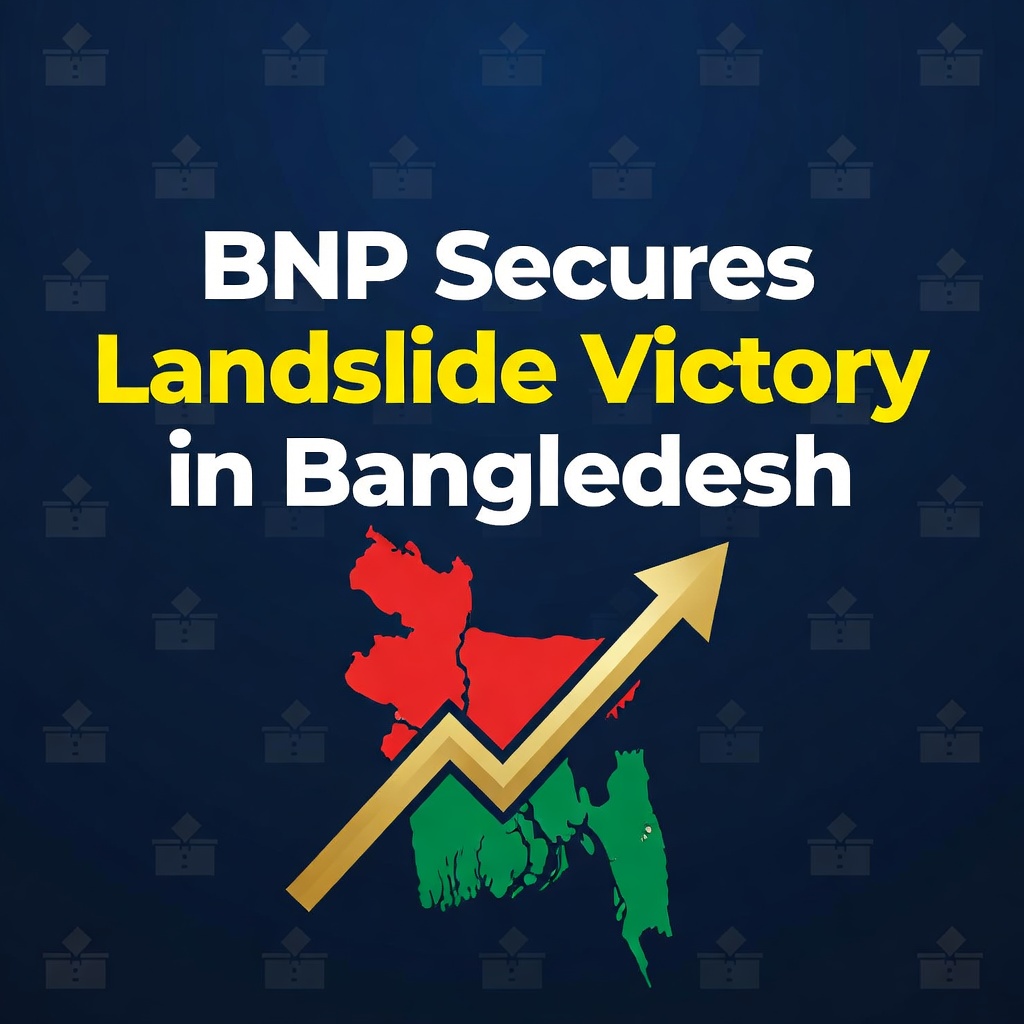
1. BNP Secures landslide vivtory in Bangladesh
GS paper II-IR
CONTEXT :The Bangladesh Nationalist Party (BNP), spearheaded by Tarique Rahman (who returned from 17 years of exile), secured a historic landslide victory.
- The Awami League was notably absent from the ballot, having been barred due to its role in the 2024 crackdowns.
- This election marks the return of the BNP to power after two decades and signals a “new dawn” for Bangladesh’s democracy
The 2026 Mandate: A Landslide Victory
- Decisive Majority: The BNP-led alliance secured a two-thirds majority, winning 212 out of 300 seats in the Jatiyo Sansad.
- The Rise of the Right: The Islamist Jamaat-e-Islami (JeI) performed significantly better than in past cycles, winning 77 seats and emerging as a formidable secondary force in the new political landscape.
- The July Charter: Alongside the vote, a referendum passed with over 68% support, introducing constitutional reforms such as a two-term limit for Prime Ministers and a bicameral legislature to prevent future autocracy.
- Leadership Shift: With the passing of Khaleda Zia in late 2025, the party is now firmly under the leadership of her son, Tarique Rahman, who is poised to become the next Prime Minister.
India-Bangladesh Relations: A Historical Perspective
- Founding and Friction (1978–2006): Founded by Ziaur Rahman, the BNP’s relationship with New Delhi has historically been complex. The 2001–2006 coalition with Jamaat-e-Islami was a period of high tension, as India alleged that insurgent groups were using Bangladeshi soil to target India’s Northeast.
- The Hasina Era (2008–2024): Relations entered a “Golden Phase” under the Awami League, marked by a crackdown on anti-India militants and deep connectivity projects. However, this perceived “unconditional support” for Hasina created resentment among the Bangladeshi public.
- The 2024 Transition: The ouster of Hasina—and her subsequent residence in India—initially soured ties, as anti-India sentiment rose during the transition period.
The “Olive Branch” Strategy: Rebuilding the Partnership
- Proactive Engagement: Prime Minister Narendra Modi was among the first to congratulate Tarique Rahman, signaling India’s commitment to a “democratic, progressive, and inclusive Bangladesh.”
- Shared Priorities: The incoming BNP government has highlighted three major areas for bilateral talks:
- Border Management: Stopping “border killings” and ensuring peaceful security.
- Water Diplomacy: The renewal of the Ganga Waters Treaty.
- Diplomatic Sensitivity: Managing the presence of Sheikh Hasina in India, who faces legal proceedings in Dhaka.
- Economic Re-alignment: While the BNP seeks to strengthen ties with China and Pakistan, it has expressed a clear desire to maintain “multifaceted relations” with India for regional stability and economic growth.
The 2026 election has cleared the path for a more pluralistic Bangladesh. For India, the challenge lies in moving past the “Hasina-centric” diplomacy of the last decade. By engaging with Tarique Rahman’s mandate, New Delhi has the opportunity to build a more sustainable, people-to-people partnership that respects Bangladesh’s sovereign democratic choices while securing its own strategic interests in the neighborhood.
2. SHANTHI ACT
GS PAPER II-polity
Context :Parliament recently passed the SHANTI Act, opening India’s nuclear sector to private players and easing supplier liability rules under the CLNDA 2010 framework.
Nuclear Liability Background
- Enacted post-India’s CSC signature for victim compensation and accountability.
- Included operator’s “right of recourse” against suppliers for defects.
- Section 46 allowed victims remedies via other laws (e.g., criminal).
- Drew supplier criticism over liability fears; nuclear power at ~3% of electricity.
SHANTI Act Highlights
Private Sector Entry
Permits private operation of nuclear plants, ending government monopoly.
Supplier Protections
- Channels all liability to operators; eliminates recourse against suppliers.
- Shields suppliers from suits over equipment defects.
Revised Liability Limits
- Operator caps: Rs. 100 crore (small plants) to Rs. 3,000 crore (large).
- Total cap (with Centre): 300 million SDRs (~Rs. 3,900 crore).
- Drops CLNDA Section 46, restricting victim legal options.
- AERB gains statutory role, but selection by Atomic Energy Commission limits independence.
Supplier Indemnity Logic
- Past accidents (Three Mile Island 1979, Chernobyl 1986, Fukushima 2011) exposed design flaws.
- U.S. suppliers balked at India’s rules; global norms favor operator-only liability.
- Aligns India with international conventions.
Liability vs. Disaster Costs
- SHANTI cap (~Rs. 3,900 crore) dwarfs Fukushima (~Rs. 46 lakh crore) or Chernobyl Belarus losses (~Rs. 21 lakh crore).
- CSC funds may cover little of major damages.
Safety Risks
- Indemnifies operators for “grave natural disasters,” diluting absolute liability.
- Moral hazard: Reduced incentives for top safety amid foreseeable risks like tsunamis.
Broader Impacts
- Eases entry for big projects (e.g., $18B Westinghouse reactors) toward 100 GW by 2047.
- Boosts private/foreign investment but questions regulation, risk sharing, and small modular reactor viability.
3. As multilateralism erodes ,india must reframe its foreign policy
GS PAPER II-IR
Context :Prime Minister Narendra Modi recently highlighted in Parliament a shift from India’s traditional strategic autonomy to a proactive, interest-driven foreign policy. This aligns with Viksit Bharat 2047 goals amid eroding multilateralism, U.S. transactionalism (e.g., 2025 steel tariffs over Russian oil), China’s UN influence, and new trade pacts like the India-EU FTA (Jan 2026).
Shift to Viksit Bharat Diplomacy
Core Shift
India moves from non-aligned neutrality to targeted global engagement for becoming a developed nation by 2047.
Decline of Global Cooperation
- WTO stalled by U.S. bypassing dispute mechanisms; India opts for bilateral mini-deals (late 2025).
- Relations turn transactional, e.g., U.S. quits ISA and WHO (2025-26).
- Trade weaponized via tariffs/sanctions, like U.S. 50% duties on Indian metals.
- China dominates UN agencies, skewing standards in digital/infrastructure.
Drawbacks of Non-Alignment
- Outdated post-Cold War; tech rivalries force choices (e.g., U.S. Patriot vs. Russian S-400).
- Economic risks from import reliance (90% semiconductors from East Asia, 2025).
- Seen as “swing state” by U.S., not truly autonomous.
- Global South fragmented, diverging on climate/finance issues.
Emerging Global Challenges
- Power favors the strong, pushing small nations into unequal deals (e.g., India-U.S. trade pact doubles imports for tariff cuts, Feb 2026).
- Tech (AI, cyber, space) defines power; India-Russia NavIC-GLONASS tie-up builds alternatives.
- Manufacturing race post-China Plus One: India’s electronics exports hit ₹4 lakh crore (2025), but Vietnam/Mexico compete.
- Neighborhood tensions rise with extremism/China influence (e.g., Bangladesh-Pakistan defense talks, 2025).
India’s Policy Overhaul
- Focus inward: PLI schemes, Rare Earth Corridors in Budget 2026-27 for self-reliance.
- Diversify trade: EU/UK FTAs, with EU deal creating vast free trade zone (99% exports).
- Tech partnerships: Russia/middle powers for quantum/space via Kazan/Tianjin summits.
- Regional restraint: Energy/investment diplomacy (e.g., India-Kuwait talks) over security fixes.
This pivot since 1991 positions India as a tech-strong pole in a splintering order, prioritizing Viksit Bharat through deals like the EU FTA.
4. Why has J&K shelved the Dal Lake restoration plan?
GS paper III-Environment
CONTEXT :J&K government has dropped the ₹416.72 crore Dal Lake restoration project in favor of an in-situ conservation approach. This allows lake dwellers to stay within the ecosystem, promoting community-led efforts amid ongoing pollution, shrinkage, and ecological threats.
Dal Lake Overview
Dal Lake serves as Srinagar’s iconic urban freshwater lake and wetland, vital for tourism, fishing, floating farms, and Kashmiri heritage.
Geographic Position
- Situated in Srinagar, J&K’s summer capital.
- Bordered by Mughal sites like Shalimar Bagh and Nishat Bagh.
Geological Background
Himalayan tectonic and glacial forces formed it within the Kashmir Valley’s lake system, part of a broader wetland network.
Hydrological Links
Feeds from catchment streams and drains into Jhelum River via regulated channels.
Distinct Characteristics
- Spans ~18 sq km within a 21 sq km wetland expanse.
- Comprises Gagribal, Lokut Dal, Bod Dal, and Nagin basins.
- Hosts floating gardens (Raad) for veggies.
- Features houseboats and shikaras boosting tourism/jobs.
- Freezes in harsh winters.
- Under strain from sewage, encroachments, nutrient overload, and poor water flow
5. Safeguarding Women at Work
Context :The Ministry of Women and Child Development (MoWCD) recently held a National Conference on Workplace Safety for Women. This event focused on better enforcing the Sexual Harassment (SH) Act 2013 and promoting the upgraded SHe-Box portal as a one-stop online tool for handling complaints.
It highlights growing female workforce participation (e.g., 4.42 lakh net additions in July 2025) amid rising underreporting of harassment, urging stronger safety measures for Viksit Bharat goals.
Protecting Women in the Workplace
Core Purpose
This involves laws and systems to stop, ban, and address sexual harassment, mainly through the Sexual Harassment of Women at Workplace (Prevention, Prohibition and Redressal) Act, 2013 (POSH Act).
Key Statistics and Insights
- Female formal employment is surging, with 4.42 lakh new payroll entries in July 2025, demanding solid safety nets.
- Two-thirds of cases remain unreported due to retaliation fears.
- NCRB logs over 400 annual reports, but experts say this understates the problem.
- Unorganized sector women (e.g., domestic workers) face high risks from poor awareness of Local Committees (LCs).
- 53% of HR staff in a 2024-25 survey struggle with full POSH compliance despite Internal Committees (ICs) in big companies.
Reasons to Prioritize Protection
Constitutional Duty
Articles 14, 15, and 21 mandate women’s rights protection. The Supreme Court in the 2023-24 Aureliano Fernandes case ruled SH Act failures breach dignity guarantees.
Boosting Economic Growth
Safe workplaces support 70% female participation targets for Viksit Bharat; safety fears drive urban LFPR drops in North India.
Talent Retention
Harassment causes high female attrition, especially in tech where mid-senior women leave over biased POSH processes (2025 data).
Promoting Inclusive Development
Unorganized workers (domestic, agricultural) need coverage; 2025 surveys show Delhi/NCR domestics unaware of District Officers’ roles.
Health Impacts
Causes psychological harm, addressed by 2025’s Project Stree Manoraksha for survivors’ mental health.
Government Steps Forward
- SHe-Box Upgrade (2024): Multilingual online hub for complaints across sectors.
- Corporate Reporting Rules: Companies must list POSH cases in annual Board Reports.
- National Safety Pledge (2026): MoWCD drive for zero-tolerance in public/private firms.
- Training Resources: ISTM handbooks on iGOT Karmayogi platform.
- Court Monitoring: Supreme Court pushes states to survey IC formations.
Key Hurdles
- Low Awareness: Few know the 3-month filing limit or IC details (only 8% in 2024 reports).
- Retaliation Risks: Victims fear job loss, as in 2024-25 sports cases against coaches.
- Weak LCs: District panels for unorganized sectors are underfunded or outdated (e.g., Eastern India 2025 probes).
- Tech Barriers: Rural women lack skills for SHe-Box; oral reports go untracked.
- Narrow Scope: POSH covers only women complainants, sparking 2025 calls for gender-neutral rules.
Path Forward
- Mandate ongoing training for all staff beyond onboarding.
- Fund and publicize LCs via panchayats/districts.
- Tie contracts/subsidies to SHe-Box safety ratings.
- Launch mobile vans/camps for unorganized workers.
- Enforce penalties like license revocation for repeat violators.
This framework via SH Act and SHe-Box builds a strong safety net, but real change needs employer action and court enforcement for India’s inclusive growth.
6. The Labour codes redefine wages ,empower the worker
GS PAPER II-Polity
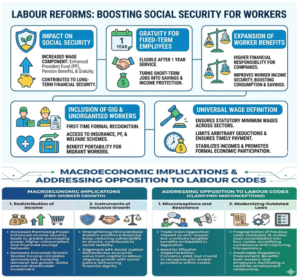
Context: India’s labour codes merge outdated laws to broaden social security coverage, standardize wage definitions, and extend protections to gig and informal workers. They promote financial inclusion, earnings security, and sustained safeguards, fostering equitable and growth-oriented economic expansion.
Key Aspects of the Labour Codes
Reform of Wage Definition: The codes redefine wages, mandating that at least 50% of total remuneration must consist of basic pay, dearness allowance, and retaining allowance. This change aims to increase social security contributions and benefits.
India’s labour codes aim to improve financial inclusion and worker empowerment by expanding gratuity, social security, and legal protections. They promote fair value distribution from capital to labour, modernise labour governance, and support inclusive, equitable growth through effective implementation.
7. India Tested, From U.S. Sanctions to One-Sided Trade Deal
GS paper II-IR
CONTEXT :India-US Bilateral Trade Agreement talks aim to cut high US tariffs and boost trade, but spark debate on economic policy and foreign ties. Framework hints at foreign policy linkage beyond commerce.
Negotiation Dynamics
- US-Led Disclosures: Key details emerge from US statements, orders, and docs first; India’s replies lag.
- Perception Issue: Joint statements from US side suggest India reacts, not co-shapes terms.
Power Imbalance Effects
- Signals unequal talks; India adjusts for tariff relief.
- Sets precedent for future trade, defense pacts.
Energy Policy Shift
- Russian Oil Role: Once ~40% of imports for cheap energy.
- Decline Noted: Purchases drop despite discounts, against affordability goals.
- Pressure Suspected: Politics over economics drives change.
Economic-Political Tradeoff
Abandoning cheap oil risks domestic costs; questions if trade gains justify energy independence loss.
Diplomatic Fallout
- Russia-Iran Ties: Cuts harm India’s reliability.
- Global South Image: Yielding to sanctions erodes leadership.
- Other Partners: Favors US, strains EU/recent deals.
Geopolitical Ramifications
- Regional Power: Less Chabahar/Iran engagement aids China.
- Future Pacts: Tariff relief may demand defense/security alignment.
Strategic Autonomy Challenge
- Core Tradition: Independence since 1947 avoids bloc ties.
- RCEP Parallel: 2019 exit guarded sovereignty; this risks reversal.
- Multi-Alignment Risk: Ties India closer to one power, limits options.
Economic upsides (tariff relief, market access) weigh against autonomy erosion in energy/diplomacy. Deal tests India’s balance in multipolar world.