1. Retail inflation at 2.75% in new CPI
GS paper III-Economy
Context: MoSPI released the first set of retail inflation data under the 2024 base year in February 2026.
- Modernization Drive: Update fixes “data lag” and aligns with the latest Household Consumption Expenditure Survey (HCES) 2023-24.
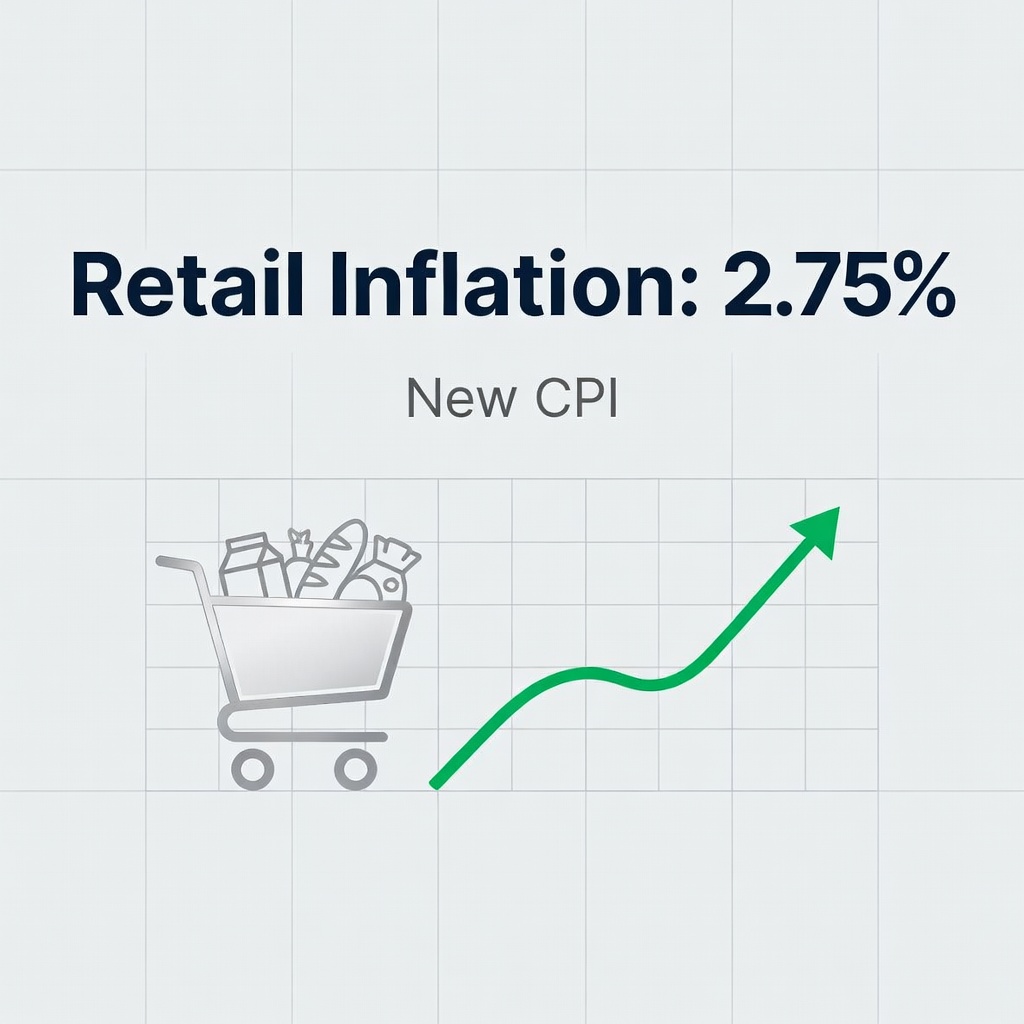
- First Reading: January 2026 retail inflation at 2.75% under new series—much lower than previous trends.
Background: What is CPI?
- Definition: Measures average change over time in prices paid by retail consumers for a fixed basket of goods/services.
- Purpose: Acts as proxy for cost of living and purchasing power of the Indian Rupee.
- Compiler: Released monthly by National Statistical Office (NSO) under MoSPI.
- Types: CPI-Rural, CPI-Urban, and CPI-Combined (headline inflation figure).
Key Highlights of New CPI Series (Base 2024)
- Item Expansion: Basket now has 358 items (up from 299 in 2012 series).
- Digital Inclusion: First-time price data from 12 online markets for cities with 25 lakh+ population.
- Broader Coverage: Price collection from 1,465 rural and 1,395 urban markets across India.
- Revision Frequency: Government plans updates every 3–5 years to avoid data obsolescence.
Major Structural Changes in New CPI
- COICOP Alignment: Follows international Classification of Individual Consumption According to Purpose (2018) framework.
- 12 Divisions: Basket split into 12 divisions (vs. 6 earlier), e.g., “Information & Communication” for granularity.
- Rural Housing: Included for first time to capture rural cost of living better.
- Additions: OTT subscriptions, babysitters, pen-drives, gym equipment.
- Deletions: Obsolete items like VCR/DVD players, tape recorders, radio.
Changes in Weightage
| Category | Old Weight (2012) | New Weight (2024) |
| Food & Beverages | 45.86% | 36.75% |
| Housing | 10.07% | 17.67% (Rural + Urban) |
| Transport | ~8% | 8.80% |
| Health | ~5.8% | 6.10% |
- Crucial Note: 9% drop in Food weight shows richer Indians spend less on basics, more on services.
Why Base Year Revision Matters
- Relevance: Reflects current behavior (e.g., more smartphones than in 2012).
- Accuracy: Avoids overestimating inflation from food price spikes due to high old weights.
- Global Standards: Matches IMF/UN best practices for national stats.
- Policy Impact: Gives realistic data for welfare spending and subsidies.
Implications for RBI & Policy
- Lower Volatility: Reduced food weight stabilizes headline inflation.
- Core Focus: RBI emphasizes core inflation (non-food, non-fuel) for demand pressures.
- Interest Rates: 2.75% print allows supportive rates for growth.
- Anchored Expectations: Accurate data steadies business/household inflation views.
Key Concept: Linking Factor
- Definition: Mathematical multiplier to convert New Series (2024) index to Old Series (2012) level.
- Purpose: Ensures continuity for comparing 2010 vs. 2026 data without graph breaks.
- Method: Arithmetic Conversion based on overlapping year’s average.
2. 114 Rafales for IAF, Six p-81 aircrafts for Navy
GS paper III-S&T
Context: DAC cleared one of India’s largest single-day procurement packages.
- Strategic Timing: Addresses IAF’s declining squadron strength and boosts maritime dominance.
- Indigenization Focus: Significant portion of high-value projects to be manufactured in India.
Acceptance of Necessity (AoN)
- First Step: Official “green signal” acknowledging operational need for equipment.
- Initiates Procurement: Enables tendering, bidding, and technical trials.
- Policy Validation: Confirms financial and strategic justification at policy level.
Key IAF Approvals
- 114 MRFA: Approval for 114 multi-role jets (understood as Rafales) to restore squadrons.
- Domestic Manufacturing: ~90 jets made in India with 50% indigenous content.
- Combat Missiles: Enhances stand-off ground-attack and precision strike capabilities.
- AS-HAPS: “Pseudo satellites” for persistent surveillance and electronic intelligence.
AS-HAPS Explained
- Pseudo Satellites: UAVs at 18–20 km altitude.
- Solar Powered: Airborne for months using solar energy.
- Persistent ISR: Continuous intelligence, surveillance, reconnaissance; telecom relays.
- Cost Effective: Satellite capabilities at lower cost, easier redeployment.
Key Navy Approvals
- P-8I Aircraft: Six additional for maritime reconnaissance and anti-submarine warfare.
- Marine Gas Turbines: 4 MW generators under Make-I category.
- Reduced Dependency: Indigenous systems cut reliance on foreign manufacturers.
Key Army Approvals
- Vibhav Mines: Indigenous anti-tank mines to disrupt enemy forces.
- Vehicle Overhauls: T-72 tanks, BMP-II vehicles, ARVs for extended life.
- Life Extension: Boosts service life and operational readiness.
Key ICG Approvals
- Surveillance Systems: EO/IR for Dornier aircraft.
- Coastal Security: Improves efficacy in coastal/offshore areas.
Self-Reliance Dimensions
- Make in India: High-end platforms like Rafale, P-8I with domestic production.
- Technology Transfer: MRFA includes airframe and systems integration transfers.
- Indigenous Categories: “Make-I” and “Buy (Indian-IDDM)” for home-grown tech.
- Supply Chain Growth: Builds sustainable aerospace/defence industrial base.
3. Bacteria are multilingual
GS paper III-Biotechnology
Context: Prof. Bonnie Bassler delivered ‘A chemical language that enables communication between diverse organisms’.
- Occasion: Held at IISc, Bengaluru, for International Day for Women and Girls in Science.
- Scientific Insights: Detailed bacterial coordination via “quorum sensing”.
Why Important?
- Evolutionary Insight: Explains collective behaviors through microscopic interactions.
- Life-Sustaining Roles: Gut bacteria digest food, provide nutrients.
- Dual Nature: Bacteria as “magical microbes”—disease-causing or life-supporting.
- Agricultural Potential: Promises new environmental and farm management methods.
Core Concept: Quorum Sensing
- Definition: Chemical process for bacteria to sense population density.
- Coordination: Colonies act unison, like multi-cellular organisms.
- Signal Detection: Release/detect chemical molecules to monitor neighbors.
- Action Trigger: At “quorum” density, launch collective behavior.
Multilingual Bacteria
- Diverse Languages: Different chemical “dialects” for own species/others.
- Intra-species Talk: Chemicals for family/species communication.
- Inter-species Talk: “Universal” language across bacterial types.
- Complex Interpretation: Distinguishes friend from foe in gut-like environments.
Example: Vibrio Species
- Vibrio cholerae: Uses quorum sensing for coordinated deadly attacks.
- Vibrio fischeri: Bioluminescent, symbiotic with Hawaiian bobtail squid.
- Camouflage Role: Glows to mimic moonlight, hides squid shadow from predators.
- Collective Light: Glows only at high density via quorum sensing.
Medical Implications
- Anti-Quorum Therapies: Drugs “jam” signals, not kill bacteria.
- Antibiotic Alternative: Lowers resistance risk.
- Precision Targeting: Hits specific harms like toxins, spares beneficial bacteria.
Awards and Recognition
- Wolf Prize: 2022 winner in Chemistry.
- Gairdner Award: 2023 Canada Gairdner Award.
- Academic Standing: Princeton professor, molecular biology leader.
4. Bodhan AI
GS paper III-S&T
Context: Bharat Bodhan AI Conclave launched on February 12, 2026, to set national AI roadmap for education.
- Bodhan AI Launch: Centre of Excellence established at IIT Madras to lead AI transformation in education.
- National Budget Support: Backed by ₹500 crore from Union Budget 2025-26.
- Six-Month Pilot: Plans to pilot AI tools in schools across 2–3 states within the next year.
Background and Context
- Viksit Bharat 2047: Key pillar to empower 30 crore students with AI skills for “Developed India.”
- Technological Shift: Moves from static “one-size-fits-all” to dynamic, personalized learning.
- Digital Infrastructure Legacy: Builds on “India Stack” (Aadhaar, UPI) success for education.
What is Bodhan AI?
- Centre of Excellence: Non-profit IIT Madras Bodhan AI Foundation for India-centric AI research.
- Multilingual Foundational Model: Sovereign AI supporting Indian languages and dialects.
- Application Aggregator: Platform for edtech startups to integrate, avoiding parallel systems.
- Sovereign Capability: Hosts educational data and models within India for data sovereignty.
What is Bharat EduAI Stack?
- Digital Public Infrastructure (DPI): Open-source, interoperable architecture for nationwide AI learning.
- Shared Technology Layer: Common base for states/institutions to build customized tools.
- Unified Ecosystem: Analyzes student responses, provides teacher/parent insights, real-time analytics.
- Safe by Design: Includes data protection, privacy, and bias controls.
Why AI in Education?
- Personalized Tutors: 24/7 feedback and practice tailored to student pace.
- Teacher Support: Automates admin tasks/grading for focus on mentorship.
- Bridging Gaps: Predictive analytics for early learning gap detection.
- Democratizing Quality: Equal access to high-quality content for remote students.
Public Digital Infrastructure (DPI) Model
- Interoperability: Seamless integration via open APIs for government/private/local systems.
- Scalability: Handles 260 million+ annual school enrolments.
- Inclusive by Design: Accessible across socio-economic/linguistic backgrounds.
- Non-Monopolistic: Free tech stack to boost competitive startup ecosystem.
Alignment with National Policies
- NEP 2020 Compliance: Supports 50% Gross Enrolment Ratio by 2035 via digital tools.
- AI Literacy: Introduces age-appropriate AI from Class 3.
- NIPUN Bharat: Strengthens foundational literacy/numeracy.
- DIKSHA and APAAR: Syncs with DIKSHA for content and APAAR for student IDs.
5. Tangkhul Hui and Kombai breeds
GS paper III-S&T
Context: In February 2026, Assam Rifles (AR) announced full-scale induction of Tangkhul Hui dogs after a successful pilot.
- New Addition: AR will start inducting Kombai breed from Tamil Nadu from April 2026.
- National Directive: Follows Ministry of Home Affairs (MHA) mandate for all Central Armed Police Forces (CAPFs) to adopt two Indian dog breeds.
Background and Context
- Atmanirbhar Push: Aligns with government’s self-reliance drive in defense assets.
- Shift from Foreign Breeds: Indian forces previously relied on German Shepherds, Labradors, and Belgian Malinois.
- Modern Identification: AR Dog Training Centre (ARDTC) identified local breeds with combat-level intelligence and stamina.
The Two Breeds: Tangkhul Hui and Kombai
Tangkhul Hui (Haofa)
- Origin: Native to Ukhrul district, Manipur; raised by Tangkhul Naga tribe.
- Role: Hunting traditionally; now specialized in narcotics detection for AR.
- Traits: Highly intelligent, extremely loyal, resistant to local diseases.
Kombai
- Origin: Ancient breed from Theni district, Tamil Nadu; known as Indian Bore Hound.
- Role: Guarding and hunting wild boar; valued for ferocious guarding instincts.
- Traits: Extremely powerful, courageous, high athletic stamina for clearing obstacles.
Role of Assam Rifles
- Oldest Paramilitary: Established 1835; “Sentinels of the North East” for border security and counter-insurgency.
- Operational Areas: Dogs deployed in high-risk Northeast and Jammu & Kashmir zones.
- Specialized Tasks: Tracking, explosives detection, narcotics smuggling prevention from Myanmar.
Why Shift to Indigenous Breeds?
- Climate Adaptability: Suited to India’s diverse, harsh weather unlike foreign breeds.
- Disease Resistance: Less prone to genetic issues and common illnesses.
- Low Maintenance: Require less medical care and no expensive imported diets.
- Strategic Self-Reliance: Cuts dependency on foreign breeding programs, reducing asset lag.
Training and Implementation
- Training Hub: ARDTC in Jorhat, Assam; houses over 100 dogs.
- Course Duration: 12 weeks basic handling + 36 weeks advanced specialization.
- Dual-Purpose Training: Exploring “assault + tracking” and “assault + explosive detection.”
- Gender Inclusion: First-time induction of women dog handlers.
6. Vande Mataram, its stanzas and a settles question
GS paper I-History
Context: Issued on January 28, a 10-page protocol for the 150th anniversary of the National Song.
- New Mandate: Requires playing/singing all six stanzas (previously only two) at official and school functions.
- Equal Status: National Song to be played before National Anthem when both performed.
- Standing Protocol: Mandatory standing to attention for full duration (~3 min 10 sec).
Historical Background
- Composition: Written by Bankim Chandra Chatterjee in 1870s, included in novel Anandamath (1882).
- Freedom Struggle: Rallying cry in 1905 Anti-Partition movement; first sung by Tagore at 1896 Congress session.
- Revolutionary Symbol: Used by revolutionaries like Madam Bhikaji Cama and Madan Lal Dhingra.
The 1937 Settlement (CWC Resolution)
- The Conflict: Objections from Muslim League over religious imagery in later stanzas.
- CWC Resolution: Congress Working Committee (Calcutta, 1937) adopted only first two stanzas for gatherings.
- Rationale: First two verses focus on motherland/nature; later invoke Hindu deities like Durga, Lakshmi.
- Unity Strategy: Supported by Gandhi, Nehru to maintain communal harmony.
Constituent Assembly Positions
- Anthem vs. Song: January 24, 1950, Dr. Rajendra Prasad announced Jana Gana Mana as National Anthem.
- Equal Status: Vande Mataram granted “equal status” as National Song for freedom struggle role.
- Limited Adoption: Carried forward 1937 logic, using only non-religious stanzas.
Constitutional Framework (Article 51A)
- Fundamental Duty: Article 51A(a) mandates respect for Constitution, Flag, Anthem.
- Notable Omission: National Song not mentioned, unlike Anthem.
- Legal Distinction: Indicates less rigid protocol historically.
Landmark Judgment: Bijoe Emmanuel vs. State of Kerala (1986)
- Right to Silence: SC ruled no forced singing of Anthem if religious objections.
- Respect vs. Participation: Standing respectfully suffices; forced singing violates Article 25.
- Standard of Law: Departmental instructions cannot override fundamental rights.
Why the 2026 MHA Order is Problematic
- Religious Sensitivity: All six stanzas include Hindu imagery, conflicting with minority faiths.
- Legal Force: Executive order mandates what Article 51A/Prevention Act do not explicitly require.
- Duration & Decorum: 3-min standing in schools seen as excessive enforced nationalism.
- Historical Reversal: Unsettles 90-year consensus for inclusivity.
Core Constitutional Logic
- Voluntary vs. Forced: Favors voluntary patriotism over coercion.
- Secular Ethos: Symbols must include all citizens regardless of beliefs.
- Precedence of Rights: Fundamental Rights (Art 19, 25) prevail over non-enforceable Duties (Art 51A).
7. Farmer pulse
GS paper III-Agriculture
Context: India announced mission targeting 350 lakh tonnes pulse production by 2030-31.
- Trade Tension: U.S. documents suggest India opening markets to American pulse imports.
- Farmer Skepticism: Domestic producers fear depressed local prices contradicting self-sufficiency goals.
Why Pulses Matter for India
- Protein Source: Account for ~25% of non-cereal protein in Indian diet.
- Livelihood: Support ~5 crore farmers and families.
- Food Security: Key to managing household costs amid global supply tightness.
Key Issues and Demand-Supply Gap
- Output vs. Demand: Production ~2.5 crore tonnes vs. demand 3.0 crore tonnes.
- Import Reliance: Annual gap of 0.5 crore tonnes filled via imports.
- Vulnerability: Exposed to global trade decisions and price shocks.
How India Manages Pulses Demand
- Import Policy: Mix of open/restricted imports for supply stability.
- Price Stabilization: Interventions to curb retail price spikes.
- Conditional Procurement: MSP encourages sales to state agencies.
Structural Problems in Pulse Sector
- Rain-fed Cultivation: Relies on unpredictable rainfall, causing yield volatility.
- Weak Procurement: Price Support Scheme coverage fluctuates 2.9%-12.4%.
- Lack of Centers: Inadequate centers force sales to private traders below MSP.
- Yield Gap: Lower than major international competitors.
The U.S. Trade Controversy
- Obligation Claims: U.S. documents imply deal mandating American pulse purchases.
- Policy Contradiction: Undermines domestic self-sufficiency efforts.
- Political Sensitivity: Echoes past farm law protests, seen as “anti-farmer.”
Government’s New Initiative
- Outlay & Scale: ₹11,440 crore mission for 310 lakh hectares cultivation.
- Production Goal: 350 lakh tonnes by decade-end.
- Mission 2025: Addresses procurement deficits in key growing belts.
Structural Reforms Needed
- MSP Guarantees: Legally-backed to boost farmer investment.
- Infrastructure: Expand procurement centers to cut middlemen reliance.
- Productivity Gains: High-yield, drought-resistant seeds for rain-fed areas.
- Market Incentives: Reward pulses over water-intensive crops.