
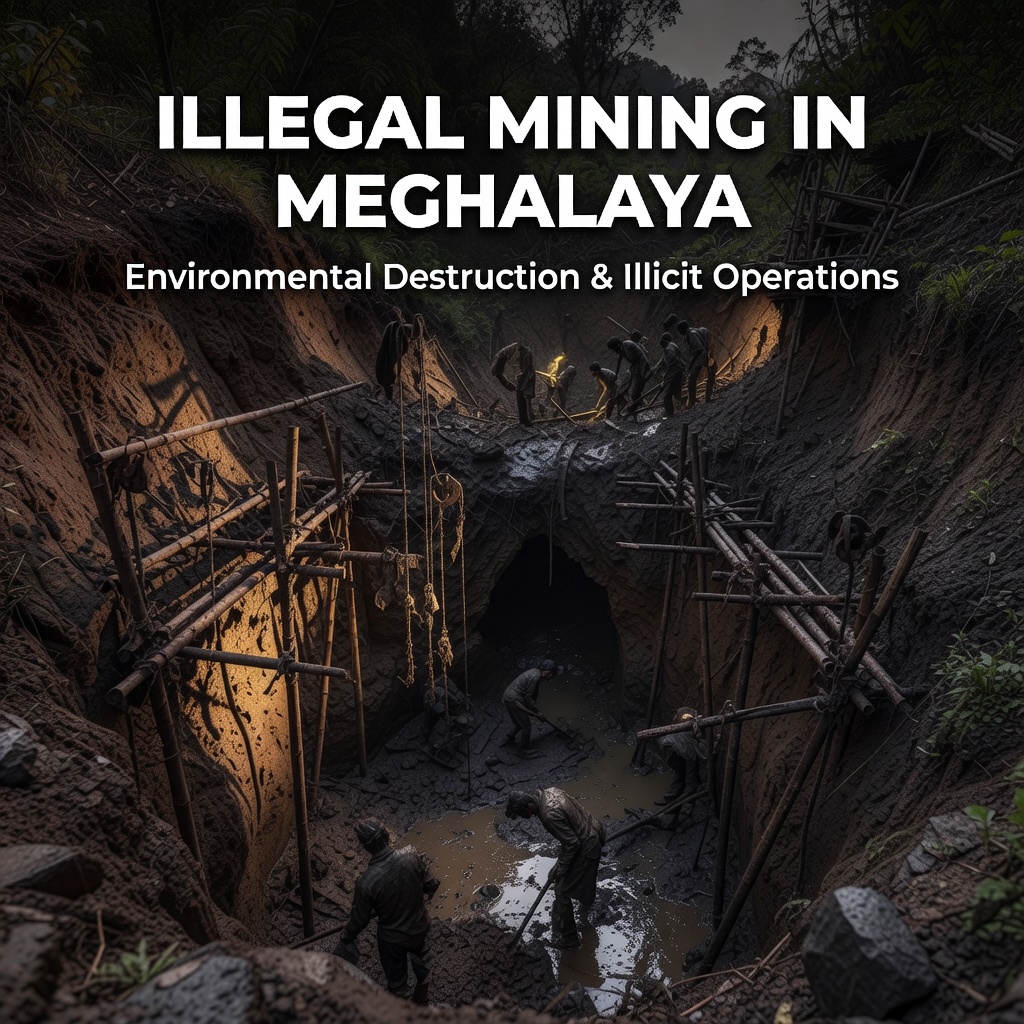
1. Illegal mining in Meghalaya
GS PAPER II-GOVERNACE
CONTEXT : a massive explosion at an illegal coal mine in East Jaintia Hills killed at least 18 labourers.
- The blast occurred in the Thangsku area, suspected to be caused by the unscientific use of dynamite in a rat-hole mine.
- Prime Minister Modi and CM Conrad Sangma announced ex-gratia for the victims while ordering a comprehensive probe.
What is Rat-Hole Mining?
- It is a primitive method of extracting coal by digging very narrow, horizontal tunnels (3–4 feet high).
- Side-cutting: Tunnels are dug directly into hill slopes to find thin coal seams.
- Box-cutting: A rectangular pit is dug vertically (100–400 feet), followed by horizontal rat-hole tunnels.
- The tunnels are so small that miners, often migrant workers or children, must crawl to extract coal manually.
Why is it Prevalent in Meghalaya?
- Thin Coal Seams: The coal layers in Meghalaya are too thin (less than 2m) for large-scale, mechanized mining.
- Conventional mining methods are considered too expensive for these specific geographical conditions.
- It provides quick cash for local tribal populations and migrant workers with limited job options.
- Tribal communities own the land and sub-soil, making they feel entitled to mine it.
Legal Status of Coal Mining in Meghalaya
- NGT Ban (2014): The National Green Tribunal (NGT) banned rat-hole mining across the state due to safety and environmental risks.
- Supreme Court Ruling (2019): The SC upheld the ban but allowed mining if done “scientifically” under the MMDR Act.
- Recent Shift: In 2025, the government began processing “scientific mining” leases to replace illegal rat-hole operations.
Reasons for the Ban
- Environmental Degradation: Acid Mine Drainage (AMD) turned major rivers like the Kopili acidic and blue, killing aquatic life.
- Risk to Life: Frequent flooding of mines during monsoons and structural collapses lead to high mortality.
- Child Labour: The narrow tunnels led to the rampant employment of children who could fit into the small spaces.
- Unscientific Extraction: Lack of pillars or supports makes these mines “ticking time bombs” for collapses.
What Went Wrong Despite the Ban?
- Enforcement Gaps: Mines are located in remote, hilly terrains that are difficult for authorities to monitor constantly.
- Political-Mining Nexus: Critics argue that powerful local interests and “coal syndicates” influence the lack of strict policing.
- Lack of Alternatives: Without a transition plan for workers, illegal mining continues as a survival necessity.
- Vested Interests: High demand for Meghalaya’s low-ash coal in cement and power plants fuels the black market.
Key Takeaways
- Safety Crisis: The 2026 tragedy highlights that illegal mining is still widespread 12 years after the initial ban.
- Environmental Blueprints: Restoring the ecosystem remains a distant goal as over 24,000 illegal mines are still estimated to exist.
- Policy Shift: Transitioning to “scientific mining” is the only legal way forward, but its implementation remains slow.
2. Procurement for minor forest produce
GS paper III-Environment
Context : the Ministry of Tribal Affairs tabled data in the Lok Sabha showing a massive 92% dip in MFP procurement.
- Procurement across 19 states plummeted from over 51,400 MT in 2023-24 to just 3,920 MT in 2024-25.
- The data was shared in response to questions about strengthening tribal livelihoods and expansion of the TRIFED network.
What is Minor Forest Produce (MFP)?
- All non-timber forest produce of plant origin, officially defined by the Forest Rights Act (FRA), 2006.
- Includes bamboo, honey, wax, lac, tendu leaves, medicinal plants, herbs, roots, and tubers.
- Specifically excludes timber and other major wood products.
- Nature: These are renewable resources that provide sustenance without damaging the forest ecosystem.
Why It Matters?
- Livelihood Security: Approximately 100 million people depend on MFPs for a substantial portion of their annual income.
- Lean Season Income: Provides critical cash income during non-agricultural months (lean seasons) for landless tribal groups.
- Nutritional Value: Many MFPs like wild fruits, seeds, and nuts are essential dietary sources for tribal households.
- Empowerment: Since women constitute the majority of forest gatherers, MFP trade strengthens their economic participation.
MSP for MFP: Concept and Objectives
- Concept: A centrally sponsored scheme launched in 2013-14 to provide a price floor for tribal gatherers.
- Primary Objective: To ensure fair and remunerative prices, protecting gatherers from exploitation by middlemen.
- Value Chain Development: Beyond just a price floor, it aims to support primary processing, storage, and transportation.
- Social Safety: It acts as a “social safety net” to reduce poverty and prevent distress migration among tribal populations.
What the Data Says? (2024-2026)
- Procurement Volatility: While 2023-24 saw a peak in procurement worth ₹124.3 crore, it fell to ₹16.68 crore in 2024-25.
- Regional Disparity: States like Odisha and Andhra Pradesh saw sharp drops, while Chhattisgarh and Gujarat reported increases.
- Institutional Reach: Over 4,125 VDVKs are currently supporting roughly 12.79 lakh tribal members nationwide.
- Fund Release: The Ministry has released approximately ₹319.65 crore to states for procurement revolving funds till date.
Why is this Discipline Important?
- Poverty Alleviation: Tribals derive 20-40% of their annual income from MFP; efficient management is key to economic stability.
- Conservation: Sustainable harvesting, a core part of the scheme, encourages forest dwellers to protect their resource base.
- Market Integration: Connects remote tribal products to global markets via retail chains like “Tribes India”.
Constitutional and Policy Framework
- Panchayat (PESA) Act, 1996: Empowered Gram Sabhas in Scheduled Areas with ownership of minor forest produce.
- Forest Rights Act, 2006: Legally vested the right of ownership and disposal of MFP in forest-dwelling communities.
- National Forest Policy, 1988: Shifted focus toward forest conservation and meeting the basic needs of local people.
- 73rd Amendment: Provided a framework for conferring MFP ownership rights to Panchayati Raj Institutions.
3. SODIUM -ION BATTERIES
GS PAPER III-S&T
Context :Dependence on lithium-ion batteries has exposed India to high import reliance and supply chain vulnerabilities.
- Sodium-ion batteries have emerged as a safer, lower-risk alternative compatible with existing infrastructure.
- Experts are calling for policy shifts and regulatory nudges to accelerate the adoption of sodium-ion technology.
- The global sodium-ion manufacturing capacity is projected to reach 70 GWh by 2025.
What is a Sodium-Ion Battery?
- It is a type of rechargeable battery that uses sodium ions ($Na^+$) as charge carriers.
- It structurally mirrors lithium-ion systems but relies on abundantly available sodium derived from soda ash.
- These batteries eliminate the need for critical, scarce minerals like lithium, cobalt, and nickel.
- They are categorized as a commercially viable solution for stationary storage and light EVs.
How Does a Sodium-Ion Battery Work?
- Charge Cycle: Sodium ions move from the positive cathode to the negative anode through an electrolyte.
- Discharge Cycle: Ions migrate back to the cathode, releasing stored electrical energy to the device.
- Current Collectors: Uses aluminum foil for both electrodes, unlike lithium-ion which requires copper for the anode.
- Stability: Sodium-ion cells can be safely stored and transported at zero volts without degradation.
Why is this Breakthrough Important?
- Supply Chain Resilience: It reduces global commodity price volatility by using earth-abundant materials.
- Cost Reduction: Sodium-ion battery costs are projected to undercut lithium-ion prices by 2035.
- Energy Security: Provides an alternative to the highly concentrated lithium and cobalt supply chains.
- Safety Standards: Sodium-ion cells exhibit significantly lower peak temperature rise during thermal runaway events.
Comparison: Sodium-Ion vs. Lithium-Ion
| Feature | Sodium-Ion Battery | Lithium-Ion Battery |
| Raw Material | Abundant (Sodium/Soda Ash) | Scarce (Lithium, Cobalt) |
| Current Collector | Aluminum for both electrodes | Copper for the anode |
| Thermal Safety | High (Less prone to fire) | Lower (Prone to thermal runaway) |
| Energy Density | Lower (Approaching LFP levels) | High (Industry standard) |
| Transport | Safe at zero volts (Lower risk) | Must be shipped partially charged |
| Cost Potential | Significantly lower in long term | Volatile due to mineral scarcity |
Why Does This Matter for India?
- Import Independence: India lacks significant domestic reserves of lithium and cobalt.
- Existing Infrastructure: Production lines can be adapted to sodium-ion with relatively minor modifications.
- PLI Scheme Integration: Expanding the PLI framework to include sodium chemistry can foster a future-ready ecosystem.
- Grid Storage: Ideal for India’s massive stationary storage needs to support renewable energy integration.
- Market Opportunity: Potential for early leadership in two- and three-wheeler EV segments.
4. Operation Kenya
Context : Recent Indian Army operations in J&K’s forested infiltration corridors (e.g., Poonch-Rajouri sector) highlight proactive counter-terrorism.
- Triggered by intelligence on regrouping terror modules post-2025 cross-border incursions, these ops (like “Operation Sindoor” extensions) underscore India’s shift to area-denial tactics amid Pakistan-backed threats.

Key Strategic Impacts
- Bolsters Domestic Security: Neutralizes emerging terrorist cells and severs transnational terror linkages, reducing future attack risks.
- Secures Critical Terrain: Establishes sustained dominance in J&K’s wooded and high-altitude infiltration routes, curbing undetected entries.
- Showcases Force Integration: Exemplifies seamless Army-J&K Police-CRPF coordination, proving capability for extended missions in rugged landscapes.
5. SABHASAAR INITIATIVE
Context :SabhaSaar Initiative automates Gram Sabha documentation using AI for efficient rural governance.
- Over 1.11 lakh Gram Panchayats adopted this tool by January 2026 for automated meeting summaries, highlighting rapid nationwide uptake.
- Pilot success in Tripura (87% adoption on launch day) spurred expansion across states. It aligns with Digital India goals amid 2026 rural governance reforms.
Background Context
Launched on August 14, 2025, by the Ministry of Panchayati Raj with IndiaAI Mission support, SabhaSaar addresses manual documentation delays in Panchayati Raj meetings. It digitizes Gram Sabha processes—key forums for village voters—to boost transparency and efficiency. Built on secure government cloud infrastructure, it ensures data privacy under DPDP Act, 2025.
Core Purpose
The platform aims to standardize meeting minutes nationwide, reducing workload for Panchayat officials and enabling focus on service delivery. It promotes participatory democracy by making records verifiable and accessible. Multilingual integration via Bhashini supports 13 Indian languages, with expansion planned.
Main Features
- Converts audio/video into structured Minutes of Meeting (MoM) using AI and NLP transcription.
- Tracks analytics like attendance, resolutions, and action items for governance insights.
- e-GramSwaraj login-enabled uploads; fully government-hosted for security.
Key Benefits
- Improves accountability with uniform, tamper-proof records.
- Empowers rural digital inclusion, aligning with AI-for-Governance initiatives.
- Streamlines follow-ups, enhancing Panchayat performance nationwide
6. The Fading on Indias environment jurisprudence
GS PAPER II-POLITY
GS PAPER III-ENVIRONMENT
Context :Regulatory changes since December 2025 allow non-coal mining EIAs without land details, while Supreme Court recalls key rulings on clearances, signaling judicial retreat from strict ecological scrutiny .
Key Policy Weaknesses
- Non-coal mining EIAs omit land specifics, bypassing prior environmental assessment norms.
- Supreme Court revoked Vanashakti vs Union of India (2025), enabling retrospective clearances despite prior bans.
- Chief Justice’s suo motu stay offers temporary relief, but trend favors procedural leniency over substantive protection.
Aravalli Ecological Crisis
- Ranges act as desertification barriers, groundwater recharge zones, and biodiversity hubs in north-west India.
- 2025 ruling adopts 100m elevation criterion, ignoring hydrology and geomorphology against 2004 M.C. Mehta precedents.
- Violates Vellore (1996) precautionary principle by excluding ecologically vital low-lying areas from mining bans.
Constitutional Violations
- Article 21’s right to clean environment, 48A’s state protection duty, and 51A(g)’s citizen obligations are undermined.
- Altitude-based Aravalli classification lacks rational nexus, breaching Article 14 equality.
- Post-facto approvals contradict Common Cause (2017) by legalizing violations after occurrence.
Coastal Mangrove Threats
- Mangroves serve as flood buffers, carbon sinks, and biodiversity hotspots along coasts.
- Judicial nods for felling thousands for infrastructure ignore decades-long ecosystem maturity.
- Compensatory afforestation fails as substitute due to irreplaceable ecological functions.
Himalayan Infrastructure Risks
- Char Dham project traverses 811 landslide zones per 2025 study, despite Citizens for Green Doon (2021) concerns.
- Wider roads approved on strategic grounds amplify flood vulnerabilities and intergenerational harm.
- Questions balancing act between development and fragile ecology post-recent disasters.
Procedural and Corporate Bias
- Large firms secure clearances easily while public hearings shrink, eroding procedural fairness.
- Compliance treated as checklist, favoring economic power over equality and public trust.
- Signals regulatory capture, violating constitutional equity in environmental governance.
Judicial Role Erosion
- Historic cases like M.C. Mehta vs Kamal Nath (1996) established public trust doctrine for resources.
- Shift demands Green Benches in Supreme Court/High Courts for consistent environmental oversight.
- Reforms needed to restore deterrence against negotiable compliance norms.
7. More money for defence ,now fix the process
GS paper III-Defence technology
Context :India’s latest defence budget marks a sustained double-digit rise to 2% of GDP amid global instability, prioritizing modernization over revenue spending, though execution challenges persist.
Budget Increase Signals
First major allocation growth after stagnation shows strategic preparedness focus.[web:context]
Capital Spending Priority
Significant capital outlay rise corrects revenue dominance, aiding IAF/Army platforms.[web:context]
Currency Impact Noted
Weak rupee erodes import purchasing power, offsetting headline gains partly.[web:context]
Indigenisation Push Strong
Large local firm reservations boost domestic manufacturing and exports decade-long success.[web:context]
Navy Allocation Paradox
Modest Navy hike despite IOR role, due to its efficient fund absorption capacity.[web:context]
Pension Burden Persists
High pension share limits flexibility, distorting historical GDP comparisons.[web:context]
Procurement Bureaucracy Hurdles
Cost-focused norms favor big firms, stifling SME innovation and private entry.[web:context]
Acquisition Delay Crisis
Decades-old projects face timeline shifts, causing fund underuse and legacy extensions.[web:context]
No Lapsable Fund Issue
Missing non-lapsable fund lets fiscal short-termism undermine long-term modernization.[web:context]
R&D Fragmentation Problem
Increased but scattered R&D lacks industry integration, trailing global benchmarks.[web:context]
Economic Multiplier Ignored
Defence framed as welfare trade-off overlooks infrastructure/jobs growth spillovers