
1. Biopharma SHAKTI
GS Paper III-Biotechnology -Health
Context : Budget 2026-27 launches ₹10,000cr Biopharma SHAKTI amid India’s NCD surge (diabetes/cancer), biologics import reliance, and push for self-reliant biopharma hub—
SHAKTI Initiative Overview
- Strategy for Healthcare Advancement via Knowledge, Technology & Innovation.
- Targets India as global biologics/biosimilars manufacturing leader over 5 years.
Core Ecosystem Build
- 3 new NIPERs + upgrades to 7 existing for biopharma-focused training.
- 1000+ accredited clinical trial sites nationwide.
- Spurs advanced biomanufacturing infra and next-gen therapy innovation.
Biologics Explained
- Complex drugs from living organisms; tough production limits access to rich nations.
Biosimilars Defined
- Near-identical biologic copies via rigorous tests; cut costs, boost competition/safety.
2. Why is India -EU trade agreement significant ?
GS PAPER II-IR
CONTEXT :India-EU FTA concluded January 27, 2026, after 20 years—linking 4th (India) & 2nd (EU) largest economies ($24T combined market)—boosts $136B goods + $83B services trade amid US tariff hikes;
‘Mother of All Deals’ Rationale
- Covers massive $220B bilateral trade; EU alone = 12% of India’s total vs 16% from 8 prior FTAs.
- Zero duties on 90.7% Indian exports Day 1; 99% total coverage via phases/quotas.
India’s Key Gains
- EU cuts duties on 70.4% lines (90.7% export value) immediately; 20.3% phased 3-5 yrs (foods/marine).
- Partial/quota access for 6.1% lines (poultry/veg/auto/steel/shrimp); services open in 144 sub-sectors (IT/professional).
- Labour-intensive sectors gain $35B (textiles/leather/chemicals/gems); agri (tea/spices/fruits) gets preferences; AYUSH pros can practice in unregulated EU states.
India’s Concessions to EU
- Zero duties on 49.6% lines (30.6% trade value) Day 1; 39.5% phased 5-10 yrs (97.5% total coverage).
- Wine duties drop to 30% (€2.5-10) or 20% (above €10) over 7 yrs within quotas; cheap wine excluded.
- Auto tariffs from 110% to 10% gradually under quotas; cars <₹25L protected, luxury gets bigger quotas.
Excluded Sensitive Sectors
- India bars beef/poultry/dairy/fish/cereals/fruits/nuts/oils/tea/coffee/spices/tobacco.
- EU excludes beef/sugar/rice/chicken/milk/honey/bananas/wheat/garlic/ethanol; quotas for sheep/grapes/onions/rum.
Lingering Concerns
- CBAM carbon tariffs unresolved; India secures MFN—any concession to others auto-applies here.
- Needs reforms in ease of business/infra to attract supply chain shifts post-FTA.
- Domestic protection via quotas/phases balances gains without flooding sensitive markets.
3. Indias battery scheme for EVs
GS III- S&T/Economy.
Context : India’s ₹18,100 crore ACC PLI scheme for EV batteries hits snags—1.4/50 GWh achieved, zero incentives paid, just 1,118 jobs created—exposing import reliance amid Budget 2026’s electronics push and global supply risks;
ACC Technology Basics
- Next-gen cells store/release electricity chemically; tech-agnostic (Li-ion, NMC, LFP, sodium-ion).
- Targets cathodes/anodes/electrolytes to cut Chinese import dependence for EVs/storage.
Scheme Goals vs Reality
- Launched 2021: 50 GWh by 2025, ₹2,900cr incentives planned; only 2.8% (1.4 GWh, Ola Electric) commissioned.
- 8.6 GWh delayed, 20 GWh stalled; 25% target investment, minimal jobs despite gigafactory ambitions.
Auction and Mechanics
- Winners: Ola (20 GWh), Reliance (25 GWh total), Rajesh Exports (5 GWh); min 5 GWh commitment, net worth tests.
- Subsidies up to ₹2,000/kWh for sales; mandates 25% DVA in 2 yrs, 60% by yr 5 for localisation.
Key Failure Drivers
- Unrealistic 2-yr timelines for greenfield gigafactories in immature ecosystem.
- Tough DVA norms amid missing lithium/nickel/cobalt refining capacity.
- Criteria favoured novices over veterans like Exide/Amara Raja.
- China reliance for inputs/tech; visa delays block Chinese experts amid skill shortages.
- Weak foundational capabilities delay commissioning across beneficiaries.
Revival Proposals
- Short-term: Extend timelines by 1 yr, fast-track expert visas, waive early penalties.
- Long-term: Boost mineral refining schemes, component PLIs, R&D/skilling investments.
4. Bharat-VISTAAR
Context :Budget 2026-27 launches Bharat-VISTAAR, a multilingual AI tool integrating AgriStack and ICAR practices, to boost farmer productivity amid India’s agri-reform push—key UPSC agriculture/tech current affairs topic.
Bharat-VISTAAR Overview
- Virtually Integrated System to Access Agricultural Resources.
- AI-driven, multilingual platform linking AgriStack portals with ICAR agronomy packages.
Key Benefits
- Custom advisory elevates farm yields and decision-making.
- Risk reduction via personalised, data-backed farmer support.
AgriStack Foundation
- Digital backbone uniting stakeholders for superior agri outcomes.
- Enables cheap credit, quality inputs, localised advice, market access.
- Streamlines govt schemes delivery and agri planning.
5. Divyangjan Kaushal Yojana
GS paper II-social justice
Context :Budget 2026-27 launches Divyangjan Kaushal Yojana (₹200cr) and Divyang Sahara Yojana (₹100cr) to skill/train PwDs and boost assistive tech via ALIMCO
Divyangjan Kaushal Yojana
- Targets skill training for dignified livelihoods among persons with disabilities.

- Offers ₹200 crore; provides industry-specific, customised training by disability group.
Covered Sectors
- IT, AVGC (animation/VFX/gaming/comics), hospitality, food & beverages.
- Focuses task-oriented, process-driven roles for employability.
Divyang Sahara Yojana
- Allocates ₹100 crore to scale ALIMCO’s high-quality assistive devices.
- Integrates AI into R&D, product design; strengthens PM Divyasha Kendras.
PM Divyasha Kendra Role
- One-stop ALIMCO centres for assessment, counselling, aid distribution, post-care.
- Adds Assistive Technology Marts as retail hubs for PwDs/seniors to test/buy devices.
6. Debating budget 2026 as turning point or tinkering
GS PAPER III-economy -budget
Context :Budget 2026–27, presented amid Trump’s second-term trade disruptions, China’s export curbs, and India’s manufacturing slump, signals policy shifts toward self-reliance and industrial revival.
Geopolitical Shifts Driving Policy
- Trump’s renewed presidency sparks global trade chaos, straining India’s US ties and labour-export hopes.
- Russia relations pressured; US tariffs hit Indian exports, pushing diversification needs.
- China import reliance persists despite curbs; new restrictions on minerals/machinery expose EV vulnerabilities.
- Budget prioritises import cuts, trade streamlining, and local production to merge economic-strategic goals.
Manufacturing Slump and Core Issues
- GDP growth hides deindustrialisation: manufacturing output share stagnant, jobs declining.
- ASI data reveals slower factory growth than official figures, signaling hidden weaknesses.
- Low fixed investment erodes capacity; heavy import reliance on capital goods hampers output.
- Inverted duties (higher on intermediates) deter value addition; Make in India/PLI yield only assembly wins.
Key Budget Fixes and Shortfalls
Tariff and Process Tweaks
- Cuts duties on capital/intermediate goods to fix production distortions and boost efficiency.
- Port delay reductions and import simplifications aim to enhance trade edge.
Electronics Supply Chain Push
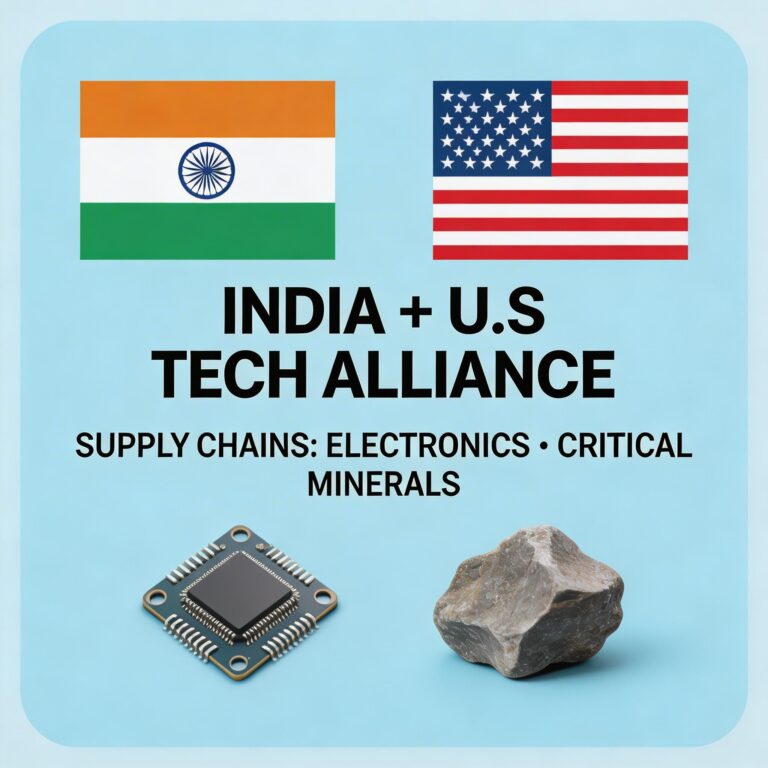
- Rare-earths corridor in mineral States to build mining-processing-manufacturing chain.
- Tax breaks for lithium-battery capital goods strengthen critical EV supply lines.
Labour Sector and MSME Boost
- New clusters, legacy upgrades, and capital access for MSMEs to lift productivity.
- Targets job-rich sectors for trade diversification, but needs scale/skills/infra support.
Investment and Fiscal Gaps
- Lacks bold incentives amid falling FDI/GDP; global climate deters multinational tech inflows.
- SEZ domestic sales allowance dilutes export focus, risking long-term trade weakness.
- Ignores Centre-State fiscal ties; pending 16th Finance Commission leaves investment coordination hanging.
Budget cautiously tackles industrial woes and import risks via tariffs/electronics/MSMEs, but success depends on execution, FDI revival, and federal alignment for true transformation.
7. Budget 2026 bets big on Industrial growth
GS paper III-Economy
Context :Union Budget 2026–27, unveiled amid India’s climb to 4th largest economy, high growth (10%+ nominal GDP), and global tariff risks, prioritises capex continuity and manufacturing revival.
Strong Economy Meets Hidden Risks
- High growth/low inflation phase boosts optimism, but geopolitical tensions and supply disruptions threaten sustained expansion.
- Budget balances continuity with vision, blending infra push, welfare tweaks, and realism against external shocks.
Capex Surge with Deficit Control
- Capex jumps to ₹12.2 lakh crore for FY27, driving infra-led growth continuity.
- Fiscal deficit targets 4.3% GDP, aligning with debt reduction path; assumes >10% nominal GDP growth.
- High borrowings limit RBI rate cuts, highlighting fiscal-monetary policy tightrope.
Manufacturing and Key Sector Drive
- Targets semiconductors, electronics, biopharma, chemicals, capital goods, textiles, and MSMEs for broad production base.
- India Semiconductor Mission 2.0, electronics boosts cut global supply chain reliance.
- Logistics/freight corridors, container focus, SME fund, and tariff-hit export aid enhance trade edge.
Policy Inconsistencies Exposed
- Disinvestment revenue targets overly optimistic despite past misses.
- Tax breaks for cloud providers via Indian data centres spark revenue loss concerns.
- Services job hopes clash with AI/automation trends reducing labour needs.
- Data centre push ignores matching power generation despite high energy demands.
- No rupee volatility fix despite macro risks.
Demand and Execution Weak Spots
- Lacks full industrial policy; risks fragmented manufacturing efforts.
- Minimal demand-side measures despite need for domestic income/jobs to fuel expansion.
- Capex execution shortfalls curb multipliers; price rises erode purchasing power.
- Global uncertainty demands stronger consumption support for resilience.
Conclusion
Budget advances infra/manufacturing stability but optimistic assumptions, contradictions, and demand gaps limit transformation. Success hinges on execution, demand revival, and policy alignment for inclusive growth.