1. India’s 2030 malaria elimination Goal
GS Paper II – Governance & Social Justice (Health)
GS Paper III – Environment & Biodiversity (Diseases and public health)
Context :Health Ministry’s “Malaria Elimination Technical Report, 2025” warns that India’s 2030 malaria elimination goal is threatened.
- Urban malaria driven by invasive mosquito Anopheles stephensi, especially in metros like Delhi, has become a national concern.
Background: India’s malaria elimination goal
- India aims to eliminate malaria by 2030, in line with WHO’s global strategy.
- Intermediate target: zero indigenous malaria cases by 2027.
New threat highlighted in the report
- Rapid spread of invasive malaria vector Anopheles stephensi in Indian cities.
- Risk of resurgence of malaria in urban and peri‑urban areas despite national decline.
Why Anopheles stephensi is a serious concern?
- Efficient vector for both Plasmodium falciparum and P. vivax.
- Adapted to urban environments, unlike traditional rural malaria vectors.
- Can undermine gains made through rural‑focused control programmes.
Breeding behaviour of Anopheles stephensi
- Breeds in artificial containers: overhead tanks, drums, tyres, construction water.
- Thrives in high‑density informal settlements with poor water management.
- Resistant to conventional rural vector‑control strategies focused on ponds and fields.
Disease transmission dynamics
- Capable of transmitting malaria year‑round in suitable urban climates.
- Container breeding enables survival during dry seasons, sustaining transmission.
- Co‑circulation of P. falciparum and P. vivax increases clinical burden.
Urban malaria: why cities are vulnerable
- High population density allows rapid spread from few infective bites.
- Construction sites, slums and migrant clusters create numerous breeding sites.
- Fragmented urban health services and weak city‑specific vector control.
Persistent high‑burden pockets in India
- Despite overall decline, high‑burden pockets remain in Odisha, Tripura, Mizoram.
- Tribal and forested areas still report intense transmission.
- Inconsistent private‑sector reporting and gaps in surveillance worsen under‑detection.
Cross‑border transmission challenges
- Movement of people across Myanmar and Bangladesh borders sustains transmission.
- Cross‑border malaria importation threatens northeast states’ progress.
- Requires coordinated surveillance and control with neighbouring countries.
Asymptomatic infections: a hidden problem
- Many infections are asymptomatic, especially in partially immune adults.
- Such carriers are not treated but continue to infect mosquitoes.
- Makes “zero indigenous cases” difficult without strong active surveillance.
Progress so far
- India has entered the “pre‑elimination” phase at national level.
- Operational research and strengthened surveillance identified new risks.
- Focus shifting from broad endemic areas to micro‑foci and vulnerable groups.
Decline in malaria burden
- Cases fell from about 11.7 lakh in 2015 to around 2.27 lakh in 2024.
- Deaths reduced by nearly 78% over the past decade.
- However, report stresses need to address urban malaria, invasive vectors, drug/insecticide resistance, and diagnostic gaps to stay on track for 2030.
Key challenges flagged by the report
- Invasive Anopheles stephensi driving urban malaria and changing vector dynamics.
- Inconsistent private‑sector reporting and limited entomological capacity.
- Drug and insecticide resistance and operational gaps in remote tribal/forest areas.
- Shortages of diagnostics and treatment commodities in some regions.
- Need for stronger surveillance, city‑specific vector control, and reliable supply chains.
2. hyper-polluting private transport
GS PAPER III-Environment and Ecology
Context :Th hyper-polluting private transport used by the super-rich has recently gained global attention due to:
- A surge in new studies and data showing that private jets, super-yachts, and space tourism generate extremely high carbon emissions per trip, far exceeding those of commercial or mass transport.
- Growing public anger and climate activism targeting the carbon-intensive lifestyles of billionaires, especially as ordinary citizens are asked to make sacrifices (like reducing car use or flying less) to meet climate goals.
- Political debates in several countries over whether luxury emissions should be taxed more heavily or regulated, with calls for “polluter pays” principles to apply even to the ultra-wealthy.
- Media spotlight on the expansion of private jet fleets and space tourism, highlighting how these activities undermine global climate commitments and deepen climate injustice.
What is hyper-polluting private transport?
Hyper-polluting private transport refers to luxury, high-emission vehicles and vessels used almost exclusively by the ultra-wealthy, including:
- Private jets (business jets, VIP airliners)
- Fossil-fuel-powered super-yachts and mega-yachts
- High-end, fuel-guzzling luxury SUVs and limousines
- Private rockets and space tourism flights
These modes of transport are not used for essential mobility but for convenience, status, and leisure, and they produce emissions far out of proportion to their utility.
Key characteristics
- Extremely high carbon intensity: A single private jet flight or a short super-yacht cruise can emit as much CO₂ as an average person’s entire annual carbon footprint. For example, a transatlantic private jet trip can emit several hundred tonnes of CO₂.
- Very low passenger efficiency: These vehicles carry very few people (often just 1–10) while burning massive amounts of fuel, making them among the least efficient forms of transport per passenger-kilometre.
- High idle and standby emissions: Private jets and yachts often run engines for long periods while parked (for air conditioning, power, etc.), adding to their emissions without moving.
- Rapid growth in use: As wealth concentrates at the top, the global fleet of private jets and super-yachts has grown sharply, especially in North America, Europe, and parts of Asia.
- Weak regulation and oversight: There are few or no emission caps, minimal mandatory reporting of emissions, and low or no taxes on fuel and operations for these luxury modes, especially in international waters or airspace.
Why it matters: Implications
- Climate injustice and equity concerns: A small elite’s luxury travel emits as much as entire populations in poorer countries, contradicting the principle that those who contribute most to climate change should bear the greatest responsibility for reducing emissions.
- Undermines climate policy credibility: When governments ask the public to adopt low-carbon lifestyles (e.g., using public transport, eating less meat), but allow unchecked emissions from the super-rich, it erodes public trust and willingness to act.
- Threat to climate targets: Emissions from luxury transport can offset climate gains made by broader society through renewable energy, energy efficiency, and sustainable consumption.
- Social and political tensions: Visible symbols of excess (private jets, yachts, space flights) fuel resentment and weaken social cohesion, making it harder to build broad-based support for climate action.
- Regulatory and fiscal challenge: There is growing pressure to close loopholes, introduce luxury carbon taxes, and bring private jets, yachts, and space tourism into national and international climate accounting and mitigation frameworks.
3. Child marriages Lead to poor outcomes in health, education ,poverty alleviation
GS Paper 1 – Indian Society -Issues related to women and children.
Context : India’s slow, uneven progress in ending child marriage by 2030 (SDG target).
- Marks one year of Bal Vivah Mukt Bharat Abhiyan, questioning gaps between law, schemes and ground reality.
Why child marriage is a serious issue
- Violates child rights and bodily autonomy.
- Traps girls in cycles of poverty, low education, and poor health.
- Undermines women’s participation in workforce and decision‑making.
Progress so far – declining but uneven trend
- NFHS: child marriage among women 20–24 fell from 47.4% (2005–06) to 23.3% (2019–21).
- Decline is uneven across States and social groups; poorest and least educated still worst affected.
High-burden States
- High rates among women 18–29 in West Bengal, Bihar, Tripura.
- Jharkhand, Andhra Pradesh, Assam, Telangana, Madhya Pradesh, Rajasthan also report high incidence.
Link between child marriage, poverty and education
- 40% of girls from lowest wealth quintile married before 18 vs 8% in highest quintile.
- 48% of girls with no education married before 18 vs 4% with higher education.
- Poverty and school dropout push families to marry girls early as a “burden‑reduction” strategy.
Legal framework and its limitations
- Prevention of Child Marriage Act, 2006 prohibits marriage below 18 (girls) and 21 (boys).
- NCB data show low reporting and conviction, indicating weak enforcement.
- POCSO Act’s stringent provisions criminalise adolescent consensual sex, deterring formal help.
- Fear of legal action pushes families to informal, unregistered, unsafe arrangements.
Health consequences of child marriage
- Early pregnancy increases maternal mortality, anaemia, obstetric complications.
- Higher risk of preterm birth, low birth weight and neonatal deaths.
- Greater exposure to domestic violence, depression and poor mental health.
Government initiatives and gaps
- Bal Vivah Mukt Bharat Abhiyan: 100‑day awareness campaign against child marriage.
- Beti Bachao Beti Padhao: promotes girl-child survival, protection and education.
- State schemes (e.g., conditional cash transfers for girls’ schooling) exist but impact is mixed.
- Implementation weak in remote, poor and socially marginalised communities.
Way forward – bridging policy and practice
- Strengthen enforcement with child‑friendly reporting and protection mechanisms.
- Tackle root causes: poverty, gender norms, and lack of quality schooling for girls.
- Expand safe hostels, clean toilets, and transport to keep girls in secondary school.
- Engage communities, religious leaders and men/boys to change social norms.
- Align health, education, women & child, and social protection programmes at district level.
4. Pradhan Mantri Gram Sadak Yojana (PMGSY)
context :PMGSY completed 25 years of operation in December 2025.
- Government highlighted its achievements in a recent PIB release.
- PMGSY Phase IV (2024–29) is now underway, drawing fresh attention.
- Anniversary has sparked discussions on rural connectivity and inclusive growth.
What is the 25th anniversary of PMGSY about?
- Marks 25 years of India’s flagship rural road scheme.
- Launched on 25 December 2000 to provide all-weather road connectivity.
- Celebrates the scheme’s role in linking villages to markets, schools, and health centres.
Key facts about PMGSY
- Launched on: 25 December 2000 (birth anniversary of Atal Bihari Vajpayee).
- Type: Centrally sponsored scheme.
- Implementing ministry: Ministry of Rural Development (MoRD), GoI.
- Core objective: All-weather road connectivity to unconnected rural habitations.
Phased evolution of PMGSY
- PMGSY Phase I (2000): Universal rural connectivity to unconnected habitations.
- PMGSY Phase II (2013): Upgradation and consolidation of existing rural road network.
- PMGSY Phase III (2019): Strengthening through routes and major rural links (about 1.25 lakh km).
- PMGSY Phase IV (2024–29): Connect 25,000 unconnected habitations via 62,500 km of roads.
Scale and progress (as of December 2025)
- Total sanctioned road length: Over 8.25 lakh km.
- Physical progress: Nearly 95% completed (about 7.87 lakh km constructed).
- Budget allocation (2025–26): ₹19,000 crore for rural road connectivity.
Key features and innovations
Technology-driven monitoring
- OMMAS for real-time tracking of physical and financial progress.
- e-MARG platform for monitoring road maintenance during 5-year Defect Liability Period.
- GPS-enabled VTS on construction vehicles and machinery.
- Geo-tagged photos and inspections uploaded via mobile apps.
Quality assurance
- Three-tier quality monitoring system:
- First tier: Executing agencies (contractors).
- Second tier: State Quality Monitors (SQMs).
- Third tier: National Quality Monitors (NQMs).
- Quality reports integrated into OMMAS for real-time oversight.
Sustainability and climate resilience
- Use of eco-friendly materials: waste plastic, fly ash, slag, C&D waste, bio-bitumen, etc.
- Climate-resilient techniques: raised embankments, improved drainage, etc.
- Over 1.24 lakh km of PMGSY roads built using sustainable technologies (as of mid-2025).
Significance and impact
Economic benefits
- Improves market access and farm-to-market linkages.
- Enables better price realisation for farmers.
- Boosts non-farm employment and rural entrepreneurship.
Social development
- Enhances access to schools and higher secondary education.
- Improves access to healthcare and emergency services.
- Supports better utilisation of welfare schemes.
Poverty reduction and inclusion
- Reduces isolation of remote and backward areas.
- Helps in poverty alleviation and inclusive growth.
- Connects LWE-affected and tribal areas through RCPLWEA.
Governance and transparency
- Digital platforms (OMMAS, e-MARG, VTS) ensure accountability.
- Reduces leakages and improves project management.
- Performance-based maintenance payments incentivise quality.
Way forward
- PMGSY Phase IV aims for near-universal last-mile connectivity by 2029.
- Focus on remaining unconnected habitations based on Census 2011 criteria.
- Emphasis on climate-resilient, sustainable, and tech-enabled rural roads.
- Strengthen maintenance regimes and integrate with schemes like PM GatiShakti.
5. UIDAI to expand full service Aadhaar centers to 473 by September
GS PAPER II-Polity and Governance
Why in News UIDAI to expand full-service Aadhaar centres from 88 to 473 by September 2026.
What is UIDAI and Aadhaar
- UIDAI: Unique Identification Authority of India, statutory body under Ministry of Electronics & IT.
- Aadhaar: 12-digit unique ID issued by UIDAI, based on biometric & demographic data.
The Announcement
- Increase full-service enrolment & update centres for adults from 88 to 473 by Sept 2026.
- Children can enrol at post offices; adults need dedicated centres for updates.
Why Expansion Needed
- Limited centres force adults to travel long distances across districts.
- Improves access for modifications, biometric updates & corrections.
- Addresses online limitations for major changes (name, biometrics, DOB).
Planned Coverage & Strategy
- At least one centre in every two districts.
- Focus on adult enrollees & updates.
- Integrate Google Maps for location visibility.
Use of Technology
- Google Maps integration to locate centres.
- Online updates for minor changes.
- Biometric verification for integrity.
Field Verification & Illegal Immigration Concerns
- Aadhaar issued only after district-level field verification in recent cases.
- Strict checks to prevent misuse by non-residents/foreign nationals.
Governance & Ethical Dimensions
- Restrict DOB changes to prevent falsification; criminal action for parents falsifying child’s DOB.
- Limit multiple DOB changes; affidavit required for clerical errors.
- Balance privacy, data integrity & accessibility.
Conclusion Expansion enhances Aadhaar access & integrity while addressing illegal immigration risks.
6. The Quiet, deserted meadows of Kashmir
GS paper II-Polity & Governance
CONTEXT : 48 of Kashmir Valley’s tourist destinations closed after April 22, 2025 Pahalgam terror attack; only 28 reopened by September 2025, severely impacting local livelihoods.
Key Developments
- Terror attack in Baisaran meadow (Pahalgam) on April 22, 2025 killed 26 people
- 48 high-altitude tourist spots (meadows, trekking areas) closed for security
- Only 28 reopened by Lt Governor Manoj Sinha in September 2025
- Doodhpathri (popular winter & summer destination) remains closed
Impact on Tourism & Economy
- Worst tourism season in recent years (2025)
- 80% families in many villages dependent on tourism
- Sharp drop in footfall → unpaid loans, distress sales of assets
- Locals took loans (₹5–60 lakh) expecting tourism boom
- Many shifted to labour, carpentry, walnut/corn selling
Livelihood Concerns
- Women started small businesses (tea stalls, corn roasting, handicrafts) during 2020–21 boom
- Now idle; anxiety over loan repayment
- High unemployment among youth
- Reduced hotel staff, retrenchment (up to 40–50%)
Security & Administrative Measures
- CRPF & J&K Police manning closed areas
- Clearance awaited from Lt Governor for remaining 20 destinations
- Audit underway for reopening under security guidelines
7. Nanobots may help deliver targeted treatment against cancer
GS PAPER III-Science and technology
Context :A breakthrough on magnetic nanobots for targeted cancer therapy by an IISc Bengaluru–led team has gained global attention.
- Dr Ambarish Ghosh of IISc won the 2025 New York Academy of Sciences–Tata Sons Transformation Prize for this work.
- The development highlights India’s growing role in advanced medical nanotechnology and targeted therapies.
What are nanobots?
- Nanobots (nanorobots) are microscopic machines, typically at the nanometre scale.
- They are designed to operate inside the human body for medical purposes.
- Main applications include targeted drug delivery, diagnosis, imaging, and therapy, especially in hard-to-reach areas like deep tumours.
How do IISc’s magnetic nanobots work?
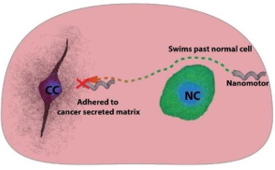
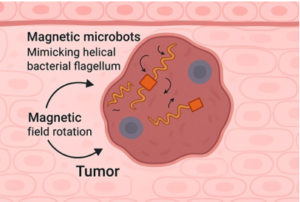
- They are helical, bacteria-inspired nanoswimmers that move like a corkscrew or propeller.
- A magnetic component (iron) allows them to be guided and steered precisely using external magnetic fields.
- They can travel through blood, dense tissue, and even enter cells under magnetic control.
- Drugs are coated on their surface or tip, enabling direct delivery to cancer cells.
- They can also generate localized heat (>42°C) under magnetic fields to kill cancer cells (magnetic hyperthermia).
Key features
- Targeted precision: Preferentially bind to cancer cells, reducing damage to healthy tissues.
- Deep tissue penetration: Can reach dense, poorly vascularised tumours that are hard to access with conventional methods.
- Multifunctionality: Can act as drug carriers, therapeutic agents, and imaging beacons (visible under MRI).
- Biocompatible materials: Made of silica and iron, materials already used safely in medical applications.
- Broad applicability: Shown effective against ovarian and breast cancer cells, bacteria, and dental infections; potential in dentistry and regenerative medicine.
Limitations and challenges
- Currently validated mainly on cell cultures and animal models; human clinical trials are still pending.
- Requires extensive safety testing and regulatory approvals before clinical use.
- Market adoption depends on scalable mass production, affordability, and acceptance by clinicians.