

1. The stark reality of educational costs in India
GS PAPER II -POLITY
Context :NSS 80th Round CMS (Education, 2025) has released fresh data on schooling and private coaching expenditure.
- Article 21A and RTE Act mandate free, compulsory education for 6–14 years, but households still bear heavy costs.
- NEP 2020 aims universalisation up to secondary level, highlighting mismatch between rights and real costs.
Enrolment trends: govt vs private
- Majority students still attend government schools, especially in rural India, but private share is high in urban areas.
- Government schools are cheapest option, while private unaided schools sit at top of the cost ladder in both rural and urban areas.
- Non‑government schools account for very high course‑fee payments compared to government schools.
Enrolment across stages & rising private share
- Government schools dominate enrolment at primary level, but private share rises sharply in urban pre‑primary and secondary stages.
- Over time, NSS data show steady growth of private (especially unaided) schools, reflecting parental search for quality and English‑medium.
- Rising private enrolment also reflects perception gaps about government school quality and status.
Cost of schooling: annual and monthly burden
- Average annual per‑student spend in government schools is around ₹2,800–₹2,900 in rural areas and about ₹4,400 in urban areas.
- In non‑government schools, average annual spending jumps to about ₹22,900 in rural and nearly ₹35,800 in urban areas.
- Converting to monthly terms, this creates a heavy recurring burden for low‑income households, often rivaling essential expenses.
Fees paid and other schooling expenses
- Only about one‑fourth of students in government schools report paying course fees, versus over 95% in non‑government schools.
- Across all schools, course fees form the largest head of spending, followed by textbooks, stationery, uniform and transport.
- Urban households consistently pay more on every component, deepening urban‑rural inequality.
Private coaching: incidence and cost
- Around one‑third of school students now take paid private coaching, with participation higher in urban than rural areas.
- Nationally, average annual coaching spend is about ₹1,800 in rural and nearly ₹4,000 in urban areas.
- Coaching costs rise with level: from roughly ₹500 at pre‑primary to over ₹6,300 at higher secondary, touching nearly ₹9,950 in urban higher secondary.
How education is becoming unaffordable
- Combined burden of school fees, ancillary costs and coaching pushes total annual outlay far beyond what poorer households can bear.
- For the poorest quintiles, education spending can approach or exceed their monthly per‑capita consumption, forcing cutbacks or drop‑outs.
- Rising private school and coaching dependence also widens gaps between rich, urban students and poorer, rural peers.
Government vs private: key contrasts
| Aspect | Government schools | Private (unaided) schools |
| Average annual spend per student | About ₹2,800 rural, ₹4,400 urban. | About ₹22,900 rural, ₹35,800 urban. |
| Share paying course fee | Around 27% students pay course fees. | Around 96% students pay course fees. |
| Coaching dependence | Lower, but rising at secondary levels. | Higher, as parents seek exam‑oriented support. |
| Affordability | Relatively affordable for poor households. | Often unaffordable for lower‑income families. |
Way forward: strengthening publicly funded schools
- Raise public spending on school education to improve infrastructure, teacher availability and learning outcomes.
- Ensure effective implementation of RTE norms, including free textbooks, uniforms and transport support for disadvantaged students.
- Invest in better classroom teaching to reduce coaching dependence, including remedial classes and subject‑wise support in government schools.
- Regulate private school and coaching fees, increase transparency, and expand scholarships or vouchers for poor students.
- Strengthen community oversight through SMCs and local bodies so that government schools become a high‑quality, no‑fee default option.
2. Playing to the gallery
GS paper II-Polity
CONTEXT : Karnataka’s Hate Speech and Hate Crimes (Prevention) Bill, 2025, sparks debate on balancing hate prevention with free speech rights. Tabled recently, it aims to penalize acts inciting disharmony but faces criticism for vagueness and overreach. This analysis covers its context, intent, concerns, and implications.
Why in News
- Bill tabled on December 10, 2025, in Karnataka Assembly’s Winter Session in Belagavi, drawing immediate scrutiny.
- Triggers national discourse on hate speech laws amid rising social media misuse and communal tensions in India.
- Opposition and civil society raise alarms over potential misuse, echoing global free speech debates.
Why Was the Bill Introduced?
- Responds to surge in hate speech targeting religion, caste, gender via public platforms, especially social media.
- Addresses Karnataka’s high incidence of misinformation-fueled prejudice leading to violence cycles.
- Builds on national laws like Bharatiya Nyaya Sanhita but seeks state-specific deterrence through harsh penalties.
Core Concern: Good Intentions, Bad Outcomes
- Pious aim to protect vulnerable groups from disharmony and violence sounds noble but risks unintended censorship.
- Vague definitions of “hate speech” as prejudicial speech causing enmity enable subjective enforcement.
- Past laws in other states show overbroad restrictions create more problems, like stifling legitimate dissent.
The Principle Stake at Free Speech in Democracy
- Free speech is democracy’s cornerstone, enabling critique of power and diverse viewpoints without fear.
- Controls must target imminent violence threats only, not broad prejudice, to avoid “slippery slope” to authoritarianism.
- Bill’s broad scope could grant impunity to authorities, undermining public discourse on social issues.
Why the Bill Is Seen as “Playing to the Gallery”
- Government appears tough on hate for political applause, ignoring flawed drafting that invites abuse.
- Non-bailable clauses and 10-year jail terms signal overreaction, prioritizing optics over balanced reform.
- Ignores evidence from Western cases where similar laws crack down on non-violent speech, eroding trust.
Overall Assessment
- Bill’s intent merits support but requires tighter definitions and safeguards to prevent chilling free expression.
- Karnataka must prioritize implementation guidelines over hasty passage for genuine societal harmony.
- Long-term success hinges on judicial oversight and public consultation to align with constitutional values.
3. What does supreme courts ruling on narco tests mean ?
GS paper II-POLITY
CONTEXT :Supreme Court ruling on June 9, 2025, reinforces protections against forced narco tests amid rising misuse in investigations.
- Highlights ongoing tension between investigative needs and constitutional rights in high-profile cases like dowry deaths.
- Sparks debate on balancing accused safeguards with victim justice in India’s criminal justice system.
What Triggered the Supreme Court Ruling?
- Patna High Court ordered involuntary narco test on accused in Amlesh Kumar dowry death case without consent.
- Accused challenged the order, arguing violation of self-incrimination and privacy rights.
- SC intervened via special leave petition to clarify limits on such tests post-Selvi v. State of Karnataka precedent.
What is a Narco Test?
- Investigative tool using sedatives like sodium pentothal to lower mental inhibitions and extract information.
- Administered intravenously, it induces semi-conscious state where subject may reveal hidden facts involuntarily.
- Often combined with polygraph or brain mapping for corroboration in serious crimes.
Why are Narco Tests Constitutionally Problematic?
- Violate Article 20(3) right against self-incrimination by compelling testimony without safeguards.
- Infringe Article 21 right to privacy and personal liberty through forced intrusion into mental state.
- Undermine fair trial principles by relying on unreliable, non-voluntary disclosures as evidence.
Balance Between Rights of Accused vs Victims
- Accused rights prioritize consent to prevent coerced confessions and ensure due process integrity.
- Victim interests served through alternative probes like witness testimonies or forensics, avoiding rights erosion.
- Fair balance achieved by voluntary tests only, upholding justice without compromising human dignity for either side.
Evidentiary Value of Narco Test Results
- Not admissible as standalone proof; must be corroborated by independent medical, legal evidence.
- SC holds results inconclusive due to potential false memories or suggestibility under sedation.
- Courts weigh test outcomes cautiously, treating them as investigative aid, not decisive fact-finder.
Can a Person Voluntarily Take a Narco Test?
- Yes, with informed consent after full disclosure of risks, procedures, and rights waiver.
- Requires video-recorded safeguards, psychological evaluation, and lawyer presence during process.
- Even voluntary, results inadmissible without external corroboration to prevent misuse.
Ethical Concerns
- Dehumanizes individuals by chemically overriding free will, akin to torture in ethical terms.
- Risks psychological harm, false confessions, or stigmatization from invasive mental probing.
- Contradicts Enlightenment principles of autonomy and dignity, prioritizing state power over personal integrity.
Why did SC Strike Down Patna High Court’s Order?
- Order lacked consent and procedural safeguards, rendering it unconstitutional per Selvi guidelines.
- Ignored mandate that narco tests cannot compel self-incriminating evidence without voluntariness.
- Emphasized privacy as paramount, quashing forced application to protect Golden Triangle rights (Articles 14, 19, 21).
4. Breeding project gives endangered western tragopan breathing space
GS PAPER III-Environment and Ecology
Context :Captive breeding success at Sarahan Pheasantry stabilizes Western Tragopan population, offering hope amid declining wild numbers.
- Recent reports highlight over 40 birds in captivity with consistent hatching of 6-8 eggs yearly, boosting conservation efforts.
- Experts warn long-term survival uncertain without habitat protection, as fewer than 9,500 individuals remain in the wild.
What Is the Western Tragopan?
- Vibrant pheasant species endemic to northwest Himalayas, known as Jujurana in Himachal Pradesh.
- Himachal’s state bird since 2007, found in high-altitude forests of Jammu & Kashmir, Himachal, Uttarakhand, and Pakistan.
- IUCN Vulnerable status with global population estimated at 3,000-9,500 mature individuals in fragmented pockets.
What Is Threatening the Western Tragopan?
- Habitat loss from human encroachment, fragmentation, and disturbance in temperate montane forests at 2,400-3,200m elevation.
- Climate change impacts seasonal breeding, food availability, and migration patterns, exacerbating decline.
- Low breeding success in wild due to stress, diseases, and limited suitable sites, with single subpopulation vulnerable to extinction.
Captive Breeding at Sarahan Pheasantry (Himachal Pradesh)
- World’s first dedicated centre established in 1993 by Himachal Forest Department, upgraded in 2003 with Central Zoo Authority funding.
- Achieved breakthrough in 2005 with four chicks hatched; now maintains over 40 birds through refined husbandry protocols.
- Annual output: 6-8 eggs hatched, 4-5 chicks survive, focusing on stress reduction and wild-mimicking enclosures.
Ex-situ vs In-situ: The Conservation Debate
- Ex-situ (captive) builds insurance population but risks inbreeding and fails to address wild habitat loss directly.
- In-situ protects natural forests like Great Himalayan National Park, preserving ecosystem but challenged by funding shortages.
- Experts advocate hybrid: Use captive stocks for reintroduction while enhancing in-situ safeguards against encroachment.
Reintroduction Attempts: Success and Challenges
- First global soft-release in 2020-2021 at Daranghati Sanctuary; experimental results viable but full integration delayed.
- Birds GPS-tagged for monitoring; survival rates promising yet bottlenecked by funding cuts and site assessments.
- Challenges include climate variability, predator threats, and need for community buy-in; long-term success demands wider habitat restoration.
5. Indus Valley Civilization’s Downfall
GS PAPER I-Modern history
Why in news :Indus Valley Civilisation’s Downfall
The Indus Valley Civilisation (IVC), or Harappan Civilisation (3300–1300 BCE), thrived across modern-day Pakistan and northwest India along the Indus and Ghaggar-Hakra rivers. Renowned for urban innovation, it featured gridded cities like Harappa, Mohenjo-
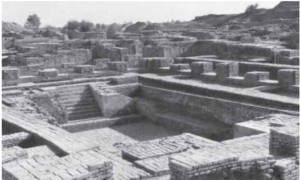
Daro, Rakhigarhi, and Dholavira. A 2025 paleoclimate study in Communications Earth & Environment reveals its decline stemmed from repeated mega-droughts over centuries, not one disaster, blending climate data, cave stalagmites, lake sediments, and models.
Key Achievements of IVC
IVC showcased Bronze Age excellence in multiple domains.
Artistic and Craft Excellence
- Mastered beadwork, pottery, terracotta figures, and bronze items like the “Dancing Girl” and “Priest-King” statues.
- Produced shell, copper, and bronze artifacts reflecting skilled artisanship.
Advanced City Design and Infrastructure
- Laid out grid streets, multi-story brick homes, citadels, granaries, and cutting-edge drainage with covered sewers and soak pits.
- Exemplified early urban planning with uniform standards.
Writing and Symbolic Systems
- Employed an undeciphered pictographic script on seals, tablets, and pottery shards.
- Lacked lengthy texts but displayed complex symbols hinting at administrative use.
Robust Economic Foundations
- Relied on farming wheat, barley, and cotton, plus crafts, local trade, and exports to Mesopotamia, Oman, and Iran via seals, weights, and boat motifs.
- Built a surplus-driven economy supporting urban life.
Social Structure and Leadership
- Featured standardized measures, consistent building styles, and orderly layouts suggesting strong civic oversight.
- Appeared peaceful and equitable with minimal hierarchy or conflict markers.
Triggers of IVC’s Gradual Collapse
Recent research pinpoints climate as the core driver, amplified by cascading effects.
2025 Study’s Climate Insights
- Four extended droughts (over 85 years each) from 2425–1400 BCE, with a peak 164-year event around 1733 BCE.
- Triggered by tropical Pacific warming, shifting from La Niña-like wet phases (3000–2475 BCE) to El Niño-like dry spells, cutting monsoon rain by 10–20% and raising temperatures 0.5°C.
Water System Disruptions
- Rivers like Sutlej, Beas, and Ghaggar-Hakra shrank; lakes and soils dried, boosting salinity.
- Hampered irrigation, crop growth, and river-based travel.
Agricultural and Food Shifts
- Failed harvests of wheat and barley pushed adoption of hardy millets.
- Eroded food surpluses, undermining city sustenance.
Trade and Economic Disruptions
- Low rivers blocked navigation to Mesopotamia, slashing exports of beads, textiles, and metals.
- Overland paths grew unreliable amid drier landscapes, hitting craft sectors hard.
Traditional Explanations Revisited
Beyond climate, other factors contributed without single-cause dominance.
River Course Alterations
- Tectonic shifts dried Ghaggar-Hakra, forcing exits from sites like Kalibangan and Banawali.
- Indus floods silted fields before diverting away from settlements.
Mesopotamian Market Failure
- Circa 2000 BCE turmoil in Akkad and Ur III reduced demand for Harappan goods.
- Trade loss crippled urban industries.
Urban Strain and Decay
- Overcrowding led to street infilling and clogged drains.
- Key structures like the Great Bath fell into disuse, signaling governance lapse.
Ruling Out Violence
- No mass burials, fire damage, or weapons support “Aryan invasion” claims from Rig Veda interpretations.
- Evidence favors internal decline over conquest.
Enduring Legacy and Modern Relevance
IVC pioneered planned cities, sanitation, hydrology, crafts, sea trade, and adaptive farming. Its two-millennia endurance amid stresses highlights resilience through crop shifts, diversified commerce, and moves to reliable water like Indus tributaries.
6. planetary-defense exercise on 3I/ATLAS
GS PAPER I-GEOGRAPHY
context :The planetary-defense exercise on 3I/ATLAS gained prominence in July 2025 amid heightened global focus on near-Earth object (NEO) threats. As the third confirmed interstellar object (following ‘Oumuamua and Borisov), 3I/ATLAS’s high velocity (~60 km/s) and uncertain trajectory prompted this unprecedented drill. Launched by ESA, it tests Earth’s preparedness just as space agencies like NASA, ISRO, and others ramp up NEO monitoring amid rising geopolitical tensions in space security, including U.S.-China-India rivalries and ESA’s expanded budget.
Overview of the Exercise
This marks the world’s largest simulation to assess detection, tracking, and response to potential NEO impacts. Led by ESA, NASA, and the UN’s International Asteroid Warning Network (IAWN), it evaluates readiness against high-speed interstellar visitors like 3I/ATLAS.
Core Objectives
- Gauge effectiveness of early-warning systems, tracking networks, emergency protocols, and public messaging.
- Uncover deficiencies in global collaboration, data exchange, and societal resilience to space threats.
Operational Mechanics
- Continuous Monitoring: Ground and space telescopes track the object’s position, velocity, and luminosity, updating orbital predictions live.
- Trajectory Assessment: Model subtle shifts from gravitational or solar influences to flag risks to Earth’s path.
- Risk Modeling: Run extensive simulations across uncertainty levels to predict impact odds or safe passage.
- Response Drills: Test deflection strategies, civil defense activations, and evacuation plans under time constraints.
- Cross-Agency Sync: Measure data-sharing speed and decision-making among NASA, ESA, ISRO, CNSA, JAXA, and UN-IAWN.
Standout Elements
- Leverages a genuine high-speed object for authentic complexity in modeling, predictions, and anomaly handling.
- Incorporates public outreach to combat misinformation and build psychological resilience.
- Engages defense space units alongside civilian agencies.
- Aligns with broader space geopolitics, including ESA’s funding surge and militarization trends.
Broader Impact
The exercise bolsters planetary defenses against escalating asteroid risks while highlighting gaps, such as the lack of unified global alerts for space events—critical for UPSC topics like environment, science & tech, and international relations.
7. UNEP Champions of the Earth 2025 Award
CONTEXT :Supriya Sahu, Additional Chief Secretary of Tamil Nadu, received the UNEP Champions of the Earth 2025 Award in the Inspiration and Action category for advancing heat resilience, nature-based solutions, and sustainable cooling in India.
Award Overview
UNEP’s Champions of the Earth, launched in 2005, represents the United Nations’ top environmental accolade, honoring 127 laureates like leaders, scientists, and activists for bold environmental efforts.
It spans four categories—Policy Leadership, Inspiration and Action, Entrepreneurial Vision, and Science & Innovation—emphasizing scalable fixes for climate justice, resilient infrastructure, methane cuts, cooling tech, and forests.
2025 Laureates
- Pacific Islands Students Fighting Climate Change (Policy Leadership): Youth group that won an ICJ opinion on states’ climate duties and rights protection.
- Supriya Sahu (India, Inspiration and Action): Drove Tamil Nadu’s heat plans, green jobs for 2.5 million, forest growth, and aid for 12 million residents.
- Mariam Issoufou (Niger/France, Entrepreneurial Vision): Designs passive cooling buildings slashing indoor heat by 10°C sans air conditioning.
- Imazon (Brazil, Science and Innovation): Applies AI geospatial tech to fight Amazon illegal logging and boost oversight.
- Manfredi Caltagirone (Posthumous, Lifetime Achievement): Pioneered methane emissions tracking via UNEP’s observatory.
Spotlight in News
This award highlights India’s rising global role in climate adaptation amid 2025’s heatwaves and UNEP’s SDG push, spotlighting Tamil Nadu’s model for UPSC topics like environment policies and disaster resilience.