

1. INDIA -RUSSIA -S-500 Acuisistion on agenda
GS paper II-IR
GS paper III-Science and technology
CONTEXT :India’s Defence Minister Rajnath Singh will meet Russian Defence Minister Andrey Belousov in New Delhi on 4 December 2025 during President Putin’s state visit.
- Core agenda: clear delays in S‑400 deliveries, examine additional S‑400 units, and hold first structured discussions on possible future S‑500 acquisition.
- The meeting will also review wider defence‑industrial cooperation, including shipbuilding, joint weapons development, border defence projects and high‑technology collaboration.
Air defence system – S‑400
- India signed a 2018 contract for five S‑400 Triumf squadrons to strengthen long‑range air and missile defence.
- Three S‑400 units have been inducted since 2021 and deployed to protect key sectors of Indian airspace.
- Russia has assured delivery of the remaining two units by around 2025–26, and both sides will use the talks to keep this schedule on track.
- India is also buying large stocks of S‑400 interceptor missiles of multiple ranges (roughly 120–380 km) to create layered defence over critical and border infrastructure.
Air defence system – S‑500
- The S‑500 “Prometey” is Russia’s next‑generation long‑range air and missile defence system, meant to tackle aircraft, cruise and ballistic missiles and some hypersonic threats up to about 600 km.
- Russia is expected to pitch S‑500 technology to India; India’s priority is to complete S‑400 induction and then see how S‑500 can fit into long‑term architecture.
- Any Indian S‑500 deal is a medium‑ to long‑term possibility, as the system itself is still being absorbed into Russian forces and needs major technological and financial investment.
Border defence and cooperation areas
- Talks will cover deployment of S‑400 along sensitive fronts and its integration with indigenous systems like Akash and ballistic‑missile‑defence projects for better cover against Pakistan and China.
- India and Russia will also explore joint shipbuilding, submarines, advanced weapons co‑development, and stronger maintenance‑repair facilities in India near operational theatres.
- Cooperation in surveillance, early‑warning radars and possibly space‑based / over‑the‑horizon sensors aims to sharpen border domain awareness and shorten response time to intrusions.
Background of the S‑400 deal
- The S‑400 contract (value over USD 5 billion) was signed in 2018 despite US sanctions risk, signalling India’s priority for robust long‑range air defence.
- Deliveries from 2021 made three units operational, significantly boosting deterrence against hostile air and missile attacks.
- Delays in remaining units arose from Russia’s own wartime requirements and sanctions, leading India to push for firm timelines and local MRO (maintenance, repair, overhaul) support.
Mission Sudarshan Chakra
- Mission Sudarshan Chakra is a proposed national programme to build an “impenetrable” multi‑layered air and missile defence shield around key military, industrial and governmental assets.
- The idea, compared to Lord Vishnu’s Sudarshan Chakra, has been outlined as a decade‑long effort to modernise India’s security architecture against increasingly complex aerial threats.
Key features of Mission Sudarshan Chakra
- Multi‑layered shield: Overlapping long‑, medium‑ and short‑range interceptors against aircraft, drones, cruise and ballistic missiles, and loitering munitions.
- Integrated sensors: Network of early‑warning satellites, long‑range radars, aerostats and ground sensors for continuous tracking and high‑accuracy targeting.
- Kinetic and non‑kinetic mix: Interceptor missiles (including indigenous BMD such as Project “Kusha”), anti‑drone systems, electronic warfare and future directed‑energy weapons.
Purpose and role in India’s defence
- Main aim is a protective “wall” around assets like Delhi‑NCR, command‑and‑control centres, nuclear sites, major airbases, naval hubs and critical industrial corridors.
- The mission seeks to integrate current assets (S‑400, BMD, Akash, QRSAM, anti‑drone systems) with future systems (S‑500, Kusha interceptors) into one network‑centric grid.
- Mobile elements are planned to shield Army strike corps and forward formations, enhancing survivability in high‑intensity border conflicts.
Strategic importance
- Creates strong deterrence by making quick, low‑cost aerial or missile strikes on Indian strategic and border targets far more difficult.
- Supports Atmanirbhar Bharat by combining foreign platforms like S‑400/S‑500 with an expanding indigenous air‑defence ecosystem.
- Strengthens India’s strategic autonomy and bargaining power, as credible air and missile defence underpins both nuclear and conventional deterrence.
2. Operation sagar Bandhu
GS PAPER III-Science and technology
Context :Severe Cyclone Ditwah battered Sri Lanka, creating an urgent need for external relief support.
- India announced Operation Sagar Bandhu and delivered the first tranche of relief material to Sri Lanka, signalling readiness to scale up assistance.
What is Operation Sagar Bandhu?
- A humanitarian assistance and disaster relief (HADR) mission by India to support Sri Lanka after Cyclone Ditwah.
- Part of the broader “SAGAR” (Security and Growth for All in the Region) approach, with “Bandhu” highlighting India as a friendly, first‑responder partner.
How India’s aid was delivered
- Relief cargo (tents, medicines, food, emergency supplies) was transported by Indian Navy platforms to Colombo.
- Supplies were ceremonially handed over to Sri Lankan authorities, with a commitment of additional consignments as needed.
Naval deployment: INS Vikrant
- INS Vikrant, India’s first indigenous aircraft carrier, carried relief stores and participated in events in Sri Lanka.
- Its presence showcases India’s blue‑water capability and ability to use high‑end combat platforms for humanitarian missions.
Naval deployment: INS Udaygiri
- INS Udaygiri, a latest‑generation indigenous stealth frigate, accompanied Vikrant and supported relief and outreach activities.
- The ship also joined the International Fleet Review, underlining defence cooperation with Sri Lanka and regional navies.
India’s diplomatic messaging
- India framed the operation under Neighbourhood First and SAGAR—standing “firmly with Sri Lanka in its hour of need”.
- The mission signals that India is a reliable first responder and long‑term development partner in the Indian Ocean, not just a crisis‑time donor.
What is Vision MAHASAGAR?
- MAHASAGAR stands for Mutual and Holistic Advancement for Security and Growth Across Regions.
- Announced by the Prime Minister as a framework for India’s global maritime engagement, extending SAGAR beyond the immediate neighbourhood.
India’s larger policy framework
- Neighbourhood First: Prioritising South Asian partners (like Sri Lanka) for rapid humanitarian, economic and security support.
- SAGAR + MAHASAGAR: Ensuring collective security, resilient supply chains, and sustainable development across the wider Indo‑Pacific and beyond.
India’s pattern of maritime relief missions
- India has repeatedly used the Navy as a first responder:
- Tsunami 2004 (Sri Lanka, Maldives, Indonesia).
- Operation Neer (water crisis in Maldives), Sagar series (COVID‑era and cyclone aid to IOR states), Operation Samudra Setu (repatriation during COVID).
- Operation Sagar Bandhu continues this pattern of “HADR diplomacy”—projecting power through relief, not coercion, and strengthening goodwill in the Indian Ocean.
3. Delay in getting syntactic foam hits Samudra Yaan
GS paper III-Science and technology
Context :Tests in the Samudrayaan project have been delayed due to late arrival of imported syntactic foam needed for the test submersible.
- This has pushed back the planned sequence of trial dives from 100 m to 500 m and eventually 6,000 m depth by several months.
What is Samudrayaan?
- Flagship mission under India’s Deep Ocean Mission to send a human‑occupied submersible to about 6,000 m depth in the Indian Ocean.
- Uses the MATSYA‑6000 submersible with a 3‑person titanium sphere to study deep‑sea minerals, ecosystems and geological processes.
Why delay? – Role of syntactic foam
- Syntactic foam is a special buoyant composite (hollow microspheres in resin) that lets the heavy submersible float while withstanding deep‑sea pressure.
- The foam for the test vehicle is being manufactured and qualified in Europe; delays in fabrication and testing have postponed its shipment to India.
- Without this foam fitted, the steel test submersible cannot safely attempt the 500 m trial, so higher‑depth trials also get delayed.
Current status – foam and testing
- Foam for the steel test hull is undergoing final qualification abroad and is expected to be delivered around the end of the year.
- Similar syntactic foam will later be produced and bonded to the final titanium hull to ensure buoyancy and stability at 6,000 m.
- ISRO is fabricating two titanium pressure spheres; once foam is ready, a sphere will be mated with it and sent for deep‑pressure tests overseas.
Testing stages of Samudrayaan
- Stage 1: Harbour and shallow‑water “wet tests” of MATSYA‑6000; initial manned and unmanned dives at port facilities have been completed.
- Stage 2: 100 m sea trial of the steel test submersible with syntactic foam to validate basic buoyancy and control systems.
- Stage 3: 500 m demonstration dive of the same test vehicle to qualify structure, life‑support and communication systems.
- Stage 4: Progressive deep‑sea trials of full MATSYA‑6000 with titanium hull, moving towards 6,000 m crewed dives.
Mission timeline (original vs revised)
| Stage / activity | Original target | Updated / likely timeline* |
| 100 m steel test submersible trial | Late 2023–early 2024 | After foam delivery, late 2025–early 2026 |
| 500 m steel test submersible trial | Early–mid 2024 | Around late 2025–early 2026 |
| Foam completion for titanium hull | Around mid‑2024 | Around end‑2025 |
| Full MATSYA‑6000 assembly and lab tests | Late 2024 | Mid–late 2026 (indicative) |
| First crewed deep‑sea dive (towards 6,000 m) | Around 2025 | Likely 2027 or later (post 500 m demo) |
(*Timelines are indicative and depend on foam delivery and success of each test stage.)
Final titanium hull
- The titanium hull is the permanent 3‑person pressure sphere designed for 6,000 m depth, where pressure is about 600 times atmospheric.
- After syntactic foam for this hull is manufactured and qualified, it will be bonded around the hull, which then undergoes hyperbaric pressure tests abroad.
- Only after passing these tests can full‑scale sea trials and eventual manned deep‑sea dives be cleared.
Why Samudrayaan matters for India
- Deep‑sea resources: Enables mapping and sampling of polymetallic nodules and other minerals in India’s exploration areas in the Central Indian Ocean Basin.
- Science and technology: Builds capability in extreme‑pressure materials, crewed submersibles, life‑support systems and underwater robotics.
- Strategic presence: Strengthens India’s role in deep‑ocean research and maritime domain awareness in the Indian Ocean Region.
- Innovation ecosystem: Drives collaboration among NIOT, ISRO, industry and academia, supporting Atmanirbhar Bharat in ocean engineering technologies.
4. Indias disasters response ,a slippery slope federalism
General Studies Paper III: Disaster and Disaster Management.
CONTEXT :July 30, 2024 Wayanad landslides became one of Kerala’s deadliest disasters, killing over 250 people and displacing thousands.
- The event exposed tensions in Centre–state relations and revived debate on disaster funding before the 16th Finance Commission.
What is the issue?
- States bear most response costs, but central assistance is delayed, discretionary and often inadequate.
- In Wayanad, Kerala sought about ₹1,300 crore against losses of ~₹2,200 crore, but received only around ₹211 crore from NDRF.
Why this matters
- Climate‑driven disasters are frequent “stress tests” on federalism and state finances.
- Under‑funding pushes states into debt, slows recovery, deepens poverty and erodes trust in cooperative federalism.
How India’s disaster funding works
- SDRF: Main state‑level fund; shared 75:25 (90:10 for NE/Himalayan states) and mostly for immediate relief.
- NDRF: Fully central fund that supplements SDRF for “severe” disasters once state funds are exhausted.
- Finance Commission: Fixes SDRF/NDRF corpus and norms; 15th FC also created SDMF for mitigation and preparedness.
Four major problems
- Gap between assessed needs and actual releases due to rigid norms and low unit costs.
- Vague criteria for “severe” disasters, allowing wide central discretion.
- Lengthy procedures and approvals, keeping focus on compliance rather than speed.
- Allocation formulas that underweight real‑time climate risk and constrain state autonomy.
Wayanad case: what it shows
- Extreme rainfall and landslides destroyed villages like Mundakkai and Chooralmala, with heavy loss of life and livelihoods.
- Kerala’s SDRF use and later NDRF grant together fell far short of estimated recovery needs.
- Delayed classification and procedural rigidity slowed central aid, fuelling Centre–state political friction.
Global best practices – key lessons
- Use objective, data‑based triggers (rainfall, wind, deaths, loss‑to‑GSDP ratios) for automatic payouts.
- Combine budgetary funds with parametric insurance and regional risk pools for rapid liquidity.
- Emphasise post‑audit accountability instead of heavy prior approvals.
What India should do
- Legally define “severe” disasters using measurable indicators and automatic NDRF triggers.
- Broaden SDRF/SDMF to cover early recovery and livelihood support, not only relief.
- Streamline procedures, giving states advance credit lines and time‑bound central decisions.
- Integrate satellite, weather and damage data and explore catastrophe bonds/insurance.
- Ask the 16th Finance Commission to weight climate vulnerability and equity more strongly.
Federalism angle
- Disasters highlight India’s “quasi‑federal” tilt, where states handle ground response but depend financially on the Union.
- If funding remains slow and politicised, crises may fuel confrontational rather than cooperative federalism.
- A rebalanced framework—states leading spending, Centre ensuring fair resources and standards—is vital for resilience and unity.
5. Are the labour laws friendly ?
GS paper II-POLITY
Context :The four labour codes have been notified for implementation (replacing 29 laws), reigniting debate between trade unions, industry and government.
- The 16th Finance Commission and ongoing economic slowdown make their impact on jobs, social security and federal fiscal relations especially salient.
- India’s labour market is modernising rapidly but remains dominated by informal, insecure work.
- The new labour codes seek to simplify regulation, boost ease of doing business and widen social protection, but have triggered sharp institutional disagreements.
Historical background of labour reform
- Legacy framework: Earlier laws, mostly from the 1940s–50s, created fragmented, overlapping and inspector‑heavy regulation.
- Changing world of work: Growth of gig, platform, logistics and contract work made old factory‑centric laws inadequate.
- Productivity push: Industry demanded simpler rules to cut rigidities and compete globally while retaining core protections.
Why were labour codes needed?
- Regulatory clutter: Multiple central and state laws with differing definitions increased compliance cost and litigation.
- Economic transition: Expansion of e‑commerce, services and start‑ups required clearer norms on contracts, hours and exits.
- Social security gaps: Only a small minority of workers had access to provident fund, insurance or pensions.
- Investment climate: Complex retrenchment and closure rules were seen as dampening formal investment and scale.
Do the codes dilute or protect worker rights?
- Union concerns: Fixed‑term contracts, higher retrenchment thresholds and a single “negotiating union” are seen as weakening job security and bargaining power.
- Collective voice: Smaller unions fear marginalisation when only one union is recognised for negotiations.
- Industry view: Clearer, consolidated rules reduce disputes, encourage formal hiring and lower compliance uncertainty.
- Protection gains: Wider minimum‑wage coverage, mandatory appointment letters and stronger OSH provisions broaden basic rights.
Social security and gig workers
- Expanded coverage: Gig and platform workers are now recognised for social security schemes, at least in principle.
- Financing debate: Disagreement persists over relative contributions of government, platforms and workers.
- Rising segment: Gig work is still a minority of employment but is growing fast, making timely scheme design critical.
Industrial relations and productivity
- Stability argument: Unified codes, simpler compliance and quicker dispute‑resolution mechanisms are expected to lower conflict and boost productivity.
- Unrest risk: If workers perceive net loss of security or voice, strikes and adversarial relations may increase.
- Policy trade‑off: The central challenge is balancing flexibility for firms with credible protections and grievance mechanisms.
Impact on organised employment
- Formalisation hope: Broader definitions of wages and employees, single registration and national floor wage may pull more workers into the formal net.
- Precarity fear: Unions warn that, without strong safeguards, firms may rely more on fixed‑term and contract labour.
Conclusion
- The labour codes are a far‑reaching attempt to modernise India’s labour regime and attract investment while expanding protections.
- Their real impact will depend on how states frame rules, how transparently they are implemented, and whether continuous dialogue with unions and employers can deliver a balance between flexibility and security
6. Hawfinch Sighting in Jim Corbett National Park
GS PAPER III-Environment and Ecology
CONTEXT :A Hawfinch (Coccothraustes coccothraustes), usually found in Europe, North Africa and temperate Asia, was photographed on 23 November in the Dhela zone of Jim Corbett National Park, Uttarakhand.
- The observation is treated as a rare “vagrant” sighting, as the bird has appeared far outside its normal distribution range.
Key features of Hawfinch
- Family: Fringillidae (true finches).
- Size and wingspan: About 18 cm long with a wingspan of roughly 29–33 cm.
- Distinctive bill: Very strong, heavy, conical beak capable of cracking very hard seeds and nuts.
- Plumage: Male and female look similar; the male is generally slightly richer and darker in tone.
Normal geographic range
- Core distribution: Woodlands and orchards across most of Europe and parts of North Africa.
- Asian range: Temperate regions of Asia, including countries such as Mongolia and Kazakhstan.
- Outside India: The species is not naturally part of India’s regular resident or wintering avifauna.
Status and records in the Indian subcontinent
- The Corbett record is categorised as a vagrant occurrence—an accidental visit beyond the species’ usual range.
- Historically, only two earlier records are noted from the region: one near Muzaffarabad (1908) and another from Aliabad (2017), both in the PoK area.
- The Corbett observation is therefore among a tiny number of confirmed Hawfinch sightings in the subcontinent.
conclusion
- The recent Hawfinch sighting in Jim Corbett is a highly unusual, scientifically valuable record of a Eurasian finch straying into India.
- Such rare vagrant events highlight both the exceptional bird diversity of Corbett and how long‑distance movements, weather patterns or migration errors can occasionally bring non‑native species into Indian habitats.
7. Mekedatu Rservoir project
GS paper II -POLITY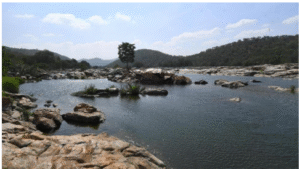
CONTEXT Karnataka has decided to send a revised Detailed Project Report (DPR) for the Mekedatu balancing reservoir across the Cauvery.
- The Supreme Court has called Tamil Nadu’s challenge “premature”, allowing expert bodies to examine Karnataka’s proposal.
Site and riparian position
- Mekedatu lies in Ramanagara district, about 100 km south of Bengaluru.
- The dam is planned on the inter‑State Cauvery River, with Karnataka as upper riparian and Tamil Nadu as lower riparian.
Karnataka’s rationale for the project
- Bengaluru’s water gap: Demand about 2,600 MLD versus supply of roughly 2,100 MLD, leaving a 500 MLD shortfall.
- Future stress: With population expected to near 20 million, demand could rise to around 4,000 MLD in six years.
- Regulation claim: Karnataka argues Mekedatu will store water and enable more regulated releases to Tamil Nadu, even in weak monsoons.
Tamil Nadu’s objections
- Historical trust deficit: Long Cauvery disputes create fear that Karnataka may withhold or time releases.
- Award and judgment concerns: Tamil Nadu says the project violates the 2018 SC verdict and Cauvery Tribunal award by altering agreed flows.
- Control over flows: Worry that additional storage lets the upper riparian retain more water before it reaches Tamil Nadu.
Union government and expert‑body role
- 2019: Karnataka’s DPR went to the Central Water Commission (CWC) and Cauvery Water Management Authority (CWMA).
- Environment ministry view: Called for an “amicable solution” since the river is inter‑State.
- 2024: CWMA sent the DPR back to CWC after discussions; now it will be re‑examined with a revised DPR, with CWMA/CWC mediating inter‑State dialogue.