
1. INS Mahe
GS PAPER III-Science and technology
Context: INS Mahe, India’s first Mahe-class anti-submarine warfare (ASW) shallow watercraft, was commissioned on November 24, 2025 at the Naval Dockyard Mumbai by Army Chief General Upendra Dwivedi, marking a significant step in indigenous naval defence.
What are INS Mahe?
- INS Mahe is a newly commissioned anti-submarine warfare vessel designed specifically for operations in shallow coastal waters.
- It is the lead ship of a class of eight vessels, built primarily by Cochin Shipyard Limited.
Indigenisation
- The vessel comprises over 80% indigenous components, reflecting India’s strong effort towards self-reliance in defence manufacturing.
- Its design, construction, and complex combat technology showcase advanced Indian shipbuilding capabilities.
Role in Coastal Defence
- INS Mahe is tasked with detecting, tracking, and neutralizing submarine threats close to India’s coasts and in littoral zones.
- It strengthens India’s near-sea dominance by safeguarding the coastal security grid and strategic maritime interests.
Why is INS Mahe Important?
- Enhances maritime security through advanced anti-submarine measures.
- Integrates with other surface and sub-surface vessels, supporting layered coastal defence.
- Demonstrates India’s ability to field technologically sophisticated warships with indigenous solutions.
Significance of Army Chief’s Commissioning
- For the first time, the Chief of Army Staff presided over a naval warship commissioning, symbolising jointness and synergy among Army, Navy, and Air Force as the “trinity” of India’s strategic strength.
- Army Chief’s presence highlights unified national defence priorities and inter-service collaboration.
Relationship to Operation Sindoor
- The commissioning highlighted seamless harmony and coordination seen during Operation Sindoor, which showcased integrated operations between services in support of national security.
Technical Features of INS Mahe
- Compact, potent weapon and sensor suite designed for anti-submarine warfare in shallow waters.
- Advanced communication and surveillance systems enable detection, tracking, and neutralisation of submarine threats.
- Capable of sustained operations in challenging marine environments, featuring prolonged endurance and tactical versatility.
INS Mahe serves as a symbol of India’s growing indigenous defence capabilities, strengthens coastal protection, and exemplifies inter-service coordination in national strategic planning.
2. ISRO to review status of Chandryaan -5 /LuPEX mission
GS paper III-science and technology
Context: A Japanese delegation visited ISRO to review the status of the Chandrayaan-5/LuPEX lunar mission and discussed future opportunities for Indo-Japanese space cooperation.
- The delegation included senior officials like Japan’s Cabinet Committee Vice-Chair Saku Tsuneta, who met ISRO Chairman V. Narayanan on November 21, 2025.
What is LuPEX and Chandrayaan-5?
- LuPEX (Lunar Polar Exploration) is a joint ISRO-JAXA mission to the lunar South Pole, aiming to land a rover to study volatile materials like lunar water in permanently shadowed regions.
- Chandrayaan-5 will be India’s fifth moon mission and is likely to enable lunar sample return, serving as a precursor for future sample missions.
Scientific Objectives
- Study presence of water ice and other volatiles in the lunar South Pole’s shadowed areas.
- Gather data critical for future lunar habitability and deeper space exploration.
- Provide new information on resources for use in future space missions.
Contribution of Each Country
India (ISRO)
- Responsible for developing the lunar lander which will deliver the rover to the moon’s surface.
- Creating scientific instruments for the mission.
Japan (JAXA)
- Provides the launch vehicle (H3-24L) and the MHI lunar rover with advanced payloads designed to operate in harsh lunar environments.
Strategic Importance for India
- Enhances India’s profile in global lunar exploration and space technology development.
- Furthers India’s goals for lunar sample return, targeted for 2040, reinforcing its status among top spacefaring nations.
- Promotes technology transfer, innovation, and international partnerships.
Scientific Significance
- Investigates critical lunar resources necessary for future human presence on the Moon.
- Advances the understanding of lunar geology and polar environment.
Technological Collaboration
- Joint development in areas like pressurised lunar rovers, advanced robotics, and payload instrumentation for harsh extraterrestrial settings.
- Strengthens shared capabilities for long-duration lunar operations.
Additional Areas for Indo-Japan Space Cooperation
- Robotic arms for space stations.
- Launching of scientific satellites.
- Supporting bilateral research and private sector collaboration in space technology.
The Indo-Japan partnership via LuPEX represents a major leap for India’s lunar ambitions, scientific research, and international leadership in space.
3. 53rd Chief Justice
GS paper II-Indian polity
Context: Took oath as the 53rd Chief Justice of India on 11 November 2025.
- Succeeded Justice B.R. Gavai, appointment made by President Droupadi Murmu.
- Has a notably short tenure of 82 days due to imminent retirement.
- Faces challenges including backlog of over 90,000 Supreme Court cases and major pending constitutional cases.
Constitutional Basis and MoP
- Appointed under Article 124(2), after President consults judges as deemed necessary.
- Memorandum of Procedure (MoP) guides appointments and transfers; based on Supreme Court judgments, not legislation.
- Convention of seniority is key principle for appointing CJI.
Step-by-Step Appointment
- Senior-most Supreme Court Judge is considered for CJI.
- Outgoing CJI makes written recommendation to Law Minister.
- Law Minister forwards recommendation to Prime Minister.
- Prime Minister advises President on appointment.
- President issues appointment warrant.
- Oath administered at Rashtrapati Bhawan.
MoP: Nature and Features
- Executive document, binding on government.
- Ensures transparency and limits political interference.
- Seniority-cum-merit principle followed; seniority usually decisive.
Role and Status of CJI
- Head of Indian judiciary and Supreme Court.
- Allocates cases, constitutes benches (“Master of the Roster”).
- Chairs Collegium for judge appointments/transfers.
- Supervises Supreme Court administration and registry functions.
Eligibility for Chief Justice of India
- Must be an Indian citizen.
- Experience: 5 years as High Court judge, or 10 years as advocate, or a distinguished jurist.
- No minimum age, retires at 65; conventionally the senior-most SC judge.
Powers and Functions
- Judicial: Allocates cases, hears major PILs.
- Administrative: Appoints staff, manages case listing.
- Collegium: Recommends appointment/transfer of judges.
- Advisory: Consulted by government on appointments and constitutional matters.
- Other: Chancellor/Visitor of National Law Universities, represents judiciary.
Significance of Seniority Convention
- Predictable CJI succession; avoids speculation and lobbying.
- Protects judicial independence; minimizes executive influence.
- Ensures stability; preserves institutional memory.
- Senior-most judge brings merit and experience.
- Prevents favoritism; supersession is rare and controversial.
Justice Surya Kant’s appointment maintains continuity, independence, and transparency in India’s highest judicial office.
4. The future of health lies in harmony
GS paper II-Indian society -Health & Education
Context: India hosted the Second WHO Global Summit on Traditional Medicine (2023) in Gandhinagar, marking a historic step toward integrating traditional healing into mainstream global health governance. For the first time, traditional medicine was formally recognized as a scientific, evidence-based, and sustainable pillar of public health. With over 90% of WHO member states reporting its regular use and India’s AYUSH sector valued at around USD 34.3 billion, the Summit signifies a paradigm shift from disease treatment to proactive well-being.
Why Traditional Medicine Is Gaining Global Relevance
- Rising lifestyle-related illnesses: The surge in non-communicable diseases has created demand for preventive and integrative healthcare approaches.
- Limits of reactive health systems: Modern, treatment-centric frameworks struggle to ensure long-term wellness and sustainability.
- Nutrition, biodiversity, and livelihood connections: Traditional medicine strengthens the link between food security, ecosystem balance, and rural livelihoods.
- Cost-effective healthcare access: In low- and middle-income countries, traditional healing remains the first and often only form of accessible care.
From Belief System to Scientific Discipline
- Strengthening evidence base: WHO encourages data-backed validation, clinical studies, and knowledge integration for global credibility.
- Shift in societal mindset: Well-being is viewed not only as personal health but as a shared ecological and social responsibility.
- Recognition as global asset: The 2023 Summit elevated traditional medicine as both a scientific resource and a cultural common good.
- Institutional reforms in India: The BIS created a dedicated AYUSH Division, while ISO/TC 249/SC 2 develops international quality and safety standards.
India’s Global Leadership in Traditional Medicine
- WHO Global Traditional Medicine Centre (GTMC), Jamnagar: Acts as a global knowledge and innovation hub for sustainability and analytics.
- Strategic partnership with WHO: India co-organized the 2023 Summit and contributes to shaping global research and policy agendas.
- Strong political-scientific support: National leadership promotes investments and policy frameworks that elevate AYUSH globally.
- Vision of shared heritage: India advocates collective ownership of traditional wisdom as a common human legacy.
Technology and the Future of Traditional Systems
- Digital health tools and big data: Enable clinical validation, transparency, and measurable outcomes.
- Eco-sustainability research: Strengthens the bridge between biodiversity conservation and traditional healing.
- Innovation-driven scalability: Integrates traditional systems with international safety, efficacy, and regulatory norms.
- Inclusive digital transformation: Democratizes access to health information and traditional knowledge systems.
Impact on Global Health Governance
- Fair benefit-sharing: Ensures equitable use of biological and cultural resources across nations.
- Mainstreaming indigenous heritage: Embeds local knowledge within global health supply chains.
- Synergy with modern healthcare: Promotes complementary roles for traditional and allopathic systems in global health planning.
- Ethical and sustainable innovation: Grounds emerging technologies in community ethics and ecological responsibility.
Conclusion
Global health is transitioning toward a model where prevention, sustainability, science, and community participation converge. Traditional medicine—strengthened by technology, research, and equitable access—offers a pathway to wellness, resilience, and harmony with nature. India’s leadership in this domain underscores health as a dynamic equilibrium between humans and their environment, not merely the absence of disease.
5. SCs Presidential Reference opinion does not overrule a judgement
GS Paper II-Indian polity
Context: Chief Justice of India B.R. Gavai clarified the Supreme Court’s advisory opinion in the 2025 Presidential Reference concerning timelines for Governors and the President to grant assent to State Bills. The clarification came following controversy over the Supreme Court’s April 2025 judgment in the Tamil Nadu Governor case, which had imposed a three-month timeline for assent to Bills, a timeline not explicitly stated in the Constitution. This controversy prompted the President to seek an advisory opinion for clarity on constitutional provisions and powers.
What is a Presidential Reference?
- It is a constitutional provision under Article 143.
- The President of India can seek the Supreme Court’s advisory opinion on questions of law or matters of public importance.
- These opinions are not binding judgments but carry significant persuasive value.
- An advisory opinion can clarify law but cannot overrule existing judgments.
Background: Tamil Nadu Governor Case.
- The Supreme Court ruled that Governors and the President must act on pending Bills within three months, or the Bill would be deemed to have received assent.
- This introduced a judicially created timeline absent in the Constitution, triggering the Presidential Reference from the President.
Supreme Court’s Advisory Opinion (November 20, 2025)
- No mandatory timelines exist in the Constitution for Governors or the President; courts cannot impose such timelines.
- Governors and the President must act within a “reasonable period,” though “reasonable” is context-dependent and not defined.
- Endless delays are impermissible; courts may intervene in cases of extreme delay through limited judicial review.
- Different Bills may warrant different time frames—for routine Bills, one month may suffice, while Bills involving emergencies require more time.
Key Constitutional Provisions
- Article 200: Governor’s options include giving assent, withholding assent, returning Bills (except Money Bills), or reserving them for the President.
- Article 201: President’s powers over reserved Bills include granting or withholding assent, with no fixed timeline prescribed.
- Article 143: Governs Presidential Reference to the Supreme Court for advisory opinions.
Other Key Statements by CJI Gavai
- Advisory opinions cannot overturn judgments.
- Judiciary-executive friction is not a necessary feature of their relationship.
- Judicial independence is not judged by rulings against the government.
- Transfers of High Court judges are administrative, occasionally following verified complaints.
- Personal note: CJI forgave a lawyer who had thrown an object at him, reflecting his temperament.
6. 350th Martyrdom Day of Guru Tegh Bahadur Ji
GS paper I -History
CONTEXT: On the occasion of the 350th Martyrdom Day of Guru Tegh Bahadur Ji, the President of India, Smt. Droupadi Murmu, paid tribute to the ninth Sikh Guru, honouring his supreme sacrifice in defending righteousness, humanity, and freedom of faith. This commemorative event highlights his enduring legacy as a protector of religious liberty and pluralism.
Who Was Guru Tegh Bahadur?
- Ninth Guru of Sikhism (1621–1675).
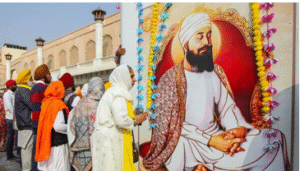
- Youngest son of Guru Hargobind Sahib, the sixth Sikh Guru.
- Revered as “Hind di Chadar” (Shield of India) for safeguarding religious freedom.
- His spiritual teachings and hymns are recorded in the Guru Granth Sahib, emphasizing detachment, courage, and equality.
Significance of His Martyrdom
- Opposed forced religious conversions during Mughal Emperor Aurangzeb’s reign.
- Defended Kashmiri Pandits facing persecution and forced conversion.
- Arrested and executed in Chandni Chowk, Delhi, on 24 November 1675.
- Symbolizes protection of freedom of conscience, pluralism, interfaith harmony, justice, and truth.
President of India’s 2025 Tribute: Key Messages
- Honoured Guru Tegh Bahadur’s courage, sacrifice, and enduring principles.
- Emphasized his pivotal role in upholding righteousness, humanity, and truth.
- Urged citizens to imbibe his values to foster unity and harmony across India.
Major Contributions of Guru Tegh Bahadur
- Spiritual Teachings: Advocated nirbhau (fearlessness) and nirvair (compassion), stressing spiritual liberation through humility and service.
- Established Sikh Centres: Founded Anandpur Sahib in 1665 and travelled widely spreading Sikh philosophy.
- Poetical Legacy: Composed 116 hymns in the Guru Granth Sahib, including shaloks on detachment and moral courage.
7. How can State PSCs be reformed?
GS PAPER II-POLITY
CONTEXT: At the 2025 National Conference of Chairpersons of State PSCs hosted by Telangana, members acknowledged the recruitment controversies affecting many aspirants. Protests by youth in Hyderabad over recruitment delays highlighted the urgent need for reform. Frequent exam cancellations and vague syllabi have eroded public trust despite PSCs’ constitutional mandate to uphold meritocracy.
Historical Evolution of State PSCs
- Montagu-Chelmsford Report (1918): Recommended statutory recruitment bodies for welfare administration, laying the conceptual foundation for PSCs in India.
- First Public Service Commission (1926): Established Pre-Independence to institutionalize merit-based recruitment.
- Constitutionalisation (Article 315): Provided for separate Union and State PSCs with autonomy and continuity post-Independence.
Constitutional Structure and Organisation
- Appointment and tenure: Governors appoint PSC chairpersons and members with fixed tenure and protected service conditions.
- Constitutional independence: PSCs function autonomously without executive interference.
- UPSC’s role: Advises State PSCs on service matters when requested.
- Ministry of Personnel: Coordinates administrative coherence across States.
Present Functioning and Examination Framework
- Syllabus review: Periodic updates to align with evolving administrative needs.
- Question setting and evaluation: PSCs set, evaluate, and prepare merit lists independently.
- Cut-offs and result publication: Merit lists based on transparent evaluation criteria.
Current Challenges
- Irregular recruitment cycles causing long delays and protests.
- Lack of transparency in evaluation and answer keys.
- Paper leaks and exam cancellations eroding trust.
- Outdated syllabi failing to meet modern governance needs.
- Varied standards across States limiting mobility and fairness.
Proposed Reforms
- Systematic manpower planning for timely vacancy forecasting.
- Fixed annual examination calendars across States.
- Transparent evaluation with disclosure of keys and cut-offs.
- Regular syllabus revision aligned with governance realities.
- Inclusion of subject experts for improved fairness and quality.
Conclusion
While State PSCs are constitutionally mandated to ensure fair public employment opportunities, ongoing recruitment irregularities and opacity have damaged public confidence. Institutional reforms focusing on predictability, transparency, and professionalism are essential to protect aspirants’ interests and restore trust in these vital constitutional recruitment bodies.