
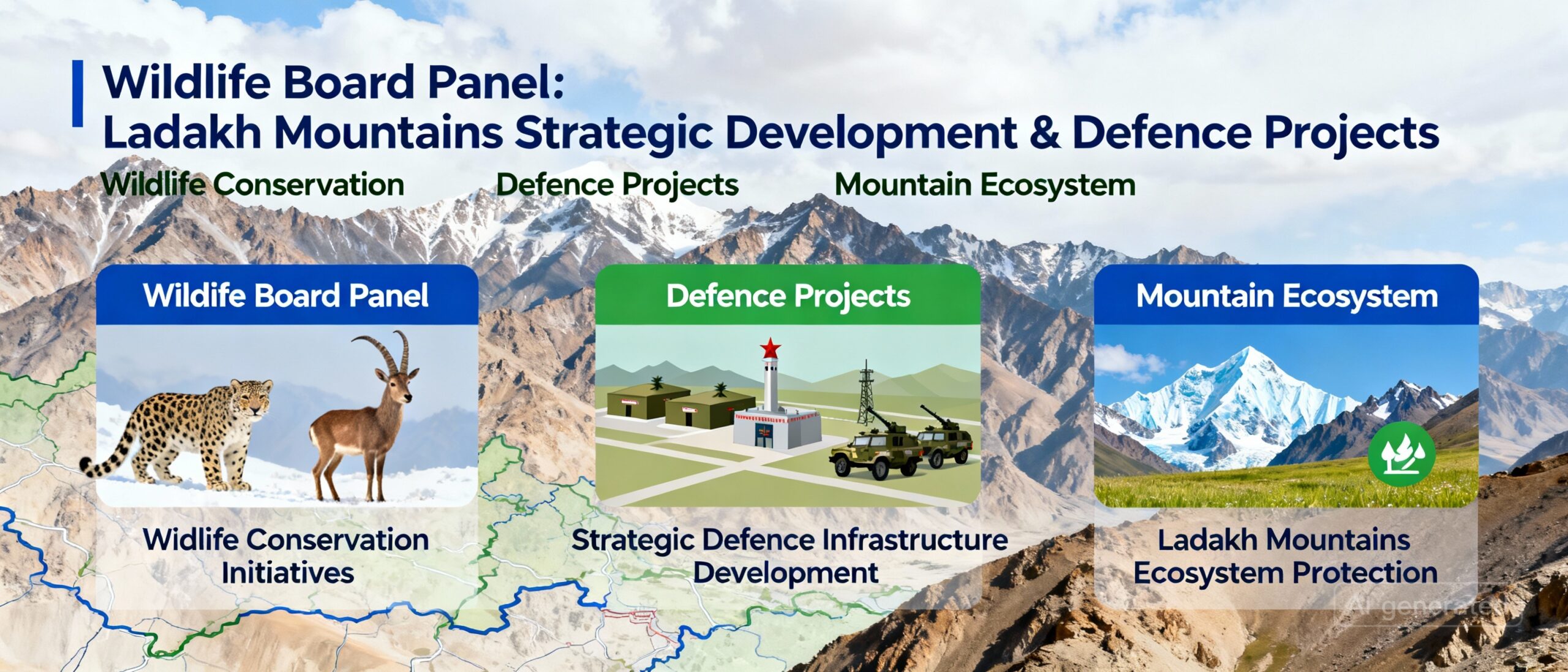
1. Wildlife Board Panel Clears 12 Key Defence Projects in Ladakh
Context
- The Standing Committee of the National Board for Wildlife (NBWL) has approved 12 strategic defence infrastructure projects in Ladakh.
- Projects lie in/around Changthang Cold Desert Wildlife Sanctuary and Karakoram Wildlife Sanctuary.
- Purpose: Border infrastructure strengthening, particularly along the Line of Actual Control (LAC) with China.
LOCATION & ECOLOGICAL SIGNIFICANCE
| Sanctuary | Key Features | Important Species |
| Changthang Cold Desert Wildlife Sanctuary | High-altitude plateau, cold desert ecosystem (3,000–5,500m) | Snow Leopard, Kiang (Tibetan wild ass), Black-necked Crane, Tibetan Gazelle, Pashmina Goat |
| Karakoram Wildlife Sanctuary | Glacial landscapes near Siachen & Karakoram Range | Snow Leopard, Argali, Ibex, Himalayan Wolf |
Why ecologically fragile?
- Low vegetation → slow regeneration

- Harsh climate → ecosystem recovery extremely slow
- Glacial melt & permafrost impact exacerbated by construction
PROJECTS CLEARED
(Not all project names released; nature of works includes:)
- Military road expansion for troop mobility
- Logistics hubs
- Forward post strengthening
- Airfield upgrade and surveillance support
- Strategic connectivity corridors near LAC
LEGAL BASIS
- Clearances processed under Wildlife (Protection) Act, 1972.
- NBWL Standing Committee can permit diversion / construction in protected areas for:
- National Security
- Public Safety
- Strategic Importance
This falls under “national security exemption” fast-track approval.
WHY NOW?
- Post 2020 LAC standoff, India is accelerating:
- Road & air connectivity to forward areas
- All-weather supply chains
- Rapid military mobilization capacity
Strengthening infrastructure is central to deterrence strategy.
CONCERNS (Mains Perspective)
| Issue | Impact |
| Habitat Fragmentation | Interrupted movement of Kiang & Gazelle; wildlife corridor disruption |
| Disturbance to Breeding Grounds | Black-necked Crane is highly sensitive to noise & human presence |
| Ecosystem Fragility | Construction scars persist for decades due to slow recovery in cold deserts |
| Lack of Cumulative Impact Assessment | Approvals are project-wise, not landscape-level |
Also, Ladakh has no elected legislature, reducing public participation in ecological decision-making.
STRATEGIC NEED VS ECOLOGY – BALANCING MEASURES
- Wildlife movement corridors must be demarcated.
- Low-impact engineering (rope bridges, tunnels, raised road sections).
- Time-bound ecological impact monitoring by independent agencies.
- Local community (Changpa pastoralists) consultation & compensation.
- Mandatory environmental data disclosure under Section 4, RTI Act.
PRELIMS POINTERS
- NBWL chaired by: Prime Minister
- Standing Committee chaired by: Minister for Environment, Forest & Climate Change
- Changthang Sanctuary: Part of Trans-Himalayan cold desert biome
- Black-necked Crane breeding in India: Only in Ladakh
- Snow Leopard conservation program: Project Snow Leopard (2009)
MAINS READY STATEMENT
Ladakh’s border infrastructure expansion reflects the strategic reality of a contested frontier. However, the region’s rare cold desert ecology is slow to heal and ecologically irreplaceable. Strategic preparedness must therefore be complemented by scientific ecological safeguards, cumulative impact assessments and local community involvement.
2. SC Pushes for Reform of Colonial-Era Property Laws
Context
- The Supreme Court recently observed the need to reform several colonial-era property laws that continue to govern land ownership, tenancy, adverse possession and property disputes in India.
- These laws often burden citizens, enable litigation delays, and continue to reflect colonial priorities rather than citizen-centric governance.
Why the Court Intervened?
- Property disputes form ~66% of all civil cases in India.
- Many laws date back to the 19th and early 20th centuries, framed for colonial revenue extraction, not welfare.
- Existing legal framework leads to:
- Unclear titles
- Encroachment disputes
- Endless civil suits
- Misuse by land mafia
The Court stated that legal clarity is essential for economic development, investment, and social justice.
Key Colonial-Era Laws Under Scrutiny
| Law | Year | Issue | SC Concern |
| Indian Easements Act | 1882 | Unclear rights of light, way, water | Causes boundary disputes |
| Transfer of Property Act | 1882 | Outdated tenancy norms | Fails to reflect modern land realities |
| Registration Act | 1908 | Multiple intermediaries | Enables fraud and duplicate land sales |
| Land Acquisition laws (pre-2013) | 1894 (replaced) | Forceful acquisition | Earlier law prioritized state over citizens |
| Doctrine of Adverse Possession | Common Law | Allows trespasser to claim land after 12 yrs | SC: Violates constitutional right to property |
Major SC Observation (2024–25)
The Doctrines like Adverse Possession treating the State or trespasser as the eventual landowner are unjust and need reconsideration.
Property rights are not feudal privileges, but constitutional entitlements under Article 300A.
Why Reform is Needed Now? (Mains Angle)
- Economic Efficiency
- Clear land titles are essential for infrastructure, housing, agriculture, and private investment.
- Reducing Litigation Load
- Property disputes clog courts → HR & judicial time wasted.
- Preventing Land Mafia & Encroachment
- Ambiguous laws create space for corruption & criminal networks.
- Urbanisation and Digital Governance
- Smart cities require digitized land records, not colonial paper deeds.
Current Government Initiatives
- SVAMITVA Scheme: Drone-based property mapping in rural areas.
- DILRMP (Digital India Land Records Modernization Programme): Computerization of land records.
- National Land Titling Law (Proposed): To move from presumptive titles → conclusive titles.
Challenges in Reform
- Federal nature of land → States must cooperate.
- Resistance from local elites / intermediaries.
- Legacy disputes difficult to resolve suddenly.
- Tribal and customary land rights need sensitive handling.
Way Forward
- Replace outdated statutes with citizen-centric, modern land laws.
- Introduce conclusive land titling (like Torrens system).
- Implement independent land valuation authorities.
- Strengthen legal aid for property disputes.
- Make digitized records mandatory & tamper-proof (blockchain pilot in Karnataka & Telangana).
Mains-Ready Conclusion
Colonial property laws were designed to protect State power and facilitate revenue collection, not to safeguard citizens’ rights. The Supreme Court’s push signals a shift toward modern, transparent and citizen-centric land governance. Reforming these laws is essential for economic development, judicial efficiency, and social justice. Clear property rights are not only a legal necessity but a foundation of trust in the rule of law.
3. The Return of Welfarism and the Challenge of Making it Sustainable
Context
- Rising inequality and “exclusive growth” have brought welfarism back to centre stage in global politics.
- Example: New York City’s Mayor-elect Zohran Mamdani has proposed free public buses, rent freezes, and universal childcare.
- Similar trends seen with Lula (Brazil), Keir Starmer (UK) and welfare-focused State governments in India.
Why Welfarism Appeals
 Quick, visible improvements in well-being
- School access, mobility, food security, basic income security.
- Bypasses slow structural reforms
- Does not wait for productivity growth, job creation or trickle-down.
- Corrects market exclusion
- Markets ration by income → poorest are left out of essential services.
The Central Problem
Welfare without design can create distortions:
- Free buses → overcrowding, low maintenance, fewer fleets.
- Rent freezes → drop in new housing supply; rise of key-money black markets.
- Universal childcare without funding → quality decline, workforce shortages.
Principle:
When price becomes zero without compensating provider funding → demand > supply → quality collapse.
Theoretical Frames (Used to Score Mains)
| Approach | Strength | Risk when over-applied |
| Pareto-efficiency (markets) | Efficient allocation | Exclusion of the poor; inequity |
| Rawlsian justice (equity) | Protects the vulnerable | Supply collapse; fiscal strain |
Balanced governance requires oscillation, not dominance of one side.
Polanyi’s Double Movement:
Societies swing between market expansion and social protection; stability lies in course correction.
What Sustainable Welfarism Requires
- Subsidise Outcomes, Not Inputs
- Contract and fund service delivery (e.g., Singapore Bus Contracting Model).
- Keep a small fare signal to avoid overuse.
- Use Means-Tested Vouchers Instead of Blanket Price Caps
- Protects access without suppressing supply (e.g., Brazil Bolsa Família).
- Expand Supply Alongside Subsidies
- Housing vouchers + zoning reforms
- Public transit subsidy + fleet expansion
- Fund Quality Explicitly
- Staff training, maintenance budgets, accreditation, inspection systems.
- Partner With Mission-Driven Providers
- Cross-subsidy + scale models (e.g., Aravind Eye Care, LV Prasad Eye Institute).
- Fiscal Honesty
- Welfare must be costed, budgeted, and linked to growth and productivity improvements.
Key Governance Principle
Welfare must guarantee access without destroying supply incentives.
Mains-Ready Conclusion
Modern welfare states cannot simply choose between markets and compassion.
A sustainable welfare architecture requires:
- Targeting, not blanket freebies,
- Quality safeguards, not just access,
- Supply expansion, not suppression,
- Transparent financing, not political romanticism.
This is welfarism disciplined by design — capable of delivering dignity at scale.