
1. QS Asia Rankings
GS Paper II: Governance, Constitution, Polity, Social Justice & International Relations, International Rankings and their impact on Indian higher education
GS Paper III: Science & Technology, Economic Development, Higher education advancements, research output, innovation in universities
Context: QS Asia Rankings 2026 announced this week.China surpasses India in university representation.
- India’s top institutions have slipped in rankings compared to 2025.
What is QS World University Ranking (Asia)
- Annual ranking by Quacquarelli Symonds focusing on Asian universities.
- Evaluates institutions by academic reputation, employer reputation, faculty–student ratio, citations, international outlook, and other measures.
- Used as a benchmark for global and regional university quality.
Key Highlights – 2026 Edition
- Total universities ranked: 1,526 (with 557 new entries).
- India: 394 universities/institutes ranked; 132 added this year.
- China: 494 universities/institutes ranked; 259 added this year.
Country-Wise Top 100 Representation
| Country | No. of Universities in Top 100 | Remarks |
| China | 25 | Most institutions in top 100; dominated top 10 |
| India | 7 | Retained count; lower average ranks |
| Hong Kong | Data not specified | Top positions dominated |
| Singapore | Data not specified | Top positions dominated |
| Others (Japan, Korea, etc.) | Data not specified | Present, but not dominant |
India Universities in Top 100
- IIT Bombay (Ranked highest at 59)
- IISc (Indian Institute of Science)
- IITs: Madras, Bombay, Kharagpur, Kanpur
- University of Delhi
Top 10: Dominated by East Asia
- Universities from Hong Kong, Singapore, China dominate the top 10 positions.
Why India Slipped Down – Key Reasons
| India’s Decline | Explanation |
| Slippage in top ranks | IIT Delhi fell from 44 → 59, Delhi Univ. from 81 → 95, IISc from 62 → 64, IIT Madras 56 → 70 |
| Increased competition | China added far more new institutions |
| Regional excellence | East Asian universities outperformed in research and reputation |
- The top 10 mainly featured Hong Kong, Singapore, and Chinese universities due to better international outlook, research, and faculty credentials.
These ranking highlights regional shifts in Asian higher education, competitive global academic standards, and the areas where Indian institutions need improvement for future ranking success.
2. Model code of conduct
General Studies Paper II: Polity and Governance
General Studies Paper IV: Ethics, Integrity, and Aptitude
Context: Bihar’s MMRY scheme has raised allegations of violating the MCC during the 2025 Assembly elections, especially due to cash transfers to women beneficiaries shortly before and during the election period.
Origin, and Spirit of the MCC
- The MCC aims to ensure free and fair elections by restricting certain government activities and conduct of parties during the election period.
- Originating from election commission guidelines and partially from legislative provisions, the MCC’s spirit is to maintain a level playing field without misuse of official machinery or public funds during elections.
Nature and Duration of Applicability
- The MCC applies from the announcement of election schedules by the Election Commission until the completion of the election process.
- It is a voluntary code and not legally enforceable as a standalone statute but may invoke provisions of other laws like the IPC and Representation of the People Act.
Objectives and Key Provisions
- Prevent misuse of government resources, maintain neutrality of administrative machinery.
- Prohibitions include using government funds or programs as inducements, restraining officials from partisan acts, and avoiding new releases or announcements that could influence voters.
- Ensures compliance with ethical norms for parties and candidates during the election period.
General Conduct and Power in Office
- Parties in power are restricted from initiating or announcing new welfare schemes or disbursing benefits that could sway voters.
- Officials must act neutrally and avoid election-related bias.
- Election manifestos and campaigns must follow guidelines limiting undue influence or expenditure beyond prescribed limits.
Legal Status
- MCC is voluntary and convention-based; not legally binding.
- Enforcement may come through related laws but not by direct legal sanction on the MCC itself.
- The Election Commission opposes making MCC legally enforceable due to practical constraints of fast election timelines and judiciary delays.
Recent Violation: Bihar MMRY Scheme 2025
- The scheme involved disbursing ₹10,000 directly to women beneficiaries through SHGs.
- Disbursements happened on October 17, 24, and 31, 2025, after MCC came into effect (after election schedule announcements on Oct 6).
- RJD leader Manoj Jha formally protested to the Election Commission over this, calling it a blatant MCC violation aimed at vote-buying.
- The timing just before the Bihar Assembly polls and scale (over a crore beneficiaries) pointed to political advantage exploitation.
Issue and Key Takeaways
- The MMRY timing was politically convenient but the scheme design aimed at women empowerment and economic inclusion.
- The MCC violation debate raises questions on governance continuity versus fair polling practices.
- Fiscal transparency and accountability are critical, given the large budgetary impact and debt concerns of Bihar’s government.
Pattern of Violations and Larger Debate
- MCC violations often include misuse of government schemes for electoral gain, premature announcements, and targeted transfers.
- Whether MCC should be legally binding is debated.
- Critics argue binding MCC could delay elections or judicially entangle the election process.
- Advocates say legal enforceability is needed for credible, fair elections and to prevent repeated violations.
Criticism of the Election Commission of India (ECI)
- Criticism arises over ECI’s perceived leniency and inability to enforce MCC strictly.
- Some argue ECI’s voluntary MCC approach allows ruling parties to exploit resources.
- Others highlight the complexity of regulating electoral conduct amid governance needs.
Author’s Argument on MCC Enforcement
- MCC is essential for fair elections but its voluntary and non-binding nature weakens its impact.
- Indian elections’ fast pace complicates binding legal enforcement.
- Different legal frameworks (IPC, RPA) partly cover violations but integrated MCC legal status could provide clarity.
- Bihar’s MMRY example shows need for clearer guidelines on welfare schemes during election times.
- Strengthening ECI’s powers and transparency mechanisms could balance electoral fairness with governance continuity.
This response integrates the MCC’s origin, purpose, nature, and legal status, with key insights from the Bihar MMRY 2025 controversy as the recent case of MCC violation and related debates.
3. Indian Navy commissions INS Ikshak
Context: The Indian Navy commissioned INS Ikshak, the third vessel of the Survey Vessel (Large) class and the first to be stationed at the Southern Naval Command, at the Naval Base in Kochi.
About INS Ikshak
- Overview: Third ship in the Survey Vessel (Large) (SVL) class; first to serve under Southern Naval Command.
- Series Lineage: Follows INS Sandhayak and INS Nirdeshak; replaces the older Sandhayak-class survey ships.
- Builder: Built by Garden Reach Shipbuilders & Engineers (GRSE) Ltd., Kolkata, under the Aatmanirbhar Bharat initiative; over 80% of components sourced from Indian MSMEs.
- Name Significance: The term “Ikshak” means Guide in Sanskrit, reflecting its role in charting uncharted waters and enhancing navigation safety in the Indian Ocean Region.
- Primary Role: Designed for hydrographic surveys and capable of supporting Humanitarian Assistance and Disaster Relief (HADR) missions; can be reconfigured as a hospital ship in emergencies.
- Key Specifications:
- Length: 110 m; Beam: 16 m; Displacement: 3,400 tonnes.
- Crew complement: around 231 personnel.
- Powered by twin main engines with twin-shaft setup; cruising speed 14 knots, maximum 18 knots.
- Survey Equipment: Fitted with multi-beam echo sounders, Autonomous Underwater Vehicle (AUV), Remotely Operated Vehicle (ROV), four Survey Motor Boats, and advanced oceanographic systems for coastal and deep-sea mapping.
- Aviation Facility: Contains a helicopter deck for extended reach and reconnaissance.
- Dual Mission Design: Convertible for disaster relief and medical support operations.
- Inclusive Infrastructure: First Indian survey vessel with dedicated accommodation for women officers and sailors.
4. Clearest Black Hole Merger signal allows probe of Hawking’s Law
GS PAPER III-SCIENCE AND TECHNOLOGY
Context: Researchers detected the clearest gravitational wave signal, GW250114, from merging black holes—providing the strongest experimental proof of Stephen Hawking’s 1971 Black Hole Area Theorem and reinforcing Einstein’s General Relativity.
About GW250114
- Detected on: January 14, 2025, by LIGO (US), Virgo (Italy), and KAGRA (Japan).
- Signal clarity: The most distinct gravitational wave ever observed.
- Source: Collision of two black holes, each about 30 times the Sun’s mass, located 1.3 billion light-years away.
- Published in: Physical Review Letters, September 2025.
- Significance: Offers direct observational evidence confirming Hawking’s theorem that black hole area cannot decrease.
Black Holes – Key Concepts
- Definition: A region in space where gravity is so intense that even light cannot escape.
- Formation: Formed after the collapse of a massive star at the end of its lifecycle.
- Types:
- Stellar black holes – formed from massive stars.
- Supermassive black holes – found at galaxy centers.
- Intermediate or primordial types – smaller or early-universe categories.
- Core properties: Defined by mass, spin, and charge; grow by accreting matter or merging with others.
Black Hole Merger Explained
- Process: Two orbiting black holes spiral inward, collide, and form a larger black hole.
- Phases:
- Inspiral– gradual inward movement due to energy loss.
- Merger– collision releasing intense gravitational waves.
- Ringdown– the new black hole stabilizes.
- Observation: Such mergers produce spacetime ripples known as gravitational waves, first detected by LIGO in 2015.
Hawking’s Black Hole Area Theorem (1971)
- Main concept: The total surface area of black holes can never decrease; it can only stay constant or increase.
- Theoretical parallel: Comparable to the Second Law of Thermodynamics, where entropy always rises.
- Physical meaning: After a merger, the resulting black hole’s surface area is equal to or larger than the combined original areas.
- Empirical confirmation: Data from the GW250114 event verified this principle, supporting Hawking’s 1971 prediction.
5. Gamma-Ray Bursts from Black Hole ‘Morsels’ could expose Quantum Gravity
GS paper III-Science and technology
Context: A new theoretical study accepted in Nuclear Physics B (August 2025) has proposed the concept of “black hole morsels” — tiny, ultra-dense micro–black holes that might form when two large black holes merge. These hypothetical remnants could emit distinctive gamma rays, offering clues to quantum gravity.
Gamma-Ray Bursts (GRBs) – Key Facts
- Nature: Extremely energetic cosmic explosions releasing intense bursts of gamma radiation, the highest-energy form of electromagnetic waves.
- Discovery: First observed in the late 1960s by U.S. Vela satellites, which were initially designed to detect nuclear test explosions.
- Classification by Duration:
- Short GRBs: Last less than 2 seconds; originate from mergers of two neutron stars or neutron star–black hole pairs.
- Long GRBs: Last 2–1000 seconds; arise from collapses of massive stars (collapsars) leading to supernovae.
- Energy Scale: Each GRB can unleash as much energy in seconds as the Sun emits over its entire lifetime (around 10⁵¹–10⁵⁴ ergs).
- Afterglow: Leaves behind emissions across X-ray, optical, and radio bands, helping locate host galaxies and measure distances.
The “Black Hole Morsel” Hypothesis
- Concept: Suggests that during black hole mergers, spacetime can “pinch off” to form ultra-compact, asteroid-mass black holes — termed “morsels.”
- Formation Mechanism: Extreme gravitational stress during coalescence creates separate, dense spacetime pockets.
- Emission Signature: Expected to radiate gamma rays and high-energy particles through Hawking radiation.
- Scientific Aim: Provides a framework to connect general relativity with quantum mechanics by exploring quantum spacetime behavior.
Characteristics of Black Hole Morsels
- Origin: Form as fragmented remnants during mergers of massive black holes.
- Size and Mass: Asteroid-scale masses but vastly denser than ordinary matter.
- Temperature and Emission: Extremely hot, releasing photons, neutrinos, and high-energy particles through Hawking radiation.
- Lifespan: Ranges from a few milliseconds to several years depending on initial mass.
- Detectability: Believed to produce near-isotropic gamma-ray flashes (unlike directional GRB jets).
- Detection Efforts: Monitoring by observatories such as HESS (Namibia), HAWC (Mexico), LHAASO (China), and NASA’s Fermi Space Telescope.
Scientific Relevance
- Quantum Gravity Test: Discovery would serve as evidence that gravity operates at quantum scales.
- Spacetime Insights: Could reveal the quantum structure of spacetime near singularities.
- Natural Particle Accelerators: Offer insights into ultra-high-energy physics, far beyond human-made colliders.
- Current Progress: No confirmed detections yet; analysis of existing gamma-ray archives continues to refine model predictions.
6. With upcoming film ‘Haq’, recalling the landmark Shah Bano case and what it held on Muslim women’s rights
GS PAPER I-Indian society: Role of Women & Women Organization
Context: An upcoming Bollywood film is set to dramatize the historic Shah Bano case (1985), one of India’s most contentious legal battles that reshaped debates on personal law, gender justice, and the Uniform Civil Code.
Case Background
- Origin: In 1978, Shah Bano Begum, a 62-year-old Muslim woman from Indore, was divorced by her husband, Mohammad Ahmad Khan, through triple talaq after 43 years of marriage.
- Legal Step: She approached the court seeking maintenance under Section 125 of the Code of Criminal Procedure (CrPC), a secular provision for dependents unable to support themselves.
- Husband’s Defence: Argued that under Muslim personal law, his responsibility ended after the iddat period (about three months) and that paying mahr (dower) completed his duty.
- Lower Court Decisions: The trial court awarded ₹25 per month; the Madhya Pradesh High Court raised it to ₹179.20. Khan appealed to the Supreme Court, setting the stage for a landmark judgment.
Supreme Court Verdict (April 23, 1985)
- Bench Composition: Five-judge Constitution Bench headed by Chief Justice Y.V. Chandrachud.
- Key Ruling: Dismissed the husband’s appeal and upheld the High Court’s order for continued maintenance.
- Secular Scope: Clarified that Section 125 CrPC applies uniformly to all citizens regardless of religion, since it aims to prevent destitution, not govern personal law.
- Maintenance Beyond Iddat: Affirmed that a divorced Muslim woman is entitled to support beyond the iddat period if unable to maintain herself.
- Religious Alignment: Quoted Quranic verses to highlight compatibility between Islamic principles and the concept of maintenance.
- Uniform Civil Code: Observed that Article 44 of the Constitution remains unimplemented and advocated progress toward a common civil code.
Broader Significance
- Reinforced the supremacy of secular principles in matters of social welfare.
- Sparked a nationwide debate on the balance between personal laws and constitutional equality.
- Led to political and legislative responses, including the 1986 Muslim Women (Protection of Rights on Divorce) Act.
- Continues to influence contemporary discussions on gender justice and the Uniform Civil Code.
7. Pravasi Parichay 2025
GS Paper I (Culture): Demonstrates India’s civilizational continuity and cultural diplomacy.
GS Paper II (International Relations): Highlights India’s diaspora engagement strategy and bilateral cultural cooperation.
Context: The Embassy of India in Riyadh recently concluded the third edition of Pravasi Parichay 2025 with a grand event themed “Gita Mahotsav – A Musical”. The celebration highlighted India’s spiritual and cultural legacy while strengthening ties between India and its diaspora in Saudi Arabia. 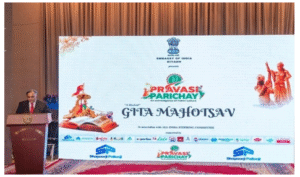
About Pravasi Parichay
- An annual diaspora cultural festival organized by the Embassy of India in Riyadh.
- Serves as a platform to showcase India’s artistic, linguistic, and philosophical diversity.
- Features performances, exhibitions, and events led by the Indian community abroad.
Host and Collaborators
- Organized by the Embassy of India, Riyadh.
- Conducted in partnership with Indian diaspora associations and cultural institutions in Saudi Arabia.
Objectives
- To promote awareness of India’s civilizational and cultural heritage among NRIs.
- To deepen emotional and cultural links between India and its global diaspora.
- To celebrate India’s unity in diversity through dance, music, art, and philosophy.
Significance
- Strengthens India’s soft power diplomacy through cultural outreach.
- Cultivates a sense of shared national identity and belonging among Non-Resident Indians.
- Encourages cross-cultural understanding and enhances India–Saudi people-to-people relations.
- Embodies the ethos of Vasudhaiva Kutumbakam (“the world is one family”), promoting global respect for Indian heritage.