1. India-ASEAN ties
General Studies Paper II: International Relations
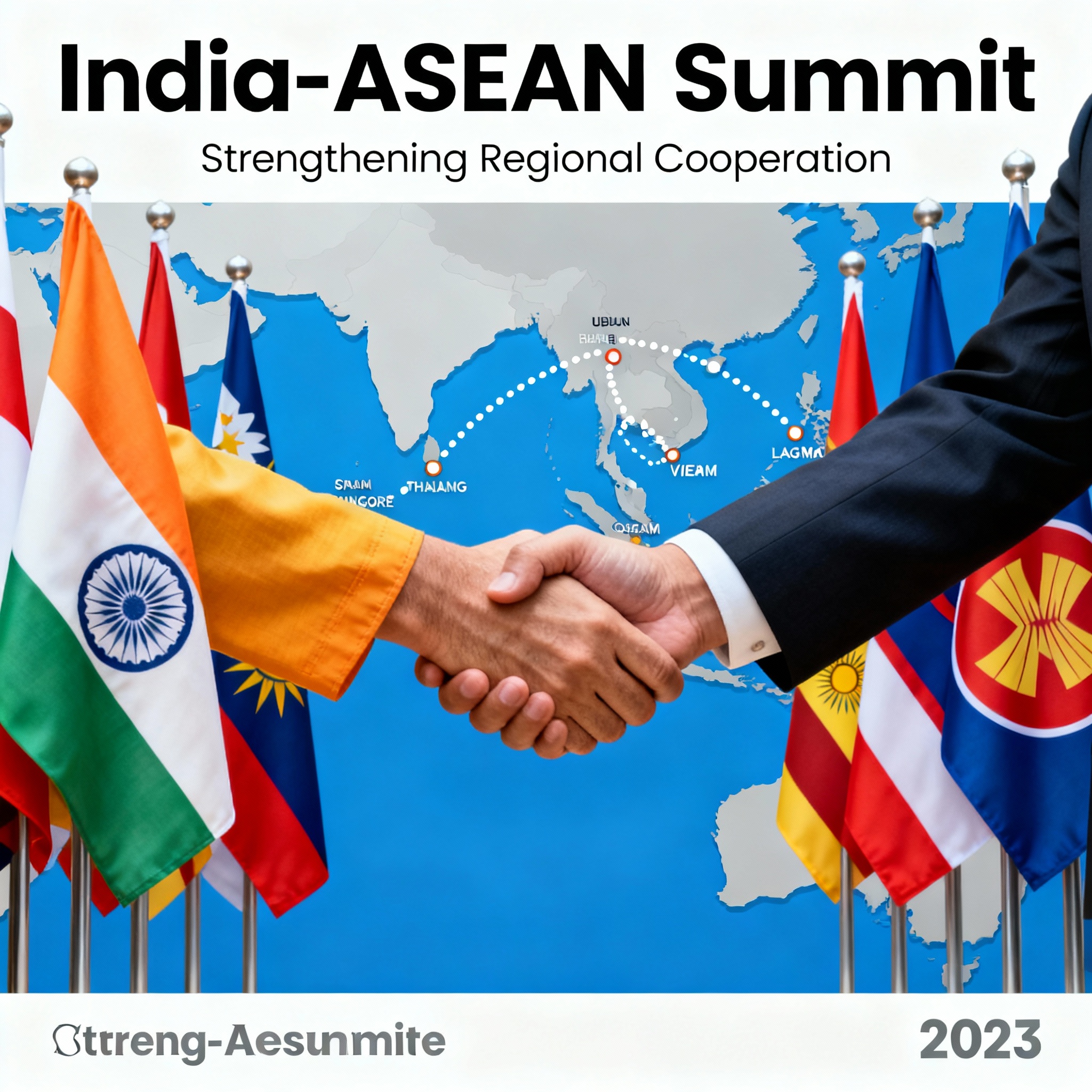
Context :22nd ASEAN-India Summit held on October 26, 2025, with PM Modi addressing virtually from Kuala Lumpur.
- Modi declared 2026 as “Year of Maritime Security” for enhanced cooperation and AITIGA review.
- Summit occurred amid global tensions, including U.S. claims on Indian oil imports and terrorism concerns.
- Modi offered condolences for Thailand’s Queen Sirikit’s passing during the address.
Background:
India-ASEAN Partnership – Years and Milestones
- 1992: Sectoral Dialogue Partnership established, marking initial engagement.
- 1995: Full Dialogue Partnership formalized, enabling regular summits.
- 2002: First ASEAN-India Summit held in Phnom Penh, Cambodia.
- 2003: Framework Agreement on Comprehensive Economic Cooperation signed.
- 2010: ASEAN-India Free Trade Agreement (Goods) enters into force.
- 2012: Elevated to Strategic Partnership; Delhi Declaration adopted.
- 2016: 25 years commemorated; Plan of Action (2016-2021) adopted.
- 2022: Upgraded to Comprehensive Strategic Partnership; 30th anniversary.
- 2023: 20th ASEAN-India Summit; Plan of Action (2021-2025) adopted.
- 2025: ASEAN-India Year of Tourism launched with USD 5 million contribution.
Key Points from PM Modi’s Address
- a) Partnership Amid Uncertainty
- Described India-ASEAN ties as a foundation for global stability amid uncertainties.
- Emphasized resilience against geopolitical shifts and economic disruptions.
- b) Shared Demographics and Values
- Highlighted shared heritage, inclusivity, and sustainability values.
- Noted ASEAN as cultural companions with one-fourth of global population.
- c) 21st Century Belongs to India-ASEAN Groups
- Asserted the 21st century as the era of India and ASEAN for global progress.
- Positioned ASEAN as a key pillar of India’s Act East Policy.
- d) Maritime Security and Cooperation
- Announced 2026 as Year of Maritime Security for domain awareness and blue economy.
- Pledged enhanced joint exercises and information sharing.
- e) Economic Cooperation
- Called for AITIGA review to address trade imbalances and boost investment.
- Promoted tourism under the 2025 Year of Tourism initiative.
- f) Digital Inclusion & Supply Chains
- Committed to digital inclusion and resilient supply chains with tech transfer.
- Highlighted AI governance, cybersecurity, and e-commerce potential.
- g) Global South Solidarity
- Stressed India and ASEAN as fellow travelers in the Global South.
- Advocated for equitable governance and climate action.
- h) Humanitarian Assistance & Disaster Relief (HADR)
- Noted India’s support in HADR operations across ASEAN.
- Proposed expanded capacity building and early warning systems.
- i) Counter Terrorism
- Urged a united fight against terrorism with zero tolerance.
- Emphasized enhanced intelligence sharing for regional peace.
Malaysian Statement (PM Anwar Ibrahim)
- Congratulated Modi for virtual participation and India’s ASEAN support.
- Highlighted progress in revising the ASEAN-India trade pact for stability.
- Emphasized ASEAN unity amid polarization and deeper collaboration.
India-ASEAN Partnership Pillars and Focus
| Pillar | Focus Areas |
| Political-Security | Maritime security, counter-terrorism, HADR. |
| Economic | Trade enhancement, investment, tourism. |
| Socio-Cultual | Education, cultural ties, health cooperation. |
Strategic Importance for India
- Geoeconomic Hub: ASEAN is India’s 4th largest trading partner (USD 130+ billion).
- Geostrategic Balance: Counters China’s influence in South China Sea.
- Global South Leadership: Amplifies India’s voice in UN, G20 forums.
- Energy and Resources: Secures access to energy markets and minerals.
Challenges in India-ASEAN Relations
| Challenge | Description |
| Trade Imbalance | Deficit (USD 50+ billion) due to imports. |
| Connectivity Delays | Slow progress on projects like Kaladan. |
| Limited Supply Chain Integration | Lags in RCEP framework with China. |
| Maritime/Security Concerns | South China Sea disputes affect unity. |
| Geopolitical Tensions | U.S.-China rivalry and Myanmar crisis. |
2. Rashtriya Vigyan Puraskar (RVP) Awards
General Studies Paper III: Science and Technology – Awards and Recognition.
Context: The government announced the second edition of Rashtriya Vigyan Puraskar (RVP) awards with 24 individual winners and one team award for 2025.
- Eminent physicist Jayant Vishnu Narlikar was posthumously honored with the Vigyan Ratna award for his lifetime contributions.
- The RVP awards have become significant because of their enhanced stature, scrutiny of selection, and focus on scientific merit rather than just government affiliation or political factors.
Background and Purpose / Objective
Background
- Instituted in 2022 to consolidate and elevate the prestige of national science awards, merging those previously given by separate scientific ministries.
- Intended to rationalize fragmented recognitions and focus on merit and national impact.
- First presented in 2024, aligning with National Space Day but conducted by the Principal Scientific Adviser.
- Nominations open annually (Oct 4–Nov 17) via awards portal; selected by a 17-member expert panel.
Purpose / Objective
- Honor outstanding scientists, technologists, and innovators for work across 13 domains.
- Foster a peer-driven, hands-off selection to reduce government and political interference.
- Encourage youth, boost credibility of Indian scientific recognition, and align with global standards of scientific excellence.
- Includes medal and certificate signed by the President.
Categories of Rashtriya Vigyan Puraskar
| Category | Description | Eligibility | Purpose |
| Vigyan Ratna (VR) | Highest honor for lifetime achievements in S&T; 1 per year | All Indian scientists/technologists; no age limit | Recognize enduring legacy and inspire future leaders |
| Vigyan Shri (VS) | Distinguished high-impact contributions; up to 25 per year | Scientists in India/Indian origin; no age limit | Honor recent research excellence and promote collaboration |
| Vigyan Yuva – SSB (VY-SSB) | Exceptional achievements by young scientists | Up to age 45 in India, individual/team | Nurture youth, encourage next generation discoveries |
| Vigyan Team (VT) | Collaborative advances, complex research problems | Teams, 3+ scientists (in/outside India) | Celebrate teamwork and interdisciplinary solutions |
This Year’s Major Winners (2025)
- Vigyan Ratna: Prof. Jayant Vishnu Narlikar (Physics) – posthumous, pioneering cosmology and steady-state theory.
- Vigyan Shri: Dr. Gyanendra Pratap Singh (Agriculture), Dr. Yusuf Mohammad Seikh (Atomic Energy), Dr. K. Thangaraj (Biological Sciences), Prof. Pradeep Thalappil (Chemistry), Prof. Aniruddha Bhalchandra Pandit (Engineering), Dr. S. Venkata Mohan (Environment), Prof. Mahan Mj (Math/CS), Shri Jayan N (Space Science).
- Vigyan Yuva – SSB: Jagad Gupta Kapuganti (Agriculture), Satendra Kumar Mangrauthia (Agriculture), Deepa Agashe (Biology), Dibyendu Das (Chemistry), Amit Kumar Agarwal (Physics), Ankur Garg (Space Science) and others.
- Vigyan Team: Team Aroma Mission CSIR (Agricultural Science) – high-value essential oil crops for rural upliftment.
Conclusion: Rashtriya Vigyan Puraskar 2025 signals India’s resolve to honor merit in science, promoting fair, transparent, peer-driven selections.
- Honoring trailblazers like Prof. Narlikar and emerging teams, the RVP boosts national pride and inspires future innovation.
- Peer selection, reduced influence, and global credibility are the new pillars of Indian scientific recognition.
3. Kopi Luwak coffee.
General Studies Paper III – (Science & Technology)
Context: Kerala researchers published a groundbreaking study in October 2025 confirming the unique chemistry behind Kopi Luwak coffee.
- The findings address ethical sourcing, premium coffee markets, and global attention on civet digestion’s effect on coffee quality.
Kopi Luwak: Origin and Process
- Kopi Luwak, or civet coffee, is made from beans passed through the Asian palm civet’s digestive tract, then collected from scat and roasted.
- Popular for its smooth, creamy flavor and rare, exotic appeal—it is among the world’s most expensive coffees.
- The process relies on wild civets selectively eating ripe cherries, aiding both coffee quality and forest ecology.
Kerala Study: Key Findings
- Research by Central University of Kerala compared civet-processed Robusta beans with regular and organic beans from Karnataka.
- Civet beans were larger, had higher fat, and showed elevated flavor-linked compounds (caprylic/capric acid methyl esters).
- Chemical results support gut fermentation by civets as responsible for unique creamy aroma and reduced bitterness.
- Differences in beans mapped to civet feeding (ripe cherry selection) and natural fermentation in gut microbiome.
- Unroasted beans studied to capture true chemical signatures; organic beans clustered separately due to farm practices.
Importance of the Study
- First robust scientific proof for unique Kopi Luwak flavors; validates high market value via measurable chemistry.
- Supports India’s potential for ethical, wild civet-sourced premium coffee, offering export opportunity and product traceability.
- Results could drive cruelty-free fermentation techniques and efforts to combat counterfeiting in luxury coffee markets.
Indian Context
- Study took place in Karnataka (Kodagu), India’s main coffee zone and Western Ghats biodiversity area.
- Spotlights India as a source for sustainable, wild civet coffee—competitive against Indonesia as a global supplier.
- Informs policy on coffee farm practices and wildlife protection; promotes ethical methods and rural income without harming civet populations.
- Addresses the need for anti-counterfeit measures and biodiversity conservation to ensure ethical, long-term benefits for communities and wildlife
4. Whale faces is an important nutrient sources
GS PAPER III -Environment and Ecology
Context: Landmark 2025 PNAS study spotlights baleen whales’ role in boosting ocean primary production.
- Media coverage connects whale nutrient recycling (“whale pump”) to climate and biodiversity benefits.
- Whale excreta shown to increase phytoplankton growth by up to 10% in nutrient-poor North Atlantic waters.
What Did Researchers Find?
- Nitrogen mainly released via urine, phosphorus and iron mostly in feces.
- Whale pump’s impact peaks in summer, offshore, nutrient-starved areas; enhances food web up the chain.
- Models suggest even current whale numbers drive significant ecosystem benefits; recovery would amplify effect.
The Concept: Whale Pump
- “Whale pump” describes baleen whales fertilizing sunlit waters with nutrients from deep prey, boosting productivity.
- Coined in early 2010s, popularized by marine ecology studies and Roman & McCarthy (2010).
Why It Is Important
- Stimulates phytoplankton, which create ~50% of global oxygen and sequester CO2.
- Supports diverse ocean life and resilient food webs; even depleted whale numbers matter.
- Recovery of whales could enhance ocean carbon sinks; each whale stores tons of carbon.
- Increases fisheries yields and the economic value of healthy ecosystems; each whale valued at ~$1 million.
Ecological Chain Summary
- Whale waste supplies N, P, Fe to surface.
- Phytoplankton flourish, boosting primary production.
- Zooplankton graze on blooms, supporting krill, fish, and up the chain.
- Larger predators benefit; whales close the loop feeding on krill.
- Redistribution of nutrients sustains ecosystem stability.
Wider Ecological Implications
- Vital in warming oceans with reduced upwelling; prevents nutrient “dead zones”.
- Enhances productivity in high-latitude, biodiversity-rich regions.
- Whale migration links polar-tropical nutrient cycles, globalizing benefits.
- Past overhunting damaged these functions; current recovery is vital for UN SDGs and natural climate solutions.
- Nutrient pulses from whales likely spurred ancient marine evolution and oxygenation.
Baleen Whales: Facts and Features
- Huge, toothless filter feeders; baleen plates sieve krill, plankton.
- Largest: Blue whale (30m, 200t); smallest: minke (6–10m).
- 14 species; diverse migrations connect distant ocean regions.
- Act as ecosystem engineers, recycling tons of nutrients yearly.
- Conservation: Status from endangered to least concern; main threats—ship strikes, entanglement, prey shifts, climate.
5. Reversing the American brain drain: Is the Indian government’s scheme enough?
General Studies Paper-II – (Governance, Constitution, Polity, Social Justice and International Relations)
Context: The Government of India is planning a new scheme to attract Indian-origin STEM researchers and scientists back from the United States.
- This initiative comes amid tightening research policies and immigration rules under the Trump administration.
- India aims to reverse decades of brain drain by offering competitive incentives and building a robust domestic research ecosystem.
Understanding Brain Drain Phenomenon
Brain Drain Definition:
- Migration of skilled professionals, scientists, and researchers from developing countries to advanced economies seeking better opportunities, funding, and research freedom.
- India has been one of the largest exporters of talent, particularly in STEM, medicine, and IT sectors.
Current Statistics:
- Over 13 lakh Indians renounced citizenship between 2015-2024, many in high-skilled sectors (MEA, 2024).
- Nearly 1.6 lakh Indian students pursuing research or doctoral studies in the U.S. alone (IIE, 2024).
- India’s R&D spending only 0.65% of GDP compared to China’s 2.7% and U.S.’s 3.5%.
Drivers of Reverse Brain Drain
External Push Factors:
- Policy uncertainty in the U.S. with tightened immigration rules and funding cuts.
- Anti-science policies under the Trump administration creating instability for researchers.
- Reduced research freedom and increased bureaucratic hurdles in traditional destination countries.
Internal Pull Factors:
- Expanding Indian research ecosystem with AI Centres of Excellence.
- Development of supercomputing infrastructure (PARAM Siddhi) and digital research platforms.
- Government incentives including attractive repatriation packages and research grants.
- Growing startup ecosystem and entrepreneurial opportunities.
- Emotional appeal of national contribution and strengthening India’s global scientific standing.
Government Initiatives for Talent Repatriation
National Level Measures:
- Proposed NRI Scientist Repatriation Scheme with substantial setup grants and placements in IITs and national laboratories.
- Startup India and Digital India platforms for returnee entrepreneurs to establish deep-tech startups.
- MeitY’s INDIAai Mission and AI Ethics Frameworks fostering inclusive AI ecosystem.
Institutional Collaboration:
- CSIR and ICSSR co-hosting Reverse Migration Roundtables on global campuses.
- Creation of AI Research Liaison Offices for coordinating onboarding and intellectual property matters.
State-Level Initiatives:
- Tamil Nadu’s “Tamil Talents Plan” with Rs 100 crore budget for new research centres.
- Collaboration with IISc and TIFR for co-supervised PhDs and AI-focused laboratories.
- Establishment of AI Startup Landing Pads in Bengaluru, Chennai, and Pune.
Implementation Challenges
Administrative Hurdles:
- Complex procurement rules and multi-layered approval processes delaying project timelines.
- Bureaucratic red tape making researchers spend more time on paperwork than innovation.
- Slow tendering processes and funding mechanism complications.
Institutional Issues:
- Resistance from existing faculty towards preferential treatment for returnee scientists.
- Hierarchy conflicts and loss of institutional cohesion due to privilege disparities.
- Rigid administrative culture resistant to experimentation and flexibility.
Infrastructure and Resource Constraints:
- Limited access to world-class laboratories and advanced research equipment.
- Inadequate data systems and technical manpower for cutting-edge research.
- Low R&D spending constraining research capabilities and infrastructure development.
Quality of Life Concerns:
- Air pollution and environmental degradation in major cities.
- Inadequate housing, schooling difficulties, and inefficient civic services.
- Long-term relocation challenges for scientists with families.
Strategic Recommendations
Research Governance Reforms:
- Single-window digital portal for procurement, fund release, and hiring approvals.
- Autonomous research clusters with flexible governance and direct funding autonomy.
- Performance-based evaluation systems and merit-driven promotion policies.
Policy and Infrastructure Improvements:
- Global mobility frameworks including spouse work visas and fast-track research clearances.
- Tax-neutral startup repatriation policies to enhance competitiveness.
- Increased R&D spending target of 1.5% of GDP by 2030.
Systemic Changes:
- Transparent evaluation mechanisms and flexible tenure systems.
- Stable funding for universities and innovation hubs.
- Collaborative industry-academia ecosystems for sustained research excellence.
6. National Blockchain Framework
Why in News?
- The Ministry of Electronics and Information Technology (MeitY) launched the National Blockchain Framework (NBF) in September 2024 with a ₹64.76 crore allocation.
- Aims to provide a unified and secure blockchain infrastructure for Indian governance and digital public services.
- Highlights India’s push for tamper-proof digital governance and BaaS (Blockchain-as-a-Service) to accelerate adoption across government sectors.
National Blockchain Framework: An Overview
- Introduced to set up a standardized, scalable, and permissioned blockchain network for government and regulatory use.
- Designed to foster trust, transparency, and smooth data exchange across digital platforms.
- Deployed at NIC data centers in Bhubaneswar, Pune, and Hyderabad.
Key Components of the NBF Ecosystem
Vishvasya Blockchain Stack
- Home-grown modular blockchain system forming the core technology layer.
- Delivers Blockchain-as-a-Service, distributed digital infrastructure, and open APIs for integration with e-governance.
- Built for secure, permissioned, and scalable deployments across government departments.
NBF Lite: Blockchain Sandbox
- Dedicated environment for startups and researchers to experiment with blockchain solutions.
- Comes with smart contract templates for governance and logistics.
- Facilitates rapid prototyping and pilot projects.
Praamaanik: Mobile App Verification
- Blockchain-backed solution for authenticating mobile apps and combating malicious software.
- Enhances digital trust and security in the mobile app marketplace.
National Blockchain Portal
- Central digital hub to streamline blockchain adoption for public sector and industry.
- Repository for standards, implementation guidelines, and policies as per MeitY’s blockchain roadmap.
Major Use Cases in Indian Governance
- Digital Certificate Chain: Safeguards vital documents (e.g., birth, caste, education certificates) against forgery. Over 34 crore digital document verifications completed.
- Land and Property Chain: Brings transparency and efficiency to land records and property transactions; targets reduced disputes and instant verification.
- Judiciary Chain: Maintains a tamper-proof log of judicial processes, enabling speedy digital delivery of legal documents. Over 665 judicial files verified.
- Criminal Justice on Blockchain: Integrates police, judiciary, and prosecution data for unified evidence tracking and case management; over 39,000 legal documents processed.
- Pharmaceutical Supply Tracking (Aushada): Ensures drug authenticity from manufacturing to hospitals in Karnataka.
- Telecom Spam Control: TRAI leverages blockchain to monitor SMS transmissions and fight spam, with 1.13 lakh entities onboarded.
- Digital Rupee Pilot by RBI: Blockchain-based central bank digital currency pilot to test real-time, traceable transactions.
- Investor Protection in Capital Markets: NSDL uses blockchain for debenture compliance monitoring, enhancing transparency for investors.
- Blockchain Technology Support Hub: National Informatics Centre’s CoE offers guidance and capacity building for ministries to develop and adopt blockchain deployments using platforms like Hyperledger and Ethereum.
7. BRO’s Project Arunank Celebrates 18 Years of Road-Building Excellence
GS Paper II – Governance
GS Paper III – Environment -Infrastructure
Context: Project Arunank of the Border Roads Organisation (BRO) recently celebrated its 18th Raising Day at Naharlagun, highlighting 17 years of significant infrastructure progress in Arunachal Pradesh’s remote frontier regions.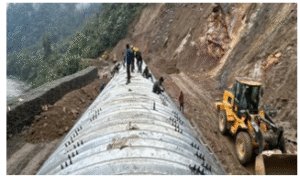
About Project Arunank
- Implemented by the BRO under the Ministry of Defence since 2008, Project Arunank is dedicated to constructing and maintaining strategic road connectivity in Arunachal Pradesh, primarily benefiting high-altitude and border zones.
- It enhances both civilian access and defence readiness through crucial transport corridors.
Major Achievements and Features
- Over 696 km of motorable roads and 1.18 km of major bridges have been built and maintained in some of India’s most challenging terrain.
- Key Highlight: The 278 km Hapoli–Sarli–Huri Road was blacktopped for the first time since Independence, linking remote Kurung Kumey to the transport grid.
- Advanced engineering solutions—like steel slag, geo cells, plastic sheets, and cut-and-cover tunnels—have been used to boost durability and environmental sustainability.
Environmental and Social Initiatives
- Under the “Ek Ped Maa Ke Naam” campaign, over 23,850 trees have been planted at project sites to help offset the ecological impact of road construction.
- Welfare measures for Casual Paid Labourers (CPLs) include upgraded shelters, safety gear, and regular health camps, reflecting attention to worker wellbeing.
9. Why has IUCN red flagged the western Ghats?
GS paper III-ENVIRONEMENT AND ECOLOGY
CONTEXT: IUCN released the World Heritage Outlook 4 report on Oct 12, 2025, assessing 271 natural/mixed World Heritage sites globally.
- India’s Western Ghats, Manas Wildlife Sanctuary, and Sundarbans National Park flagged as “significant concern” due to deteriorating conservation status.
Broader Asian and Global Findings
- 30% of assessed Asian sites now face “significant concern,” up from 26% in 2020.
- 43% of global sites face high/very high threats, mainly from climate change and infrastructure.
What is the IUCN World Heritage Outlook Report
- Assesses condition and trends in Outstanding Universal Value, threats, and site management.
- Reviews 271 sites (235 natural, 41 mixed) across 115 countries; uses IUCN Green List and expert reviews.
- Published every 3–5 years; fourth edition tracks conservation status since 2014.
Key Global Findings
- 61% of sites have positive outlook; 33% under significant concern; 43% face threat from climate change.
- Biodiversity features are declining in many sites; South and Southeast Asia among the most vulnerable regions.
Major Threats in South Asia
- Climate Change: Top risk—sea-level rise, extreme weather, affecting 43% of sites.
- Invasive Alien Species: Fast-rising, affecting forests and endemics in Ghats and Nilgiris.
- Infrastructure Development: Dams, roads, tourism facilities fragment habitats (rise since 2020).
- Overexploitation: Illegal fishing, logging, poaching reduce species, affecting tigers, endemics.
Status of Indian Sites (2025 Outlook)
- “Good”: Khangchendzonga National Park.
- “Good with Some Concerns”: Great Himalayan, Kaziranga, Keoladeo, Nanda Devi-Valley of Flowers.
- “Significant Concern”: Manas, Sundarbans, Western Ghats.
- “Critical”: None in India.
Why Western Ghats Red-Flagged
- In 2012, inscribed for ecological processes and biodiversity; one of eight global hotspots.
- Previously rated “good with some concerns”; now downgraded for rising threats.
- Key threats: infrastructure, agriculture, invasive species, logging, and climate-induced changes.
Sundarbans Issues
- Exposed to sea-level rise, salinity, erosion, loss of mangroves, and major cyclones.
- Faces high pollution, unsustainable extraction, and increasing port development.
Positive Global Expansions
- 29 sites improved since 2014, including African, South American, and Asian successes.
- Pest eradication and sustainable finance models (like blue bonds) highlighted as best practices.
Importance of the Report
- Tracks progress towards Kunming-Montreal targets and highlights finance/management needs.
- Guides conservation action, Indigenous engagement, and global SDG strategy.
- Urges urgent action as sites cover <1% of Earth but host >20% of its species richness