Need a law to protect domestic workers
GS Paper II: Role of judiciary, governance, and social justice initiatives
Context: Supreme Court (Jan 2025) directed the Union Government to form a committee for a comprehensive domestic workers’ law, report due by July 2025.
- As of October 2025, committee status is unclear and no law enacted, highlighting urgent need for protection.
- Ongoing op-eds and state legislation efforts (e.g., Karnataka, Tamil Nadu) spotlight delays amid rising exploitation cases.
Why the Supreme Court Stepped In?
- SC acted after pleas about exploitation and absence of national law, leading to abuse, trafficking, and lack of rights.
- Noted power imbalances, child labor, isolation, and need for enforceable protections and accountability in households.
Who Are Domestic Workers? Key Facts
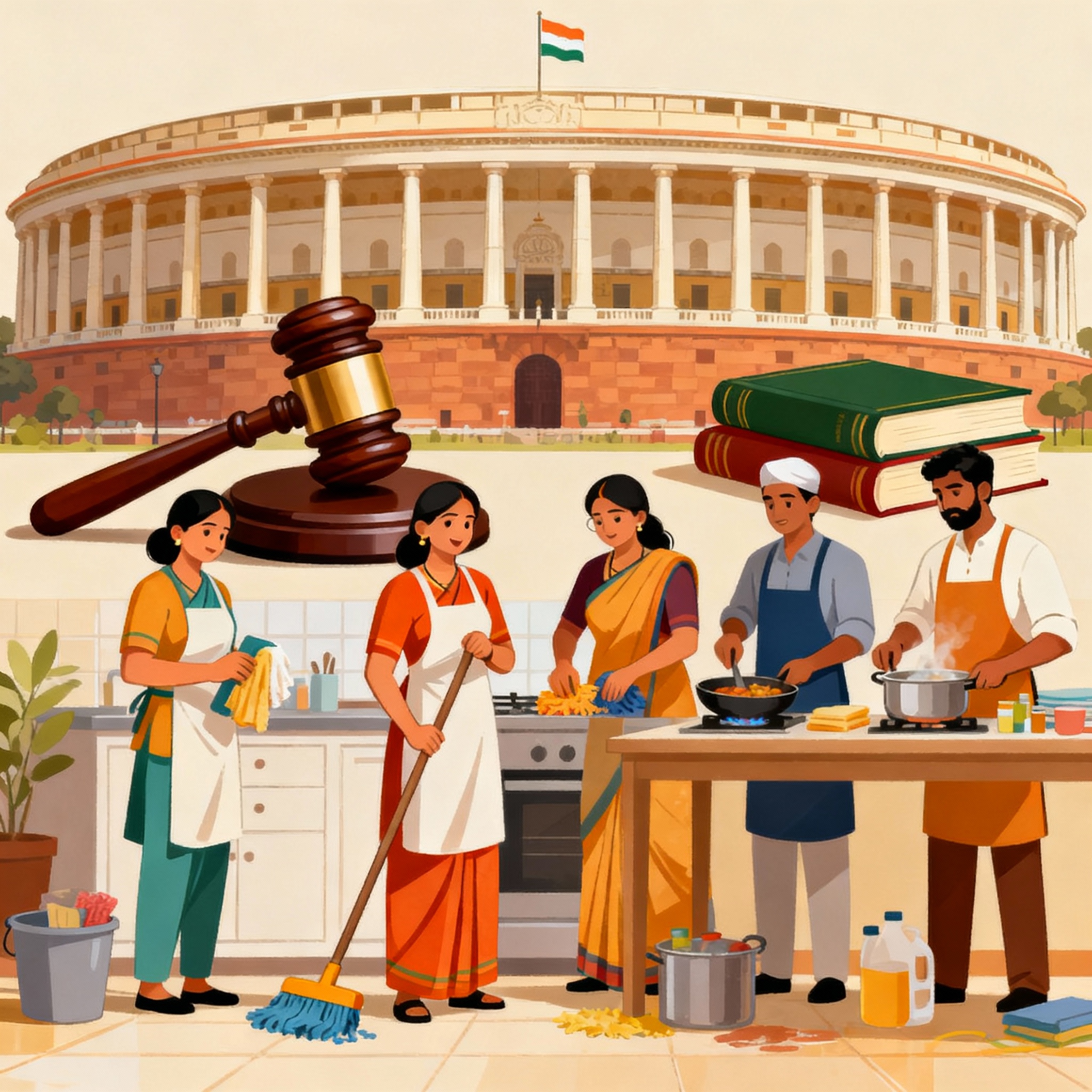
- Work includes cleaning, cooking, childcare, and elderly care; mostly women/migrants from marginalized backgrounds.
- No formal contracts, low pay, long hours; vulnerable to discrimination and abuse.
- India has 4–50 million domestic workers, majority from SC/ST communities and rural areas.
Challenges and Vulnerabilities
| Issue | Explanation |
| Exploitation/Abuse | Rampant child labor, sexual, physical abuse; isolation issues |
| Legal Protections | Lacks minimum wage, pensions, or regulated hours |
| Wage Theft | Below-market pay, irregular payments, no overtime |
| Health/Safety Risks | No insurance for hazardous conditions; vulnerable during crises |
| Trafficking/Confinement | Trafficked/migrant workers face restricted mobility |
| Discrimination | Based on caste, gender, and migration status |
International Framework – ILO Convention 189
- Sets global standards for contracts, wages, rest periods, and protection from abuse; ratified by over 30 countries.
- India voted in favor but hasn’t ratified, citing implementation challenges due to informality.
National Efforts So Far
- a) Legislative Attempts
- Bills since 1950s, Domestic Workers Bill (2017 and 2025) propose registration, minimum wages, and social security; progress slow.
b) Judicial Interventions
- SC (2025): Directed committee/report, but no status update as of Oct 2025.
- High Courts: Called for inclusion under existing labor laws and new frameworks for domestic workers.
State Level Measures – Progressive Examples
| State | Law/Initiative | Main Provisions |
| Tamil Nadu | Manual Workers Act, 1982; Welfare Board | Pensions, maternity aid, MW |
| Karnataka | Domestic Workers Bill (2025, draft) | Registration, written contract, MW, social security, tripartite board |
What Should the National Law Include
| Measure | Explanation |
| Minimum Wages/Hours | National wage, 8 hour limit, overtime, holidays |
| Written Contracts | Mandatory agreements for pay, duties, terms |
| Social Security | Pensions, insurance, maternity leave, welfare fund |
| Protection Mechanisms | Abuse/harassment complaints, inspections |
| Registration/Boards | Universal registration, boards for dispute |
| Inclusion | Child/migrant workers, anti-trafficking |
Why a National Law is Urgently Needed
- Absence of central law leads to exploitative conditions and fragmented rights.
- State solutions lack consistency and mobility protections for workers.
- Enacting a national law meets ILO standards, boosts India’s global labor reputation, and prevents exploitation.
Conclusion
- Supreme Court-mandated action stalled; urgent, comprehensive law still needed to protect millions of vulnerable workers.
- National law can harmonize worker rights, address exploitation, and foster fair employment practices.