

1. Russia backs AMCA, offers to make SU-57 jets India
GS III: Science and Technology:
Context: Russia has reaffirmed its commitment to deepen defence ties with India, offering support for local production of Su-57 fifth-generation fighter jets in support of the Advanced Medium Combat Aircraft (AMCA) programme.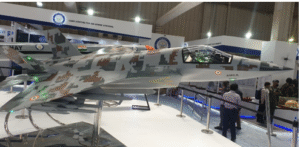
Background:
AMCA (Advanced Medium Combat Aircraft)
- Indigenous Indian fifth-generation stealth, multirole fighter for IAF and Navy.
- Designed by HAL and DRDO for air superiority, ground-attack, and multirole missions.
- Key features: stealth tech, advanced avionics, supercruise, internal weapons bay, composite structure.
- Supports roles: air supremacy, electronic warfare, ground-strike, and SEAD missions.
- Expected induction by 2035; focuses on “Make in India” and self-reliance.
- Joint engine development underway with France for a 120 kN class jet engine.
SU-57 Fighter Jet
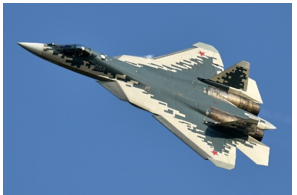
- Russian twin-engine, stealth fifth-gen multirole fighter for air superiority and strike.
- Features: stealth shaping, supermaneuverability, supercruise, advanced radar and EW suites.
- Developed under the PAK FA program, operational with Russian Air Force; Su-57E export model for partners.
- Carries internal and external weapons—missiles, guided bombs, precision munitions.
- Represents Russia’s most advanced combat aircraft, matching Western fifth-gen fighters.
Significance of Russia’s Offer
Strategic Level
- Strengthens India-Russia defence partnership through joint development and co-production.
- Stops gap for fifth-gen fighters until AMCA’s induction, counters China-Pakistan threats.
- Diversifies India’s defence procurement sources beyond Western suppliers.
- Demonstrates Russia’s commitment to deep, flexible defence ties with India.
Technological Level
- Facilitates technology transfers in stealth, avionics, and EW systems for AMCA.
- Enables local production of Su-57, boosting Indian aerospace manufacturing skills.
- Allows sharing of next-gen tech like radars and precision strike tools.
- Helps bridge the gap until AMCA achieves full operational capability.
Economic Level
- Involves investments in Indian production lines, creating jobs, and boosting tech industry.
- Lowers long-term costs via domestic maintenance and manufacturing.
- Supports “Make in India” and defence export ambitions through potential joint products.
- Provides cost-effective solutions amid fluctuating global prices.
Energy & Geopolitical Context
- Announcement comes amid US pressure over India-Russia oil trade, with Russia assuring continued energy cooperation.
- Russia highlights flexibility in logistics and payments, ensuring India’s energy security.
- Reinforces India’s multi-alignment, balancing ties with Russia and the West.
- Maintains Russia’s strategic leverage via defence and energy partnerships.
Future Cooperation Areas
- Both sides to collaborate in advanced fighter technologies and stealth systems.
- New projects include anti-drone systems and cutting-edge radar solutions.
- Focus on precision strike capabilities and next-generation weapons technology.
- Emphasizes joint development, co-production, and full technology transfer.
2. SAIME Model
GS paper III-Environment and ecology
Context: The SAIME model was awarded FAO’s Global Technical Recognition during the organization’s 80th Anniversary at the World Food Forum in Rome, Italy, on October 15, 2025.
- Developed by the Nature Environment and Wildlife Society (NEWS) in West Bengal’s Sundarbans, it showcases a successful blend of environmental and livelihood goals.
What is the SAIME Model?
- SAIME is an ecosystem-based, climate-adaptive, and conservation-linked livelihood initiative integrating 5%–30% mangrove cover into aquaculture ponds, primarily shrimp farming.
- It is a multi-stakeholder partnership involving local communities, NGOs, and international partners to restore mangroves alongside productive, chemical-free shrimp aquaculture.
Concept: Integrating Mangrove with Aquaculture
- Traditional Problems
- Conventional shrimp farming often involves clearing vast tracts of mangrove forests, leading to habitat loss, coastal erosion, reduced biodiversity, and increased vulnerability to storms.
- Dependency on commercial feed and chemicals raises production costs and creates pollution.
- SAIME Innovation
- Mangrove seedlings are planted within aquaculture ponds and embankments, stabilizing soil, promoting biodiversity, and providing natural feed (leaf litter) for shrimp.
- Farmers use mangrove litter as fodder, minimizing input costs and avoiding chemical feed and antibiotics, thus enabling more resilient, cost-effective, and ecologically harmonious farming.
Environmental & Ecological Benefits
| Benefit | Explanation |
| Coastal resilience | Mangroves buffer against cyclones, storm surges, and coastal erosion. |
| Carbon sequestration | Mangroves trap carbon, mitigating climate change. |
| Biodiversity conservation | Enhanced mangrove cover supports diverse fauna, birds, and aquatic species. |
| Habitat restoration | Restored mangrove ecosystems replenish degraded coasts and embankments. |
| Water quality improvement | Mangroves filter pollutants and stabilize soil, improving pond health. |
Economic & Social Benefits
| Benefit | Explanation |
| Reduced input costs | Mangrove litter serves as natural feed, minimizing need for commercial feeds. |
| Higher profitability | Farmers’ annual net profit increased over 100% due to lower production costs. |
| Sustainable livelihoods | Supports local income and community empowerment, especially among marginal farmers |
| Community ownership | Participatory model strengthens social cohesion and joint resource management. |
| Skill development | Training in sustainable aquaculture and nursery management boosts local expertise. |
Why Did the FAO Recognise It?
- The model sets a replicable benchmark for integrating nature-based solutions with food production, supporting “better environment, better nutrition, and better life” goals central to FAO’s mission.
- Its innovation lies in balancing climate adaptation, biodiversity restoration, and economic sustainability, addressing urgent food-security and climate-crisis challenges.
Global Relevance
- The approach offers scalable lessons for coastal regions worldwide facing similar threats of habitat loss, climate change, and the need for sustainable aquaculture.
Challenges Ahead
| Challenge | Explanation |
| Scaling the model | Wider adoption requires more technical training, policy support, and investment. |
| Climate change impacts | Rising sea levels, shifting salinity, and increasing cyclones challenge farm stability. |
| Socio-economic barriers | Marginal farmers need financial and institutional support to transition away from intensive monocultures. |
| Conservation vs. production | Balancing ecosystem health with commercial output remains complex. |
3. GOVT. seeks to boost defence exports to ₹50,000 crore by 2029
GS paper III -SCIENCE AND TECHNOLOGY
Context: The Indian government aims to boost annual defence exports to ₹50,000 crore by 2029 and expand the domestic defence manufacturing ecosystem to ₹3 lakh crore, as announced by Defence Minister Rajnath Singh.
Key Data Highlights
| Indicator | Past (Approx.) | Present | Target (2029) |
| Annual defence production | ₹46,000 crore | ₹1.5 lakh crore | ₹3 lakh crore |
| Defence exports | (NA, low) | ₹33,000 crore | ₹50,000 crore |
- Private sector’s contribution to defence exports stands at ₹33,000 crore currently.
Context: Why It Matters
Strategic Importance
- Reduces India’s reliance on foreign arms, fostering national security and self-sufficiency.
- Supports indigenous military modernization, making India a global defence hub.
Economic Significance
- Defence manufacturing expansion creates jobs and drives industrial growth.
- Higher exports improve the balance of payments and attract investment.
Geopolitical Impact
- India’s emergence as an arms exporter strengthens diplomatic leverage and strategic alliances.
- Reduces vulnerability to international embargoes or disruptions in supply chains.
Government Initiatives Driving Defence Self-Reliance
- Policy reforms: Introduction of laws and policies promoting defence production post-independence.
- Institutional support: Empowering defence-related institutions and promoting R&D through DRDO and private partnerships.
- Security support: Fostering an environment for private sector investment and innovation in defence.
Role of Private Sector
- Private companies are central in boosting production and exports, with an active role in indigenous equipment design and manufacture.
- Collaboration with public institutions ensures timely deliveries and cutting-edge innovations.
Operation Sindoor – Symbol of Self-Reliance
- Operation Sindoor showcased India’s self-reliance, using indigenously developed and produced equipment in active missions.
- Recognized as an example of “Made-in-India” military capability and operational success.
Historical Context: Lack of Political Will After Independence
- Post-independence, India lacked the political will and legal frameworks for robust arms production and youth engagement in defence manufacturing.
- The renewed push in recent years has reversed this trend, catalyzing reforms and self-reliance.
Pune’s Role in the Defence Ecosystem
- Pune, hosting multiple defence establishments and Southern Command headquarters, is a major centre for defence R&D, manufacturing, and skill development.
- Its ecosystem acts as a hub for innovation, tradition, and advanced defence contributions.
4. DRDO to extend Astra Mark 2 missile’s range beyond 200km
GS paper III -SCIENCE AND TECHNOLOGY
Context: The Defence Research and Development Organisation (DRDO) is developing an extended-range variant of the Astra Mark 2 beyond-visual-range (BVR) air-to-air missile.
What is Astra Mark 2?
- Indigenous BVR (Beyond Visual Range) air-to-air missile, boosting the Indian Air Force’s interception range.
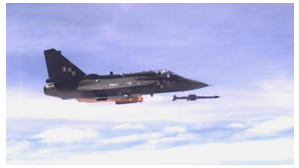
- Builds on Astra Mark 1 legacy and supports India’s self-reliance mission in advanced missile tech.
Core Features and Innovations
- Dual-Pulse Propulsion: Uses dual-pulse solid rocket motor for longer, sustained thrust compared to Mk-1.
- Operational Range & Speed: Can engage targets at 150–200+ km, achieving up to Mach 4.5.
- Advanced Guidance: Fitted with indigenous RF seeker and robust ECCM for precision even in contested zones.
- Operational Flexibility: Effective day/night, in adverse weather, with off-boresight and data-link targeting.
- Stealth Launch: Smokeless propellant reduces missile visibility on launch.
Integration and Collaboration
- Designed for Su-30 MKI, LCA Tejas, with plans for Rafale, AMCA, TEDBF jets.
- Developed with contributions from over 50 industry partners, including HAL and BDL.
Recent Developments
- Range pushed beyond initial 160 km; upcoming version enters the 200+ km class.
- India plans acquisition of 700+ Astra Mk-2 units for fighter fleet standardization.
Strategic Significance
- Matches capability with PL-15 (China) and AIM-120D AMRAAM (US), improving deterrence.
- Supports Atmanirbhar Bharat in missile autonomy, forms basis for Astra Mark 3 with advanced ramjet propulsion.
Astra Mark 2 is setting a new benchmark in indigenous air-to-air missile technology, securing India’s skies with advanced homegrown systems.
5. States must set up special prisons for fugitives
GS Paper II (Polity & Governance), GS Paper III (Internal Security & challenges).
Context: Union Home Minister Amit Shah urged states to set up special prisons for fugitives and outlined a comprehensive strategy for effective extradition and bringing back criminals hiding abroad.
Why the Issue?
- Fugitives evade extradition claiming Indian prisons do not meet global standards, hampering India’s ability to prosecute offenders.
- Their continued presence abroad threatens India’s sovereignty, economy, law and order, and national security.
Key Provisions by Amit Shah
- a) Special Prisons for Fugitives
- States must create prisons meeting international standards to counter foreign legal objections and facilitate extradition.
- b) Coordination between Passport and Law Enforcement
- Mechanisms to flag or cancel passports of fugitives upon issuing Red Corner Notices, curtailing their mobility abroad.
- c) Conversion of Notices
- Existing Blue Corner Notices should be converted into Red Corner Notices for stronger international law enforcement action.
- d) Creation of Multi Agency Task Force
- Establishment of a dedicated special task force (under MAC) to oversee tracking and implementation of fugitive retrieval across agencies.
- e) Zero Tolerance Policy
- Adopting a stringent, “zero-tolerance” approach to expedite bringing fugitives and economic offenders who harm India’s interests back to justice.
Key Conference Themes
- Discussion on cybertechnology, financial crimes, tracing the flow of funds, simplifying extradition, creating fugitive databases, and international cooperation.
Significance of These Measures
- Enhances governance by closing legal loopholes and strengthening institutional cooperation.
- Upholds rule of law, deters economic offenders, and improves India’s ability to protect sovereignty and public order.
Key Challenges in Extradition Process
| Challenge | Description |
| Prison standards objection | Foreign courts refuse extradition citing poor prison quality. |
| Legal complexities | Complex and prolonged legal processes in foreign jurisdictions. |
| Limited coordination | Lack of synergy between passport authorities and law enforcement. |
| International protocols | Stringent global norms for prisoner treatment and human rights. |
| Tracing fugitives | Difficulty in tracing financial crimes, assets, and locations. |
India’s Current Efforts
- Active use of Red Corner Notices and passport cancellation to restrict fugitives’ movement.
- Organizing high-level conferences to develop strategies and harmonize multi-agency efforts.
- Implementing databases for fugitive tracking and enhancing cyber and financial crime investigation capacity.
- Expanding cooperation with international agencies and streamlining extradition protocols.
6. India’s open natural ecosystems are increasingly threatened, IUCN Redlist update shows
GS paper III-Environment and ecology
Context: The State of India’s Birds (SoIB) 2025 report and IUCN Red List have uplisted four Indian bird species due to rapid habitat loss and declining populations.
- The update highlights the crisis facing India’s grasslands and open ecosystems, vital for many endemic species.
Bird Species Uplisted by IUCN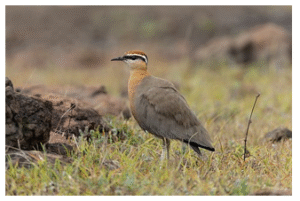
- Indian Courser (Cursorius coromandelicus):
Endemic to India; moved from Least Concern → Near Threatened due to loss of grasslands and fallow land. - Indian Roller (Coracias benghalensis):
Uplisted to Near Threatened; impacted by widespread habitat conversion and electrocution from power lines. - Rufous-tailed Lark (Ammomanes phoenicura):
Now Near Threatened; decline driven by intensive agriculture and land-use change. - Long-billed Grasshopper-Warbler (Locustella major):
Uplisted to Endangered due to reedbed and scrub habitat destruction.
About the State of India’s Birds (SoIB) Report
- Conducted by the State of India’s Birds Partnership, a collaboration of 13 organisations, including BNHS, WII, ZSI, SACON, WTI, WWF-India, ATREE, NCF, and Wetlands International – South Asia.
- Assessment used citizen-science data from eBird, analysing long-term population and habitat trends.
- Out of 1,360 global bird species assessed, 12 were from India — 8 downlisted and 4 uplisted.
Key Findings
- Decline is most severe in open-country birds like grassland and scrubland species.
- Habitat degradation from agriculture, infrastructure expansion, and afforestation of open lands are key threats.
- The report urges action beyond protected areas, emphasizing conservation of human-dominated landscapes.
Why It Matters
- The uplisting of these birds signals a broader ecological crisis for India’s disappearing grasslands, often overlooked in conservation planning.
- It also underscores the power of citizen science in influencing IUCN assessments and guiding targeted policies for ecosystem conservation