
1. 2025 Nobel Prize in Physiology or Medicine
GS-III: “Science and Technology GS-III: “Health – Issues Related to Public Health”
Context: The Nobel Prize was awarded on October 7, 2025, to Mary E. Brunkow, Fred Ramsdell, and Shimon Sakaguchi.
- Recognizes their groundbreaking discoveries on regulatory T cells (Tregs) and the FOXP3 gene.
- Their work revealed how the immune system prevents attacks on the body’s own tissues, advancing treatments for autoimmune diseases, cancer, and transplantation.
Background: What the Prize Recognizes
- Identified regulatory T cells (Tregs) as immune “security guards” that suppress harmful immune responses.
- Showed peripheral immune tolerance, active suppression outside the thymus, prevents autoimmunity.
- Shifted understanding from passive elimination to dynamic immune regulation.
Laureates’ Key Contributions
- Shimon Sakaguchi (1995): Discovered CD4+CD25+ Tregs that prevent autoimmune diseases in mice.
- Mary Brunkow & Fred Ramsdell (2001): Identified FOXP3 gene as master regulator of Treg development.
- Linked FOXP3 mutations to severe autoimmune syndrome (IPEX) in mice and humans.
Problem Before the Discovery
- Immune tolerance was thought to rely only on thymus-based deletion of self-reactive T cells.
- Could not fully explain autoimmunity or develop targeted therapies.
- Existing immunosuppressants cause broad effects and infection risk.
Sakaguchi’s Breakthrough
- Identified special Tregs that actively suppress auto-reactive T cells.
- Demonstrated that absence of Tregs causes multi-organ autoimmunity.
- Conceptualized peripheral immune tolerance beyond central tolerance.
Impact on Immunology
- Redesigned view of immune regulation as a balance between attack and suppression.
- Revealed molecular mechanisms such as IL-2 signaling in Treg function.
- Initiated large-scale research, influencing vaccines, cancer, allergy, and microbiome fields.
FOXP3 Gene Discovery
- Discovered by Brunkow & Ramsdell in 2001 in scurfy mice with fatal autoimmunity.
- Showed FOXP3 is required for Treg formation and function.
- Human relevance confirmed via IPEX syndrome linkage.
- Sakaguchi confirmed FOXP3’s role as “master gene” for Tregs.
Medical Applications Today
- Autoimmune diseases: Treg therapies reduce inflammation without wide immunosuppression, eg. IL-2 expansion.
- Organ Transplantation: Tregs promote graft tolerance, reducing immunosuppressant needs.
- Cancer: Strategies aim to inhibit tumor-protecting Tregs to enhance anti-tumor immunity.
Ethical and Policy Considerations
- Need equitable access to expensive Treg therapies to avoid health disparities.
- Risks of immune over- or under-suppression require vigilant monitoring.
- Gene editing of FOXP3 raises germline ethics debates.
- Regulatory harmonization needed for global trials and standards.
- Public-private investment critical for translating research to therapies.
2. INS Androth
GS-I: Geography (focus on India’s maritime boundaries, coastal security, and strategic islands like Androth).
GS-III: Security and Defence (focus on naval modernization, indigenous shipbuilding, and maritime security challenges).
Context: INS Androth’s induction reflects a milestone in naval modernization and Atmanirbhar Bharat.
- Second ASW-SWC vessel in a planned series of 16, following INS Arnala’s recent induction.
- Reinforces India’s emphasis on coastal defense amid increasing submarine threats from regional adversaries.
What the News Says ?
- Commissioned on October 6, 2025, at Visakhapatnam, led by Vice Admiral Pendharkar.
- Built by GRSE, 77m long, 1,500 tonnes, designed for anti-submarine operations in shallow/coastal waters.
- Features advanced indigenous machinery, 80%+ local content, and modern ASW systems.
- Enhances Navy’s capability against underwater threats and supports low-intensity operations.
Technical Specifications
| Parameter | Specification |
| Length | 77.6 meters |
| Beam | 10.5 meters |
| Displacement | 1,490–1,500 tonnes (full load) |
| Propulsion | 3 diesel engines, water-jet propulsion |
| Maximum Speed | 25 knots |
| Range | 1,800 nautical miles at 15 knots |
| Draft | ~3 meters for shallow ops |
| Armament | 76mm SRGM, twin torpedo tubes, RBU-6000, lightweight torpedoes |
| Sensors | Hull/VDS sonar, EW suite, advanced comms |
| Crew | About 57 personnel |
| Indigenous Content | Over 80% |
What are ASW-SWC Ships?
- Compact corvettes for anti-submarine operations in near-shore waters.
- Part of Arnala-class (GRSE) and Mahe-class (CSL) series for the Navy.
- Agile, low-draft, and optimized for restricted, shallow water zones.
Why Shallow Water?
- Littoral areas allow submarines to hide or lay mines along coasts and EEZ boundaries.
- Ships have low draft, quiet water-jet propulsion, and superior maneuverability for chokepoint patrols.
Key Tasks
- Subsurface surveillance with sonar arrays.
- Search/attack hostile subs using torpedoes/rockets.
- Counter and clear mines in shallow waters.
- Escort amphibious/merchant ships in low-risk areas.
- Integrate into networked ASW ops alongside larger assets.
Significance for India’s Maritime Security
- Counters submarine threats from Pakistan/China in the Indian Ocean.
- Persistent patrols protect islands, harbors, and 2 million sq km EEZ.
- Promotes indigenous industry, supporting plans for a 200+ ship Navy.
- Enables strategic deterrence, supports QUAD and SAGAR goals.
The Arnala Class Series
- 8 vessels by GRSE (₹6,000 crore deal, 2019); 8 more by CSL for Navy induction through 2029.
- INS Arnala delivered May 2025, commissioned June 2025; INS Androth is the second, with more ships in pipeline.
- Indigenous design emphasizes stealth, modularity, and DRDO integration.
Naming Pattern
- Named after coastal islands/heritage sites, strengthening maritime legacy.
- INS Arnala (Maharashtra), INS Androth (Lakshadweep); focus is on defending critical island chains.
Strategic Pattern
- Shifts emphasis toward littoral anti-submarine warfare and away from deep-sea dominance.
- Over 80% indigenous content boosts MSME and technology transfer.
- Part of India’s Navy expansion for area denial in IOR, interlinked with other assets.
- Counters “String of Pearls” strategy, supports SAGAR for regional maritime security.
Strategic Context
| Aspect | Explanation |
| Project Origin | Started post-26/11, upgrades Abhay-class for robust near-shore ASW roles |
| Builder Split | 8 ships by GRSE, Kolkata (Arnala-class); 8 by CSL, Kochi (Mahe-class) |
| Tech Edge | Water-jet propulsion, DRDO sonar for quiet, stealthy sub-hunting |
| Op. Base | Initially at Visakhapatnam; eventual spread to island commands |
| Challenges | Faced certification/delivery issues, overcame via phased trials |
| Future | Scalable for upgrades/exports; aligns with Navy’s long-term force goals |
3. India prepares a new Nuclear Bill
GS-III: “Science and Technology – Developments in Energy Sector”
Context: India prepares a new Nuclear Bill to open the sector for private/foreign investment, boost clean energy, and accelerate Atmanirbhar Bharat.
- The reform aims to update laws controlling nuclear power generation, safety, and liability as India targets major expansion of nuclear capacity by 2047.
Current Legal Framework for India’s Nuclear Sector
| Law / Aspect | Status / Provision |
| Atomic Energy Act, 1962 | Centralizes all nuclear activities, only public bodies (NPCIL/DAE) manage sector, exclusive control |
| Civil Liability for Nuclear Damage Act, 2010 | Assigns strict operator liability, Rs 1,500 crore cap; right of recourse against suppliers; government liable up to 300 million SDR |
| Regulatory Bodies | Department of Atomic Energy (DAE) manages all nuclear activities and policy |
| Private Investment Provisions | Not permitted for plant operation or R&D; JVs possible only with PSUs, not private sector |
Why a New Nuclear Bill?
- Meet rising future energy needs by massively scaling clean baseload capacity.
- Accelerate self-reliance in advanced nuclear tech and local manufacturing.
- Enable private investment, PPPs, and tech transfer to speed up deployment.
Legal & Policy Obstacles (Existing)
| Obstacle | Details |
| Atomic Energy Act, 1962 | Only public sector can operate, limits private entry |
| CLND Act, 2010 | Ambiguous supplier liability, strict caps, burdens operators and deters private/JV participation |
| Regulatory Monopolies | DAE controls all licensing, tariffs, and management |
Global Context – Liability Conventions
| Feature | CSC (Convention on Suppl. Comp.) | India Law (CLND Act, 2010) |
| Operator Liability | Strict, capped, only on operator | Yes, strict, capped, operator |
| Supplier Liability | Not enforced by CSC, only for negligence | Broader, can extend to suppliers by Section 17 |
| Claims Mechanism | International pool for claims over national cap | Government covers over operator’s capped liability |
| India’s Status | Ratified CSC in 2016, unique dual liability regime | Section 17(b) grants operator recourse, debated constitutionality |
Key Policy Questions Under Debate
- Who manages nuclear waste and safeguards environmental impact—public body, private JV, or both?
- Can private firms lead R&D, reactor design, and deployment under new law?
- How will liability and compensation be structured between operators and suppliers, for victim protection and global compatibility?
India’s Emerging Nuclear Strategy
- Public-private partnerships (PPP) for faster, flexible deployments.
- Rollout of Bharat Small Reactors (BSRs) and Small Modular Reactors (SMRs) for decentralised clean energy.
- Networked deployment across states, islands, and industrial zones for grid resilience.
Significance of the Proposed Nuclear Bill
| Dimension | Benefit |
| Capacity Expansion | Scales nuclear power significantly for net zero targets |
| Technology Transfer | Enables faster adoption of latest global reactor designs |
| Atmanirbhar Bharat | Nurtures local supply chains, manufacturing jobs |
| Investment Attractiveness | Draws private & foreign funds for infrastructure |
| Safety & Governance | Modernizes regulatory oversight, aligns with global norms |
Challenges & Concerns
| Concern | Explanation |
| Regulatory Bottlenecks | DAE monopoly, risk of red-tape and slow approvals |
| Liability Uncertainties | Supplier liability extension may deter investment; global misalignment |
| Safety and Security | Ensuring robust mechanisms before private entry |
| Transparency/Accountability | Need to strengthen checks, public oversight for expanded sector |
| Nuclear Waste Handling | Unclear division of responsibilities for long-term waste management |
| Constitutional Challenges | CLND Act liability cap challenged in Supreme Court (right to life) |
4. Fisheries sector hopes to beat U.S curbs with sustainability label
GS-III: “Economy – Agriculture and Allied Sectors”
GS-III: “Environment – Conservation and Sustainable Development”
Context: India is fast-tracking MSC certification for seafood after the US imposed a 59.71% cumulative tariff on frozen shrimp in August 2025, threatening $1 billion in annual exports and sector growth.
- The focus is on eco-labels to show sustainable practices, bypass US/EU curbs, and unlock premium pricing in Europe/Japan for export-led growth.
Background – India’s Fisheries Sector
- Second-largest fish producer globally, with 8% of world output and 18 MT annual production.
- Marine and inland fisheries support 14+ million livelihoods, ~1.1% of GDP, and $8 billion in exports (60% shrimp).
- Growth driven by PMMSY investments, export regulations (MPEDA), and infrastructure upgrades.
- Addressing challenges of overfishing, antibiotics, and global sustainability norms to protect access to top markets.
Fisheries and Sector Details
| Aspect | Marine Fisheries | Inland Fisheries | Sector Highlights |
| Production (2023-24) | 4.7 MT (shrimp: 0.8 MT) | 13.3 MT (carp, prawns) | 18 MT; 8% annual growth |
| Key Species | Shrimp, squid, octopus, tuna | Rohu, catla, prawns, tilapia | Shrimp=60% exports |
| Employment | 4 million coastal fishers | 10 million in aquaculture | 14+ million total; 40% women |
| Export Value | $5B (70% total exports) | $3B (processed products) | US: 25%, EU: 20%, Japan: 10% |
| Sustainability Focus | 70% stocks overfished | High antibiotic usage | MSC push for 10 eco-labelled types |
| Infrastructure | 13 major harbors, EEZ: 2M km² | 2.5M ha ponds, 500+ hatch. | 200+ seafood units, cold chain gaps |
The Issue – US Curbs on Indian Seafood
- Since 2004, US applies anti-dumping/countervailing duties; August 2025 review raised shrimp tariffs to 59.71%.
- Indian exporters face 20% revenue loss, reduced US share from 30% to 25% of exports.
- Forces diversification and pushes sustainable certification to regain and expand global market share.
What is Marine Stewardship Council (MSC) Certification?
| Aspect | Description |
| Definition | Leading global standard for wild-capture fishery eco-certification |
| Principles | 1) Sustainable stocks; 2) Minimize ecosystem impact; 3) Effective governance |
| Process | 3-5 year audit (pre-assessment, evaluation, annual/5-yr recertification) |
| Scope | Applies to marine capture fisheries (not aquaculture), covers 400+ fisheries globally |
| Benefits | Eco-labeled products fetch 10-30% premium, key for EU/Japan access |
| Market Assurance | Signals traceability, legal & sustainable catch to buyers |
India’s Certification Plan
- Varieties Targeted: Shrimp (vannamei/black tiger), squid, cuttlefish, octopus, select finfish.
- Process: Began in 2020; FIPs→technical audits by SSNI/MPEDA→full MSC bid by 2026.
- Government Support: Subsidies under PMMSY; technical help via MPEDA, research by CMFRI.
- Key Officials: Fisheries Commissioner K. M. Koya; MPEDA Chairman; CMFRI scientists; MSC India head Ranjit Suseelan.
Why This Matters – Benefits & Implications
- Economic: Premium (10-30%) pricing, offsets US/EU non-tariff barriers, stabilizes $8B exports.
- Environmental: Encourages bycatch controls, reduces overfishing in India’s EEZ, aligns with SDG 14.
- Social/Livelihood: Helps 4M small fishers adopt sustainable practices, boosts women’s processing jobs (40% of sector).
- Trade/Geopolitics: Bypasses US/EU curbs, strengthens India’s Indo-Pacific export role, rivals Norway/Chile.
- Policy: Accelerates Atmanirbhar goals for traceable, high-value seafood, and domestic innovation.
Challenges
- Technical: Long, costly audits (₹5-10 cr/fishery), patchy data on stocks, certification only for well-tracked fisheries.
- Compliance: 50%+ vessels lack monitors; high antibiotic use in aquaculture can bar entry.
- Market Risks: Tightening EU rules, competing certified suppliers (Thailand, Vietnam).
- Environmental: Climate change shifts fish stocks, illegal foreign fishing hinders compliance claims.
- Implementation: Requires coordination across states, tech upgrades, and persistent post-certification efforts.
5. Why MGNREGA norms were tweaked to push spending on water projects
GS paper -II: Governance, Issue: MGNREGA
Context: Recent amendments to Schedule-1 of MGNREGA are designed to address India’s water crisis by increasing funding for water conservation and harvesting projects.
What is MGNREGA?
|
The Latest Amendment: Prioritizing Water Projects
- On September 2025, the Ministry of Rural Development amended Schedule-1 of MGNREGA.
- Focus Area: The amendment emphasizes water conservation and harvesting activities.
- New Provision: A new clause in Paragraph 4 guides the prioritization of works by Gram Panchayats during Gram Sabha meetings.
- Fund Allocation Criteria: Allocation of funds for water-related projects will depend on the groundwater extraction status of each rural block.
- Classification System: The Central Ground Water Board (CGWB) classifies blocks as “over-exploited,” “critical,” “semi-critical,” or “safe”, which determines funding priority.
The new norms:
- Over-exploited blocks (groundwater extraction > 100%): minimum 65% of MGNREGA works’ costs to be spent on water conservation, harvesting, and related works.
- Critical blocks (groundwater extraction 90–100%): also 65% spending on water projects.
- Semi-critical blocks (extraction 70–90%): 40% minimum.
- Safe blocks (extraction ≤ 70%): 30% minimum.
States Expected to Benefit Most
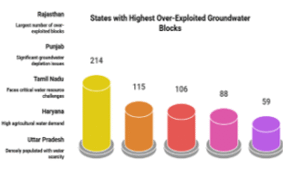
- According to the CGWB’s National Compilation on Dynamic Ground Water Resources of India, 2024, a significant number of blocks are categorized as “over-exploited” in several states.
- Out of the total 6,746 blocks in the country, 751 (11.13%) were assessed as ‘over-exploited’, 206 blocks (3.05%) as ‘critical, 711 blocks (10.54%) as ‘semi-critical, and 4,951 blocks (73.39%) as ‘safe’ in 2024.
- The remaining 127 blocks were assessed as having salinity.
The MGNREGA amendment prioritizing water conservation and harvesting seeks to combat water scarcity, boost groundwater recharge, enhance farm productivity, and strengthen climate resilience in rural India.
6. Blizzard
What is a Blizzard?
- A blizzard is a powerful mid-latitude snowstorm with intense winds (≥56 km/h), freezing temperatures, and visibility reduced to near zero by blowing snow.
- It forms when cold air masses meet moist air, resulting in heavy snow and violent winds.
How Does a Blizzard Form?
- Cold Air Source: Cold, dense air from polar regions or high mountains allows for snow formation instead of rain.
- Moisture Supply: Moisture-laden air from oceans or large lakes fuels condensation and snowfall.
- Uplift Mechanism: Warm, moist air is forced upward—either by fronts or mountain slopes (orographic uplift)—creating thick snow clouds.
- Pressure Gradient: A steep difference in air pressure drives the strong winds that carry snow horizontally and blunt visibility.
Main Features of a Blizzard
- Wind Speed: Typically 80–100 km/h, sometimes exceeding 120 km/h.
- Temperature: Remains below freezing, with wind chill making it feel colder.
- Visibility: Drops under 0.4 km for at least three hours, leading to dangerous whiteout situations.
- Duration: Can last from several hours to days, often followed by cold waves.
Types of Blizzards
- Ground Blizzard: Strong winds lift already fallen snow, reducing visibility without new snowfall.
- Nor’easter: Coastal blizzards common along the North Atlantic, bringing heavy snow and strong winds.
Environmental and Human Impact
- Environmental Effects:
- Triggers avalanches, deepens snow cover, and temporarily increases glacier size.
- Alters the Earth’s reflectivity (albedo) and influences regional climate patterns.
- Human Effects:
- Risks include frostbite, hypothermia, and fatalities for trekkers or locals exposed to extreme cold.
- Causes transport bottlenecks, disrupts communication, and damages power lines due to heavy snow and wind.
Blizzards are dangerous weather phenomena, especially in mountainous or polar regions, and require careful preparedness and monitoring.
7. IUCN World Conservation congress 2025
Context: India will launch its first-ever Red List of Endangered Species at the IUCN World Conservation Congress 2025 in Abu Dhabi. The IUCN Congress is a major global event that shapes nature conservation strategies and policies worldwide.
What is the IUCN World Conservation Congress?
- The IUCN World Conservation Congress (WCC) is a global summit held every four years by the International Union for Conservation of Nature (IUCN).
- It gathers governments, NGOs, scientists, businesses, and indigenous groups to define priorities for biodiversity, climate action, and sustainable development.
- This congress is considered the world’s most important forum for conservation policy.
Congress History and Participation
- The first IUCN Congress was held in 1948; India has been a member since 1969.
- The last meeting was in Marseille, France, in 2021, with a focus on post-pandemic recovery, biodiversity loss, and climate change.
- Over 9,000 delegates are expected, including global leaders, scientists, and multilateral organizations like the CBD, UNFCCC, Ramsar Convention, and UNEP.
Key Themes for 2025 Congress
- Resilient Conservation: Scaling up ecosystem restoration and species protection.
- Climate Risk Reduction: Accelerating climate mitigation to avoid ecological tipping points.
- Equity in Conservation: Ensuring conservation is inclusive and community-led.
- Nature-Positive Economies: Advancing sustainable production, circular economies, and green finance.
- Disruptive Innovation: Using technology, AI, and youth leadership to drive conservation breakthroughs.
Main Features and Activities
- Policy Voting: 1,400+ member organizations vote on critical conservation resolutions.
- Innovation Exchange: Forum for sharing new research, technologies, and nature-based solutions.
- Networking: Connects diverse groups for coordinated conservation efforts.
- Public Engagement: Outreach with exhibitions, films, and educational initiatives.
Expected Outcomes
- Approval of a Global Conservation Declaration, setting the direction for achieving 2030 biodiversity goals.
- Recognition of India’s national Red List as a step toward global biodiversity monitoring and species protection.