

1. Exercise KONKAN 2025
(GS) Paper II -(International Relations)
GS Paper III (Security, Technology, Environment, Disaster Management).
Context: Exercise Konkan 2025 began on October 5, 2025, with first-ever full Carrier Strike Group participation by both India and the UK.
- Upgraded cooperation amid Indo-Pacific tensions reflects deeper maritime security alignment.
- Coincides with UK’s Operation Highmast, demonstrating global naval reach and defense partnerships.
What is Exercise Konkan
- Biennial India–UK maritime exercise launched in 2004 to boost interoperability and joint capabilities.
- Focuses on maritime domain awareness, combined maneuvers, and air–sea integration.
- Features harbor phase for planning and sea phase for tactical drills, cross-deck ops, and exchanges.
Latest Edition 2025 – Key Highlights
- Dates & Location: From October 5–12, 2025, in the Arabian Sea off India’s west coast.
- Participants: UK CSG led by HMS Prince of Wales; India led by INS Vikrant and supporting warships.
- Scale: Largest Konkan yet; over a dozen ships, multi-domain assets.
- Phases: Harbor (interactions, planning), Sea (live-fire, warfare drills).
- Inaugural Day: Anti-submarine, surface warfare tactics, personnel exchanges.
What is a Carrier Strike Group (CSG)?
- Carrier-centric naval task force for power projection, air dominance, and multi-domain operations.
- Includes an aircraft carrier, destroyers, frigates, submarines, and support ships.
- Example: UK’s 2025 CSG—HMS Prince of Wales, Type 45 destroyers, frigates, Astute-class submarines, F-35B jets.
Operations in Exercise Konkan 2025
- Harbor Phase: Interactions, joint planning, expert exchanges.
- Sea Phase: Anti-submarine drills, surface/air warfare, cross-deck flying, maritime interdiction, search & rescue.
- Main Focus: Multinational maritime-air capability, upholding rules-based order.
Operation Highmast
- UK’s eight-month global deployment (Sept 2025–Apr 2026) led by HMS Prince of Wales.
- CSG visits allies, conducts joint exercises (Konkan, RIMPAC), boosts operational/humanitarian presence.
- Konkan integrates into Highmast’s Indo-Pacific leg for combined carrier drills with India.
Strategic Significance
For India
- Expands blue-water capability, counters Chinese activity, secures vital sea lanes.
- Strengthens ties with Western navies; advances QUAD, multi-alignment policy.
- Access to advanced UK assets bolsters carrier ops and joint training.
For the UK
- Reinforces Indo-Pacific focus, projects naval power, supports AUKUS/FPIP ties.
- Enhances defense export prospects, logistics, and regional influence.
- Validates CSG readiness for potential conflicts in contested zones.
For Both
- Deepens people-to-people and defense links; adds to UK–India Vision 2035.
- Supports Indo-Pacific stability, enables response to threats like piracy, disasters.
- Sets the stage for future multinational drills and collective security efforts.
Upcoming Phase: Aerial Defence Exercise
- After port calls (Mumbai, Goa), UK CSG joins Indian Air Force for joint air defence on October 14.
- Focus: Integrated tactics—missile intercepts, fighter launches, electronic warfare vs. simulated threats.
- Participants: UK F-35Bs, Indian Rafale/Su-30MKI, ground radar assets.
- Objective: Deepen air–naval interoperability with 12 allied nations, as part of Highmast deployment.
2. Philippines pioneers’ coral larvae cryobank to protect threatened reefs
General Studies Paper III: Conservation, environmental pollution and degradation,
Context: Philippines launched the world’s first coral larvae cryobank to conserve genetic diversity of threatened reefs in the Coral Triangle.
- Led by University of the Philippines, it sets a regional model for climate adaptation and reef restoration.
The Coral Triangle: Amazon of the Seas
| Feature | Details |
| Geographic Extent | Covers Indonesia, Malaysia, Papua New Guinea, Philippines, Solomon Islands, Timor-Leste. |
| Biodiversity | Hosts 600+ coral species, 3,000+ fish species, vital nursery grounds for marine life. |
| Ecological Role | Supports fisheries, tourism; shields coasts from erosion; vital for global carbon cycling. |
| Economic Value | Sustains ~120M livelihoods, invaluable fisheries and tourism revenue. |
| Conservation | UNESCO priority site; Coral Triangle Initiative (CTI) drives protection efforts. |
Why is the Cryobank Needed?
Threats to Coral Reefs
- Mass coral bleaching from rising temperatures; widespread habitat loss from destructive fishing and pollution.
- Ocean acidification weakens coral skeletons; overfishing destroys ecosystem balance and resilience.
- Natural disasters and invasive species (e.g., starfish outbreaks) compound threats to coastal communities.
Global Coral Loss
- 14% global coral decline since 2009; up to 90% reefs in Coral Triangle threatened by 2050.
- Recent global bleaching event hit 60%+ reefs; urgent action needed for food security and livelihoods.
What is the Coral Larvae Cryobank?
Concept
- Facility stores coral larvae at ultra-low temperatures, preserving genetic options for future restoration.
- Larvae are easier to freeze in bulk and keep genetic diversity intact versus adult corals.
Key Technique: Verification
- Larvae frozen in liquid nitrogen at -196°C, using vitrification and rapid laser thawing.
- Verification checks post-thaw survival (typically 50-90%) and normal larval development.
How It Helps
- Enables release of thawed larvae for rapid reef recovery; stores traits for climate adaptation.
- Supports research and sharing of resilient coral strains regionally.
Benefits Table
| Benefit | Explanation |
| Genetic Diversity | Safeguards thousands of larvae from varied species, including climate-resilient strains. |
| Restoration Scale | Enables mass replanting using stored larvae, speeding up reef rebuilding. |
| Resilience/Climate Adaptation | Facilitates breeding for heat tolerance, future-proofing reef ecosystems. |
| Economic/Social | Prolongs fisheries, tourism, and coastal protection for communities. |
| Scientific Research | Provides a valuable resource for genetic studies, policy, and restoration techniques. |
Regional Collaboration
- Collaboration among Philippines, Taiwan, Indonesia, Malaysia, and Thailand under Coral Triangle Initiative.
- Knowledge, expertise, and training shared; plans to scale up cryobanks throughout the region.
Challenges in Cryopreservation
Technical
- Survival rates vary by species; damage from ice crystals and cryoprotectants is a major issue.
- Limited coral spawning seasons restrict larval collection volume.
Scalability
- Logistics for bulk collection and long-term storage need reliable, expensive facilities.
Integration and Research
- Thawed larvae must thrive and integrate genetically without bottlenecks; large-scale adaptation is complex.
Funding and Policy
- High setup costs, need for continued international financial/policy support amid wider development goals.
3. India’s only Mud Volcano erupts after 20-years in Andaman
GS paper I Geographical Features & Their Location
CONTEXT; India’s only mud volcano at Baratang Island in the Andaman and Nicobar Islands has erupted after being dormant for over two decades.
- Barren Island, India’s only active lava volcano, has also erupted recently.
About Barren Island Volcano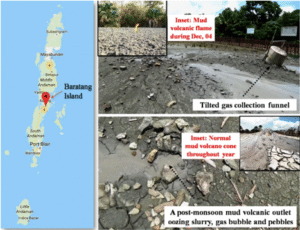
- Type: Active lava volcano
- Location: About 140 km from Port Blair in the Andaman Sea
- Tectonic Position: Lies at the junction of the Indian and Burmese tectonic plates
- Eruption History: Recorded eruptions in 1787 (first), 1991, 2005, 2017, November 2022, and September 2025
About Baratang Mud Volcano
- Location: Baratang Island, around 100–150 km north of Port Blair, in the North and Middle Andaman district
- Uniqueness:
- India’s only cluster of mud volcanoes — 11 in total across the archipelago
- Eight of these are located on Baratang and Middle Andaman Islands
- Recent Activity:
- Last major eruption reported in 2005
- The 2025 event marks the first significant eruption in 20 years
Characteristics and Composition
- Type of Emission:
- Emits cool mud, water, and gases such as methane and hydrogen sulfide
- Does not eject lava or fire
- Features Formed:
- Creates mud cones, bubbling pools, or dried crater-like structures
- Eruption Nature:
- Generally low-intensity, involving slow oozing and gas bubbling rather than violent explosions
Accessibility and Sensitivity
- The site is located about 160 metres from the nearest road.
- Lies close to the Jarawa Tribal Reserve — photography is prohibited here for ethical and legal reasons.
Geological Formation and Mechanism
- Tectonic Setting:
- Formed due to subduction of the Indian Plate beneath the Burmese Plate, releasing gases and fluids from deep layers
- Formation Process:
- Decomposition of underground organic matter generates gas pressure
- This pressure pushes mud and fluids upward, creating eruptions or vents
- Material Expelled:
- Contains saline water, organic sediments, methane, and hydrogen sulfide, giving it a distinct odour and appearance
- Scientific Importance:
- Helps study fluid migration, methane emissions, and crustal deformation in active subduction zone
4. India ‘s direction for disaster resilience
General Studies (GS) Paper III: Disaster Management and Internal Security
Context :New CII report and govt. actions spotlight ₹2.28 lakh crore DRR allocation, shifting India from relief to resilience for rising climate risks.
India’s Multi-Hazard Vulnerability
- India faces cyclones, floods, landslides, droughts, and earthquakes annually—eight coastal states and Himalayas are most exposed.
- Urbanization and climate change worsen these risks, needing rapid multi-hazard warning systems.
Institutional Framework
| Level | Key Body | Functions |
| National | NDMA | Oversees post-disaster needs, DRR policy, implements PM’s Ten Point DRR Agenda |
| National | MHA | Allocates relief/mitigation funds |
The Shift: Post-Disaster Relief → Pre-Disaster Preparedness
- India now emphasizes advance planning, preparedness, capacity building, and mitigation.
- New focus on using technology, capacity-building, and scientific disaster assessments before disasters strike.
- Significant resources now allocated to preparedness/mitigation, rather than just response.
15th Finance Commission’s DRR Framework
| Phase | % Allocation | Focus |
| Preparedness & Capacity | 10% | Pre-disaster readiness, early-warning capability |
| Mitigation | 20% | Nature-based, long-term risk reduction: geospatial labs, blue-green infrastructure |
| Response | 40% | Immediate emergency action |
| Reconstruction | 30% | Post-disaster rebuilding and resilience |
Nature-Based Disaster Risk Reduction
- Projects encourage public finance to leverage scientific mitigation—wetland restoration, slope stabilization, afforestation.
- National Cyclone Mitigation Programme (2011-2022) led to significant reduction in cyclone vulnerability.
- Eco-engineering solutions being adopted for floods, landslide/erosion-prone areas, and forest fire prevention.
Recent Approvals and Actions
- Reconstruction Projects :Over ₹25,000 crore approved for first phase packages in flood/landslide-prone states: Uttarakhand, Himachal, Sikkim, Assam, Kerala.
- Capacity Building :Focused on geo-spatial labs, faculty-led disaster research, village-level capacity enhancement, and school safety programmes.
- NIDM launched 36 new disaster management streams, standardizing training and research.
Mitigation—20% Window, ₹10,000 Crore Projects :
Over ₹10,000 crore of mitigation projects cleared, prioritizing nature-based, long-term resilience strategies.
- Current projects include slope stabilization, rejuvenation of urban water bodies, and embankment reinforcement.
Legacy of National Cyclone Risk Mitigation Programme (2011–2022)
- Built advanced early-warning systems, cyclone shelters, embankments across India’s coasts.
- Reduced casualties and losses during cyclones through better warning, evacuation, and preparedness.
Early Warning Systems & Communication
- Multi-layer early warning infrastructure, including a 327-member university network, real-time alerts, and mock drills at village/school level.
- Community capacities built through training; mock exercises and risk awareness campaigns nationwide.
International Coordination & Global Role
- India promotes global DRR cooperation—Coalition for Disaster Resilient Infrastructure, leads G20, SCO, BIMSTEC, IORA DRR talks.
- India’s academic and policy leadership shaping global resilience standards; sharing best practices internationally.
5. Treat employment as a national priority
(GS) Paper III Indian Economy and Issues relating to Planning, Mobilization of Resources, Growth, Development and Employment
Context: CII urges making employment a national priority to harness India’s youth bulge, with a report calling for integrated policy reforms and coordination at all levels.
Background
- India’s working-age population is rising by 133 million over 25 years; urgent action is needed to use this demographic dividend.
- Skill mismatches, regional disparities, and tech shifts risk leaving many out if unaddressed.
- Past fragmented schemes have led to uneven job growth, requiring a shift to long-term, equitable strategies.
Why Employment is a National Priority
Economic Importance
- Employment sustains growth, productivity, and the transition from low to high-value sectors.
- High employment in the gig economy (potential 9 crore jobs by 2030) can drive GDP growth.
Social Importance
- Jobs ensure equity, reduce disparities, and empower marginalized groups.
- Stronger social security fosters inclusion and stability, especially for informal workers.
Strategic Importance
- Boosting employment raises national resilience to global shocks and advances sectoral competitiveness.
- Strategic focus aligns reforms for global competitiveness and “Viksit Bharat.”
Current Gap
- Jobs and skills mismatched; migration and support systems for mobility are weak.
- Fragmented policies lack long-term job creation focus and leave workers unsupported.
- Data gaps and implementation hurdles persist, with lagging high-quality employment stats.
Integrated National Employment Policy (INEP)
- INEP would merge schemes and unify governance across Centre, State, and District levels.
- Policies should target high-unemployment sectors, tackle regional disparities, and support emerging tech areas.
- Promotes “One India” through labour code prioritization and advisory support for mobility.
Addressing Labour Market Issues
- Demand Side Interventions: Back labour-intensive sectors via targeted incentives and urban job guarantee pilots.
- Boost gig formalization with fair contracts and regulatory measures.
- Steer finance, tech, and skilling to reduce sectoral frictions.
- Supply Side Interventions: Implement industry-aligned upskilling, especially in Tier-2/3 cities and emerging tech domains.
- Support regional talent mobility and internships in underserved districts.
- Enhance state-level coordination to cover marginalized populations.
Labour Codes Implementation
- Urgently prioritize labour code rollout with clear guidelines and transition support.
- Ensure enforcement, social security onboarding, and redressal for formal/informal sectors.
Focus on the Gig Workers Economy—What’s Needed
- 1.8 crore in the gig economy, with potential to reach 9 crore by 2030, especially in smaller cities.
- National gig policy for sector growth, fair wage standards, and robust protections.
- District-level oversight and integration with INEP to unlock potential.
Improving Job Quality
- Prioritize creation of quality jobs over ad-hoc schemes, centralizing skill and social security frameworks.
- Emphasize safe conditions, regular pay, and housing/mobility support for workers.
Enhancing Female Labour Force Participation
- Remove work barriers via childcare, eldercare, and remote/BPO incentives.
- Integrate skilling and protective measures to boost women’s participation in growth sectors.
Data and Monitoring
- Build a real-time, high-quality employment database to guide reforms and reduce policy lags.
- Track job quality, female participation, and regional progress for results-based action.
Link with National Vision
- Employment is central to achieving “Viksit Bharat by 2047,” linking growth with inclusion and resilience.
- Policy focus aims to unlock demographic potential and realize a competitive, equitable India for the future.
6. Why is ADR crucial for India’s courts?
(GS) Paper II Governance, Constitution, Polity, Social Justice, and International Relations
Context: Judicial Backlog and Reforms
- Indian judiciary faces over 5 crore pending cases and chronic vacancies (33% in High Courts, 21% in District Courts).
- Average case disposal takes 4.5 years, limiting access to timely justice.
- 2021 Arbitration Amendment and government reforms emphasize ADR, rooted in constitutional values for collective consensus.
- India Justice Report 2025 highlights severe inter-state disparities, urging ADR to decongest courts and promote timely dispute resolution.
What is ADR?
- ADR offers non-court ways to amicably resolve civil/commercial disputes voluntarily.
- Arbitration: Binding decision by neutral arbitrator(s), faster than courts; regulated by Arbitration and Conciliation Act 1996 (amended 2021).
- Conciliation: Non-binding facilitation for mutual agreement by conciliators.
- Mediation: Confidential mediator-assisted negotiation emphasizing harmony and party control.
- Lok Adalat: People’s court for compoundable offenses; resolves disputes through compromise with no appeal.
Constitutional and Legal Basis of ADR
- Article 39A mandates free legal aid and speedy justice.
- ADR principles supported by Articles 14 (equality) and 51A (promoting harmony).
- Section 89 CPC requires courts to refer cases to ADR processes.
- Legal Services Authorities Act empowers organizing Lok Adalat camps and permanent Lok Adalats for public utility disputes.
- Recent amendments limit arbitration timelines and strengthen institutional arbitration.
Features and Timeframes of ADR
- Processes are voluntary, confidential, and party-controlled.
- Neutral experts oversee proceedings with flexibility unlike strict court protocols.
- Arbitration awards carry court decree status; Lok Adalat settlements are final and non-appealable.
- Arbitration capped at 12 months (extendable 6 months); mediation and Lok Adalat resolve within 1-3 sessions; ADR generally 6-18 months vs. court’s 4.5+ years.
Role of ADR in Reducing Delays and Backlogs
- ADR diverts 20-30% civil cases through court referrals, reducing court load by 15-20% annually.
- Faster and cheaper dispute resolution (70-80% efficiency); Lok Adalats settled 1.5 crore cases in 2023-24.
- Encourages 60-70% amicable settlements, preventing appeals and reducing High Court burden.
- Focuses on marginalized disputes, enhancing justice access and satisfaction (>90%).
Judicial Data and Disparities (India Justice Report 2025)
- Supreme Court backlog: 87,500 cases; High Courts: 63.7 lakh; District Courts: 4.5 crore+.
- Prison overcrowding at 250%, with 76% undertrials.
- Judges workload average 2,200 cases; High Court vacancies 33%, District Courts 21%.
- Uttar Pradesh leads backlog count (~4 crore), others vary; women judges 38% indicating gender gap.
Challenges to ADR Implementation
- Low public awareness and less than 20% referrals, particularly in rural and Tier-2/3 cities.
- Arbitration awards face 30% court rejections; Lok Adalat limited to compoundable disputes.
- Overburdened Legal Services Authorities and inconsistent arbitrator quality leads to 10-15% re-litigations.
- State-level enforcement inconsistencies and delays in foreign award implementation.
Way Forward
- Train 50,000+ mediators annually through NIDM/NALSA; incorporate ADR in legal education for standardization.
- Launch nationwide e-ADR platforms and utilize AI for case triage to increase referrals by 30%.
- Amend CPC to mandate pre-litigation mediation; allocate 10% judicial budget to ADR infrastructure.
- Monitor ADR efficacy via NJDG dashboards; incentivize voluntary settlements with tax rebates, aiming 50% backlog reduction by 2030.
7. Historic Launch of First Commercial Coal Mine in Arunachal Pradesh at Namchik-Namphuk
CONTEXT: Arunachal Pradesh has launched its first commercial coal mine at the Namchik-Namphuk coal block in Changlang district.
- This marks the state’s entry onto India’s coal production map as the country surpasses 1 billion tonnes output in FY 2024–25.
Key Features of Namchik-Namphuk Coal Mine
- Location: Situated in Changlang district, Arunachal Pradesh, near the Indo-Myanmar border.
- Reserves & Quality: Holds around 1.5 crore tonnes (~15 million tonnes) of lignite/sub-bituminous coal, mainly for thermal power and industry.
- Operator & Allocation: Operated by Coal Pulz Private Limited (CPPL), allotted through a transparent auction process in 2022. First allocated in 2003 but delayed due to environmental and administrative hurdles.
- Production & Revenue: Initial annual production capacity is 0.2 million tonnes, with projected revenue of ₹100 crore per year for the state government.
National and Policy Significance
- National Context: Marks the formal end of illegal mining and the start of regulated, community-driven extraction in Arunachal Pradesh.
- Development Vision: Aligns with the EAST Vision (Empower, Act, Strengthen, Transform) for North-Eastern development.
- Sustainable Mining: Part of Mission Green Coal Regions, aiming to reclaim 73,000 hectares of land by 2030, integrating ecological restoration into the mining process.
Broader Impacts and Strategic Importance
- Economic Benefits: The mine is expected to boost state revenue, generate local jobs, and promote industrial growth.
- Ecological Responsibility: Emphasis on sustainable operations with no compromise on ecology, setting a national benchmark for environmentally responsible mining.
- Community Inclusion: Focused on “Jan Bhagidaari” (community participation) for shared prosperity and transparent governance.