
1. Eight states with international borders ,0.13%of exports
General Studies Paper III (GS-3): Economy (External Trade, Export Infrastructure, Economic Disparities).
Geography (Trade Corridors and Regional Connectivity), and Internal Security (Border Infrastructure)
CONTEXT: The US tariff hike spotlights India’s internal export imbalance.Gujarat alone contributes 33% of exports; Northeast’s contribution is minimal.
- India negotiates global trade deals while economically excluding its eastern frontier.
- Infrastructure and incentives are clustered in few industrial hubs, leaving others behind.
Why is India’s Export Economy So Centralised?
- Gujarat, Maharashtra, Tamil Nadu, Karnataka dominate exports (>70%).
- Infrastructure, political stability, and incentives favour these States.
- Populous States like Uttar Pradesh, Bihar, and Madhya Pradesh remain marginal.
Why Does the Northeast Remain Marginalised?
- Northeast contributes just 0.13% despite 5,400 km of international borders.
- Borders prioritised for security and counterinsurgency over trade.
- No representation from Northeast in key trade policymaking bodies.
- Northeast is missing in export strategy and infrastructural planning.
Ground-Level Impacts of Neglect
- Assam’s tea industry suffers from poor branding; tariff hikes threaten jobs.
- Numaligarh Refinery depends on imports vulnerable to sanctions affecting local economy.
- Border trade with Myanmar collapsed due to scrapping of Free Movement Regime.
- Infrastructure exists on paper but lacks real operational support.
Global Context
- China strengthens control and influence in northern Myanmar.
- India’s India-Myanmar-Thailand highway remains incomplete, missing regional connectivity.
- Southeast Asia develops new trade corridors; India still relies on colonial-era routes.
What Does This Reveal About India’s Trade Resilience?
- Exports dangerously dependent on few corridors; disruptions can paralyse trade.
- Northeast’s economic exclusion is by design, not accident.
- India’s claim to Indo-Pacific leadership contrasts with its Eastern economic neglect.
Conclusion: India needs to integrate Northeast into its economic blueprint for equity and strategy. Uplifting the Northeast with infrastructure, policy, and representation is urgent. Without inclusion, India risks negotiating global trade yet ignoring key geographic assets.
2. HC cuts security amount to ₹1,227.62 cr. for MSC Elsa 3
General Studies Paper III (GS-3): Environment and Ecology:
Context: Kerala High Court cut security amount for MSC Elsa 3 owners from ₹9,531 crore to ₹1,227.62 crore after environmental damage claims from the May 2025 shipwreck.
- Court found state’s compensation claims (mainly for marine pollution, fishers’ losses) were not adequately substantiated.
- Related: MSC Akiteta-2 (sister ship) detained until payment, highlighting court’s use of admiralty powers for compensation enforcement
Oil Spills – Basics
- Oil spills: Accidental/deliberate petroleum release into water bodies, mostly from maritime accidents.
- Causes: Vessel accidents, pipeline leaks, operational discharges, natural seeps, illegal dumping.
- Types: Crude (persistent) vs. refined oil (lighter, evaporative); impact varies by type and site.
- Worst spills can release millions of barrels; globally 2.7 million liters spilled yearly.
Environmental Impacts
| Impact Area | Description (≤1.5 line) | Example/Consequence |
| Marine Ecosystem | Oil coats, ruins habitats/oxygen balance | Coral bleaching, erosion |
| Marine Fauna | Smothers gills/plumage; toxins kill, harm food chain | Bird hypothermia, deformities |
| Human Health | Toxic air/food causes illness, stress, cancer risk | Illness in workers, community |
| Livelihood | Fishery/tourism collapse; cleanup jobs risky, short-lived | Kerala fishers in debt |
India’s Legal & Institutional Framework
- Environment Act, 1986: Allows control and compensation for pollution events.
- Merchant Shipping Act, 1958: Handles vessel liabilities and admiralty compensation suits.
- NOS-DCP, 2015: Indian Coast Guard leads 3-tier spill response; roles for ports, states.
- CPCB, State PCBs: Enforce monitoring and cleanup measures.
- Bunker Convention not ratified, leaving fuel spill liability gaps.
International Framework
- MARPOL: Regulates oil discharges, enforced via port inspections.
- OPRC: Sets cooperation rules, mandates national response plans (e.g., NOS-DCP).
- Civil Liability Convention: Compulsory tanker owner liability, with excess fund support.
- Bunker Convention: Covers non-tanker spills, but India hasn’t ratified it yet.
Preparedness Mechanism
- Drills: NATPOLREX-IX (2023) involved 50+ agencies and 80 vessels in a mega-drill.
- OOSAS: ICG’s satellite-based oil spill detection, with remote predictive modeling.
- Spill trajectory modeling (e.g., MIKE21, GNOME) forecasts movement, improves response.
Cleanup & Mitigation Techniques
- Booms/barriers: Enclose oil to prevent spread, especially near sensitive coasts.
- Skimmers: Mechanically recover surface oil—works best in calm seas.
- Dispersants: Break oil into droplets, aid microbes, but risk deeper toxicity.
- Sorbents/burning: Soak up/burn thick oil patches for localized clean-up.
- Bioremediation: Microbes naturally degrade oil, esp. for long-term detoxification.
Innovations in Bioremediation
- Bioaugmentation: Add engineered bacteria, boosting breakdown by up to 70%.
- Biostimulation: Use nano-enhancers plus nutrients to speed oil-eating microbes.
- CRISPR/genetic techniques: Custom microbes degrade toxins 3x faster.
Key Challenges (India-Specific)
- Limited Tier-III gear hampers mega-spill response; dependence on foreign support.
- Legal overlaps and lack of full Bunker Convention ratification hinder action.
- Surveillance, oil-spill monitoring, and small spill reporting require upgrades.
- Fisher/tourism compensation slow; clean-up worker safety standards are weak.
Conclusion: MSC Elsa 3 highlights urgent oil spill management, better laws, and tech needs.Faster ratification, tech upgrades, and community participation will reduce future risks.
3. Defence Ministry ,HAL ink ₹62,370-cr.deal for 97 light combat aircraft for IAF
General Studies Paper III :Science and Technology
Context: Defence Ministry signed a ₹62,370-cr contract with HAL for 97 Tejas Mk-1A fighter aircraft for the Indian Air Force.
- India is boosting indigenous military aviation through the Tejas LCA program, promoting self-reliance in defence.
- Mk-1A is the latest, most advanced version, reflecting higher indigenous content and new technologies.
- Procured under ‘Buy (India-IDDM)’ of Defence Acquisition Procedure 2020, furthering Aatmanirbhar Bharat goals.
Tejas Light Combat Aircraft
- Tejas LCA is a single-engine, multirole, 4.5-gen combat jet designed by ADA and built by HAL.
- Compact, agile, delta wing design, optimised for interception, ground attack, and anti-ship roles.
- Key specs: up to 1.6 Mach speed, max take-off weight ~13,500 kg, range ~3,000 km.
New Features in Tejas Mk-1A (Compared to 2021 Contract)
- 67 new indigenous items added since 2021 contract, raising local content to ~64%.
- UTTAM AESA Radar (indigenous), Swayam Raksha Kavach, advanced control actuators for better survivability.
- Unified Electronic Warfare Suite (UEWS) and improved flight control computer enhance operational capability.
- Improved turnaround, cockpit ergonomics, reduced maintenance time, additional weapon options.
- Enhanced weapon integration: BVR missiles (Astra, Derby), air-to-air, air-to-ground, advanced jammers.
| Feature | Mk-1A (2025) | Previous Contract (2021) |
| AESA Radar | UTTAM (indigenous), EL/M-2052 | Only EL/M-2052 (Israeli) |
| EW Suite | Unified Suite, Self-protection jammer | Basic EW jammer |
| Indigenous Content | ~64% | ~50% |
| Advanced Actuators | Yes (indigenous) | Limited |
| Weapons | BVR missiles, advanced integration | Fewer options |
| Turnaround/Maintenance | Improved | Standard |
Significance
For Indian Air Defence
- Modernises IAF fleet, improves readiness and firepower.
- Tejas to become a mainstay for versatile combat and strategic missions.
- Advanced sensors and EW boost survivability in future conflicts.
For Indigenisation
- Supports 105+ Indian suppliers, deepens domestic aerospace ecosystem.
- Promotes Aatmanirbhar Bharat by reducing reliance on imports.
- Grows national R&D, manufacturing, supply chain for future defence projects.
For Economy
- Estimated ~11,750 jobs per year by direct/indirect effects during production.
- Stimulates high-tech industry, local innovation, and skill development.
- Generates export potential for Tejas Mk-1A in international markets.
For Strategic Autonomy
- Enhances India’s self-reliance in defence technology through indigenous systems.
- Reduces vulnerability to supply chain shocks and political pressures.
- Strengthens India’s position as a defence exporter and strategic player.
Challenges Ahead
- Delivering 97 aircraft on schedule requires robust supply chain management.
- Further indigenous subsystem development (engine, radar, weapons) essential.
- Upgrading maintenance, pilot training, and integrating with legacy IAF systems needed.
- Competing globally requires continuous tech advancements and cost controls.
Conclusion: The contract for Tejas Mk-1A marks a historic step for Indian aerospace, blending defence modernization, economic impact, and strategic autonomy. Success hinges on timely delivery, technology evolution, and deepening indigenous capacities.
4. SC seeks center’s reply on import of yellow peas
General Studies Paper III (GS-3): Agriculture (pulse production, imports, MSP), Economy (foreign trade, impact of imports on farmers), Food Security (concerns over dependency and price volatility).
Context: The Supreme Court on September 25, 2025, sought the Centre’s response to a PIL challenging duty-free imports of yellow peas, citing harm to domestic farmers.
- The petition by Kisan Mahapanchayat argues cheap imports (~₹35/kg) undercut MSP and market prices of pulses like tur, chana, and moong.
- The Court noted potential consumer impact but showed concern for farmer distress; referred to expert reports from CACP and NITI Aayog recommending import restrictions.
- This case highlights tensions between food security, farmer welfare, and import policies amidst record pulse imports (6.7 MT in 2024).
Botanical & Agriculture Facts
- Yellow peas (Pisum sativum var. arvense) belong to the Fabaceae family; cool-season, nitrogen-fixing legume improving soil fertility.
- Grown mainly in temperate climates; sown in rabi season; matures in 90-110 days.
- Major pulse used both as human food and animal feed globally; susceptible to aphids and powdery mildew.
Nutritional Significance
- Rich in protein (~24g/100g), dietary fiber, iron, potassium, magnesium, folate, and B-vitamins.
- Low glycemic index, supports heart health, weight management, and anti-inflammatory benefits.
- Used in dals, soups, and flours to enhance protein content in meals.
Global Production
- Global production ~25-28 million tonnes (2024), with Russia (5.1 MT) and Canada (3.17 MT) as top producers and exporters.
- India imports mostly from Canada and Russia, accounting for ~3 MT yellow peas in 2024 (about 50% of total pulse imports).
- Climate issues and market shifts affect production zones.
India’s Import Dependence
- India consumes about 25-27 MT pulses annually, producing ~26 MT domestically, importing ~6.63 MT, with yellow peas surging in recent years.
- Duty-free imports of yellow peas from Dec 2023 onwards accounted for massive influx, depressing domestic pulse prices.
- Imports distort markets, reduce farmer income, and cause forex outflow (~$2-3 billion annually).
Policy Timeline
- 2017: 10-30% import duty plus quota on pulses post-glut.
- 2023-2025: Multiple extensions of duty-free import of yellow peas due to inflation concerns.
- May 2025: Duty-free imports allowed till Mar 2026, causing market disruption.
Impact of Imports
- Imported yellow peas sold at ₹3,500/quintal, less than half MSP (~₹7,400/quintal for tur), leading to price collapse.
- Farmer incomes fall, affecting 10-12 million pulse farmers; increased debt and distress reported.
- Market distortions risk long-term self-reliance and shift to less nutritious substitutes.
Government Measures
- MSP hikes in 2025-26 for pulses to incentivize farmers.
- Price Support Scheme and procurement upscaled significantly.
- National Food Security Mission-Pulses allocation increased; seed subsidies & crop insurance extended.
- Buffer stocks and import duties adjusted; focus on domestic R&D.
Way Forward
- Impose phased import duties or quotas on yellow peas per expert advice.
- Expand domestic pulse production to 30 MT by 2030 via improved seeds, irrigation, and extension.
- Promote crop diversification and strengthen market procurement.
- Engage farmers, use tech for yield improvement, and ensure fair pricing.
- Aim for import neutrality by 2030 with coordinated policy and private sector role.
5. Citizens, domicile, migrants: Why should we worry about Provincial Citizenship?
General Studies Paper 1 (GS-1) covering social justice, federalism, and polity-related issues.
Context: Discussions around provincial citizenship have grown due to political developments in Jharkhand, Jammu & Kashmir, and Assam.
- Unofficial citizenship claims based on domicile now rival official national citizenship.
- Courts have had to intervene to resolve conflicts between migrant rights and local domicile rules.
What is Provincial Citizenship?
- Rooted in local nativist politics, emphasizing belonging to a state over national citizenship.
- Used politically to mobilize “locals” against “outsiders.”
- Blurs legal freedoms like movement and equal rights guaranteed by the Constitution.
Issues with Provincial Citizenship
- Causes exclusion and discrimination against internal migrants, violating Articles 15, 16(2), and 19.
- Fragments national unity and fosters regionalism.
- Restricts labour mobility, harming industries dependent on migrant workers.
- Adds judicial burden with frequent Supreme Court cases resolving domicile-related disputes.
Benefits of Provincial Citizenship
- Strengthens local identity and sense of belonging (“sons of the soil”).
- Protects vulnerable groups (e.g., in Jammu & Kashmir).
- Ensures equitable resource allocation for locals in jobs, education, and land.
- Encourages democratic mobilization around regional issues.
Jharkhand as a Case Study
- Statehood in 2000 transformed sub-nationalist demands into domicile-focused politics.
- Reflects majoritarian grievances expressed via domicile rules.
- Unlike Sixth Schedule areas, applies uniformly statewide, challenging federal norms.
Role of Jammu & Kashmir and Assam
- J&K’s domicile laws protect minorities after revocation of Article 370.
- Assam’s NRC and SIR reflect anxieties over migration and exclusion.
Challenge to One Citizenship Idea
- Provincial citizenship undermines constitutional equality and mobility rights (Articles 15, 16, and 19).
- Supreme Court adjudicates disputes, reflecting political gaps.
- Concepts like differentiated citizenship and hyphenated nationality explain the reality.
Is this an Old or New Phenomenon?
- Historical warnings exist since the 1950s and 1970s about migration-linked conflicts.
- Now, provincial citizenship has shifted from theory to active and powerful politics.
Way Forward
- Maintain constitutional balance by protecting national citizenship guarantees while allowing affirmative local protections.
- Establish national migrant worker protections ensuring rights portability.
- Promote Centre-State coordination to harmonize domicile rules with constitutional mandates.
- Judicial oversight and possible legislative review needed.
- Encourage inclusion and constitutional morality to prevent exclusionary regionalism.
Conclusion: Provincial citizenship threatens to fracture India’s inclusive national identity.
- State-specific domicile politics in Jharkhand, Assam, and J&K show growing contestations of belonging.
- Harmonizing local and national citizenship ideals is essential for democratic federalism and unity.
6. Why India’s urban definition is failing its growing towns
GS paper I: Society and Social Justice, Issue: Urban Areas – Definition in Census
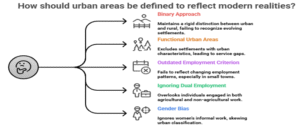
Context: India’s 2011 Census definition of “urban” is outdated and fails to reflect today’s evolving settlements. By classifying areas only as statutory towns (with formal governance) or census towns (meeting population and job criteria but still under rural governance), it misses many fast-urbanizing villages and peri-urban regions.
- This misclassification results in weak governance and inadequate infrastructure for transitional settlements.
What are the different types of urban settlements in India?
- Urban settlements in India can be classified into several different types, which can provide insights into the country’s urbanization patterns
- Census Town: Population of at least 5,000, a population density of at least 400 per sq km, where at least 75% of the male working population is engaged in non-agricultural pursuits.
- Statutory Town: A town officially designated as such by the relevant state government. These towns typically have a corporation or municipality in charge of local government.
- Satellite Town: A town that is located in close proximity to a larger urban center and is dependent on it for economic and social activities.
- Urban Agglomeration: A continuous urban area of the city/town and also the suburban fringe/rural areas lying within the administrative boundaries of a nearby town/city.
- Outgrowth: A small settlement adjacent to a larger town or city that has grown out of it, but is still considered a separate entity by the government for administrative purposes.
Examples
- West Bengal: From 2001 to 2011, 526 new census towns were identified, yet 251 census towns from 2001 remained governed rurally in 2011, showing governance delays.
- Growing Peri-Urban Areas: Settlements around metropolitan cities like Bengaluru and Delhi exhibit urban features but remain under rural administration, leading to poor urban service delivery.
- Gig Economy in Small Towns: App-based delivery and freelancing jobs spread into semi-rural areas, blurring urban-rural workforce distinctions ignored in current classifications.
Governance Challenges and Steps Taken by Government to Improve Urban Development
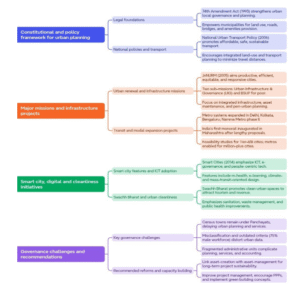
Conclusion: India’s outdated urban classification overlooks dynamic towns and peri-urban regions, causing
misclassification, weak governance, and poor services. Updating the definition with inclusive criteria and expanding municipal governance is crucial for better planning, infrastructure, and quality of life in India’s growing urban areas.
7. Coffee board to hold EU rule Awareness programmes: CEO
General Studies Paper III: Agriculture: Coffee cultivation, production distribution, major growing regions
Why in the News?
- The Coffee Board of India is conducting extensive awareness and capacity-building programs to increase registrations on its mobile app for EU Deforestation Regulation (EUDR) compliance.
- The board is engaging with associations and stakeholders, as about 4.41 lakh coffee growers need to comply.
- Coffee exports crossed $1,000 million for the fourth consecutive year in 2024-25, with a total of $1,803 million.
| What is EU Deforestation Regulation (EUDR)?
Effective from June 2023, EUDR prevents import of products linked to deforestation, including coffee, cocoa, palm oil, soy, rubber, cattle, and wood.
|
About Coffee Board of India
- Established in 1942 under the Coffee Act; functions under Ministry of Commerce & Industry with headquarters in Bengaluru.
- It is a statutory body with 33 members and a Chairperson/CEO appointed by the government.
- Focus areas include research, extension, development, market intelligence, export and domestic promotion.
- Previously, coffee marketing was state-controlled until liberalization in 1995 moved marketing to private hands.
- Runs campaigns like India Coffee, Walk With Coffee, and EUDR compliance awareness.
Coffee Cultivation in India
|
Production Statistics (2025-26)
- Projected production: 4.03 lakh tonnes, an 11% increase over last year.
- Arabica output forecast: 118,000 tonnes (up 12%).
- Robusta output forecast: 285,000 tonnes (up 9.5%).
- Karnataka is the top producer (~70%), followed by Kerala and Tamil Nadu.
- India ranks 7th globally in production, 5th in exports.
- India contributes 3.5% of global coffee production and 5% of global exports.
- Exports reached $1.8 billion in 2024-25, doubling in 11 years.
- Around 70% of Indian coffee is exported, primarily to primarily to Europe (Italy, Germany, Belgium), the Middle East, Japan, and Korea.
8. DRDO conducts rail-based launch of Agni-Prime missile
General Studies Paper III (GS-3): Science and Technology:
Context: DRDO and Strategic Forces Command successfully test-fired the Agni-Prime missile from a rail-based mobile launcher on September 24, 2025, at Dr. APJ Abdul Kalam Island, Odisha.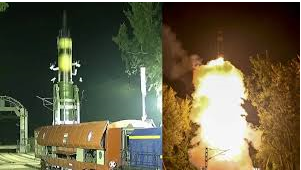
- This is the first ballistic missile launch from a rail platform in India, demonstrating mobility, rapid deployment, and low visibility.
- The Defence Ministry stated this test enhances strategic readiness, aligning with India’s nuclear deterrence amid regional security concerns.
About Agni-Prime Missile
- Medium-range ballistic missile (MRBM) with 1,000-2,000 km range, capable of carrying 1-1.5 tonne nuclear or conventional warheads.
- Two-stage solid-fuel design; canister-launched with readiness under 10 minutes; weighs about 50 tonnes compared to Agni-III’s 70 tonnes.
- Advanced guidance: inertial navigation with ring laser gyroscope (RLG) IMU, GPS/GLONASS support, maneuverable re-entry vehicle (MaRV) with CEP under 10 meters.
- Road and rail-mobile launcher compatibility; includes shock-resistant systems and decoys for survivability.
Background – Agni Missile Development
|
Rail-Based Mobile Launcher – First-Time Use
- Missile launched from a custom-designed rail-mobile launcher integrated into a modified boxcar on Indian Railways network.
- Enables cross-country mobility with rapid launch readiness and reduced detectability.
- Offers camouflage by blending with regular freight trains, includes mechanisms to handle electrified overhead cables.
- Enhances survivability and operational flexibility compared to fixed or road-mobile launchers.
- India joins select nations (Russia, US, China) with rail-based ballistic missile launch capability.
Strategic Significance
- Strengthens India’s ‘credible minimum deterrence’ and nuclear triad, supporting no-first-use doctrine.
- Covers threats from Pakistan and western/northern China with rapid, mobile strike capability.
- Rail mobility complicates adversary targeting, enhancing second-strike survivability.
- Complements longer-range missiles like Agni-V; induction of ~50 Agni-Prime missiles planned by 2028.
- Responds to regional missile developments including China’s DF-21/26 and Pakistan’s Shaheen series.
Broader Missile Development Context
- Part of broader strategic developments including hypersonic hypersonic BrahMos-II, ballistic missile defence (BMD), and MIRV-equipped Agni variants.
- Emphasizes indigenous technological progress and private sector involvement.
- Supports India’s standing as a top-5 missile power with a robust strategic deterrent.
Conclusion
- The Agni-Prime missile rail-launch test is a landmark achievement in India’s strategic defence.
- It provides high mobility, survivability, and precision in missile deployment.
- Enhances strategic autonomy and prepares India for next-generation missile systems.
- Sustained R&D and deployment will support regional stability through credible deterrence.