GS-II (Polity & Governance): Freedom of speech (Article 19), executive overreach, and judicial role in protecting rights.
GS-IV (Ethics): Balancing regulation with free expression; misuse of state power.
Context : Union government to create guidelines to regulate social media speech, citing “misuse of freedom of speech.”
Background
- A petition was filed over derogatory online remarks against disabled persons.
- The Supreme Court urged the Union government to draft guidelines regulating social media speech.
The Risk of False Righteousness
- Distasteful vs. Criminal Speech
- The Court responded to the petition by focusing on regulating speech on social media.
- Distasteful humour, although offensive, is not criminal speech.
- Treating this as a legal problem reflects a false sense of moral superiority (“false righteousness”).
- Societal Impact
- Film producers/directors avoid sensitive, socially important topics.
- Journalists face FIRs for their professional work.
- Fundamental rights become conditional, rather than guaranteed.
Judiciary as Guardian of Fundamental Rights
- The judiciary’s constitutional role is to protect constitutional rights in a democracy.
- Recent Supreme Court directives risk enabling government overreach over free speech.
- The IT Rules, 2021 already give the government broad powers over online speech.
Expanding Executive Power over Free Speech
- The Supreme Court directed the government to regulate online speech.
- These guidelines may widen government censorship under vague terms like “misuse of freedom of speech.”
Balancing Regulation and Censorship in Digital Speech
- The IT Rules, 2021 let the government flag and demand removal of content, penalizing intermediaries.
- 2023 amendments increase government powers by holding social media firms accountable for user content.
- Both rules face legal challenges, making further expansions questionable.
Risks of False Moral Certainty
- Hate speech and incitement to violence are already criminalized.
- Regulating offensive humour or dissent risks overstepping constitutional limits.
- Such censorship chills freedom of expression due to fear of punishment.
- Artists, journalists, and filmmakers face pressure limiting free speech and debate.
Questions on the Judiciary’s Role
- Courts must limit executive overreach and protect freedoms.
- Recent judicial encouragement of executive regulation risks the courts overstepping as unchecked authorities.
- Instead of reinforcing protections against hate speech abuse, the Court seems to promote executive control in vague areas.
Wider Democratic Effects
- Governments have used similar laws to suppress political opponents and dissenting voices.
- This creates an atmosphere of censorship undermining democracy, dissent, and innovation.
- Mature democracies prefer civil remedies and self-regulation rather than strong state control.
Constitutional Provisions Referenced
|
Conclusion
- The judiciary must protect constitutional freedoms, not widen government powers.
- Hate speech is punishable by law; censoring humour or artistic expression causes fear and conformity.
- The Supreme Court should guard liberty, not assist in limiting it.
| India’s Economic Vulnerability and the Gender Angle |
GS-I (Society): Gender inequality and low FLFPR as economic challenges.
GS-II (Governance): Need for women-centric policies.
GS-III (Economy): Tariffs’ impact and potential 27% GDP boost via gender parity.
Context: India’s economy is growing fast, now valued at $4.19 trillion and set to become the third-largest globally. However, the US’s proposed 50% tariffs on $40 billion of Indian exports threaten nearly a 1% GDP loss. Labour-intensive sectors like textiles, gems, leather, and footwear—major employers of women—are severely affected.
Impact on women employment
- Export Dependence on the U.S.:The United States represents 18% of India’s total exports, and higher tariffs could push Indian goods into a 30–35% cost disadvantage compared to rivals such as Vietnam.
- Vulnerable Sectors at Risk:Industries like textiles, gems and jewellery, leather, and footwear, which together employ around 50 million workers, may see exports shrink by as much as 50% under adverse tariff conditions.
- Low Female Workforce Participation:India’s female labour force participation rate (FLFPR) continues to remain weak at 37–41.7%, well below both the global average and China’s 60% benchmark.
- Missed Economic Potential:The International Monetary Fund estimates that narrowing the gender gap in employment could raise India’s GDP by nearly 27% in the long term, underscoring the cost of exclusion.
Measures and Initiatives to Empower Women
Indian Initiatives:
- Karnataka’s Shakti Scheme (2023): Free bus travel increased female mobilityby 40%, %, improving access to work and education.
- Rajasthan’s Indira Gandhi Urban Employment Guarantee Scheme created jobs with nearly 65% going to women in sanitation, greening, and care work.
- Formalizing gig and part-time work with labour protections brings women into the formal economy. For instance:
- Urban Company has 15,000+ women service providers earning ₹18,000-₹25,000 monthly with benefits.
International examples
- US: Equal pay and childcare during WWII boosted women’s labour participation.
- China’s reforms raised female participation to 60% through state care and education.
- Japan raised female participation from 63% to 70%, increasing GDP per capita.
- The Netherlands’ part-time work model suits women’s preferences in India.
Conclusion: Empowering women is not just a matter of social justice but an economic necessity. Unlocking the potential of working-age women is vital for harnessing the demographic dividend, strengthening export competitiveness, and ensuring balanced development. India’s aspiration to emerge as a global leader depends on sustained investment in its women, paving the way for resilience, prosperity, and inclusive growth.
| Cooperatives at a crossroad |
GS-II (Polity): Cooperative federalism; Centre-State dynamics.
GS-III (Economy): Cooperatives’ role in rural development and GDP growth.
GS-IV (Ethics): Transparency and inclusivity in cooperative governance.
Context :The National Cooperative Policy, 2025, launched by Union Home and Cooperation Minister Amit Shah in July 2025, aims to modernize India’s cooperative sector. However, it has faced strong opposition from Kerala, a state with a well-established cooperative system. Kerala views the policy as an unconstitutional intrusion, which has intensified the ongoing Centre-State conflict over cooperative federalism.
Background
- History of Kerala Cooperatives: Originating in the early 1900s across Cochin, Travancore, and Malabar, Kerala’s cooperatives have been governed by the Travancore-Cochin Cooperative Societies Act, 1951, and the Kerala Co-operative Societies Act, 1969.
- Economic Role: Cooperatives manage deposits worth ₹2.94 lakh crore, supporting rural farmers and businesses through Primary Agricultural Cooperative Societies (PACS).
- Structural Reform: In 2020, Kerala merged district cooperative banks into the Kerala State Cooperative Bank (Kerala Bank), streamlining from a three-tier to a two-tier cooperative credit system.
- Karuvannur Scam: In 2021, fraud allegations at the Karuvannur Service Cooperative Bank (Thrissur) harmed public trust, leading to the Kerala Co-operative Societies (Amendment) Act, 2023, which introduced safeguards and audits.
Constitutional Provisions
- Article 246 and the Seventh Schedule divide cooperative legislative powers, placing cooperatives under Entry 32 of State List.
- The 97th Constitutional Amendment, 2011, added cooperative rights and governance provisions (Articles 19(1)(c), 43B, and Part IXB), but the Supreme Court struck down parts of this amendment due to lack of state ratification.
- The Centre’s authority extends only to multi-state cooperatives under Entry 44 of the Union List.
Conflict Between Centre and Kerala
- Alleged Political Motives: Kerala alleges the BJP aims to gain control of its cooperative sector — which holds nearly ₹3 lakh crore — for electoral advantage.
- Central Directives: The policy mandates state cooperatives to adopt central bylaws, integrate technology systems, and coordinate with national bodies, perceived as encroachments on state autonomy.
- Funding Leverage: Kerala fears losing central financial support if it rejects the policy.
| Supreme Court in Union of India v. Rajendra Shah affirmed cooperatives as “wholly and exclusively” under state control.Union of India v. Rajendra Shah affirmed cooperatives as “wholly and exclusively” under state control. |
Challenges in Kerala’s Cooperatives
- Financial Irregularities: Several cooperative banks, including Karuvannur, have faced embezzlement allegations and failure to refund depositors’ money, harming sector credibility.
- Government Response: Kerala strengthened laws in 2023 to address loopholes and restore public confidence.
- Implementation Hurdles:Merging state cooperatives into MSCSs and enforcing centralized rules may face resistance and practical difficulties.
Future Prospects and Crossroads
- Evolving Challenges: Kerala’s cooperatives face urbanization, shifting youth employment goals, and changes in energy, technology, health, and shipping sectors.
- Need for Adaptation: The sector must diversify to stay relevant and support Kerala’s economy.
- Centre-State Tensions: Balancing tradition, modernization, and autonomy will shape the cooperative sector’s economic impact.
What is the National Cooperative Policy 2025?
Objectives
Features
|
Conclusion :Kerala’s cooperative sector, crucial for its rural economy, is at a critical juncture due to the National Cooperative Policy, 2025, and ongoing financial scandals. The dispute between the Centre and Kerala over federalism and control threatens the autonomy of cooperatives. Their ability to modernize while preserving grassroots support will determine their economic impact in the state.
| ECI’s Role and Electoral Roll Concerns: Rahul Gandhi’s Allegations and Bihar SIR |
GS-II (Polity): ECI’s role, Article 324, electoral integrity.
GS-IV (Ethics): Transparency and neutrality in constitutional bodies.
Context :The Election Commission of India (ECI) faces scrutiny following allegations by Rahul Gandhi about voter list manipulation and concerns over the Special Intensive Revision (SIR) of electoral rolls in Bihar. The Supreme Court’s intervention and the ECI’s response highlight tensions over electoral integrity and constitutional limits.
ECI’s Response to Allegations
- Rahul Gandhi accused manipulation of voter lists in the 2024 election, citing suspicious entries like many voters with the same address and fake details.
- On August 17, 2025, CEC responded by demanding Rahul Gandhi submit a sworn affidavit supporting his claims or apologize, instead of addressing the details directly.
- This response was seen as politically charged, unusual for an impartial constitutional authority like the ECI.
Constitutional Role of ECI
- Under Article 324 of the Indian Constitution, the ECI supervises and conducts elections to Parliament, State legislatures, and President/Vice President offices.
- It holds broad powers to ensure free and fair elections, integral to the Constitution’s basic structure.
- The ECI must exercise its powers fairly, maintaining neutrality and staying within constitutional bounds.
- Engaging in political battles or issuing ultimatums is beyond ECI’s mandate.
Legal Provisions on Electoral Rolls
- The Representation of the People Act, 1950, and related rules provide for the preparation and revision of electoral rolls via annual or special revisions.
- Once elections conclude, rolls are considered final, making post-election challenges difficult.
- Multiple checks, public inspections, and dispute mechanisms exist to protect electoral integrity.
Issues Raised by Allegations
- Legal requirement demands voters be “ordinarily resident,” i.e., permanently living at their registered address.
- Reporting 80+ voters at one address violates this principle, raising concerns of fraudulent enrollment.
- It questions the accuracy and fairness of electoral rolls, impacting voter rights.
Special Intensive Revision (SIR) in Bihar
- ECI conducted SIR in Bihar before assembly elections, deleting millions of voters to clean up rolls.
- The qualifying date used (July 1) violated the law that sets January 1 as the roll revision date.
- Intensive revision requires a comprehensive house-to-house survey, unlikely to be completed in one month, causing confusion and protests.
- The Supreme Court ordered ECI to publish names and reasons for voter deletions, increasing transparency.
Concerns and Reflections
- While ECI’s constitutional powers are significant, misuse or bias jeopardizes democracy.
- Justice S. Murtaza Fazal Ali warned unchecked powers could cause political instability and damage ECI’s integrity.
- Allegations require thorough, impartial investigation to maintain public trust.
- Transparency, adherence to laws, and neutral functioning are critical for securing faith in India’s democratic elections.
Conclusion
- The ECI must handle serious allegations like Gandhi’s with clear, transparent investigations rather than ultimatums to maintain electoral integrity.The Bihar Special Intensive Revision (SIR) exposes legal flaws and massive voter deletions, underscoring the need for strict adherence to the Representation of the People Act, 1950.While Article 324 grants broad powers to the ECI, it must exercise them judiciously and impartially, avoiding political involvement to protect India’s democracy.
| Jan Vishwas 2.0: What the Bill to amend 16 laws seeks to do |
Paper: GS-II, Subject: Governance, Topic: Government Policies, Issue: The Jan Vishwas (Amendment of Provisions) Bill, 2025
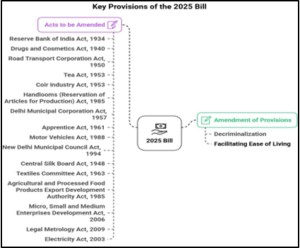
Context : The Jan Vishwas (Amendment of Provisions) Bill, 2025, which seeks to decriminalize and rationalize certain offenses and penalties across 16 Central Acts.
Background
- Second Jan Vishwas Reform: The Jan Vishwas (Amendment of Provisions) Bill, 2025 is the second major legislative initiative of the Modi government aimed at reducing over-criminalisation.
- The first law, passed in 2023, decriminalised 183 provisions spread across 42 central legislations.
- The new Bill expands this reform drive by targeting 16 Central Acts supervised by 10 different ministries/departments.
Why was the Bill brought in?
- Problem of over-criminalisation: India has many outdated laws that prescribe prison sentences for minor or technical violations (like milking a cow on the street, wrong vehicle registration, non-standard weights, etc.).
- Simplify compliance for businesses and citizens to boost economic growth and improve quality of life.
- Reduce judicial burden by shifting minor penalties to administrative processes, freeing courts for serious cases.
- Promote trust-based governance under the “Minimum Government, Maximum Governance” vision.
- Arbitrary Power: Criminal provisions, even if rarely enforced, can lead to arbitrary exercise of power by the State.
What does the 2025 Bill do?
- Amends 355 provisions across 16 central laws.
- 288 provisions decriminalised – Prison terms removed for minor/technical issues, replaced by fines or warnings.
- 67 provisions amended – Penalties rationalised, procedures streamlined.
Key Provisions
- Decriminalisation of minor offences :Replaces jail terms with monetary fines or warnings for routine violations.
- Example: Under the Electricity Act, imprisonment for non-compliance replaced by fines of ₹10,000–₹10 lakh.
- “Warning” and “Improvement Notice” system :New feature in 76 offences under 10 laws (like Motor Vehicles Act, Apprentices Act, Legal Metrology Act).
- First-time offenders get a chance to correct mistakes instead of being penalised immediately.
- Rationalisation of penalties :Penalties updated, made more realistic.
- For repeat offenders, fines automatically increase by 10% every three years → ensures deterrence without rewriting laws again.
- Affected laws (16 Acts) :Includes laws from sectors like banking (RBI Act), healthcare (Drugs and Cosmetics Act), transport (MVA), electricity, municipal governance, textiles, MSMEs, agriculture exports, etc.
Conclusion
- The Jan Vishwas (Amendment of Provisions) Bill, 2025, represents a significant step towards decriminalizing minor offenses, rationalizing penalties, and improving the overall legal and business environment in India. Its focus on trust-based governance and ease of living has the potential to reduce the burden on the judicial system, promote economic growth, and foster a more citizen-friendly regulatory landscape.
Pradhan Mantri Jan Dhan Yojana (PMJDY) – 11 Years of Financial Inclusion
Source :PIB
Pradhan Mantri Jan Dhan Yojana
- The Pradhan Mantri Jan Dhan Yojana (PMJDY) is India’s flagship financial inclusion program designed to provide universal access to banking and financial services. It enables easy opening of Basic Savings Bank Deposit Accounts (BSBDA) with simplified paperwork, relaxed KYC norms, and e-KYC facilities.
- Beyond account opening, PMJDY offers savings, remittance, credit, insurance, and pension services. Key features include RuPay debit cards with ₹2 lakh accidental insurance, overdraft up to ₹10,000 for account holders under 65, and access to micro-credit, micro-insurance, and pension products.
- Integrated with other government initiatives, the scheme significantly reduced traditional banking barriers for the unbanked. Notably, it set a Guinness World Record by facilitating 1.8 crore account openings in just one week during its launch phase, underscoring its scale and impact.
Digital and Technological Transformation :Issued 38.68 crore RuPay debit cards, promoting cashless
transactions, insurance coverage, and reducing reliance on foreign payment systems.
- Created a strong foundation for UPI adoption, contributing to India’s global leadership in digital payments.
JAM Trinity & Governance :Forms the core of Jan Dhan–Aadhaar–Mobile (JAM) integration for transparent and efficient welfare delivery.
- Enables Direct Benefit Transfers (DBT), real-time verification, reduced leakages, and improved governance efficiency.
Women’s Empowerment & Social Impact :Women own 56% of accounts (31.31 crore), ensuring direct financial access, particularly in rural areas.
- Shift to individual-based account openings (2018) boosted female participation.
- Access to micro-credit, pensions, and insurance strengthened women’s entrepreneurship, education, and healthcare investments.
Implementation Challenges
- Dormant accounts: 13.04 crore inactive as of July 2025 (20–23% of total), with higher rates in states like Bihar, UP, and MP.
- Infrastructure gaps: Poor connectivity, power supply issues, and limited Business Correspondent (BC) training.
- Low financial literacy: Many beneficiaries lack awareness of savings, credit use, and digital banking.
Future Priorities
- Focus on deepening engagement rather than just access—through literacy programs, fintech integration, and customized low-income financial products.
- 2025 Saturation Campaign: Nationwide drive to reactivate dormant accounts, enroll new users, and expand coverage between July–September 2025.
- Technology integration: Biometric ATMs, USSD banking (#99), AI/ML for fraud detection & personalized services, and blockchain for secure DBTs.
Conclusion
Over 11 years, PMJDY has connected 56+ crore people with banking, advanced digital payments, promoted gender equality, and made welfare delivery more efficient. Despite challenges like dormancy and digital literacy gaps, it remains a global model of large-scale financial inclusion and social transformation.
Prelims Facts
Project Aarohan
Context : The National Highways Authority of India (NHAI) launched Project Aarohan in 2025 to support the educational aspirations of toll plaza employees’ children, focusing on economically weaker sections.
Objective
- To support the educational goals of toll plaza employees’ children.
- Remove financial barriers and provide equal access to quality education for economically weaker sections.
Key Features
- Covers 500 students from Class 11 to final year of graduation.
- Each student receives an annual scholarship of ₹12,000 for the financial year 2025-26.
- 50 bright students pursuing postgraduate or higher studies will get scholarships of ₹50,000 each.
- Scholarship aims to nurture talent to contribute to the country’s growth.
Application Process :Conducted online.
- Requires submission of important documents: academic records, income proof, caste certificate, ID proof.
Significance : Reflects NHAI’s commitment towards welfare of toll plaza employees and their families.
- Aims to empower students from underprivileged backgrounds for a better future.
Impact
- Financial Inclusion: Supports economically weaker students, reducing financial barriers to education.
- Empowerment: Enhances opportunities for toll plaza employees’ children, fostering talent development.
- National Growth: Aims to nurture students who will contribute to India’s progress.
| Will the ‘One Nation, One Subscription’ scheme fill the gap left by the Sci-Hub ban? |
Context : The Delhi High Court’s order to block Sci-Hub and its mirror sites, following a lawsuit by publishers Elsevier, Wiley, and the American Chemical Society, has sparked debate about access to research papers. The One Nation, One Subscription (ONOS) scheme, launched in 2024, aims to address this by providing equitable access to scholarly journals.
Sci-Hub Ban and Research Access in India
- The Delhi High Court ordered ISPs to block Sci-Hub and its mirrors, due to copyright violations upheld in litigation by major publishers.
- Sci-Hub was widely used for free access to research papers but faced legal action for infringement.
- The ban brings to light the issue of who can access scholarly research and how affordably.
The Sci-Hub Case
- Court Ruling:
- Delhi High Court blocked Sci-Hub and mirrors for violating copyright laws.
- Elbakyan found in contempt for uploading articles and using Sci-Net to bypass orders.
- Criticism:
- Reinforces publishers’ business model, prioritizing profits over public access.
- Ignores scholarly publishing’s unique nature (public funding, no author royalties).
- Impact:
- Limits access for researchers outside elite institutions, who relied on Sci-Hub.
- Highlights need for affordable, equitable alternatives like ONOS.
What is One Nation One Subscription (ONOS)?
- Launched by the Indian government, ONOS is a national subscription program providing access to about 13,000 journals from 30 major publishers.
- Aims to provide researchers, students, and faculty in government and public institutions equal and affordable access to high-quality research.
- Administered by INFLIBNET and supported with ₹6,000 crore funding (2025-2027).
- Covers 6,300 institutions and around 1.8 crore researchers and students.
Benefits of ONOS
- Legal and affordable access to research, reducing dependence on illegal sites like Sci-Hub.
- Supports interdisciplinary and cutting-edge research, including in tier 2 and tier 3 cities.
- Aligns with India’s education and research policies like NEP 2020 and National Research Foundation goals.
- Promotes knowledge sharing and democratizes research access.
Issues and Challenges
- ONOS currently excludes many private universities and independent researchers, limiting reach.
- India remains dependent on foreign publishers and subscription fees.
- The system still requires Indian researchers to transfer copyrights to publishers.
- Rising open-access movement worldwide questions the long-term viability of subscription models.
- Success depends on improving usability, updating subscriptions based on researchers’ needs, and promoting indigenous publishing and open-access repositories.
Conclusion : While Sci-Hub’s ban ends an era of free but illegal research access, ONOS could provide a legal, fair alternative. Its effective implementation and expansion, coupled with a cultural shift towards open access, are vital for India’s research progress and equity in knowledge dissemination.