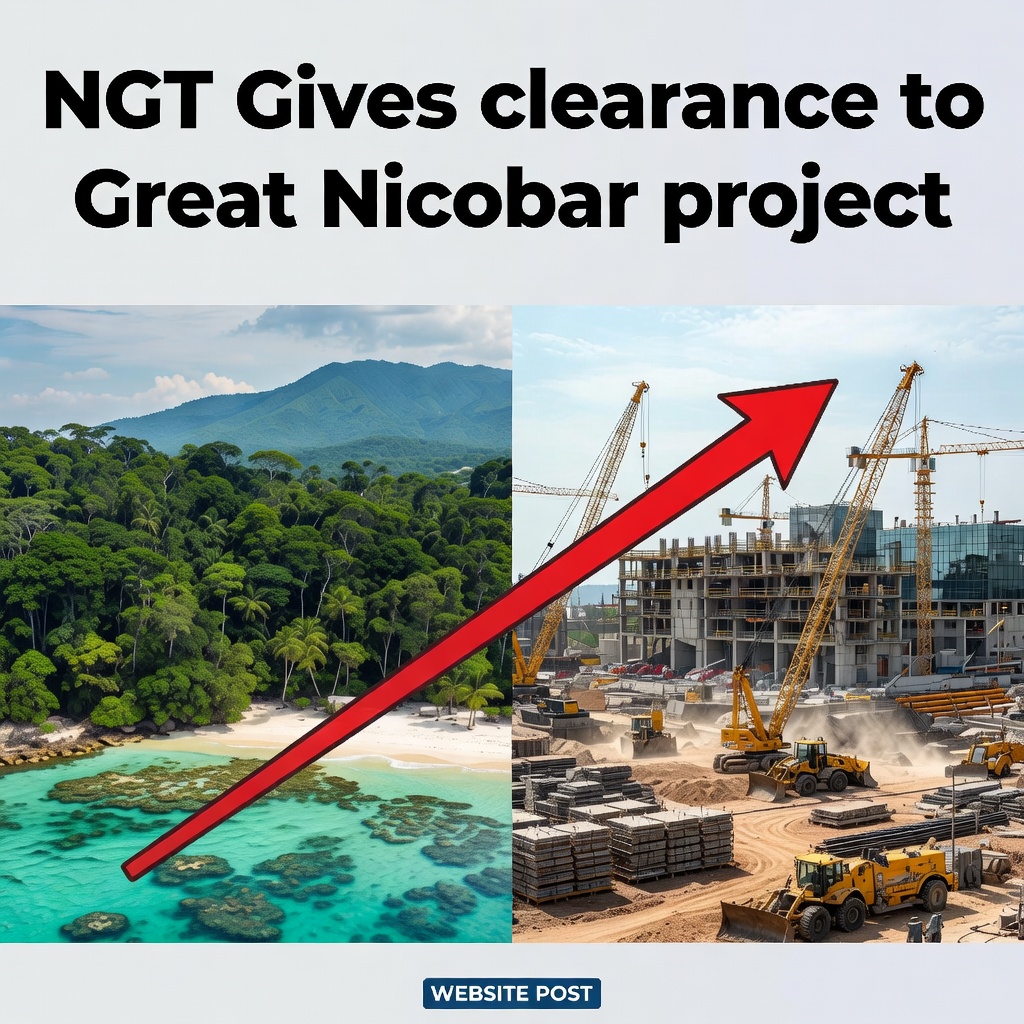
1. NGT Gives clearance to Great Nicobar project
GS PAPER III-Environment
Context : A special six-member NGT bench upheld the project’s environmental clearance.
- Strategic Approval: The tribunal cited “adequate safeguards” and the “strategic national importance” of the project.
- Ongoing Legal Battle: Despite the NGT ruling, opposition remains high, with activists looking to the Calcutta High Court.
What is the Great Nicobar Project?
- Mega Infrastructure: A ₹81,000 crore “Holistic Development” plan by NITI Aayog for Great Nicobar Island.
- Major Components: Includes a Transshipment Port, a Greenfield International Airport, and a modern township.
- Strategic Hub: Aims to leverage the island’s location near the Malacca Strait to rival Singapore’s port.
- Power & Energy: Features a 450 MVA gas and solar-based power plant to support the new urban center.
Role of National Green Tribunal (NGT)
- Judicial Oversight: The NGT reviewed petitions alleging violations of coastal and forest regulations.
- High-Powered Committee: It mandated a committee to investigate concerns like coral reef destruction.
- Final Ruling: Concluded that the project could proceed if all environmental conditions are strictly followed.
- Balance of Interests: The NGT sought to balance national security/economic growth with ecological protection.
Environmental Concerns Risked
- Massive Deforestation: Requires felling nearly 10 lakh trees in a UNESCO Biosphere Reserve.
- Biodiversity Loss: Threatens the Leatherback Sea Turtle, Nicobar Megapode, and endemic macaques.
- Coral Reef Damage: Dredging and construction could destroy vital marine ecosystems at Galathea Bay.
- Seismic Vulnerability: The island sits on a major fault line, making it highly prone to tsunamis.
Tribal and Local Opposition
- Indigenous Rights: The Shompen (a PVTG) and Nicobarese tribes face loss of ancestral lands.
- Consent Issues: Tribal councils withdrew earlier consent, claiming they were pressured or misinformed.
- Genocide Warnings: Experts warned that the population influx could wipe out the isolated Shompen tribe.
- Health Risks: Outside contact could introduce diseases to which the tribes have no immunity.
Government Jurisdictions
- Implementing Agency: The Andaman and Nicobar Islands Integrated Development Corporation (ANIIDCO).
- Central Oversight: NITI Aayog conceived the plan; MoEFCC provides the environmental clearances.
- Tribal Governance: Ministry of Tribal Affairs oversees rights under the Forest Rights Act (FRA).
- National Security: The Ministry of Defence views the project as vital for Indo-Pacific maritime security.
2. Transitioning to green steel
GS paper III-Environment
Context :The Ministry of Steel recently organized a high-level “Chintan Shivir” at NISST to accelerate green steel production in the secondary sector.
- Taxonomy Implementation: India’s Green Steel Taxonomy (introduced Dec 2024) is now operational, providing star ratings based on emission intensity.
- Carbon Market Launch: The Indian Carbon Market (CCTS) is set to begin trading in October 2026, imposing emission targets on the steel sector.
What is Green Steel?
- Low-Carbon Production: Steel manufactured without fossil fuels, aiming for near-zero $CO_2$ emissions.
- Indian Definition: Under India’s taxonomy, steel is “green” if emission intensity is below 2.2 $tCO_2$ per tonne of finished steel.
- Key Technologies: It utilizes Green Hydrogen-based Direct Reduced Iron (H2-DRI) and Electric Arc Furnaces (EAF).
- Resource Circularity: It prioritizes scrap metal recycling and renewable energy (solar, wind) over coal-fired blast furnaces.
Why Green Steel is Important for India
- Net Zero 2070: Essential for achieving India’s pledge to reach net-zero emissions by 2070.
- Emission Hotspot: The steel sector accounts for roughly 12% of India’s total $CO_2$ emissions.
- Decoupling Growth: Allows India to reach its 300 MTPA production target by 2030 without a massive surge in emissions.
- Sectoral Leadership: Decarbonizing steel supports the greening of dependent sectors like automotive, construction, and infrastructure.
Government Efforts & Policy Initiatives
- National Green Hydrogen Mission: Allocated ₹455 crore for pilot projects using hydrogen in steelmaking.
- National Steel Policy 2017: Aims for 300 MT capacity by 2030 while transitioning toward energy efficiency.
- Greening Steel Roadmap: A comprehensive action plan by the Ministry of Steel to guide industry transition.
- Steel Scrap Recycling Policy (2019): Promotes urban mining to increase scrap availability for low-carbon EAF production.
Biggest Challenges: The “Green Premium”
- High Production Cost: Green steel currently faces a significant “green premium” (extra cost) compared to traditional coal-based steel.
- Hydrogen Prices: Green hydrogen must fall to $1.5–$1.6/kg (from current >$3/kg) to be economically viable.
- Capital Intensity: Transitioning requires massive upfront investment in new technology and renewable energy infrastructure.
- Infrastructure Gaps: Limited availability of low-carbon hydrogen and reliable high-capacity renewable grids.
Administrative & Policy Changes
- Green Certification: NISST is now the nodal agency for green steel certification, already certifying 76 industries.
- Star Rating System: A 3-to-5 star system now identifies and rewards low-emission steel products.
- National Mission for Sustainable Steel: A proposed ₹15,000 crore mission focusing on the secondary steel sector.
- Mandatory Disclosures: Shifting from voluntary to mandatory emission reporting under the new carbon credit framework.
Global Economic Pressure on India
- CBAM Impact: The EU’s Carbon Border Adjustment Mechanism penalizes carbon-intensive imports, risking billions in Indian exports.
- Global Supply Chains: International brands (automotive/electronics) are increasingly demanding green materials to meet their own ESG goals.
- Trade Barriers: Failure to decarbonize could lead to Indian steel being locked out of high-value Western markets.
Strategic Importance for India
- Indo-Pacific Competitiveness: Ensures Indian industry remains a competitive global manufacturing hub in a carbon-conscious world.
- Avoid Carbon Lock-in: Prevents new plants from being “locked” into coal technology for the next 30-40 years.
- Energy Security: Reducing coking coal imports by shifting to domestic renewable energy and green hydrogen.
- Building the Future: 70-75% of the infrastructure needed for “Viksit Bharat 2047” is yet to be built, requiring green materials.
Public Procurement as a Solution
- Draft GPP Policy: Proposes mandating 25-37% green steel usage in all public infrastructure projects.
- Demand Aggregation: Bulk government orders can provide the scale needed to drive down production costs.
- Market Signal: Public procurement creates a guaranteed market, encouraging private investment in green technology.
Way Forward
- Scale Renewables: Rapidly integrate the 9 GW of announced captive renewable capacity into steel plants.
- Enhance Scrap Infrastructure: Formalize the scrap collection sector to ensure raw material for secondary steelmakers.
- CCUS Deployment: Pilot Carbon Capture, Utilization, and Storage for existing blast furnaces that cannot shift immediately to hydrogen.
- Financial Support: Introduce production-linked incentives (PLI) and credit guarantee facilities for green transitions.
3. Copper is pricing scarcity at a time of plenty
GS paper I-Geography
CONTEXT :Projections indicate a refined copper shortfall of approximately 330,000 tons this year, the largest gap in recent history.
- Prices surged above $6.00 per pound in January 2026 due to acute supply disruptions and low global inventories.
- Critical Mineral Status: In late 2025, the United States officially added copper to its “critical minerals” list, following the EU’s earlier 2023 designation.
- Supply Shocks: Major output losses at the Grasberg mine (Indonesia) and disruptions in Chile/Peru have severely tightened the market.
The “Near Perfect Lockstep”: EVs vs. Copper Demand
- Copper Intensity: Battery Electric Vehicles (BEVs) require roughly 83 kg of copper, compared to only 23 kg for traditional internal combustion engines.
- Elasticity Linkage: Between 2016 and 2024, copper demand elasticity relative to EV sales exceeded 1.0, meaning copper consumption grew faster than adoption.
- No Substitutes: Despite research into aluminum, copper remains irreplaceable for EV motor windings, battery cell connections, and inverters due to conductivity.
- Infrastructure Multiplier: Every EV sale triggers secondary demand for charging stations and grid upgrades, both of which are copper-intensive.
Explosive EV Growth vs. Slow Copper Supply
- Unprecedented Sales: Global EV sales expanded from 0.75 million units in 2016 to nearly 20 million units by 2025.
- Mining Lag: It takes 7 to 10 years (and sometimes up to 17 years) to bring a new copper mine from discovery to production.
- Declining Ore Grades: Average ore grades have fallen to below 0.6%, requiring miners to process twice as much rock to extract the same amount of metal.
- Underinvestment: A decade of subdued capital expenditure in mining has left the industry unable to meet the 600,000-ton annual new supply requirement.
Shifting Global Power Balance: China’s Dominance
- Consumption Lead: China currently absorbs approximately 60% of the world’s refined copper to fuel its manufacturing base.
- Integrated Supply Chain: China controls over 70% of global battery cell production, effectively dictating copper flow in the EV market.
- Strategic Stockpiling: In February 2026, China moved to aggressively expand its national copper inventories to hedge against supply risks.
- Smelter Control: While most mining occurs in Latin America, China dominates the smelting and refining stage of the value chain.
Broader Policy & Governance Implications
- Resource Nationalism: Countries like Chile and Peru are introducing higher royalties and stricter environmental regulations, affecting global output.
- Energy Security: Copper is no longer viewed as a mere commodity but as a national security asset vital for defense and power grids.
- Tariff Wars: The US implementation of Section 232 tariffs on refined copper has created disjointed global inventory pools and price premiums.
- Social License Challenges: Indigenous rights and water scarcity concerns are increasingly stalling project approvals in major mining jurisdictions.
Way Forward
- Recycling Acceleration: Expanding “urban mining” is crucial, though currently, scrap only covers roughly 30% of global needs.
- Permitting Reform: Governments are under pressure to compress the 15-year permitting timeline for critical minerals to meet climate goals.
- Supply Diversification: Western nations are launching programs like “Project Vault” to build strategic reserves and reduce dependence on single-source chains.
- Technological Innovation: Incentivizing mining technologies that can process low-grade ores or seawater-cooled extraction methods.
4. Creative Industries as Growth Engines: The Rise of the Orange Economy
Context :Creative industries, often called the “Orange Economy,” gained prominence in the Union Budget 2026-27 and Economic Survey 2025-26.
- These documents spotlight their potential as growth drivers, projecting 2 million jobsin the Animation, Visual Effects, Gaming, and Extended Reality (AVGC-XR) sector by 2030.
- The Budget also allocated funds for 15,000 Content Creator Labsin schools to nurture young talent.
Understanding the Orange Economy
The Orange Economy—coined by Iván Duque and Felipe Buitrago—captures the ecosystem fueled by creativity, culture, and intellectual property (IP). It links traditional elements like arts, crafts, and festivals with cutting-edge digital fields such as gaming, VFX, and OTT platforms. In India, it’s emerging as a way to turn imagination into a globally traded asset.
Vital Statistics on India’s Creative Sector (2024-26)
- Market Size: Media and entertainment (M&E) hit ₹2.5 trillion ($30 billion) in 2024, eyeing ₹3.06 trillion by 2027.
- Job Impact: Sustains over 10 million jobs, with creative roles offering 88% higher pay than average.
- Export Surge: Creative services exports jumped 20% in 2023, broadening India’s services beyond IT.
- Gaming Boom: Revenue at ₹232 billion, serving 500 million gamers.
- VFX Spend: Blockbusters now dedicate 25-30% of budgets to visual effects.
Driving Economic Growth Through Creativity
- Youth Employment Boost: AVGC-XR draws talent from smaller cities; e.g., studios booming in Pune and Indore to meet 2 million job targets by 2030.
- Cultural Influence Abroad: Content exports enhance soft power and tourism; e.g., RRR and Project K turned filming sites into global hotspots.
- Local Economic Ripple: Events like 2025 stadium concerts in Ahmedabad spiked hotel bookings and gigs by 40%.
- Tech Innovations Spillover: Gaming tools like Unreal Engine aid medical training and defense simulations.
- Inclusive Access: Platforms empower rural creators; e.g., DD National’s Creator’s Corner integrates micro-influencers into ads.
Major Government Steps Forward
- WAVES Summit 2025: Launched WAVES Bazaar for global script and music trading.
- IICT Mumbai: National hub for AVGC-XR training.
- School Labs Initiative: ₹250 crore for 15,000 labs teaching digital storytelling.
- Create in India Challenge: Talent contest linking winners to events in Tokyo and Madrid.
Hurdles Facing the Sector
- Algorithm Dependency: Global platforms’ changes caused 30% revenue drops for influencers.
- Funding Shortfalls: MSMEs can’t collateralize IP; Bengaluru studios turn to costly private loans.
- Talent Gaps: Graduates master tools but lack storytelling; noted at 2026 IGDC.
- Tech Barriers: High rendering costs force outsourcing due to limited local HPC.
- Event Red Tape: 10-15 clearances delay festivals, prompting 2026 cancellations.
Path Forward for Sustainable Growth
- IP-Based Loans: Partner RBI to accept copyrights as collateral.
- Unified AVGC Policy: Roll out model state incentives.
- Homegrown AI Tools: Cut costs for animation and dubbing.
- Event Streamlining: Activate LEDC for single-window approvals.
- Original Content Focus: Move from Hollywood outsourcing to global Indian IP licensing.
5. PM Modi Launches PM RAHAT Scheme
Government schemes
Context: India faces over 1.5 lakh road accident deaths yearly, with 50% preventable via Golden Hour treatment. Launched recently by the Ministry of Road Transport and Highways, PM RAHAT ensures cashless care up to ₹1.5 lakh per victim, easing financial barriers and boosting emergency response.
Core Purpose
PM RAHAT (Road Accident Victim Hospitalization and Assured Treatment) delivers national cashless emergency coverage up to ₹1.5 lakh for 7 days post-accident. It prioritizes life-saving intervention within the critical first hour to cut fatalities.
Implementing Agencies
- MoRTH: Oversees policy and links via eDAR platform for accident reporting.
- NHA: Manages claims through TMS 2.0 system.
Primary Goals
- Prevent deaths from delayed medical aid.
- Build robust emergency response networks.
- Assure hospitals of quick payments for seamless care.
Standout Features
- Coverage Limit: ₹1.5 lakh cashless per victim for 7 days.
- Golden Hour Priority: Ties into 112 helpline for fast hospital transfers.
- Treatment Timeline: 24 hours (non-critical); 48 hours (life-threatening).
- Digital Flow: eDAR-TMS integration for claims; police verifies in 24-48 hours.
- Funding Source: MVAF—insured via premiums; others from budget.
- Fast Payouts: State approvals lead to payments in 10 days.
- Oversight: District Road Safety Committees (DM-led) handle grievances.
Strategic Impact
- Tackles India’s high accident toll where timely aid saves half the victims.
- Supports Good Samaritan efforts by streamlining aid without legal hassles.
- Advances digital integration in health and road safety systems.
6. A budgetary signal as bonds cannot bear it all
GS paper III-Economy
Context :India’s Union Budget 2026 has introduced key financial reforms, such as a market-making framework for corporate bonds, signaling a strategic pivot toward a market-driven financial system.
- These measures address a core structural flaw where banks bear excessive long-term risks typically handled by bond markets in advanced economies.
- They gained prominence due to Budget 2026 announcements (presented in February 2026), aiming to deepen the corporate debt market amid ongoing efforts to reduce banking fragility and boost economic resilience.
Reasons in News
- Budget 2026 Focus: Reforms like bond market liquidity enhancement, total-return swaps, partial credit guarantees for infrastructure, and REIT expansion were highlighted to rebalance India’s bank-heavy financing model.
- Persistent Banking Stress: Recurring crises (e.g., post-2017 recapitalizations exceeding ₹3.2 lakh crore) underscore the need to shift long-term project funding from banks to markets.
- Global Benchmarks: India’s corporate bonds at 15-16% of GDP lag far behind the US (much higher), China, and Europe, prompting policy action for better risk distribution.
- Economic Imperatives: With infrastructure needs rising, these steps support monetary policy effectiveness and credit flow to SMEs, aligning with India’s growth goals.
Key Issues
- Financial System Imbalance: Shallow corporate bond market (15-16% GDP) vs. robust G-Secs (90% GDP) forces banks to hold 60-65% of corporate debt, unlike 30% in US or 40% in Europe.
- Maturity Mismatch Risks: Banks use short-term deposits to fund 15-20 year projects (e.g., highways, power plants), leading to fragility when delays occur.
- Fiscal and Credit Distortions: Taxpayer-funded bank bailouts misallocate capital, starving SMEs despite ample total credit.
- Monetary Policy Hurdles: Bank-laden risks hinder interest rate pass-through, unlike fluid repricing in deep bond markets.
Reform Objectives
- Risk Redistribution: Enable pension funds, insurers, and investors to absorb long-term credit via liquid bonds and hedging tools.
- Market Deepening: Boost corporate debt issuance to rival global peers, reducing bank dominance.
- Stability Gains: Minimize sudden losses in banks, easing fiscal burdens and enhancing shock absorption.
- Efficiency Boost: Improve policy transmission, SME lending, and overall financial resilience for sustained growth
7. Indias federalism needs a structural rest
GS paper II-polity
Context :India’s federal structure, initially centralized post-independence for stability, now requires recalibration amid political maturity and administrative evolution, as debated in recent policy discourse. Continued Union dominance risks governance inefficiencies, prompting calls for balanced Union-State relations to enhance cohesion and responsiveness.[ from prior context]
Reasons in News
- Budget 2026 Linkages: Financial reforms (e.g., corporate bonds, municipal bonds) underscore fiscal federalism needs, highlighting states’ role in urban infra and market deepening.
- Political Shifts: Rise of regional parties and coalition dynamics (post-2024 elections) revive demands for cooperative federalism, echoing NITI Aayog’s ongoing reviews.
- Judicial Interventions: Recent Supreme Court rulings (e.g., on GST compensation, governors’ powers) expose central overreach, fueling think-tank reports on constitutional recalibration.
- Economic Pressures: States’ pleas for greater fiscal autonomy amid infra gaps (₹25 lakh crore urban needs) tie into decentralization for better policy experimentation.
Historical Roots of Centralisation
- Post-1947 Imperatives: Partition, princely state integration, and fragmentation fears led to strong Union under GoI Act 1935 influences.
- Defensive Design: Emergency-era structures persisted as habit, prioritizing unity over dispersion.
- Party Dominance Effect: Single-party rule reinforced hierarchy, limiting state autonomy despite legal powers.
Core Principles of Federalism
- Proximity Matters: Local decision-making boosts info access, accountability, and responsiveness.
- Restraint Key: Federations thrive on limited roles—Union for national functions, states for regional needs.
- Diversity Demand: Uniform policies fail India’s ecological, linguistic, and economic variations.
Mechanisms of Central Overreach
- Fiscal Leverage: Conditional transfers, CSS schemes create dependence (states get ~40% revenue from Centre).
- Legislative Encroachment: Concurrent List overuse, amendments dilute state domains.
- Administrative Control: Duplicate ministries, executive rules override state laws.
- Judicial Pushback: Bommai (1994) affirms federalism as Basic Structure, yet practice lags.
Governance Benefits of Decentralisation
- Experimentation Edge: States pioneer successes (e.g., nutrition in Tamil Nadu, employment in Kerala) for national scaling.
- Risk Containment: Failures stay local, avoiding systemic shocks.
- Efficiency Gains: Frees Union for strategic roles (defence, foreign affairs), enhances legitimacy via participation.
Path Forward
- Functional Shift: Assign clear spheres—states handle welfare/infra, Union focuses on macro/national.
- Fiscal Reforms: Untie transfers, boost state shares via Finance Commission tweaks.
- Cooperative Model: NITI Aayog-led councils for collaboration, not control.
- Avoid Zero-Sum: Stronger states sharpen Union focus, fostering unity through balanced practice.