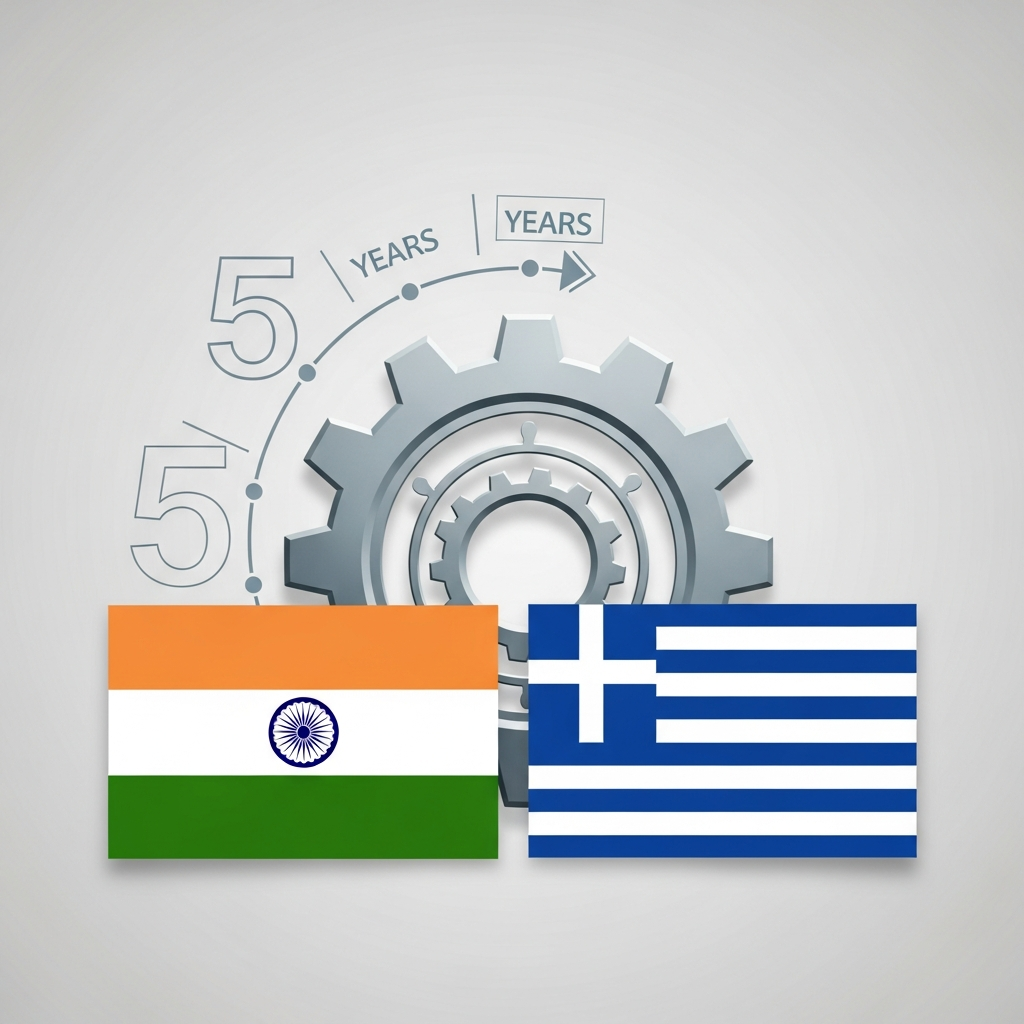
1. India and greece agree to strengthen defence industrial coopertaion in five year road map
GS paper II-IR
Context : India and Greece recently strengthened their strategic defense ties through a high-level meeting in New Delhi.
- Solidifying the “Strategic Partnership” established in 2023.
- Aligning India’s Aatmanirbhar Bharat goals with Greece’s Agenda 2030 reforms.
- Signing a landmark “Joint Declaration of Intent” for defense industrial collaboration.
Who was Involved?
- Rajnath Singh, Union Minister of Defence (India).
- Nikolaos-Georgios Dendias, Minister of National Defence (Greece).
- Defence industry stakeholders from Indian DPSUs (e.g., HAL, BEL) and private startups.
Key Outcomes & Agreements
Defence Industrial Cooperation
- Five-year roadmap via the signed declaration as a starting point.
- Joint R&D, co-production, and technology partnerships.
- Greek delegation toured aerospace and electronics hubs in Bengaluru.
Bilateral Military Cooperation
- Exchanged “Bilateral Military Cooperation Plan for 2026” for exercises.
- Enhanced training exchanges and staff-level talks.
Maritime & Regional Security
- Greece to post a liaison officer at IFC-IOR in Gurugram.
- Focus on maritime security in Mediterranean and Indo-Pacific.
- Greece supports India on counter-terrorism and UNSC seat bid.
Value-Based Partnership
- Rooted in shared principles of peace, stability, freedom, and mutual respect.
- Emphasizes historical ties as ancient seafaring civilizations
2. Anaemia ,blood disorders can distort diabetes test Hb A1c results
GS paper III-S&T
Context :A recent Lancet study highlights how anemia and blood disorders distort HbA1c results, leading to diabetes misdiagnosis in India and South Asia.
New Lancet Regional Health study flags HbA1c flaws due to anemia in high-prevalence regions.
- Published Feb 2026, warns of misrepresenting India’s diabetes burden.
Why HbA1c Important?
- Measures average blood glucose over 2-3 months for diabetes diagnosis/monitoring.
- Convenient, no fasting needed; widely used in clinics and surveys.
Problems in India & South Asia?
- High anemia prevalence (>50% in some Indian regions per 2025 data).
- Common hemoglobinopathies, G6PD deficiency distort HbA1c readings.
- Affects rural/tribal areas most; inconsistent lab quality worsens issues.
Key Findings of Study
- Anemia, hemoglobin disorders falsely elevate/lower HbA1c, causing misclassification.
- G6PD deficiency in men may delay diagnosis by up to 4 years.
- Public surveys using only HbA1c overestimate/underestimate diabetes rates.
Expert Recommendations Instead
- Use OGTT (fasting + 2-hr post-glucose) for diagnosis in low-resource settings.
- SMBG with glucometers 2-3x weekly plus basic hematology screening (Hb, smear).
- Avoid sole HbA1c reliance; confirm with plasma glucose if anemia suspected.
Public Health Significance for India
- Risks delayed treatment, higher complications in millions with anemia/diabetes overlap.
- Urgent need for adapted guidelines to avoid skewed national diabetes estimates.
- Improves accurate screening in anemia-hotspot regions like South Asia
3. What is the current controversy around form 7?
GS paper II-POLITY
Context :India’s electoral rolls face controversy over alleged Form 7 misuse during Special Intensive Revision, leading to 6.5 crore voter deletions.
Recent Voter List Disputes
- Bulk Form 7 applications filed without voter consent in multiple states.
- Opposition alleges targeted deletions of eligible voters in Rajasthan, Gujarat.
- 51 crore voters reduced to 44.4 crore after draft roll deletions (ASD category).
Voter Rolls’ Democratic Function
- Foundation for citizen voting rights under Representation of People Act, 1950.
- Periodic updates add eligible voters, remove dead/shifted/duplicates.
- Accuracy ensures fair elections, political representation, public trust.
Form 7 Legal Process
- Objects to entries based on death, duplication, relocation, age/citizenship.
- 2022 amendment allows any constituency voter to file (previously booth-only).
- ERO mandatory verification for bulk filings (>5 by one person).
Special Intensive Revision Overview
- ECI Phase II covers UP, Gujarat, Tamil Nadu, West Bengal (51 crore voters).
- Involves BLO field checks, objection hearings, compressed timeline.
- UP reports highest deletions, raising rushed verification concerns.
Mass Deletion Criticisms
- Claims of impersonation via unauthorized Form 7 submissions.
- Targets marginalized, weaker sections risking disenfranchisement.
- Tight schedule questions adequacy of notices/hearings.
Verification Protocols
- BLOs conduct home visits, neighbor confirmations, death certificate checks.
- Affected voters receive notice, attend deletion hearings.
- 15-day appeals to district magistrate after final roll publication.
Challenges and Reforms
- False Form 7 declarations punishable under Section 32, 1950 Act.
- Experts urge bulk scrutiny, digital tracking, extended timelines.
- Balance roll purification with voter protection via transparency.
4. New species Lyriothemis keralensis
GS paper III-environment
Context :Formally identified February 2026 after decade of research.
- Published in International Journal of Odonatology.
- Misidentified as Lyriothemis acigastra since 2013 Varapetty sighting.
- Boosts Kerala’s odonate count, highlights Western Ghats biodiversity.
News Specials
- Thrives in human-modified pineapple/rubber plantation landscapes.
- Seasonal resident visible only during SW monsoon (May-August).
- Shifts conservation to private farmlands/irrigation canals.
Characteristics
- Small: ~3 cm long.
- Males: Deep blood-red abdomen, black markings.
- Females: Bulkier, yellow-black coloration.
- Slender abdomen, unique anal appendages, genital structures.
- Larvae in pools/canals year-round; adults emerge in rains.
Habitat and Distribution
- Shaded vegetated canals, seasonal pools in agriculture.
- Low-lying coastal Kerala.
- Varapetty near Kothamangalam, Ernakulam district.
- Specific to irrigation/shaded plantation ecosystems.
5. Seven Chakras of the India–AI Impact Summit 2026
Context :India is hosting the India–AI Impact Summit 2026, the first major global AI summit in the Global South, drawing participants from over 100 countries.
- Organized around the ancient concept of Seven Chakras(thematic working groups) and guided by Three Sutras—People, Planet, Progress—the event aims to create actionable policies, governance, and strategies for responsible, inclusive AI worldwide.
- These chakras translate high-level principles into practical steps, addressing challenges like job shifts, equity gaps, and sustainability.
Rephrased Seven Chakras
Here’s a rephrased version of the chakras, with refreshed headings and points for clarity and flow while preserving the original meaning. Each highlights its core role in fostering equitable AI growth.
- Building AI Talent and Skills
Shields against mass job losses from AI, supports seamless workforce shifts, and establishes India as a worldwide center for AI expertise to drive fair, inclusive prosperity. - AI for Inclusive Empowerment
Guarantees AI advantages flow to women, farmers, informal laborers, people with disabilities, and linguistic minorities, weaving equity and social justice into AI frameworks. - Reliable and Secure AI Systems
Fosters public confidence via openness, responsibility, and bias reduction, allowing AI innovation to advance without eroding democracy, rights, or values. - Advancing Scientific Discovery
Speeds up innovations in healthcare, climate solutions, energy, and farming, while bridging the research gap between Global North and South through shared, open collaboration. - Sustainable AI Innovation
Harmonizes AI growth with eco-friendly practices, champions low-energy computing, and cuts the environmental impact of massive AI setups. - Opening Access to AI Tools
Tackles the worldwide digital divide by broadening availability of data, computing power, and models, empowering startups, researchers, and emerging economies to innovate independently of tech giants. - AI-Driven Growth and Welfare
Transforms AI strengths into tangible gains in farming, health, education, justice, productivity, and broad-based economic progress for social benefit.
6. Japan
Mapping
Context :India’s Prime Minister congratulated Sanae Takaichi on her coalition’s historic win in Japan’s House of Representatives election, signaling stronger bilateral ties amid shared interests in the Indo-Pacific. Japan, a key strategic partner for India, operates as a constitutional monarchy with a parliamentary democracy under its 1947 Constitution.
Geography Overview
Japan is an East Asian archipelago nation in the western North Pacific, stretching northeast to southwest off the Asian mainland.
- Borders the Sea of Japan (East Sea), East China Sea, Pacific Ocean, and Sea of Okhotsk.
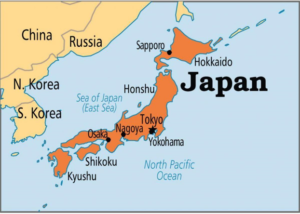
- Capital city: Tokyo.
Physical Landscape
The terrain features rugged mountains covering over 80% of the land, shaped by intense tectonic forces.
- Four primary islands: Hokkaido, Honshu (the largest), Shikoku, and Kyushu.
- Lies on the Pacific Ring of Fire, prone to earthquakes and volcanoes; highest point is Mount Fuji (3,776 m), an active stratovolcano.
- Short, fast-flowing rivers and limited coastal plains hosting most of the population.
- Influenced by subduction of Pacific and Philippine plates under the Eurasian Plate.
Political Structure
Japan blends ceremonial tradition with modern representative governance.
- Constitutional monarchy: Emperor serves as symbolic head of state; executive power lies with the Prime Minister and Cabinet.
- Bicameral legislature: National Diet with two houses for balanced law-making, reflecting public will and institutional stability.
7. The next big commodity is the mineable self
GS PAPER III-economy
Context : Contemporary capitalism commodifies the human self as an infinite economic resource through digital tracking and narrative exchange.
Self-Commodification Core
- Markets extract value from identity, emotions, lived experiences.
- Digital networks turn personal interactions into profitable data streams.
- Individuals become renewable inputs via continuous behavioral recording.
Labor to Social Extraction
- Capitalism shifts from physical work to relationships, habits, expressions.
- Profiling friendships erodes privacy for corporate dataset value.
- Conversations, purchases feed endless data monetization systems.
Global Narrative Fusion
- Local stories achieve worldwide reach through universal theme framing.
- Geography dissolves into networked cultural content marketplaces.
- Narrative relevance defines communities over physical proximity.
Streaming Visibility Economy
- Platforms democratize content with everyday personalities, no gatekeepers.
- Algorithmic profiles fragment identity into measurable traits.
- Selfies convert appearance into shareable platform currency.
AI Personhood Challenge
- Chatbots mimic empathy, blurring authentic vs. constructed selves.
- Machines compete in emotional communication spaces.
- Identity becomes performative among digital-human networks.
Virality Performance Cycle
- Social media demands constant storytelling for recognition rewards.
- Influencers monetize disclosure, creating audience dependency.
- Attention serves as currency in visibility-driven markets.
Paradox of Participation
- Enables expression freedom alongside commercial self-observation.
- Private life fuels profit through connected experience extraction.
- Human self emerges as endlessly mineable global commodity.
8. A chance for India to polish the Kimberley process
GS paper II-IR
Context :India’s 2026 Kimberley Process chairmanship provides opportunity to strengthen global diamond trade ethics and modernization.
Global Diamond Issues
- Luxury trade historically funded 1990s civil wars via conflict diamonds.
- Kimberley Process (2003) now regulates 99.8% of rough diamond production.
- India as largest processor holds key reform leverage position.
KP History and Scope
- Launched 2000 by African nations against rebel war financing.
- Certification mandates verified origin for all rough diamond exports.
- Covers 60 participants across 86 countries with data sharing.
Certification Operations
- Shipments require legitimate origin certificates between members only.
- Regular production/export statistics ensure supply chain transparency.
- Limits scope to rebel conflicts, excludes other violence forms.
India’s Supply Chain Dominance
- Imports 40% global rough diamonds despite minimal domestic mining.
- Surat/Mumbai handle primary cutting, polishing operations.
- Exports finished goods to US, China, UAE, Hong Kong markets.
Major Process Weaknesses
- Excludes state violence, forced labor, environmental destruction.
- Consensus decisions allow single-country veto power delays.
- Sanctions like 2013 CAR ban increased smuggling, harmed locals.
Proposed 2026 Reforms
- Technical working group to broaden conflict diamond definitions.
- Independent audits, public disclosure, civil society inclusion.
- Capacity building through African training and forensic support.
Technological Modernization
- Blockchain implementation for tamper-proof tracking records.
- Digital time-stamped documentation from mine to market.
- Enhanced traceability reduces fraud across supply chain.
Sustainable Development Focus
- Align KP with SDGs targeting poverty reduction, decent employment.
- Channel mining revenues to health, education, infrastructure.
- Transition from punitive measures to cooperative enhancement.
India’s Leadership Role
- Represents Global South balancing producers, processors, consumers.
- Promotes accountability, multilateral cooperation strengthening.
- Positions India as responsible global ethical trade leader.