1. India and Malaysia sign pact
GS PAPER II-IR
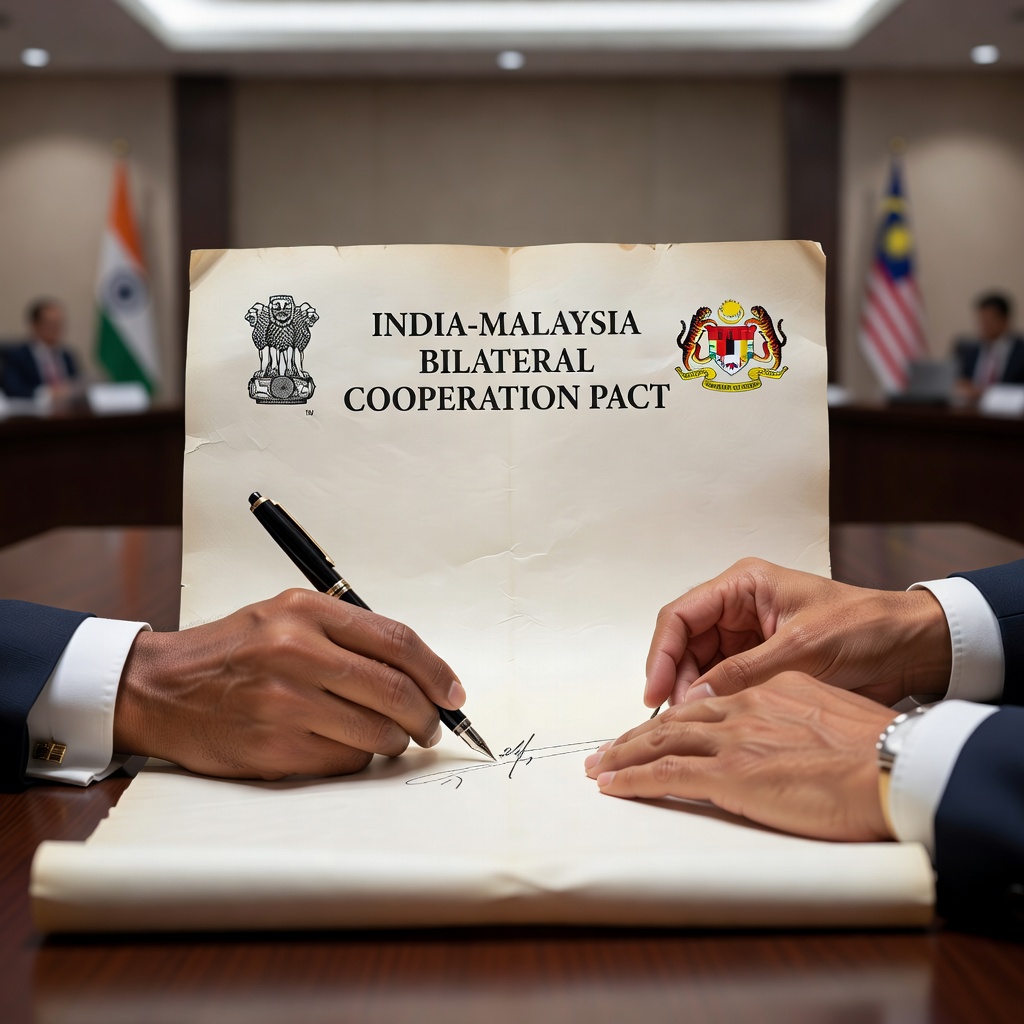
CONTEXT :PM Modi’s state visit to Malaysia (Feb 7-8, 2026) reaffirmed the CSP elevated in 2024.
- 11 MoUs signed on semiconductors, digital payments, security, disaster management, and peacekeeping.
- Shift toward strategic synergy in defense, tech, and economy amid shared maritime interests.
Historical Background
- Diplomatic relations established in 1957, rooted in civilizational and cultural links.
- Elevated to Enhanced Strategic Partnership in 2015; further to CSP in August 2024.
- Maritime neighbors sharing Bay of Bengal and Andaman Sea, fostering security cooperation.
Trade & Economy Highlights
- Local currency settlement using INR and MYR to reduce third-party currency reliance.
- Bilateral trade hit ~$20 billion (2024-25), targeting $25 billion by 2026 or higher by 2030.
- Malaysia as key palm oil supplier; 10th CEO Forum boosts infrastructure and energy investments. [user query]
| Aspect | Key Details | Target/Impact |
| Trade Volume | $18.6-20B (recent) | $25B by 2026 |
| Sectors | Palm oil, electronics | Diversification via MICECA amendments |
| Forum | 10th CEO Forum | Private investment in infra, energy [user query] |
Defence & Security Ties
- Su-30 forum for technical expertise sharing on jointly operated fighter jets. [user query]
- Co-chair ADMM-Plus Counter-Terrorism Group (2024-2027); condemn terrorism without double standards. [user query]
- Enhance Harimau Shakti (Army) and Udara Shakti (Air Force) exercises; Indo-Pacific patrols and intel sharing. [user query]
Semiconductors & Tech Collaboration
- Framework links India’s design expertise with Malaysia’s 13% global packaging share. [user query]
- IIT Madras partners Advanced Semiconductor Academy of Malaysia (ASEM) for workforce skills. [user query]
- IESA-MSIA linkage for supply chain resilience; UPI-PayNet for cross-border QR payments. [user query]
Regional & Global Alignment
- Malaysia supports India’s permanent UNSC seat in reformed Council. [user query]
- Commitment to ASEAN centrality in free, open Indo-Pacific. [user query]
- Malaysia as gateway for India’s Act East Policy into ASEAN markets. [user query]
People-to-People Links
- New Indian Consulate General in Sabah (Borneo) for diaspora services. [user query]
- Thiruvalluvar Chair at Universiti Malaya for cultural studies. [user query]
- ESIC-PERKESO pact for Indian workers’ social security; eased visas for tourism/students. [user query]
Strategic Value to Malaysia
- India as massive market for palm oil/electronics, aiding economic diversification. [user query]
- Stabilizing force in South China Sea/Indo-Pacific security balance. [user query]
- Aligns with Malaysia’s reduced single-market dependency via CSP.
2. On Thin ice
GS paper I-GEOGRAPHY
CONTEXT ;Drilling Mission (2026): Expedition targets 1,000m ice core at grounding line to analyze warm water intrusion accelerating melt.
- Seabed Curtain Proposal: Giant underwater barriers considered to block warm currents from reaching ice base.
- Instability Warning: February 2026 studies predict Eastern Ice Shelf breakup within 10 years, risking WAIS collapse.
Location & Characteristics
- Position: Walgreen Coast, Marie Byrd Land in West Antarctic Ice Sheet (WAIS).
- Dimensions: Widest glacier globally (~120 km wide), area equals Great Britain or Florida.
- Ice Volume: Holds ~65 cm sea-level equivalent alone; buttresses larger WAIS reservoir (~3m potential rise).
“Doomsday Glacier” Nickname
- Threat Scale: Collapse could flood coastal cities worldwide catastrophically.
- Plug Role: Stabilizes inland ice; failure triggers domino WAIS disintegration.
- Change Rate: Fastest-evolving ice-ocean system in Antarctica.
Ice Dynamics Issues
- Marine Ice Sheet Instability (MISI): Downward-sloping bedrock enables runaway inland retreat.
- Grounding Line Retreat: Warm water lifts ice from seabed, widening melt cavities.
- Shelf Weakening: Floating shelf fractures from basal melt, removing flow brake.
Ice Loss Rates
- Annual Deficit: ~50 billion tons net loss yearly (outpaces snowfall).
- Velocity Surge: Grounding zone speeds >2 km/year.
- Global Impact: ~4% of current annual sea-level rise.
Climate Drivers
- Ocean Warming: Winds push Circumpolar Deep Water into sub-ice cavities.
- Polar Amplification: Twice-global warming rate erodes ice reflectivity.
- Feedback Loops: Thinning creates bigger warm-water access, self-amplifying melt.
Collapse Consequences
- Flooding Crisis: 65 cm+ rise inundates lowlands, displacing millions.
- Domino Risk: Triggers Pine Island and neighbor collapses (~3m total rise).
- Ocean Disruption: Freshwater pulse alters circulation, harms biodiversity.
3. Agni-3 Intermediate-Range Ballistic Missile
Context :DRDO conducted successful Agni-3 test from Integrated Test Range, Chandipur (Feb 2026).
- All technical parameters validated, confirming missile reliability under Strategic Forces Command.
- Enhances India’s nuclear triad amid regional security challenges.
Missile Overview
- Class: Intermediate-Range Ballistic Missile (IRBM).
- Developer: Defence Research & Development Organisation (DRDO).
- Operator: Strategic Forces Command (nuclear delivery arm).
Technical Specifications
- Range: ~3,000 km (covers most regional adversaries).
- Propulsion: Two-stage solid fuel rocket motor.
- Launch Mode: Road-mobile canister launcher (high mobility).
- Payload: Conventional or nuclear warheads (strategic flexibility).
- Guidance: Ring-laser gyroscope inertial navigation (high CEP accuracy).
Strategic Role
- Deterrence Pillar: Credible minimum deterrence against long-range threats.
- Second-Strike: Reliable retaliatory capability post-first strike.
- Spectrum Coverage: Bridges Agni-1/2 (short/medium) and Agni-4/5 (longer range).
Operational Significance
- Validates canisterised road-mobile deployment readiness.
- Confirms nuclear command-control integration.
- Strengthens extended regional strategic depth (700-5,000 km band).
4. Virtual Private Network
GS PAPER III-S&T
Context :Multiple Delhi schools got identical bomb threat emails, forcing evacuations.
- Fire services, bomb disposal teams conducted intensive security sweeps.
- Probe focuses on tracing anonymous emails routed through VPN services.
VPN Basics
-
- Definition: Virtual Private Network creates encrypted tunnel between device and remote server.
- Core Function: Masks IP address, encrypts data traffic, bypasses geo-blocks.
- Components: No physical cables (virtual), data privacy (private), device-server link (network).
Key Advantages
- Data Encryption: Scrambles internet traffic, unreadable without decryption key.
- IP Masking: Hides real location/IP from websites, ISPs, trackers.
- Censorship Bypass: Accesses blocked sites by spoofing foreign server locations.
Security Benefits
- ISP Privacy: Prevents service providers logging browsing history.
- Surveillance Evasion: Defeats government/corporate network monitoring.
- Secure Public WiFi: Protects data on unsecured networks (airports, cafes).
Hoax Threat Context
- VPNs enable anonymous email sending, complicating law enforcement tracing.
- Threat actors exploit encryption to mask location, evade IP-based tracking.
- Raises need for telecom/VPN provider cooperation in national security cases.
VPNs balance privacy rights with law enforcement challenges during hoax threats, demanding calibrated regulation over outright bans.
5. A social media ban will not save our children
GS paper III-social justice
Context :Ghaziabad tragedy: Suicide of three sisters sparked national outrage and calls for social media bans.
- Public demands immediate action against digital platforms amid adolescent mental health crisis.
Core Argument
- Complex social issues need balanced policy, not blanket prohibitions.
- Bans risk undermining children’s rights while ignoring root causes.
- Focus on corporate accountability over restricting youth access.
Social Media Risks
- Heavy use links to anxiety, depression, cyberbullying in teens.[web:context]
- Girls face higher body image pressure from online comparison.
- Digital harm interacts with family stress, not sole cause.
Global Policy Trends
- Australia bans under-16s via age verification on platforms.
- Spain proposes algorithm liability for harmful content.
- Such measures promise protection but face enforcement gaps.
Moral Panic Critique
- Complex problems simplified to single “tech villain.”
- Symbolic crackdowns provide emotional relief, not solutions.
- Overreaction ignores technology’s social benefits.
Why Bans Fail in India
Technical Issues
- Teens bypass via VPNs, unregulated apps easily accessed.
- Pushes users to encrypted spaces with greater risks.
- Verification enables invasive surveillance.
Social Harms
- Marginalized youth lose vital online communities.
- Rural/LGBTQ teens rely on digital support networks.
- Deepens isolation for vulnerable groups.
Democratic Flaws
- Youth excluded from policymaking affecting them.
- Treats adolescents as subjects, not stakeholders.
- Misses lived experiences in solution design.
Gender Impact
- Boys retain access; girls face stricter device controls.
- Widens existing digital gender access gap.
- Limits girls’ education, skills, mobility.
Better Alternatives
Regulate Platforms
- Duty of care laws hold companies accountable.
- Ban harmful algorithms, enforce safety design.
- Independent technical regulator needed.
Research & Inclusion
- Study regional variations by class, caste.
- Long-term data over knee-jerk reactions.
- Youth consultations shape effective policy.
Emerging Concerns
- AI chatbots pose new emotional dependency risks.
- Need consistent standards across all digital tools.
- Critical thinking weakened by over-reliance.
Forward Path
- Build healthy media ecology via education.
- Corporate responsibility plus parental guidance.
- Ethical innovation preserves opportunity.
6. Myanmar’s military -scripted polls ,India strategic bind
GS PAPER II-IR
Context :Myanmar military elections (Dec 2025-Jan 2026), 5 years post-2021 coup.
- USDP victory amid opposition suppression and civil war.
- Process institutionalizes junta rule, not civilian restoration.
- Elections excluded 20% of townships, mainly rural resistance areas.
- NLD and ethnic parties dissolved; military ran as USDP candidates.
- 55% turnout reflects rejection amid surveillance and fear.
Controlled Legitimacy Process
- Voting limited to 265/330 townships, mainly urban areas.
- Rural resistance zones completely excluded from polling.
- Election Commission banned major opposition parties pre-vote.
Elections During Civil War
- 113,000+ structures destroyed since 2021; Sagaing/Magway heavily impacted.
- People’s Defence Forces + ethnic armies control significant territory.
- Polls deepen divisions rather than stabilize governance.
India’s Strategic Dilemma
- Myanmar key to Act East Policy connectivity and border security.
- India supports “free elections” rhetoric but maintains high-level contacts.
- Humanitarian aid (post-2025 earthquake) shows calibrated engagement.
Security Threats to India
Refugee Crisis
- Heavy influx into Mizoram/Manipur strains state resources.
- No national refugee policy exposes governance gaps.
Infrastructure Delays
- Kaladan Project, Trilateral Highway stalled by insecurity.
- Post-election claims won’t resolve ground-level risks.
Crime Surge
- Cyber-scam centres, human trafficking thrive in chaos.
- Thousands of Indians trapped in scam operations.
India’s Dual Approach
- Engage junta diplomatically without formal recognition.
- Maintain contacts with ethnic stakeholders and opposition.
- Prioritize border stability over ideological positioning.
Global Response Limits
- West/ASEAN reject election legitimacy but lack leverage.
- Military entrenched; opposition fragmented and territorialized.
- India’s middle path balances democracy ideals with security needs.
Myanmar elections formalize military rule amid civil war, forcing India into pragmatic engagement despite democratic concerns.
7. Why has AYUSH got a major push in Budget?
GS PAPER III-economy
Context :Union Budget 2026-27 allocates Rs. 4,408 crore to AYUSH, up 10% from 2025-26.
- Announces 3 new All-India Ayurveda Institutes and enhanced WHO Jamnagar Centre.
- Bharat-VISTAAR AI launched for medicinal plant farmers.
AYUSH Framework
- Covers Ayurveda, Yoga, Unani, Siddha, Homoeopathy systems.
- Ministry of AYUSH (2014) oversees hospitals, research, regulation.
- National AYUSH Mission integrates services in primary health centres.
Budget Highlights
- Total allocation: Rs. 4,408 Cr (vs Rs. 3,992 Cr previous year).
- Three new AIIMS-like Ayurveda excellence centres announced.
- WHO Global Traditional Medicine Centre (Jamnagar) gets upgrade funds.
Infrastructure Boost
- Rs. 1,300 Cr for NAM hospital/dispensary modernization.
- Enhanced funding for AYUSH pharmacies, drug testing labs.
- Bharat-VISTAAR: AI assistant for medicinal plant cultivation.
Global Market Access
- India-EU FTA enables AYUSH clinics in Europe.
- Mutual recognition of lab tests, safety certifications.
- TKDL protected against biopiracy in patent systems.
Key Challenges
- IMA demands RCT evidence for AYUSH therapies.
- Heavy metal contamination in Ayurvedic formulations.
- Mixopathy disputes over AYUSH surgical/allopathic practice. (c) 1 and 3 only