
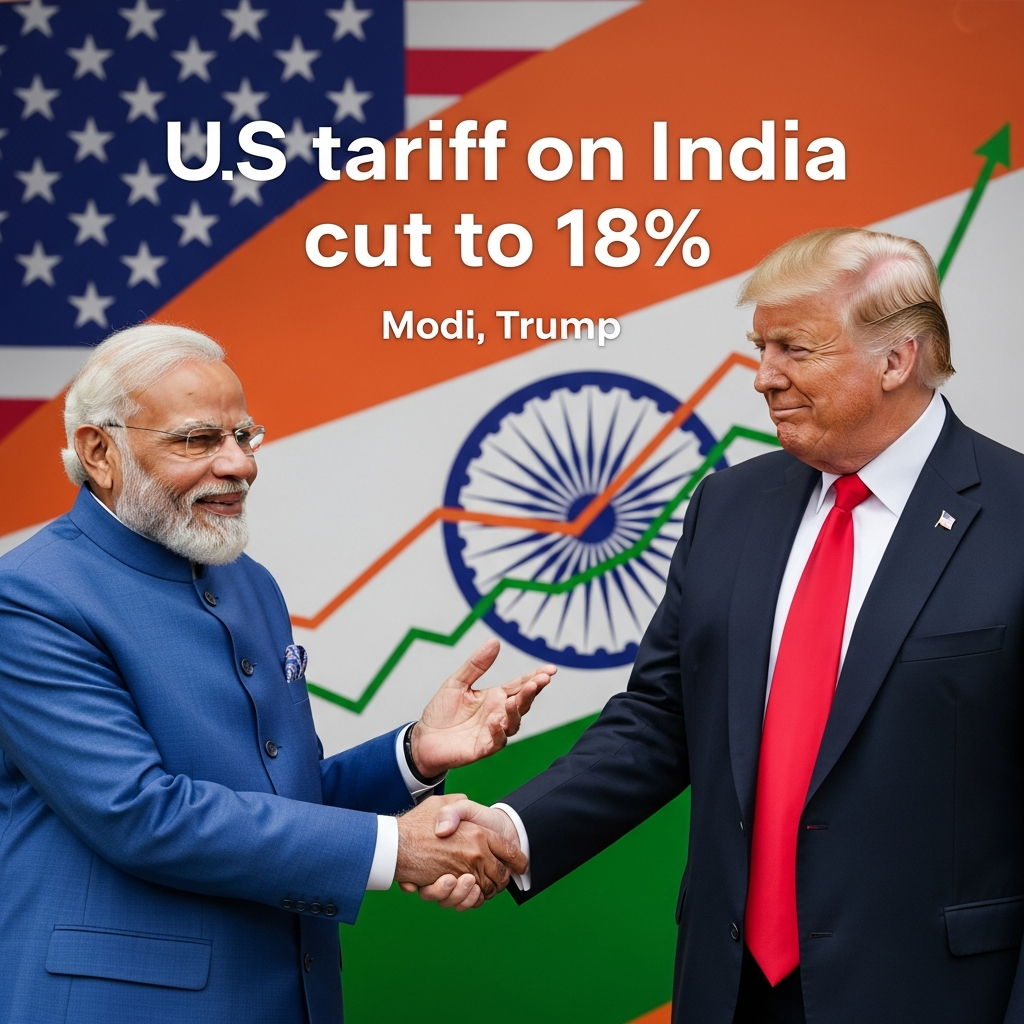
1. US tariff on india cut to 18%,say Modi ,Trump
GS PAPER III-ECONOMY
Context :The U.S. has reduced the effective tariff rate on most Indian goods from 50% down to 18%.
- Immediate Effect: The deal was finalized over a 30-minute phone call and took effect immediately on February 2, 2026.
- Energy Pivot: India has reportedly agreed to halt purchases of Russian crude oil in favor of U.S. and Venezuelan energy.
What has Changed Now?
Tariff Reduction
- Old Rate: Indian exports were facing a 25% “reciprocal” tariff plus a 25% “punitive” penalty (totaling 50%).
- New Rate: The punitive penalty has been scrapped, and the reciprocal tariff lowered to a flat 18%.
- Competitiveness: India now faces lower U.S. tariffs than regional rivals like China (34%), Bangladesh (20%), and Vietnam (20%).
Claim vs. Confirmation
- U.S. Claim: Trump stated India will reduce its own tariffs and non-tariff barriers to zero and “Buy American.”
- India’s Stance: PM Modi welcomed the 18% cut but has not yet officially confirmed the “zero tariff” or “Russian oil halt” details.
- The Gap: While Trump claims a $500 billion commitment for U.S. goods, Indian official statements remain more cautious and focused on the 18% relief.
Why is this Important for India?
Trade & Economy
- Export Boost: Textiles, jewelry, and leather—sectors hit hardest by 50% duties—will see an immediate rebound in orders.
- Market Rally: The announcement sparked a record rally in Indian stock markets, with the Nifty jumping nearly 5%.
- Currency Support: The deal is expected to strengthen the Rupee, which had been trading near record lows against the USD.
Strategic Relations
- Diplomatic Reset: Resolves a period of “trade war” friction and re-establishes the “Modi-Trump” personal chemistry.
- Supply Chains: Positions India as the primary “trusted partner” in the Indo-Pacific, separate from Chinese influence.
Energy & Geopolitics
- Russia Shift: Moving away from Russian oil aligns India with U.S. foreign policy regarding the Ukraine conflict.
- Energy Security: Diversifying sources to include the U.S. and Venezuela helps secure long-term energy stability.
- Critical Minerals: The deal paves the way for India’s inclusion in U.S.-led mineral supply chains for semiconductors and EVs.
2. Polar satellite Launch Vehicle
GS paper III-S&T
CONTEXT : PSLV-C62 mission failed to reach orbit on January 12, 2026, due to a flight anomaly.
- Second Consecutive Setback: Marks the second PSLV failure in eight months.
- Major Loss: 16 satellites lost, including DRDO’s strategic surveillance satellite Anvesha (EOS-N1).
What Exactly Failed?
- Third-Stage Issue: Rocket operated normally in first two stages but malfunctioned in the third stage (PS3).
- Roll-Rate Disturbance: ISRO Chairman V. Narayanan confirmed excessive spinning, causing path deviation.
- Previous Failure (C61): Sudden drop in combustion chamber pressure led to insufficient orbital velocity.
- Suspected Causes: Possible manufacturing defects like propellant cracks or lapses in solid motor quality control.
Reasons for External Investigation Team
- Restoring Confidence: Minister Jitendra Singh announced a “third-party” review to rebuild public and investor trust.
- Independent Analysis: Provides fresh perspective on repeated technical problems.
- Addressing Transparency Concerns: Follows criticism over ISRO’s internal handling of the C61 probe report.
Impact on ISRO’s Credibility
- Declining Success Rate: PSLV’s lifetime success rate now at about 93.7%.
- Commercial Risks: Higher insurance costs and competition from SpaceX, Rocket Lab threaten India’s market share.
- Continued Partnerships: U.S., Japan, and France partners remain committed to future launches.
- Strategic Gaps: Loss of two Earth Observation Satellites temporarily hampers border surveillance.
Next Steps and Timeline
- Target Launch: June 2026 for PSLV’s “return-to-flight” mission.
- Prerequisites: Awaits committee findings, defect fixes, and certification.
- 2026 Schedule: ISRO plans 18 launches, including six for private sector, despite the pause.
3. Mountain gorillas (Gorilla beringei beringei)
GS paper III-Environment
Context :Mountain gorillas (Gorilla beringei beringei) are a unique success story in wildlife conservation, being the only great ape subspecies whose population is currently increasing.
- Population Milestone: As of early 2026, the global population remains stable at approximately 1,063 individuals, a significant rise from near-extinction levels.
Basic Facts & Distribution
- Species: They are a subspecies of the Eastern Gorilla (Gorilla beringei).
- Restricted Range: Found only in two isolated populations in East-Central Africa.
- Geography: They inhabit high-altitude montane and bamboo forests at elevations up to 13,000 feet.
- Three Countries: Their habitat spans Uganda, Rwanda, and the DRC.
Conservation Status
- IUCN Red List: Currently classified as Endangered.
- Recent Upgrade: Downlisted from “Critically Endangered” in 2018 due to steady population growth.
- Vulnerability: Despite growth, they remain conservation-dependent and could decline rapidly without protection.
Biological & Behavioral Traits
- Physical Strength: Adult males (silverbacks) can weigh up to 180kg and are twice the size of females.
- Adaptation: They have thicker fur than other gorillas to survive sub-freezing mountain temperatures.
- Social Structure: Live in stable family groups of 10 to 40, led by a dominant silverback.
- Diet: Primarily herbivorous, eating up to 18kg of shoots, leaves, and bark daily.
- Intelligence: They share approximately 98% of their DNA with humans and display complex emotions.
Major Threats
- Political Instability: Armed conflicts in the DRC disrupt patrols and turn parkland into battlefields.
- Habitat Loss: Expanding agriculture and charcoal production fragment the small forests they inhabit.
- Human Disease: Susceptible to human illnesses like the common cold or flu, which can be fatal.
- Poaching Snares: While not usually targeted for meat, gorillas are often killed by snares set for other animals.
Important Protected Areas
- Bwindi Impenetrable National Park (Uganda): Home to roughly half the world’s population.
- Volcanoes National Park (Rwanda): Famous for Dian Fossey’s research and intensive tourism management.
- Virunga National Park (DRC): Africa’s oldest national park, covering a quarter of the species’ range.
- Mgahinga Gorilla National Park (Uganda): Part of the transboundary Virunga Massif habitat.
4. Booster Shot for educatio and skilling
GS paper II-polity -governace
Context :Union Budget 2026-27, presented by Nirmala Sitharaman, boosts education, skills, and jobs via structural reforms aligned with NEP 2020 and Viksit Bharat vision.
Governance and Structural Changes
- Education-to-Jobs Committee: New high-powered standing committee to drive India’s 10% global services share by 2047, assessing AI’s job impact.
- AI in Curriculum: Committee to integrate AI from school level, preparing workforce for future disruptions.
- University Townships: Support for 5 state-led townships near industrial corridors, hosting universities, skills hubs, and research centers.
Future-Ready Skilling and Creative Sectors
- AVGC Labs: Content creator labs in 15,000 secondary schools and 500 colleges to boost Animation, VFX, Gaming, and Comics sector.
- Corporate Mitras Program: ICAI/ICSI to create modular courses for MSME compliance helpers in Tier-II/III towns.
- Samarth 2.0 Initiative: Industry-academia tie-up to upgrade textile skilling ecosystem.
- Youth Dialogue Input: Budget draws from Viksit Bharat Young Leaders Dialogue ideas.
Targeted Health and Specialized Training
- Allied Health Expansion: Add 100,000 professionals over 5 years via upgraded institutions in 10 fields like radiology and optometry.
- Caregiver Upskilling: Train 5 lakh in wellness, yoga, and medical devices for robust care ecosystem.
- AYUSH Boost: 3 new All India Ayurveda Institutes; upgrade pharmacies for skilled staff.
- Veterinary Scale-Up: Loan-subsidy for private colleges to increase professionals by 20,000+.
Infrastructure and Inclusive Access
- Girls’ STEM Hostels: One hostel per district with capital aid to encourage women in Science, Technology, Engineering, and Math.
- New Eastern NID: National Institute of Design via challenge-based selection in East India.
- Hospitality Upgrades: Elevate National Council for Hotel Management to National Institute; upskill 10,000 guides at 20 tourist sites via IIM course.
- Divyangjan Skills Scheme: Tailored training for persons with disabilities in IT, AVGC, and hospitality.
Cutting-Edge Research Infrastructure
- Astrophysics Facilities: Upgrade/establish 4 key sites like National Large Solar Telescope and COSMOS-2 Planetarium for hands-on learning.
5. Rare earth corridors to cut China imports
GS PAPER II-IR
Context :Union Budget 2026-27 introduces Rare Earth Corridors in four coastal states to build a self-reliant critical minerals supply chain from mining to manufacturing. These target beach sand monazite deposits rich in REEs like neodymium for EVs, defense, and clean energy tech.
Rare Earth Corridor Overview
Definition: State-led industrial clusters integrating REE mining, processing, R&D, and magnet production (REPMs) in coastal zones.
States Covered: Odisha (Chhatrapur/OSCOM hub), Kerala (Chavara/Vizhinjam), Andhra Pradesh (Srikakulam-Nellore coast), Tamil Nadu (Manavalakurichi areas).
Core Aim: End import dependence (53,000+ MT magnets in FY25); enable 6,000 MTPA domestic REPM capacity via ₹7,280 Cr scheme.
Key Initiative Features
- Integrated Value Chain: Co-locates extraction, separation, refining, and manufacturing to cut logistics/tech gaps.
- Financial Incentives: ₹6,450 Cr sales-linked aid plus ₹750 Cr capital subsidy for REPM units.
- Policy Alignment: Operationalizes National Critical Minerals Mission at state level with PLI/GSI support.
- Sector Boost: Supplies magnets for EVs, wind/solar, defense missiles, semiconductors, and thorium reactors.
Coastal Monazite Potential
- Odisha: Highest processing at OSCOM; monazite-rich beach sands near Chhatrapur.
- Kerala: Major reserves at Chavara; leverages Vizhinjam Port for exports/processing.
- Andhra Pradesh: 30-35% of India’s monazite along 974 km coast (Bhimunipatnam to Dugarajapatnam).
- Tamil Nadu: Key southern deposits in Manavalakurichi for light REEs like cerium/lanthanum.
Emerging Inland Deposits
- Arunachal Pradesh: Papum Pare district rich in neodymium from river-valley soils.
- Rajasthan: 1 lakh+ tonnes REE oxides in Balotra; active in Sirohi/Bhilwara.
- West Bengal: Purulia’s South Purulia Shear Zone under GSI exploration.
- Gujarat: Amba Dongar/Kamthai carbonatites as REE hotspots.
- Madhya Pradesh: Singrauli coalfields yield REEs tied to coal seams.
- Jharkhand/Chhattisgarh: Heavy REE placers in Chotanagpur Granite Gneiss
6. Union Budget 2026-27: Major Boost for Livestock & Fisheries Expansion
Context : Union Budget 2026-27 boosts livestock/fisheries by 26.7% to ₹8,915.26 crore, recognizing 7.1% growth vs. 3.5% for crops; now ~16% of farm income.
Livestock Sector Focus
- Veterinary push: 20,000+ professionals via loan-linked subsidies for colleges, labs, breeding centers.
- Rashtriya Gokul Mission: ₹800 crore for indigenous cattle productivity and health.
- Entrepreneurship scheme: ₹500 crore credit subsidies for livestock startups, FPOs.
- Dairy cooperatives: Tax relief on cattle feed, inter-coop dividends.
Fisheries Sector Reforms
- Inland infra: Develop 500 reservoirs, Amrit Sarovars for higher fish production.
- Coastal chains: Women-led FPOs, 200+ startups for value addition.
- Allocation peak: ₹2,761.80 crore for blue economy, global exports.
Key Export Reforms
| Reform | Impact |
| Input imports | Duty-free limit up to 3% of export turnover. |
| EEZ catch | Fully duty-free for Indian vessels. |
| Foreign landings | Treated as exports for deep-sea fleets. |
| Courier cap | ₹10 lakh limit removed for e-commerce. |
7. Union Budget 2026: scheme to develop Buddhist circuit in Northeast
GS PAPER I-ART &CULTURE
Context :Union Budget 2026-27 launches Northeast Buddhist Circuit scheme to conserve monasteries/temples, boost tourism, and integrate with Purvodaya growth (₹5,000 cr for CERs, 4,000 e-buses).
Northeast Buddhist Circuit Overview
Heritage-tourism project across Arunachal, Sikkim, Assam; links culture to East Industrial Corridor, livelihoods.
Key Budget Measures
- Monastery preservation: Temples/monasteries get restoration, pilgrim amenities.
- Tourism infra: 5 destinations in Purvodaya states, 4,000 e-buses for mobility.
- Regional push: ₹5,000 cr over 5 yrs for City Economic Regions (Tier II/III cities).
Key Monasteries by State
Arunachal Pradesh
- Tawang Monastery: India’s largest (2nd globally), 17th century, 18-ft gilded Buddha at 10,000 ft.
- Bomdila Monastery: 1965 Mahayana center with Himalayan views.
- Urgelling Monastery: 15th century, birthplace of 6th Dalai Lama.
- Golden Pagoda (Namsai): Burmese-style Theravada gold-plated structure.
- Taktsang Gompa: Tiger’s Nest near Bhutan, Guru Padmasambhava meditation site.
Sikkim
- Rumtek Monastery: Largest in Sikkim, Gyalwang Karmapa seat (Kagyu sect).
- Pemayangtse Monastery: Oldest Nyingma hub, controls state monasteries.
- Enchey Monastery: 200-yr-old Gangtok site, blessed by Lama Druptob Karpo.
- Tashiding Monastery: Holiest in Sikkim; glimpse believed to cleanse sins.
- Dubdi Monastery: Oldest (1701), Hermit’s Cell from first Chogyal era.
Other Sites
- Ghoom Monastery (West Bengal): Darjeeling, 15-ft Maitreya Buddha statue.
- Namphake Monastery (Assam): Tai-Phake Theravada, near Dibrugarh.
- Venuvan Vihara (Tripura): Agartala site with Myanmar-sourced Buddha statue.
8. Wetland as a national public good
GS paper III-Environment
CONTEXT :World Wetlands Day 2026 theme—”Wetlands and traditional knowledge”—spotlights India’s 75+ Ramsar sites amid ongoing degradation (e.g., recent Lok Sabha data shows 40% urban wetland loss.
Wetlands and Traditional Wisdom
- Cultural Ties to Wetlands: India’s communities have long relied on wetlands for livelihoods, identity, and rituals, blending ecology with society through sustainable practices.
- Local Examples of Harmony: Tamil Nadu’s kulams manage farm water; Kerala’s kenis supply drinking/ritual water; Andhra fishers use seasonal methods to protect ecosystems.
- Value of Indigenous Practices: These socio-ecological systems embed conservation in culture, positioning locals as active stewards over passive aid recipients.
Policy Setup vs. Ground Reality
- Robust Legal Framework: Includes 2017 Wetland Rules, NPCAE, CRZ norms, and Ramsar pledges covering diverse wetland types.
- Core Implementation Failures: Delays in notifications, poor enforcement, siloed agencies, and weak coordination lead to massive losses and degradation.
Threats from Development and Environment
- Urban and Infra Pressures: Rapid city growth, roads, and land fills fragment wetlands at land-water edges.
- Hydrology Disruptions: Dams, mining, and over-extraction alter flows, crippling ecological roles.
- Pollution Overload: Sewage, effluents, runoff cause eutrophication, biodiversity crash, and poor water quality.
- Climate and Coastal Risks: Sea rise, storms erode mangroves/lagoons amid development squeeze.
Governance and Capacity Shortfalls
- Institutional Weaknesses: Understaffed wetland authorities lack funds, skills, enforcement, and community links.
- Planning-Monitoring Gaps: Overlapping mandates without coordination hinder even strong policies.
Pathways for Effective Action
- Foundation Steps: Fast-track notifications with clear, participatory mapping and boundaries.
- Urban Wetland Safeguards: Block polluting inflows; no using them as sewage dumps.
- Landscape-Level Fixes: Restore catchments and hydrology links for functional wetlands.
- Coastal Resilience Role: Treat mangroves/riparian zones as natural flood barriers vs. man-made ones.
- Build Long-Term Capacity: Train staff, tie management to community benefits for sustained stewardship.
9. Visible Progress, Invisible Exclusion
GS paper III-ECONOMY
Context :Union Budget 2026-27 (Feb 2026) emphasizes capex amid PLFS 2024-25 data showing stagnant EPFO payrolls and rising NEET.
Budget 2026-27: Capex Pivot
- Macro Shift to Investment: Targets 4.3% fiscal deficit with ₹12.2 lakh crore public capex, ditching crisis mode for infra-led growth and MSME props.
- Capex as Policy Core: Share in total spend jumped from 12% to 22% post-2020, aiming to crowd-in private funds, boost productivity, and create jobs.
Growth Without Jobs
- Weak Job Transmission: Youth NEET (15-29) stuck at 23-25% despite rising investment, signaling poor aggregate growth-to-employment link.
- Construction Job Fade: Infra-linked sector’s employment elasticity dropped from 0.59 (pre-COVID) to 0.42 (post-2021), fewer jobs per rupee spent.
Sectoral Employment Reversal
- Agriculture’s Distress Pull: Elasticity surged from 0.04 pre-COVID to 1.51 post, as workers return to low-productivity farms amid stalled non-farm shifts.
- Structural U-Turn: Modern infra upgrades clash with workforce drifting to subsistence, reversing labour release from farms.
Capital Bias and Inequality
- Rising Capital Intensity: Public spend favors machines over labour; net value added per worker up, but wages lag as profits capture gains.
- Dual Economy Trap: Big firms dominate output via infra/logistics but hire few; MSMEs can’t scale into capital-heavy chains, pushing masses to informal/low-wage work.
- Inclusion Barriers: Jobs need formal skills, urban access, automation-fit; others fall to self-employment or subsistence.