
1. Safe City Project
GS paper III-Science and technology
Context :In January 2026, Delhi Police launched the Safe City Project with 10,000 AI cameras for facial recognition and distress detection, while Maharashtra rolled out MahaCrime OS AI for predictive policing.
PM Modi’s directive urges states to form AI task forces, training 70% police personnel, amid rapid AI surveillance expansion.
Current AI Use in Policing
- Delhi Safe City: 10,000 AI cameras detect faces, screams, emergency gestures via CCTNS data.
- Maharashtra MahaCrime OS: Predicts crime hotspots, analyzes FIR patterns for faster probes.
- Drones & Social Media: Crowd/traffic control; tracks misleading posts in Bengaluru.
Power Centralization Risks
Shifts authority from local cops to remote data centers, eroding human oversight.
Beat officers face constant CCTV/geotag monitoring, codifying hierarchy.
Excessive Surveillance Issues
One AI camera equals 100 policemen; Hyderabad’s millions create mass suspicion.
Undermines protest rights, fosters “guilty until proven innocent” via anomaly detection.
Bias and Targeting Problems
Trained on biased historical data, AI perpetuates community discrimination.
Telangana 2023 case: Innocent Mohammed Khadeer Khan killed post wrongful facial match.
Transparency Gaps
No statutory AI rulebook like police manuals; decisions become unchallengeable black boxes.
DPDPA 2023 exempts law enforcement, widening privacy voids.
Needed Safeguards
- Enact AI policing laws mandating pre-deployment safety tests, audits.
- Human-in-loop: Officers accountable for final arrest calls.
Reform CrPC 2022: Limit non-convict data collection to protect privacy.
2. The EV Boom is accelerating a copper crunch
GS paper III-science and technology
Context :The EV boom accelerates a copper crunch as explosive demand from electric vehicles outpaces slow supply growth, creating global deficits.
This mismatch threatens energy transition goals and raises prices.
Why Copper Crucial
Copper’s superior conductivity, durability, and recyclability make it essential for electrification.
It enables efficient power delivery in EVs, grids, and renewables.
Key Uses in EVs
- Li-ion batteries for performance and longevity
- Powertrain motors and controllers for efficient delivery
- Wiring harness and high-voltage cabling
- Charging infrastructure for fast charging
EVs Copper Requirement
EVs require 3-5 times more copper than ICE vehicles (e.g., 200 lbs vs 40 lbs for Honda Accord).
Batteries, motors, wiring, and chargers drive this higher usage.
EV Growth vs Copper Supply
EV sales hit 20.7 million in 2025, fueling demand surge.
Supply grows slowly at 0.9-2.3% annually due to mining constraints.
Demand Side: EV Boom
Global EV adoption, AI data centers, renewables pull copper demand up 50% by 2040.
EVs alone account for 55% of incremental demand.
Supply Side Challenges
Declining ore grades, high capex, permitting delays slow new mines (16+ years discovery-to-production).
Mine disruptions in Chile, Indonesia, Congo cut output.
EV Sales and Copper Demand
EV sales and copper use grow in near-perfect lockstep, with each EV needing 3-4x more copper.
Charging infrastructure amplifies this linkage.
Global Copper Deficit
ICSG projects 150,000-tonne refined copper deficit in 2026, up from prior surplus forecast.
Goldman Sachs sees 160-200,000 tonnes through 2026.
Causes of Deficit :Slower production growth (1.4% in 2025), disruptions, and underinvestment in new supply.
Demand from EVs, AI, grids exceeds supply response.
Consequences
Higher prices (potentially $12,000/tonne), EV production delays, costlier batteries.
Slows net-zero targets and raises consumer prices.
China’s Dominance
China leads via strong ties to copper exporters, massive EV/charging buildout.
Controls refining, infrastructure stimulus for sustained demand.
Global Comparison
China edges US/West in mineral foresight and supply security.
India faces supply gaps despite EV targets, relies on imports.
Policy and Governance Implications
India needs supply chain indigenization, mining reforms, recycling push.
Global: Trade reforms, resource nationalism risks, sustainability focus.
3. Board of Peace” for Gaza
GS PAPER II-IR
Context :US President Donald Trump invited India to join his “Board of Peace” for Gaza via a letter to PM Modi, raising diplomatic debates on mandate clarity and UN bypass risks.
India adopted a cautious wait-and-watch stance amid unclear board structure, potential $1B funding ties, and Pakistan’s parallel invitation.
Board Overview
US-led forum to oversee Gaza’s post-war governance, reconstruction, and security after Israel-Hamas conflict.
Chaired by Trump with veto powers, beyond his presidential term; invites ~60 nations including India, Egypt, Jordan.
Core Objectives
Stabilize Gaza via technocratic Palestinian NCAG administration and ceasefire monitoring.
Mobilize investments, public services, and economic revival, potentially expanding to other conflicts.
Key Functions
- Supervise governance transition from Hamas rule
- Coordinate reconstruction funding and capital flows
- Ensure compliance with ceasefire terms
- Facilitate high-level political-financial decisions
India’s Dilemma
Clashes with India’s UN multilateralism advocacy and Global South reforms push.
Balancing US ties, Israel defence cooperation, and two-state Palestinian support invites Arab/Islamic scrutiny.
Clarity Concerns
Draft charter omits “Gaza,” uses vague “world peace” terms; hints at UNSC alternative.
Unclear mandate, executive roles, NCAG integration per experts like Veena Sikri.
Funding Controversy
Permanent membership may require $1B reconstruction fund contribution, creating pay-to-play selectivity.
Contrasts UN’s inclusive stakeholder model, risks fragmented peace processes.
Pakistan Complication
Pakistan invited too, possibly for Gaza stabilization troops; India rejects non-UN missions.
Sharing platform risks domestic backlash over terrorism accusations, no-talks policy.
Strategic Risks
Joining dilutes multilateral credibility; abstaining cedes influence in emerging platforms.
Tests India’s Gaza balancing act amid US engagement and constitutional UN commitment.
4. The importance of pax silica for India
GS PAPER II-IR
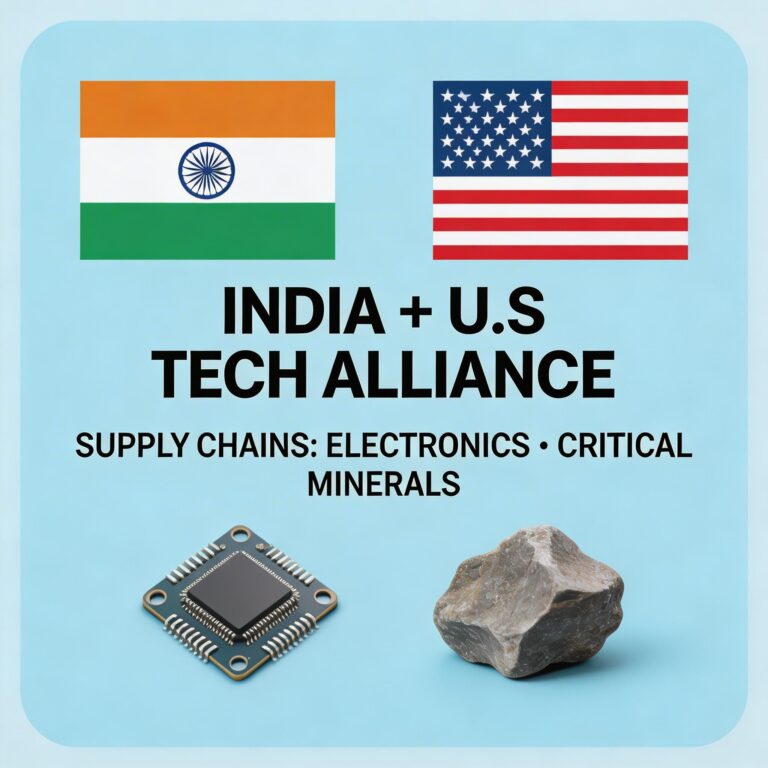
context :Pax Silica launched by US in December 2025 at inaugural summit.
- US-led initiative to secure AI, semiconductors, and critical minerals supply chains.
- India invited to join soon, highlighted in recent diplomatic statements.
- Response to China’s dominance in rare earths and tech supply chains.
- Gaining attention due to geopolitical shifts and India’s potential role.
What is Pax Silica?
- US-led strategic initiative for secure, resilient silicon supply chain.
- Covers critical minerals, energy, advanced manufacturing, semiconductors, AI infrastructure, logistics.
- “Pax” means peace; “Silica” refers to key chip compound.
- Aims to reduce coercive dependencies and build trusted tech ecosystems.
- Non-binding declaration promotes peace, prosperity via cooperation.
Key Members and Participants
- Core signatories: US, Japan, South Korea, Singapore, Netherlands, UK, Israel, Australia.
- Additional: UAE joined later; Qatar also mentioned in expansions.
- Guests/observers initially: Taiwan, EU, Canada, OECD.
- India set to join soon as invited partner.
- Evolving coalition of trusted, tech-advanced nations.
Why Pax Silica? (Countering China)
- China dominates ~90% of rare earth processing and refining.
- Beijing uses export controls, restrictions on critical minerals.
- Creates vulnerabilities in global tech, AI, defense supply chains.
- US seeks to counter coercive leverage and single-point failures.
- Builds alternative trusted networks excluding dominant adversary.
India’s Prior Efforts on Supply Chain Resilience
- Active in Quad Critical Minerals Initiative with US, Japan, Australia.
- Collaborations with Japan, Singapore on semiconductors.
- Domestic push via semiconductor missions and AI ecosystem growth.
- Investments in rare earth processing and tech self-reliance.
- Partnerships with US firms and allies for resilient chains.
Why Pax Silica Matters for India?
- Access to secure, diversified critical minerals and tech inputs.
- Strengthens India’s growing AI market and digital infrastructure.
- Positions India in trusted global tech ecosystem.
- Reduces over-dependence on single suppliers like China.
- Aligns with India’s semiconductor ambitions and innovation goals.
Strategic Benefits for India
- Collaboration on AI, semiconductors, advanced manufacturing projects.
- Attracts investments, joint ventures from member countries.
- Enhances export opportunities in tech and critical minerals.
- Bolsters national security through resilient supply chains.
- Leverages India’s talent pool and market size for mutual gains.
India’s Key Challenges and Concerns
- Navigating US export controls and technology restrictions.
- Balancing relations with non-members like China.
- Ensuring domestic industry protection and preferential treatment.
- Addressing expectation gaps with high-income Pax Silica nations.
- Managing potential export regulations and compliance burdens.
The Road Ahead: A Bipolar Tech Order?
- Pax Silica may deepen global tech divide (US-led vs China-led).
- Creates parallel supply chains excluding rivals.
- India as first major developing nation could bridge or choose side.
- Risks entrenching bipolarity in AI, semiconductors.
- Opportunity for India to shape inclusive, multi-aligned framework.
5. Indian Skimmer
GS Paper III-Environment
Context : BNHS launched “Safeguarding breeding habitats of Indian Skimmer” project with NMCG in Dehradun on Jan 18, 2026, inaugurated by Jal Shakti Minister C R Patil.
Targets Ganga Basin sandbars via monitoring and community guardians, building on Chambal success amid population decline.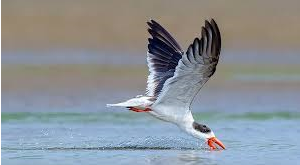
Species Profile
One of three Rynchops skimmers (family Laridae), named for low-flight fish-skimming feeding style.
IUCN Endangered; sharp decline from habitat loss, dams, sand mining, predation.
Physical Traits
Black upper body, white underbelly, orange beak with elongated lower mandible for surface skimming.
Long angular wings enable precise, fast flight over water.
Habitat Preferences
Large sandy lowland rivers, lakes, marshes; estuaries/coasts in non-breeding season.
Key Indian site: Chambal River; also Upper Ganga (Bijnor-Narora), Prayagraj, Vikramshila.
Distribution Range
Native to South Asia: India, Bangladesh, Pakistan; extends to Nepal, Myanmar.
Ganga Basin focus protects sympatric species like River Tern, Black-bellied Tern.
Major Threats
- River habitat loss and sandbar degradation
- Unplanned dam water releases disrupting nests
- Sand mining, human/livestock disturbance
- Predation on eggs/chicks
Conservation Strategy
Trains locals as Nest/River Guardians for monitoring, threat reduction, data collection.
Expands Chambal model to Ganga stretches; creates livelihoods for sustained stewardship.
6. Why only female Darwin’s bark spiders weave the toughest webs .
GS Paper III – Environment & Energy
Context :Scientists from China, Madagascar, Slovenia, and US published 2026 research on Darwin’s Bark Spider (Caerostris darwini) and C. kuntneri, analyzing conditions for their exceptionally tough silk production.
Spider Profile
Orb-weaver (Araneidae family) famous for world’s largest/toughest webs (up to 2.8m², 25m bridge lines).
Discovered 2001, described 2009; named for Charles Darwin’s Madagascar connections.
Physical Traits
Females 2-2.5cm body length (males much smaller); dark brown mottled bark camouflage.
Short lifespan typical of orb-weavers; females outlive males post-mating.
Habitat Range
Endemic to Madagascar’s riverine forests, wetlands; uniquely builds webs over fast-flowing water.
Unlike typical orb-weavers, avoids vegetation for aquatic insect prey capture.
Silk Properties
Toughest biological material known—twice stronger than other spider silks, outperforms steel.
High extensibility from proline-rich GPGPQ motifs in novel MaSp4 proteins.
Web Architecture
Giant orb webs span rivers (diameters 25m+), supported by bridge lines up to 82ft long.
Simple capture spirals with few radials optimized for semi-aquatic insect swarms.
Ecological Role
Controls aquatic insect populations (mayflies, dragonflies) emerging from rivers.
Biomimicry potential for ultra-strong, lightweight synthetic fibers.
7. How reusability can lead to sustainable cost-effective access to space
GS paper III-science and technology
Context :The space industry is undergoing a tectonic shift. For decades, space was the exclusive playground of powerful governments, but today, we are witnessing the dawn of the Commercial Space Era.
The Big Picture: From Monopoly to Commercial Era
- Historical Monopoly: Space was once a high-risk, high-cost domain restricted to superpowers (USA/USSR) for national pride and security.
- Commercial Shift: Private entities like SpaceX and Blue Origin are now leading, treating space access as a logistics business rather than just a scientific feat.
- The “New Space” Economy: This shift has democratized access, allowing startups and smaller nations to launch satellites for communication, climate monitoring, and research.
Key Driver: Reusable Rocket Technology
- Cost Disruption: Traditional rockets were “expendable,” meaning millions of dollars of hardware were thrown away after a single 10-minute use.
- Aviation Parallel: Reusability treats a rocket like an airplane; you don’t throw away a Boeing 747 after one flight, you just refuel it.
Why Space Launch is Inherently Expensive
- Crewed vs. Uncrewed Missions: Crewed missions require heavy life-support systems, redundant safety backups, and re-entry shielding, making them 10x–100x more expensive.
- Physics Constraints: To reach orbit, a rocket must travel at nearly 28,000 km/h, requiring immense energy and specialized materials to survive the heat and pressure.
The Core Problem: Tsiolkovsky Rocket Equation
The fundamental math governing flight is the Tsiolkovsky Rocket Equation:
- The “Tyranny” of the Equation: To increase velocity (), you must add fuel. But fuel has mass, which requires more fuel to lift, creating an exponential “mass penalty.”
- Key Insight: About 90% of a rocket’s initial mass is just fuel; the actual payload (satellite/crew) is often less than 2-5% of the total weight.
Why Rockets Have Multiple Stages
- Shedding Dead Weight: Once a fuel tank is empty, it becomes “dead mass” that hinders acceleration.
- Efficiency: Staging allows the rocket to drop empty tanks and heavy engines, letting the smaller upper stage accelerate much more efficiently in the vacuum of space.
Reusable Rockets: The Game Changer
- Economic Impact: Reusing the first stage (the most expensive part) can reduce launch costs by up to 65-80%.
- How They Land: After separation, the booster uses Grid Fins for steering, performs a “Boostback Burn” to return, and uses Landing Legs for a vertical “propulsive landing.”
Next Step: Fully Reusable Rockets
- The Goal: Current rockets (like Falcon 9) only reuse the booster. The next frontier is reusing the Upper Stage and Fairings as well.
- Starship Era: Vehicles like SpaceX’s Starship aim for 100% reusability, potentially bringing costs down to under $100 per kg (from $10,000/kg in the 1990s).
Where Does India Stand?
- RLV-TD Success: ISRO has successfully tested its Reusable Launch Vehicle-Technology Demonstrator (RLV-TD), named Pushpak, including autonomous runway landings.
- ADMIRE Testbed: India is developing vertical take-off and landing (VTOL) technologies to mimic the success of the Falcon 9 boosters.
What Should India Do Going Forward?
- Scale Up Production: Transition from “Demonstrators” to operational reusable heavy-lift vehicles (like the NGLV—Next Generation Launch Vehicle).
- Private Collaboration: Encourage Indian startups (e.g., Skyroot, Agnikul) to develop low-cost, reusable micro-launchers to capture the global small-satellite market.
- Infrastructure: Build dedicated landing zones and sea-based recovery platforms to support high-frequency reusable launches.
8. India launched Responsible Nations Index (RNI) 2026
Context :India launched Responsible Nations Index (RNI) 2026 at Dr. Ambedkar International Centre, New Delhi, under World Intellectual Foundation (WIF), graced by former President Ram Nath Kovind.
India ranks 16th (score 0.5515) among 154 countries, topping Asian nations ahead of South Korea (21st).
Index Framework
Global composite assessing ethical governance, social well-being, environmental stewardship, global responsibility beyond GDP/power metrics.
Shifts to responsibility-centric evaluation via 4 pillars, promoting policy introspection.
Core Pillars
- Ethical governance and institutional integrity
- Social well-being and inclusiveness
- Environmental responsibility/sustainability
- Global cooperation and international conduct
Top Rankings
Singapore (1st, 0.619), Switzerland (2nd), Denmark (3rd), Cyprus (4th), Sweden (5th).
9/10 top countries European; Central African Republic last (154th, 0.357).
India’s Performance
16th globally (0.5515), ahead of France (17th), Germany (12th), US (66th), China (68th).
Top Asian nation, reflecting balanced internal/environmental/global responsibility.
Launch Highlights
3-year research by WIF with JNU, IIM Mumbai contributions; NK Singh chaired expert panel.
Annual RNI Report released to foster ethical benchmarking, global dialogue.
Strategic Significance
Complements SDGs, climate goals; encourages responsibility over competition.
Redefines success via moral values, humanitarian outcomes for sustainable progress