1. IMF upgrades Indias growth projections to 7.3%
GS paper III-Economy
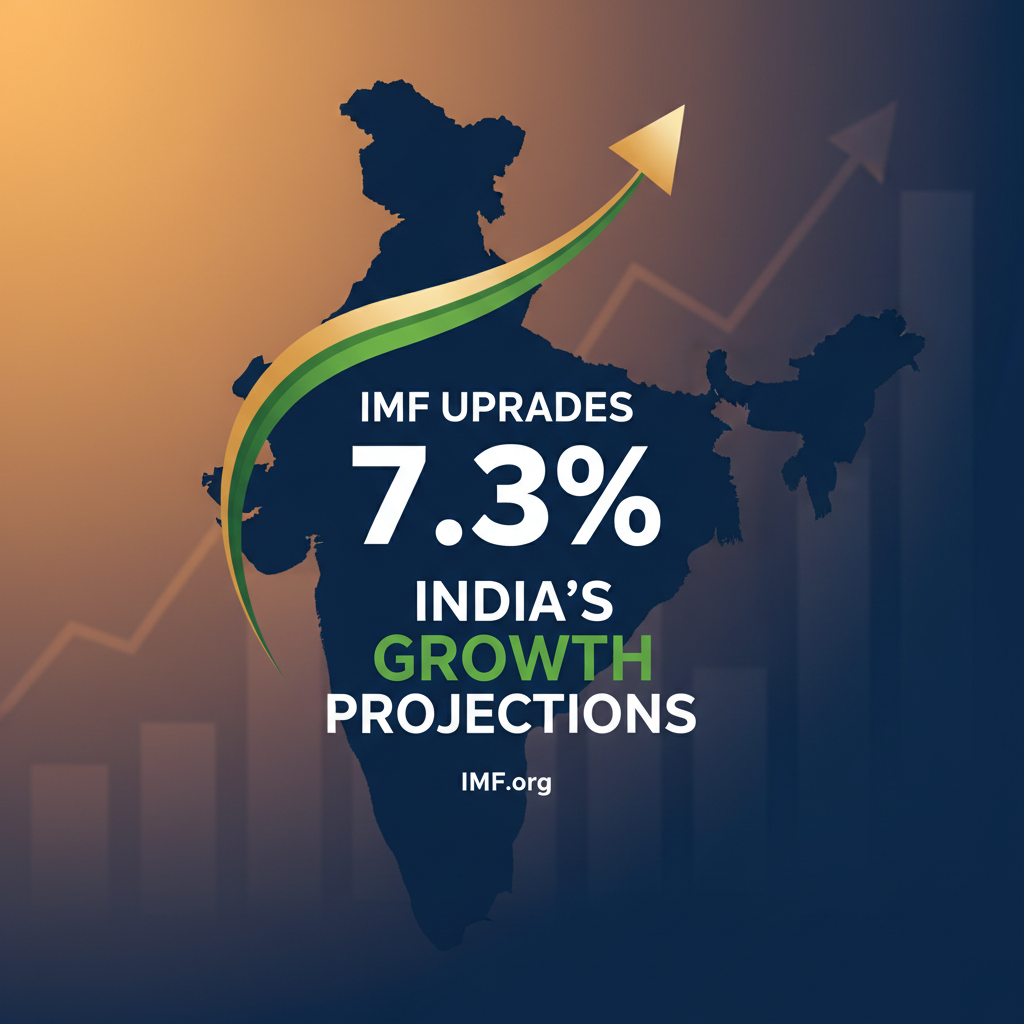
Context : IMF raises India’s GDP growth projection to 7.3% for FY26, citing robust domestic and external factors.
- Key upgrade: From earlier 6.8% estimate, marking one of the highest globally amid moderating global growth.
- Context: Reflects India’s resilience in a world economy projected at 3.3% for 2026.
Background
India’s growth forecasts frequently revised upward by global agencies due to strong macro indicators post-COVID recovery.
IMF’s periodic World Economic Outlook (January, April, October) tracks revisions based on quarterly GDP data and policy impacts.
Previous upgrades: FY25 forecast raised to 6.9% in Oct 2025; FY26 now at 7.3% signals sustained momentum.
Reasons for IMF’s Upward Revision
- Strong Recent Performance
- Q2 FY26 GDP grew 7.7%, exceeding expectations and driving upward bias in full-year projection.
- Earlier FY26 growth hit 6.5-7% in Q1, supported by resilient consumption and investment.
- Comparison with Government Projections
- Matches RBI’s 7.0% FY26 estimate; aligns closely with Finance Ministry’s 6.3-6.8% range for sustained momentum.
- Outpaces IMF’s prior 6.8% own forecast, validating government’s optimistic quarterly outlook.
- Other Institutions’ Estimations
- World Bank: 6.7% for FY26 (Oct 2025), slightly below IMF but upgraded from 6.5%.
- OECD: 6.4% projection, conservative due to global trade risks; IMF more bullish on India.
- Consensus (Bloomberg): ~6.9%, with IMF now leading upward revisions amid strong services exports.
Additional Factors
- Robust domestic strength: Private consumption up 6%, capex cycle gaining traction.
- External tailwinds: Services exports and remittances support current account; oil prices stable.
- Global context: India’s forecast contrasts with downgrades elsewhere, highlighting structural reforms’ role.
2. International conference on election management
GS paper II-POLITY
CONTEXT :Election Commission of India (ECI) launches inaugural India International Conference on Democracy and Election Management (IICDEM) 2026 to boost global ties in electoral practices.
Conference Highlights
- Event Details: First-ever 3-day global summit on electoral governance, set for January 21–23, 2026, at Bharat Mandapam, New Delhi.
- Global Reach: Draws ~100 delegates from over 70 countries, featuring EMB heads, State/UT CEOs, experts, and practitioners.
ECI Overview
- Legal Foundation: Constitutional authority under Article 324, formed in 1950.
- Structure: Led by Chief Election Commissioner (CEC) plus two Election Commissioners (multi-member since 1993).
- Key Terms: Appointed by President; 6-year tenure or until age 65, whichever comes first.
3. BRICS Digital Currencies
GS Paper III-ECONOMY
CONTEXT :RBI has recommended to Government of India to include proposal for linking CBDCs of BRICS countries on 2026 BRICS Summit agenda
- India will host the next BRICS Summit in 2026
- Proposal aims to make cross-border payments easier and reduce dependence on US dollar
What are CBDCs?
- CBDC = Central Bank Digital Currency
- It is digital form of a country’s fiat currency issued and backed by its central bank
- Exists in two main forms: Retail CBDC (for public) and Wholesale CBDC (for banks/financial institutions)
- India’s retail CBDC is called e-Rupee (e₹)
Why does RBI want BRICS CBDCs linked?
- To make cross-border payments faster, cheaper and more efficient
- To reduce heavy reliance on US dollar in international trade
- To strengthen financial sovereignty amid rising geopolitical tensions
- To promote greater use of local currencies in BRICS trade
Current Status of Digital Currencies in BRICS (early 2026)
- All 5 major BRICS members (India, China, Russia, Brazil, South Africa) have launched pilot projects
- India → e-Rupee launched in Dec 2022 → ~7 million retail users
- China → e-CNY (digital yuan) most advanced, large scale pilots running
- Russia → Digital Ruble pilot ongoing
- Brazil → Drex (digital Real) pilot stage
- South Africa → Exploring/wholesale CBDC pilot
- No country has fully launched/rolled out CBDC at national scale yet
Challenges in Linking BRICS Digital Currencies
- Need consensus on technology platforms and interoperability standards
- Different regulatory frameworks and governance rules among countries
- Technical challenges in creating seamless cross-border payment system
- Hesitation to adopt platforms developed by other countries
- Managing trade imbalances through the system
- Geopolitical sensitivity → likely to irritate US (de-dollarisation concern)
- Requires strong bilateral swap arrangements and trust among central banks
4. India -UAE
GS PAPER II-IR
Context : India and UAE agreed to explore ‘Digital Embassies’ during UAE President Sheikh Mohamed bin Zayed Al Nahyan’s visit to New Delhi on January 19, 2026, marking a step toward securing critical data abroad under mutual sovereignty pacts.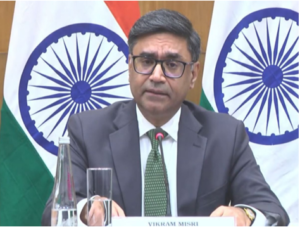
Joint statement post UAE-India summit directs teams to study data embassies alongside AI, supercomputing, and data centre collaborations.
Proposal Core
- Setup: Indian data centres in UAE governed solely by Indian laws, accessible only to authorised Indian entities.
- Scope: Backup for vital data like financial records and public archives during crises.
Driving Factors
- Shields against cyber threats, disasters, or geopolitical risks ensuring digital government continuity.
- Builds high bilateral trust, first such Indian initiative abroad.
Concept Basics
- Data Embassy: Foreign-hosted servers under home nation’s full legal control and data sovereignty.
- Key Principles: Data follows owner’s laws; enables crisis-resilient digital operations.
Precedents Worldwide
- Estonia pioneered in Luxembourg (2017); Monaco followed (2021).
- Rare due to sovereignty hurdles; India eyes reciprocal UAE setup too.
India’s Approach
- Ongoing talks recognise mutual data sovereignty and regulations.
Lacks diplomatic embassy status; focuses on strategic data protection.
5. India signs letter ofintent to elevate defence ties with UAE
GS Paper II-IR
Context :India and UAE signed a Letter of Intent (LoI) during UAE President Sheikh Mohamed bin Zayed Al Nahyan’s January 2026 New Delhi visit to formalize a Bilateral Strategic Defence Partnership amid West Asia’s escalating tensions.
Agreement coincides with Gaza conflict, Yemen instability, and Saudi-Pakistan defence pact (Sept 2025), prompting UAE to deepen security ties with India [conversation_history].
Agreement Highlights
- Defence Framework: LoI establishes structured cooperation building on joint exercises, training, and maritime security exchanges.
- Trade Ambition: Targets doubling bilateral trade to $200 billion by 2032 alongside energy and space pacts.
- Regional Focus: Covered Gaza, Iran protests, Yemen; counters Saudi-Pakistan Yemen military alignment pressuring UAE.
Defence Cooperation Context
- Gulf Tensions: Saudi-Pakistan mutual defence deal boosts Riyadh’s Yemen operations, straining UAE positions.
- Strategic Gains: Enhances India’s energy security, West Asia influence while preserving autonomy.
- Space Synergy: Separate LoI between IN-SPACe and UAE Space Agency for joint industry development.
Broader Implications
Mature partnership leverages trust, shared security needs, and economic complementarity for institutionalised defence-industrial ties.
6. In a changing world, it is ‘small tables, big dividends’
GS- paper II : International Relations
Context: India’s 2026 diplomatic calendar—featuring EU Republic Day chief guest role, BRICS chairmanship, and potential Quad summit hosting—positions it to exploit global power shifts via targeted engagements.
EU Partnership Push
- Key Signal: EU institutional leaders as Republic Day guests signal deepening strategic ties amid trade negotiations.
- Main Goal: Fast-track India-EU FTA as mutual “de-risking” pact against China reliance and US uncertainties.
- Gains: Better EU market entry, value chain integration, buffer from potential American tariffs.
BRICS Leadership Role
- Current State: Expanded group faces internal divergences diluting original focus on reform.
- India’s Chance: As 2026 host, redefine via practical NDB guarantees and actionable toolkits.
- Balancing Act: Steer clear of anti-West tones to safeguard economic stakes amid US tariff risks.
Quad Strategic Value
- Summit Potential: Hosting leaders (possibly new US President) elevates Indo-Pacific focus.
- Core Agenda: Convert maritime awareness, resilient ports into public goods for littoral states.
- Proven Model: Builds on successes like Operation Sagar Bandhu aid to Sri Lanka.
Overall Strategy
Small, results-driven forums outperform broad multilaterals for India’s influence in fragmented global order. Prioritizes trade, standards, and public goods delivery over rigid alliances
7. Chips to Start-up (C2S) Programme
Context :MeitY spotlighted C2S outcomes—56 chips fabricated, extensive training across 400+ institutions, and rising IP generation—to demonstrate India’s advancing chip design ecosystem amid global talent shortages.
Programme Essentials
- Launch & Scope: MeitY initiative started 2022 with ₹250 crore outlay over 5 years, targeting 85,000 skilled professionals via nationwide academic engagement.
- Core Focus: Hands-on chip design, fabrication, and testing to bridge academia-industry gap in semiconductors.
Implementation Framework
- Key Enablers: ChipIN Centre (C-DAC Bengaluru) provides EDA tools (Synopsys, Cadence), HPC, IP cores; SCL Mohali handles wafer fabrication.
- Participant Reach: 100+ funded institutions plus 200+ others accessing training, SMART labs, and certification courses.
Targeted Outcomes
- Talent Pipeline: 200 PhDs, 7,000+ M.Tech (VLSI/related), 69,000 B.Tech students trained for industry roles.
- Innovation Goals: 25 start-ups incubated, 10 tech transfers, 50 patents, 2,000 research publications.
Strategic Value
- Addresses 1M+ global semiconductor workforce gap by 2032, fostering self-reliance in a $1T industry.
- Democratises advanced tools for students nationwide, boosting Atmanirbhar Bharat in critical tech.