1. Elevated corridor project in kaziranga
Gs paper III-ENVIRONMENT
Context :PM Modi laid foundation stone during Assam visit, highlighting wildlife conservation and infrastructure.
- Project addresses rising human-wildlife conflicts amid growing traffic on NH-715 through the park.
Background
- Kaziranga National Park faces daily 5,000-6,000 vehicles on highway, causing animal deaths, especially during floods.
- Concept approved two decades ago by Wildlife Institute; now executed by NHAI in EPC mode.
- Covers Kaliabor-Numaligarh section across Nagaon, Karbi Anglong, Golaghat districts.
Key Features
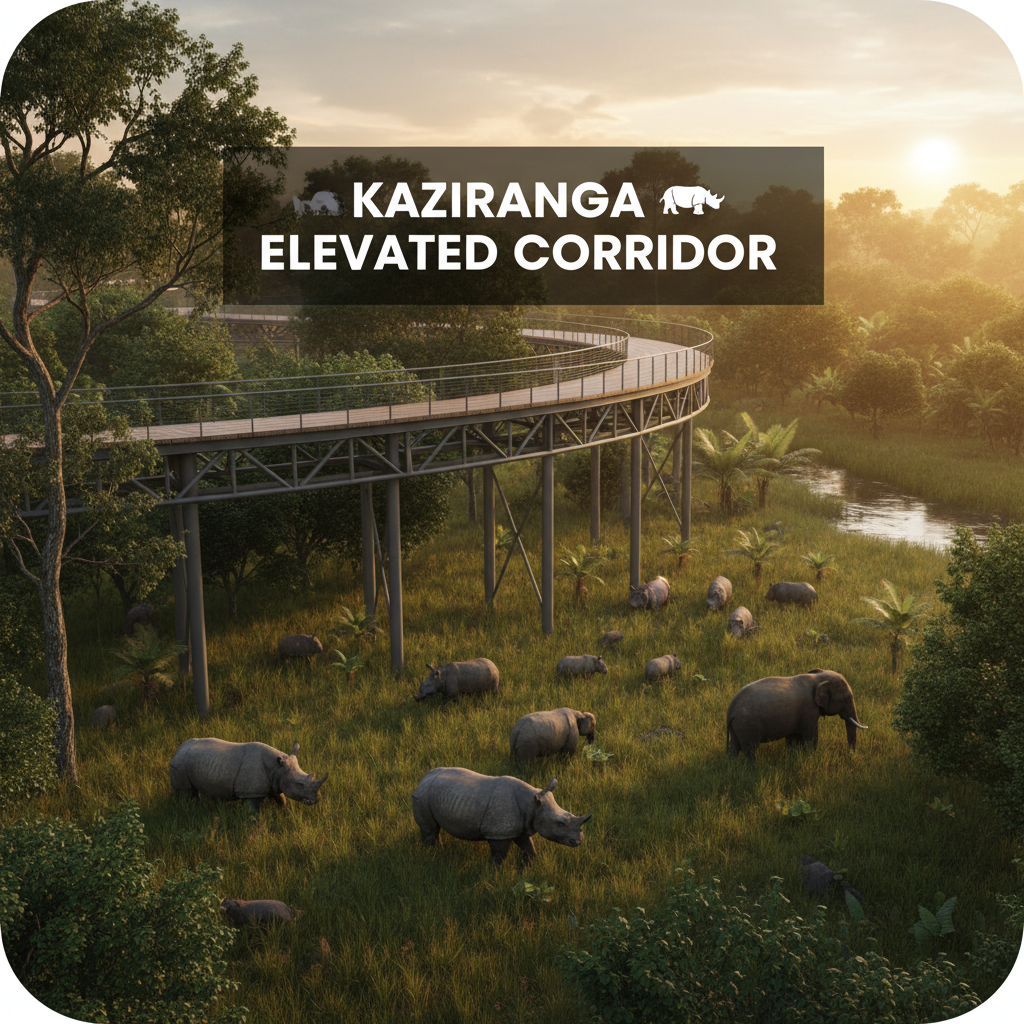
- 35 km elevated wildlife corridor over park; 21 km bypasses; 30 km 4-laning of existing highway.
- Covers all 9 animal corridors for rhinos, elephants, tigers using traditional routes.
- Total length 85.675 km, cost ₹6,957 crore, generates jobs and boosts ecotourism.
Why Elevated Corridor
- Allows vehicles above, wildlife below uninterrupted, reducing accidents and conflicts.
- Flood-resilient in Brahmaputra floodplain, ensures all-season access unlike ground roads.
- Proven model from other Indian national parks for balancing development and ecology.
Aims To
- Improve connectivity to Upper Assam, Arunachal Pradesh; cut travel time, support traffic growth.
- Ensure safe animal migration during monsoons to higher grounds like Karbi Anglong hills.
- Decongest towns via Jakhalabandha, Bokakhat bypasses; enhance urban mobility.
Environmental Aspects
- Design follows traditional animal paths, minimizes disturbance to biodiversity hotspot.
- Reduces wildlife deaths from vehicles; protects UNESCO site with one-horned rhinos.
- Generates 15 lakh direct, 19 lakh indirect person-days employment sustainably.
Governance Aspects
- Cabinet-approved eco-conscious highway by NHAI; strict guidelines from park director.
- PM praised as “priceless jewel” for Assam’s green infrastructure synergy.
- Improves safety, regional links; opens opportunities with new rail services
2. How should India tackle child trafficking?
GS Paper II-polity
- SC Ruling: K.P. Kirankumar v. State (2025 INSC 1473) mandates sensitive evaluation of minor victim testimony.
- New Legal Regime: BNS Sections 143-144 replace IPC 370 with harsher child trafficking penalties.
- Rising Cases: Post-COVID distress, digital grooming surge organized networks.
What is Child Trafficking
- Recruitment & Movement: Transporting minors (<18) for exploitation via force/fraud.
- Purposes: Forced labor, sexual abuse, domestic servitude, organ removal.
Indian Legal Definition (BNS 2023)
- Section 143: Defines child trafficking (under 18) for exploitation; consent irrelevant.
- Punishment: 10 years to life; multiple victims attract life imprisonment.
Constitutional Protection
- Article 21: Right to life free from exploitation.
- Article 23: Prohibits human trafficking, forced labor.
- Article 24: Bans child labor under 14 in hazardous work.
Key Laws – Criminal Laws
- BNS 2023: Sections 143 (trafficking), 95 (child criminals).
- ITPA 1956: Penalizes sex trafficking networks.
Key Laws – Special Laws
- POCSO 2012: Child-friendly trials for sexual offenses.
- JJ Act 2015: Rehabilitation for Children in Need of Care.
- Child Labour Act 2016: Bans labor under 14, hazardous adolescent work.
Judicial Approach
- Victim-Centric: Kirankumar prioritizes minor testimony credibility over contradictions.
- Speedy Justice: Special POCSO courts mandated to prevent delays.
Why Persisting – Socio-Economic Factors
- Poverty: Families lured by false job/education promises.
- Education Gap: High rural dropouts make children vulnerable.
New-Age Challenges
- Digital Grooming: Social media/apps enable online-to-offline trafficking.
- Dark Web: Anonymity aids global exploitative networks.
Governance Issues
- Poor Database: No real-time missing children tracking.
- Low Convictions: Witness intimidation, legal loopholes.
Centre-State Cooperation Crucial
- Cross-Border: 90% cases interstate need police coordination.
- Funding: Centre supports AHTUs; states implement SOPs.
Way Forward
- Strengthen AHTUs: Functional units in every district.
- Tech Solutions: AI, facial recognition for tracking.
- Rehabilitation: Long-term psychological, educational support
3. Coconut root wilt disease
Gs paper III-Environment
Context :Rapid spread in Pollachi-Anaimalai (TN), Alappuzha (KL) destroys groves, no cure available.
- participatory science to tackle phytoplasma threat effectively.
Importance of Coconut Trees
- Supports 12 million livelihoods via nuts, coir, oil; contributes ₹2.5 lakh crore to GDP.
- “Tree of life” yields food, fiber, medicine; employs 6 lakh in coir industries (80% women).
- Key in homestead farming on coasts; export revenue from products like soap, coir.
What is Coconut Wilt Disease
- Root Wilt Disease (RWD) caused by phytoplasma bacterium; wilts leaves, rots roots.
- Symptoms: drooping, yellowing, necrosis of leaflets; attracts secondary insects.
- Fatal in poorly maintained gardens; spreads via vectors like plant hoppers.
Why Spreading Rapidly Now
- Climate change (abiotic stress): Alters temperature, rainfall favoring phytoplasma and vectors.
- Biotic stress: Native/invasive insect vectors multiply; human movement spreads via plants.
- Poor maintenance, neglected groves worsen spread in high-density areas.
Results
- Palms uneconomic within years; yield drops up to 51% in affected areas.
- Massive tree removal needed; plantations wiped out in Kerala-TN borders.
- Secondary pests damage further; no natural recovery observed.
Socio-Economic Impact
- Farmers lose Rs 900/tree in replanting; insurance claims inadequate.
- Coconut price crash to Rs 8/piece cripples smallholders; affects coir workers.
- Threatens food security, exports; ₹30 crore losses saved via interventions.
Why Existing Approaches Inadequate
- Eradication (cutting palms), mulching, microbes reduce mildly but fail severely.
- Labor-intensive, costly; no full control in endemic zones like Kerala.
- Routine strategies ignore vectors; recurrence common in neglected gardens.
Integrated Management Practices
- Soil microbes (Trichoderma, Bacillus) + neem cake @3 months; FYM mulching.
- Remove severe palms; apply consortia (Azospirillum, VAM) twice yearly.
- Needs coordination; still inadequate without resistance breeding.
Resistant/Tolerant Varieties
- CPCRI develops tolerant West Coast Tall seedlings via participatory selection.
- Farmers identify local survivors for nurseries; PPVFR Act royalties incentivize.
Why Breeding Tolerant Varieties Best
- Long-term solution: phytoplasma unbeatable chemically; varieties adapt locally.
- Reduces removal costs; sustains yields in disease hotspots sustainably.
- Builds resilience to climate/vectors; scalable via farmer nurseries.
What is Participatory Science
- Farmers join scientists in selecting/breeding tolerant palms from survivors.
- Community trials in Kerala (e.g., Alappuzha) validate varieties on-ground.
Why Participatory Crucial
- Farmers know local conditions; speeds identification of adapted varieties.
- Eases research burden; royalties motivate nursery setup by communities.
- Ensures adoption via ownership; coordinates CPCRI, unis, govt effectively.
4. Microscopic crustacean.
GS paper III-Environment and Ecology
Context :Researchers from the Cochin University of Science and Technology (CUSAT) have discovered a new microscopic marine organism in the Lakshadweep islands. This organism, a harpacticoid copepod, represents both a new genus and a new species.
News Summary
- Major Discovery: Researchers established a new genus and species of a microscopic crustacean.
- Research Team: Found by Neelima Vasu K. and S. Bijoy Nandan from CUSAT.
- Scientific Tribute: The discovery honors both India and a prominent Indian scientist.
Discovery Location
- Specific Site: Found in the Kavaratti lagoon of the Lakshadweep archipelago.
- Environment: Inhabits the sediments (benthic zone) of the southeastern Arabian Sea.
Taxonomic Classification
- Phylum: Arthropoda (Class: Crustacea).
- Order: Harpacticoida (Subclass: Copepoda).
- Family: Laophontidae (Subfamily: Laophontinae).
Name of the New Species
- Scientific Name: Indiaphonte bijoyi.
- Genus Name: Indiaphonte honors India and its marine biodiversity.
- Species Name: bijoyi honors Prof. Dr. S. Bijoy Nandan, a veteran marine scientist.
Why is it a New Genus?
- Unique Traits: It possesses a combination of morphological features not found in any existing genus.
- Lack of Dimorphism: Uniquely, males and females lack the typical sexual dimorphism in their swimming legs.
- Distinct Appendages: Features specific segmentation in swimming legs and unique caudal rami structures.
Physical Characteristics
- Size: Microscopic; females are 518–772 micrometres and males are 508–756 micrometres.
- Body Shape: Semi-cylindrical and depressed, wider in the middle and tapering toward the back.
- Features: Equipped with antenna-like appendages at the front and identical structures in both sexes.
What is Meiofauna?
- Definition: Tiny invertebrate animals smaller than 1 millimetre living in aquatic sediments.
- Habitat: They live in the interstitial spaces between grains of sand and mud on the seafloor.
Ecological Importance
- Nutritional Role: They produce essential Omega-3 fatty acids (EPA/DHA) for fish and shellfish.
- Food Web Link: Act as a vital link between primary producers (bacteria/algae) and higher-level fish larvae.
- Bio-indicators: Highly sensitive to pollution and climate change, indicating the health of the marine ecosystem.
Research and Publication
- Journal: Described in the international taxonomic journal Zootaxa in January 2026.
- Collaboration: Conducted with Prof. Samuel E. Gómez-Noguera from UNAM University, Mexico.
5. Sammakka-Saralamma Jatara
GS paper I-Art &culture
Context :Telangana prepares for Asia’s largest tribal festival from January 28, 2026, at Medaram amid major sacred site redevelopment.
Recent Developments
- Why in News: Biennial Jatara begins January 28, 2026; TGSRTC launches ‘Bangaram Prasadam’ home delivery service.
- Economic Surge: 12 tonnes jaggery sold daily as pilgrims offer body-weight equivalent to deities.
- Infrastructure: Festival precinct expanded with arches, granite flooring to handle 1+ crore devotees.
Festival Overview
- Tribal Significance: Honors Sammakka-Saralamma, ancestral goddesses of Koya Adivasi community.
- Global Scale: Recognized as world’s second-largest human gathering after Kumbh Mela.
- Location: Medaram village, Mulugu district within Eturnagaram Wildlife Sanctuary.
Historical Origin
- Legend: Forest-born Sammakka and daughter Saralamma resisted Kakatiya tax oppression.
- Martyrdom: Attained martyrdom fighting rulers; symbolize tribal resistance.
- Forest Deities: Brought symbolically from forests, not housed in permanent temples.
Unique Traditions
- Bangaram Offering: Devotees offer jaggery (called “gold”) equal to body weight.
- Tribal Rituals: Conducted only by Koya priests using indigenous customs.
- Animistic Worship: Sacred trees, bamboo totems, flags replace stone idols.
Cultural Importance
- Tribal Identity: Preserves Koya kinship-based belief system treating deities as family.
- Equality Symbol: Jaggery offerings reflect agrarian life over monetary wealth.
Collective Memory: Celebrates historical resistance against state oppression.
6. Mount Elbrus
Mapping
Context :A controlled avalanche was artificially triggered on Mount Elbrus in Russia to release built-up snow safely following heavy snowfall. This operation, reported by BBC, aimed to prevent natural disasters in the popular mountaineering area.
Overview of Mount Elbrus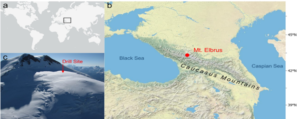
Mount Elbrus stands as Europe’s highest peak and an ancient, dormant stratovolcano featuring twin summits—East and West.
Geographical Position
- Situated in southwestern Russia within the Caucasus Mountains, immediately north of the Georgia border.
- Positioned between the Black Sea to the west and the Caspian Sea corridor to the east.
- Forms part of the expansive Caucasus mountain range.
Geological Characteristics
- Twin-coned stratovolcano that originated around 2.5 million years ago.
- West peak elevates to 5,642 meters; East peak to 5,595 meters.
- Hosts 22 glaciers supplying major rivers such as the Kuban and Terek.
- Inactive for about 2,000 years, yet shows signs of activity through sulphurous gases and nearby mineral springs.
Importance and Relevance
- Counts as one of the Seven Summits, drawing global climbers and adventure enthusiasts.
- Serves as a hub for mountaineering, alpine tourism, and economic growth in the Caucasus.
- Vital for glaciological studies and climate monitoring, even observable from the International Space Station.
7. India -Germany ties can only solar higher
GS paper II-IR
Context :German Chancellor Friedrich Merz undertook his first official visit to India and his first visit to Asia since assuming office, underscoring that Germany sees India as a key strategic partner in the Indo‑Pacific.
- The visit followed the 25th anniversary of the India–Germany Strategic Partnership (2025) and precedes the 75th anniversary of diplomatic relations (2026), marking a new high for bilateral ties.
- Against a backdrop of global trade disruptions, weakening multilateral rules, and geopolitical instability, both sides are pushing for deeper cooperation in trade, defence, and green technologies.
Key Points / Developments
Strengthening of Strategic Partnership
- India and Germany are moving beyond traditional diplomacy towards a more robust, trust‑based strategic partnership grounded in shared democratic values and long‑term commitment.
- The two countries are engaging at the highest political level, including regular Inter‑Governmental Consultations (IGCs), to institutionalize cooperation across multiple domains.
Economic Complementarity
- Germany’s strength in advanced manufacturing, engineering, and technology is well matched by India’s large domestic market, skilled workforce, and growing industrial base.
- India’s rapid economic growth is seen as beneficial for Germany, offering a larger market for German products and creating a competitive environment for innovation.
Trade and Investment Push (EU–India FTA)
- Both sides are actively supporting the conclusion of the EU–India Free Trade Agreement (FTA) to boost trade, reduce barriers, and make supply chains more resilient.
- The Chancellor emphasized that a free trade pact between Europe and India is crucial to counter trade wars and enhance economic resilience in an uncertain world.
Defence and Security Cooperation
- India and Germany are deepening defence ties, including institutionalised staff talks, joint exercises, training exchanges, and regular naval port calls.
- A new Track 1.5 Foreign Policy and Security Dialogue has been established to coordinate on regional and global security issues.
Shared Challenges and Concerns
- Both countries share concerns over the erosion of multilateral trade rules, weakening of the rules‑based global order, and rising protectionism.
- They also worry about instability in their respective regions and the impact of global geopolitical tensions on economic and security interests.
Strategic Convergence
- India and Germany are increasingly aligned on issues like the Indo‑Pacific, ASEAN centrality, UN Security Council reforms (under G4), and the importance of a rules‑based international system.
- This convergence is driving closer cooperation in critical technologies, digital public infrastructure, AI, semiconductor partnerships, green hydrogen, and climate action.
Germany as an Economic Powerhouse
- Germany remains the world’s third‑largest economy, while India is the fourth‑largest; projections suggest India may soon overtake Germany to become the third‑largest economy.
- A stronger Indian economy is viewed not as a threat but as an opportunity for Germany to expand its industrial and technological footprint in Asia.
Broader Implications for India–Germany Ties
- The relationship is being reimagined as a “3D partnership” – Defence, Digitalisation, and Decarbonisation – combining India’s scale and growth with Germany’s technology and capital.
- Close cooperation helps both countries diversify supply chains, enhance resilience, and co‑create solutions in green growth, critical technologies, and skilled mobility.
- In a multipolar world, a stronger India–Germany partnership can act as a stabilising force and help shape a more secure, sustainable, and rules‑based global order