1. Ovlive Ridley deaths raise cocncern as new nesting season begins in season begins in A.p
GS paper III-Environment
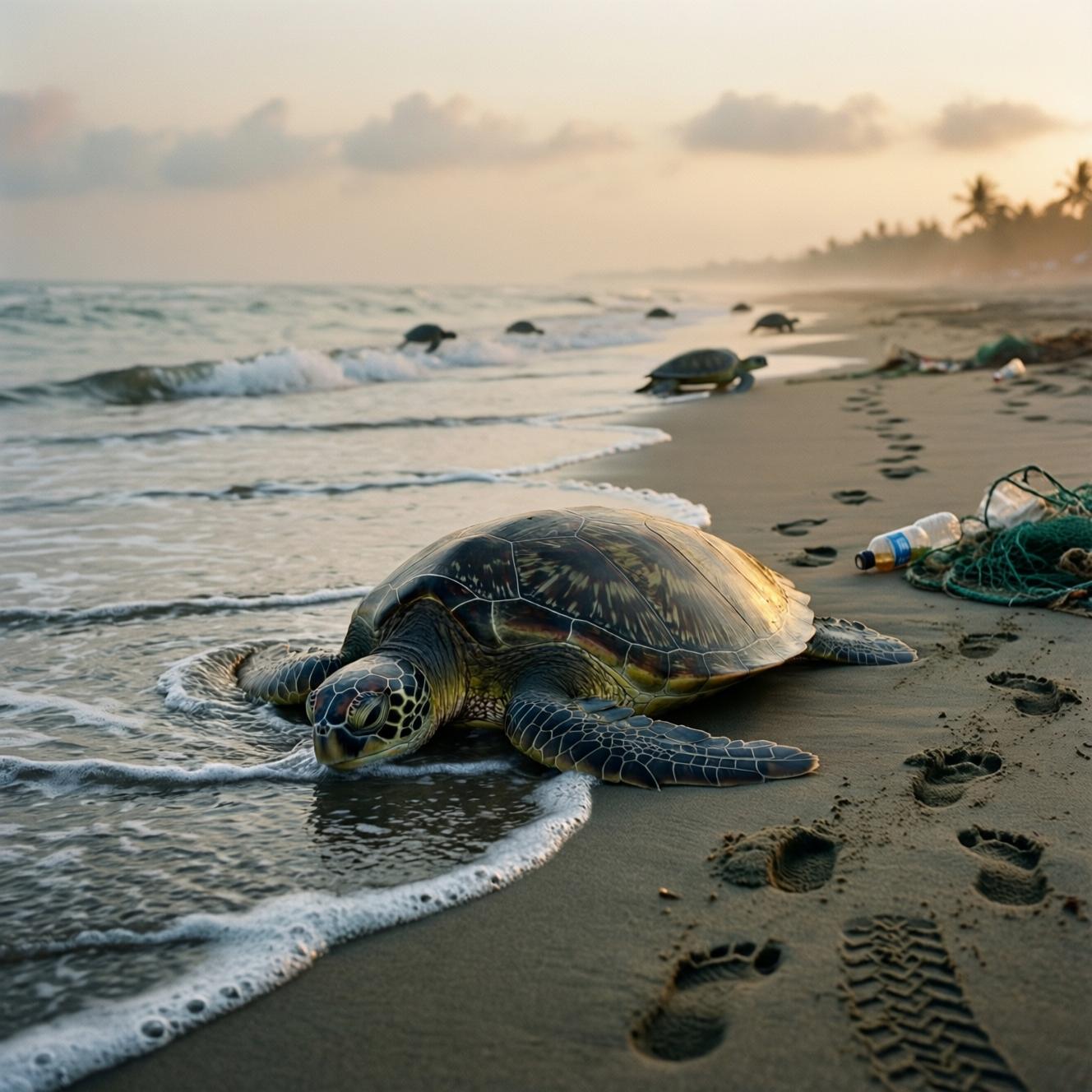
Context : New nesting season has started along Andhra Pradesh and Visakhapatnam beaches (Dec–Apr).
- Hundreds to thousands of carcasses have recently washed ashore on AP beaches during this period.
- These beaches are key nesting grounds for olive ridleys in the Bay of Bengal region.
Conservation status
- IUCN status: Vulnerable globally due to declining populations.
- India: Listed in Schedule I of Wildlife (Protection) Act, 1972 – highest legal protection.
- Included in Appendix I of CITES – bans international commercial trade in the species.
- Protected under Convention on Migratory Species for conserving migratory routes and habitats.
What happened in Andhra Pradesh
- Carcasses reported along stretches near Visakhapatnam, Machilipatnam and Krishna estuary.
- Reports mention over 2,600 turtles found dead along AP coast in January in one recent season.
- Forest department and NGOs have begun beach monitoring and set up hatcheries near Vizag to protect nests.
Likely cause of deaths
- Post‑mortem observations indicate drowning after entanglement in mechanised fishing nets.
- Trawlers and gill nets operate close to shore in peak breeding months, increasing bycatch risk.
- Many boats do not use Turtle Excluder Devices (TEDs), so trapped turtles cannot escape and suffocate.
Legal & regulatory issues
- Wildlife (Protection) Act bans hunting/harassing Schedule I species, but at‑sea bycatch is poorly enforced.
- State marine fishing regulations mandate seasonal fishing restrictions, yet trawlers often fish within prohibited zones.
- Use of TEDs is recommended/mandated in policy, but compliance monitoring on mechanised vessels is weak.
- Coastal Regulation Zone norms seek to limit coastal infrastructure and lights, but light pollution still disturbs nesting beaches
2. ICGS Samudra Pratap
GS paper III-science and technology
CONTEXT ;Defence Minister is commissioning I CGS Samudra Pratap in Goa as the first of two new pollution‑control vessels.
- The ship will enhance Indian Coast Guard (ICG) roles in pollution response, fire‑fighting and maritime security.
What is ICGS Samudra Pratap?
- A dedicated Pollution Control Vessel (PCV) of the Indian Coast Guard.
- Designed mainly for detection, containment and recovery of marine oil and chemical spills.
Type of vessel
- Special‑purpose offshore pollution‑control and support ship.
- Also capable of limited patrol, fire‑fighting and support to other maritime operations.
Key technical specifications
- Length about 114.5 metres; displacement around 4,200 tonnes.
- Speed over 22 knots with endurance of roughly 6,000 nautical miles.
Advanced pollution‑control capabilities
- Fitted with sensors and systems to detect oil in water and monitor spills.
- Can recover viscous oil, separate oil from contaminated water and store recovered pollutants.
- Has equipment to analyse contaminants on board for quicker response decisions.
Operational area: EEZ and beyond
- Meant for operations across India’s Exclusive Economic Zone and adjoining high seas.
- Can support regional pollution‑response missions under bilateral or multilateral arrangements.
Why EEZ protection is important
- EEZ holds major offshore oil, gas, fisheries and shipping routes vital for the blue economy.
- Oil spills here can damage livelihoods of coastal communities and sensitive ecosystems.
Strategic and environmental significance
- Strengthens India’s reputation as a responsible maritime power in the Indian Ocean.
- Enhances capability to respond to tanker accidents near busy sea lanes around India.
- Reduces dependence on foreign assistance for large‑scale spill response and clean‑up.
National commitments
- Supports India’s obligations under MARPOL and other marine‑pollution conventions.
- Aligns with national goals on coastal resilience, blue‑economy growth and disaster management.
3. Venezuela crisis unlikely to hit Indias energy security
GS paper II-IR
Context :Fresh data show sharp fall in Indian crude oil imports from Venezuela since U.S. sanctions in 2019.
- Ongoing political and economic turmoil in Venezuela raised questions on India’s energy security.
Background: India–Venezuela oil trade
- Venezuela was once a major crude supplier to India, with imports touching around 13 billion dollars in 2013.
- State refiners like Reliance and Nayara earlier relied significantly on Venezuelan heavy crude blends.
Present situation & imports from Venezuela
- In 2025–26 (up to November), India imported about 255 million dollars of Venezuelan crude, roughly 0.3% of total oil imports.
- India has diversified towards Middle East, U.S., Russia and others, reducing dependence on Venezuelan barrels.
U.S. sanctions and their effect
- U.S. sanctions imposed from 2019 targeted Venezuela’s oil sector and threatened secondary sanctions on buyers.
- Indian companies gradually wound down contracts and shipping arrangements to avoid exposure to U.S. financial penalties.
Impact of current Venezuela crisis on India
- Low trade volume means even severe disruption in Venezuelan exports will barely affect India’s crude availability.
- India’s diversified supplier base and strategic petroleum reserves further cushion any price or supply shock.
Venezuela, OPEC and global impact
- Venezuela is a member of OPEC but currently contributes only a small share of global crude output.
- Its limited effective production capacity means disruptions have modest impact compared with larger OPEC producers.
Heavy crude oil issues
- Venezuelan crude is mostly extra‑heavy, high‑sulphur oil needing complex, specially upgraded refineries.
- Few refineries worldwide can process such crude economically, so sanctions plus technical limits keep its market narrow.
U.S. politics and geopolitical angle
- U.S. policy seeks to pressure the Venezuelan government while also managing domestic fuel prices and supply.
- Control over Venezuelan oil assets and market access is part of broader U.S. competition and alignment politics in the Americas.
4. National seminar ‘Aeronautics 2047’ in Bengaluru
GS paper III-science and technology
Context :Air Chief Marshal A.P. Singh inaugurated the two-day national seminar ‘Aeronautics 2047’ in Bengaluru on January 4, 2026.
- The event marked 25 years since the maiden flight of LCA Tejas (January 4, 2001).
- He stressed timely delivery of combat aircraft to maintain IAF operational readiness amid evolving threats.
- DRDO Chairman Samir V. Kamat highlighted indigenous tech development to reduce import dependence for Viksit Bharat @2047.
LCA Tejas Programme: A Symbol of Atmanirbhar Bharat
- Fully indigenous 4.5-generation multirole fighter designed by ADA and manufactured by HAL.
- Involved over 100 design centres (govt labs, academia, industries).
- Over 5,600 successful flights; developed niche tech despite sanctions/delays.
- Reduces import reliance (India historically >70% defence imports).
- Boosts domestic ecosystem, jobs, tech transfer; aligns with self-reliance vision.
- Builds capability/capacity for future platforms like Mk2/AMCA.
What is LCA Tejas?
- Single-engine, delta-wing, lightweight multirole combat aircraft.
- Replaces ageing MiG-21 fleet; performs air superiority, ground strikes, reconnaissance.
- 4th/4.5-generation with supersonic capability, advanced avionics.
- Variants: Mk1 (inducted), Mk1A (upgraded), Naval, Trainer.
- Current IAF strength: ~40 Mk1 (two squadrons).
Key Achievements
- Maiden flight: January 4, 2001 (25 years celebrated in 2026).
- Over 5,600 flights without major incidents.
- Induction: Two IAF squadrons operational.
- Orders: 40 Mk1 + 83 Mk1A (2021) + 97 more Mk1A (2025) ≈ 220 total.
- International displays: Bahrain, Singapore, Malaysia interest.
- Proven in exercises like Gagan Shakti.
Advanced Indigenous Technologies in Tejas
- Fly-by-wire flight control system.
- Carbon composites/light-weight materials.
- Digital utility management system.
- Glass cockpit.
- AESA radar (Uttam in Mk1A).
- Electronic warfare suite.
- On-board oxygen generation (OBOGS).
Tejas Variants Comparison Table
| Variant | Status (as of Jan 2026) | Key Features | Engine | Deliveries/ Timeline |
| Tejas Mk1 | Operational (40 inducted) | Base 4th-gen fighter; F404 engine | GE F404-IN20 | Complete; two IAF squadrons active |
| Tejas Mk1A | Under production; delays ongoing | AESA radar, EW suite, improved avionics/maintainability | GE F404-IN20 | First expected March 2026; engine delays |
| Tejas Mk2 | Prototype ground testing; rollout soon | Larger, canards, higher payload (6.5t), 13 hardpoints | GE F414-INS6 | Rollout March-June 2026; first flight late 2026/early 2027 |
Concerns Highlighted by the Air Force Chief
- Strict adherence to delivery timelines critical for IAF readiness.
- Delays impact squadron strength (current ~30 vs authorised 42).
- Rapidly evolving security environment demands timely induction.
- Mk1A delays (engine supply, testing) affect operational gap.
DRDO Perspective: Reduce Import Dependence
- Develop cutting-edge indigenous tech for self-reliance.
- Tejas built capability to design/manufacture fighters domestically.
- Shift focus to Mk2/AMCA for advanced platforms.
- Aligns with Viksit Bharat @2047; minimises foreign vulnerability.
Aeronautics 2047: Looking into the Future
- Seminar explores next-gen aerospace tech.
- Topics: Digital manufacturing, AI in design, advanced aerodynamics.
- Propulsion, flight testing, digital twins, certification.
- Avionics, maintainability, precision manufacturing.
- Vision: Indigenous ecosystem for 5th-gen AMCA, reduced imports by 2047.
5. India loses 0.4% of its GDP every year to natural disasters
GS paper III-Economy
Context :OECD released Economic Outlook for Southeast Asia, China and India 2025: Enhancing Disaster Risk Financing in December 2025.
- Report highlights escalating disaster frequency, intensity, and economic losses in Emerging Asia.
- India loses average 0.4% of GDP annually to natural disasters (1990-2024 data).
- Calls for urgent shift to proactive disaster risk financing amid climate change.
Core Message of the Article
- Emerging Asian economies face rising disaster risks in frequency and severity.
- Annual disasters ~100, affecting ~80 million people regionally.
- Economic losses escalating; disaster risk finance now policy priority.
- Need data-driven foundations, ex-ante financing (insurance, pools), regional cooperation.
- Climate change amplifies hydrological (floods) and meteorological (storms) events.
Disaster Technologies in Emerging Asia: Country-Wise Patterns
- India/China: High seismic risks + floods/storms; hydrological dominant.
- Philippines/Vietnam: Tropical cyclones frequent; meteorological primary.
- Indonesia: Volcanic + earthquakes; geophysical significant.
- Myanmar/Cambodia: Predominantly meteorological/cyclonic storms.
- Thailand/Malaysia: Floods + storms; hydrological leading.
- Geography drives variation: Coastal (cyclones), Himalayan (landslides), seismic zones.
Total Disaster Occurrence (2000-2024 Approx.)
- Highest: China (~600 events), India (~400+), Indonesia (~300+).
- Philippines (~250+), Vietnam (~200).
- Dominant types: Floods (leading), storms, earthquakes, droughts, volcanic.
- Sharp rise post-2000; floods/storms surged due to climate factors.
Rising Economic Damage
- Total damage 1980-2024: Highest in China/India (hundreds of billions $).
- Recent decades (2010-2024): Accelerated due to intensity + asset exposure.
- Emerging Asia: Losses equivalent to significant GDP shares annually.
- Cascading effects: Infrastructure, agriculture, supply chains disrupted.
India’s 0.4% GDP Loss Explained
- Average annual direct losses 1990-2024 ≈ 0.4% of GDP.
- Primarily from hydrological (floods/landslides) + meteorological events.
- Distinct from others: Non-storm floods dominant vs. cyclones elsewhere.
- Compounded by population density, urbanisation in vulnerable areas.
- Edge case: Actual may vary yearly; indirect losses (productivity) higher.
What Does 0.4% GDP Loss Mean?
- For India’s ~$4 trillion GDP (2025 est.): ~$16 billion annual loss.
- Covers direct damages: Infrastructure, crops, housing, public utilities.
- Excludes indirect: Lost growth, poverty spikes, fiscal reallocation.
- Implication: Drains investment; hinders Viksit Bharat goals.
- Nuance: Sustainable loss if mitigated; otherwise compounds inequality.
Composition of Disaster Losses
- Hydrological (floods/landslides): Dominant in India/Indonesia.
- Meteorological (storms/cyclones): High in Philippines/Vietnam.
- Geophysical (earthquakes/volcanic): Significant in Indonesia/China.
- Climatological (droughts/wildfires): Rising regionally.
- Overall: Floods > storms > earthquakes > others.
World Risk Index (2025 Rankings – Key Asia)
- Philippines: Highest risk globally.
- India: 2nd worldwide (switched with Indonesia).
- Indonesia: High (top 5).
- China: Re-entered top 10.
- Factors: Exposure + vulnerability (susceptibility, coping, adaptation).
- Philippines/India: High due to geometric exposure + population factors.
Why Disaster Risk Finance is Now Crucial
- Losses escalating faster than GDP growth in vulnerable nations.
- Traditional ex-post (budget reallocation) insufficient; creates fiscal gaps.
- Shift to ex-ante: Insurance, cat bonds, regional pools (e.g., SEADRIF).
- Builds resilience: Quick recovery, protects poor, enables investment.
- Policy needs: Institutional capacity, education, regional cooperation.
6. Somnath Swabhiman Parv
GS Paper I-History-Art and Culture
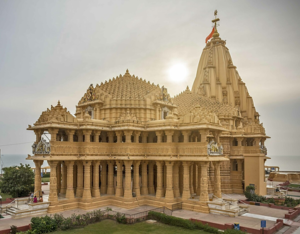
Context : Somnath Swabhiman Parv commemorates 1,000 years (1026–2026) since the first recorded destruction of the Somnath Temple, symbolising India’s uninterrupted civilisational faith, resilience, and cultural resurgence.
Somnath Swabhiman Parv – key idea
- Period: 1026–2026, linking millennium‑long resistance, reconstruction and faith.
- Nature: Cultural–civilisational commemoration, not a conventional political or religious campaign.
- Core theme: Swabhiman (self‑respect), unbroken faith, and resilience of Indian civilisation.
- Focus: Civilisational memory, cultural pride, correcting historical neglect, and inspiring youth.
Somnath Temple – essentials
- Location: Prabhas Patan on Gujarat’s Arabian Sea coast.
- Religious status: Revered as the first of the twelve Shiva Jyotirlingas.
- Scriptural link: Mentioned in Vedic tradition and associated Puranic literature.
- Sacred geography: At the Triveni Sangam of Kapila, Hiran and the (mythic) Saraswati.
Jyotirlinga context
- Somnath is one among 12 Jyotirlingas central to pan‑Indian Shaiva devotion.
- Others: Mallikarjuna, Mahakaleshwar, Omkareshwar, Vaidyanath, Nageshwar, Kedarnath, Grishneshwar, Bhimashankar, Trimbakeshwar, Rameshwaram, Kashi Vishwanath.
Historical timeline: attacks & rebuilding
- 1024–26 CE: Somnath plundered by Mahmud of Ghazni, becoming a symbol of cultural resistance.
- 1297 & 1394: Repeatedly damaged during Delhi Sultanate campaigns in Gujarat.
- 1706: Ordered demolished under Aurangzeb, reflecting late‑Mughal iconoclasm.
- Modern era: Rebuilt after Independence in Chalukya (Solanki) style in its traditional site.
- Reconstruction: Championed by Sardar Vallabhbhai Patel as Deputy PM & Home Minister.
- 1951: Prana‑pratishtha of the new temple performed by President Dr. Rajendra Prasad.
7. Indus Waters Treaty & Salal Reservoir
GS paper II-polity
Context : Following the Indus Waters Treaty (IWT) being kept in abeyance, India has initiated desilting of the Salal reservoir in Jammu & Kashmir to maximise water utilisation and hydropower efficiency.
Indus Waters Treaty – basics
- Signed in 1960 between India and Pakistan with World Bank facilitation.
- Allocates eastern rivers (Ravi, Beas, Sutlej) for near‑exclusive Indian use.
- Reserves western rivers (Indus, Jhelum, Chenab) mainly for Pakistan, with limited Indian use for hydropower, irrigation and domestic needs.
- Provides detailed design constraints for Indian projects on western rivers to protect downstream flows.
Key terms – desilting and RoR
- Desilting: Removal of silt deposits from reservoirs to regain storage, improve flood control and sustain power output.
- Run‑of‑the‑River (RoR) project: Hydropower scheme with minimal live storage, using river flow as it comes, generally permitted on western rivers subject to IWT design limits.
Salal Hydroelectric Project – essentials
- Located in Reasi district of Jammu & Kashmir on the Chenab River.
- Operated by NHPC as a run‑of‑the‑river hydropower station with relatively small storage.
- Among the earliest major Indian projects on the Chenab planned and executed under IWT constraints.
- Chronic siltation has reduced its effective storage and power potential over time.
Strategic significance of desilting Salal
- Restores India’s capacity to utilise its entitled share of Chenab waters more efficiently.
- Enhances peaking power availability and grid stability in northern India.
- Signals a more assertive approach within the treaty’s legal space, especially after the IWT was put in abeyance.
Broader implications for IWT and water use
- Desilting and efficiency upgrades help India maximise benefits from existing projects without formally violating treaty terms.
- Could set a precedent for similar optimisation at other western‑river projects.
- May sharpen India–Pakistan discourse on “interference” with downstream flows, making technical compliance and transparency more important.