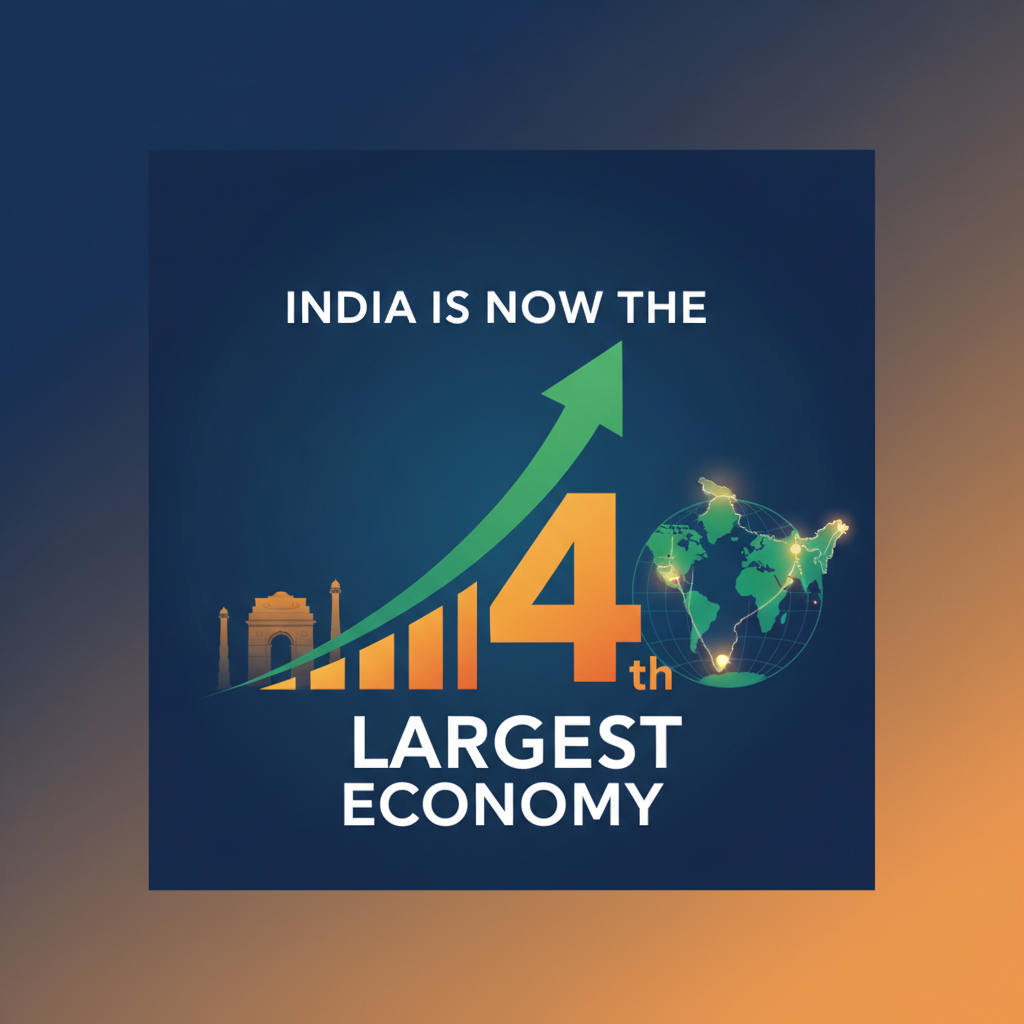
1.India is now the fourth largest economy: center
GS paper III-Economy
Context :Government announced that India’s GDP has reached about 4.18 trillion dollars, surpassing Japan.
- Official note also highlighted reforms in 2025 and optimistic medium‑term growth projections.
Why fourth largest economy
- India’s nominal GDP size (around 4.18 trillion dollars) is now above Japan’s but below US, China and Germany.
- Projections suggest India could overtake Germany around 2030 with GDP near 7.3 trillion dollars.
Growth performance of India
- Real GDP growth was about 8.2% in Q2 2025‑26, a six‑quarter high.
- Recent quarters show sustained growth above 7%, making India the fastest‑growing major economy.
Key drivers of growth
- Strong domestic drivers, especially robust private and urban consumption, supported expansion.
- Structural reforms, stable financial conditions, improving exports and benign inflation reinforced momentum.
Global institutions’ view
- IMF, World Bank, ADB and rating agencies project growth mostly in the 6–7.5% range for coming years.
- They see India as a resilient, fast‑growing G20 economy but stress the need for continued reforms and higher investment.
Long‑term vision: India 2047
- Government aims to make India a high‑middle‑income or high‑income economy by 2047, India’s centenary of independence.
- Strategy focuses on sustained high growth, stronger productivity, higher investments and inclusive social progress
2. Ministry tells social media platforms to block Obscene and pornographic content
GS paper II : Indian Polity and Governance / Government Policies & Interventions
Context :Centre issued a fresh advisory on 29 December 2025 to check obscene and unlawful online content.
- It follows rising concern and court scrutiny over vulgar and harmful material on the Internet.
Who is affected
- Large social‑media platforms and significant online intermediaries with big user bases in India.
- OTT and other content‑hosting services that allow users to upload or share material.
Content to be removed
- Obscene, pornographic, vulgar and indecent posts, images or videos.
- Paedophilic, child‑harmful or otherwise unlawful content under Indian law.
Legal basis: IT Rules 2021
- Rules require intermediaries to ensure users do not host, upload or share such illegal content.
- They mandate prompt takedown after court or government notice, including 24‑hour removal for certain sexual content.
If platforms do not comply
- Platforms risk losing safe‑harbour protection and becoming liable for user content.
- They can face prosecution, penalties and stricter government action for continued violations.
Why advisory issued now
- Government review found platforms were missing or ignoring large amounts of obscene material.
- Also responds to Supreme Court concern over unchecked online obscenity and need for stricter enforcement.
Why the issue matters
- Aims to protect children and vulnerable users from online exploitation and harmful exposure.
- Strengthens accountability of big tech while balancing free speech with public order and morality.
3. Himachal apple growers oppose reduced import duty on New Zealand
General Studies Paper III – Indian Economy (Agriculture, Trade Liberalization, Protectionism).
Context :Himachal Pradesh apple growers protested reduced import duty on New Zealand apples from 50% to 25%.
- Group led by Congress MLA Kuldeep Singh Rathore met Governor on Dec 30, 2025, seeking intervention.
Why Import Duty Being Reduced
- Proposed as part of India-New Zealand trade deal negotiations.
- Aims to facilitate market access and boost bilateral trade.
Why Himachal Apple Growers Opposing It
- Fear cheaper imports will flood market, reduce domestic prices, and erode market share.
- Limited landholdings (avg. 2 acres) and low diversification make apple cultivation primary livelihood.
Importance of Apple Economy in Himachal Pradesh
- Produces ~6.5 lakh tonnes annually, ~25% of India’s total apple production.
- Backbone of rural economy; contributes ~₹5,500 crore annually, supports over 1.5 lakh families.
Additional Stress on Apple Growers
- Climate change: rising temperatures, erratic weather.
- Rising input costs, labour shortages, shrinking margins, distress sales.
Concerns About a Dangerous Precedent
- Could trigger similar duty cuts for apples from US, Chile, Italy (40% global exports).
- Risk dismantling protections for farmer community in Himachal.
Economic Concepts Involved
- Trade liberalization vs. protectionism: lower tariffs for FTA benefits vs. safeguarding domestic producers.
- Dumping risk: cheaper imports threatening local industry.
- Infant industry argument: need to protect nascent/high-cost domestic sectors.
4. HAL enters civil markets with Dhruv NG helicopter
GS paper III-science and technology
CONTEXT ;Dhruv NG completed maiden flight on December 30, 2025, in Bengaluru, flagged off by Civil Aviation Minister K. Ram Mohan Naidu.
- HAL formally entered civil helicopter market, marking shift from defence focus.
- DGCA certified indigenous Shakti civil engine production, a first for India.
What is Dhruv NG Helicopter
- 5.5-tonne, light twin-engine, multi-role helicopter designed and manufactured by HAL in India.
- Engineered for diverse Indian terrains; features glass cockpit, modern avionics, crashworthy seats, self-sealing fuel tanks.
- Configurable for VIP transport, air ambulance, offshore operations, disaster relief, law enforcement.
DGCA Certification: A Major Milestone – What Happened
- DGCA issued type certification for indigenous Shakti 1H1C civil engine during event.
- First aero engine certified for indigenous production in India.
- Dhruv NG progressing toward full civil certification in 3-4 months.
Why It Important
- Boosts Aatmanirbhar Bharat in civil aviation; reduces import dependence.
- Offers cost-effective, high-performance alternative to foreign helicopters.
- Enhances safety, reliability, and operational efficiency for growing civil market.
Role of Indigenous Technology & Global Collaborations
- Core design and manufacturing indigenous by HAL; Shakti engine co-developed/produced locally.
- Collaboration with Safran (France) for engine technology transfer and support.
- Addresses past safety concerns with advanced systems and global standards compliance.
Economic and Strategic Significance
- Economic: Lower costs, faster delivery, job creation; potential exports and revenue for HAL.
- Strategic: Self-reliance in critical tech; supports regional connectivity (heliports in districts), disaster response, offshore ops.
- Positions India as aviation manufacturing hub, balancing defence-civil capabilities.
5. Defence Ministry Inks contarcts for procurement for Army and Navy
GS PAPER III-science and technology
context : Defence Ministry inked procurement contracts worth about ₹4,666 crore for CQB carbines and heavyweight torpedoes.
- Contracts were signed in presence of Defence Secretary in New Delhi, underscoring high‑level priority.
Details of the contracts
- First contract: around 4.25 lakh CQB carbines with accessories for the Indian Army and Navy.
- Second contract: 48 heavyweight torpedoes plus associated equipment for Kalvari‑class (Project‑75) submarines.
Strategic importance of CQB carbines
- Vital for close‑quarters urban and counter‑terror operations where engagements are at short range.
- Enhance lethality, accuracy and manoeuvrability for infantry and special forces in built‑up or confined spaces.
Why CQB carbines matter
- Replace ageing 9 mm/other legacy small arms, reducing dependence on imports and diverse inventories.
- Improve soldier survivability through better ergonomics, rapid target acquisition and higher rate of fire.
Importance of heavyweight torpedoes
- Provide principal offensive weapon for submarines in anti‑submarine and anti‑surface warfare.
- Extend underwater engagement range, payload and precision, boosting deterrence in the Indian Ocean.
Link with Atmanirbhar Bharat & Make in India
- Contracts placed on Indian firms deepen indigenous design, manufacturing and supply chains.
- Encourage MSMEs and private sector participation, enhancing defence‑industrial ecosystem and self‑reliance.
Defence capitalisation and modernisation
- Part of ongoing capital acquisition push to replace legacy systems with modern, networked platforms.
- Supports long‑term force restructuring to meet two‑front and high‑technology warfare requirements.
Challenges and critical perspective
- Need to ensure timely deliveries, quality control and life‑cycle support from domestic vendors.
- Must integrate new systems with training, doctrine and jointness; otherwise hardware gains remain under‑utilised.
6. A multipolar World with bipolar characteristics
General Studies Paper II (International Relations) – Global Power Dynamics, Multipolarity, US Foreign Policy.
Context : emerging global order as “multipolar with bipolar characteristics.”
- Highlights US-China-Russia as three great powers pulling world in divergent directions amid Trump’s NSS focus on Latin America.
Background: From Unipolarity to Today (Post-Cold War Onwards)
- Post-1991: Soviet collapse led to US unipolar dominance; expanded NATO, intervened globally.
- 1990s-2000s: US GDP ~50% world; China rising economically.
- 2010s: China ~66% US economy; Russia annexed Crimea (2014), challenged West.
- Today: Shift to multipolarity; US no longer sole centre.
Why Unipolarity is Ending
- China’s rapid economic/military growth closing gap with US.
- Russia’s resurgence, ability to challenge rules-based order.
- US relative decline; overextension, domestic polarisation.
- Rise of middle powers hedging between great powers.
US Strategy: Reasserting Primacy, Not Retreating
- Trump’s NSS (Dec 2025): Latin America/Caribbean as strategic priority; deny China influence.
- Reinforce American primacy in Western Hemisphere.
- Burden-sharing with Europe; reduce US commitments there.
- Confront China as systemic challenger; partner Russia tactically if needed.
Europe Burden Shifting
- US pushing Europe to shoulder more security (e.g., Ukraine).
- Trump critiques NATO; seeks Europe to handle regional threats.
- Allows US focus on Indo-Pacific, Latin America.
The Three Great Powers Today
- United States – The Reigning Power: Pre-eminent military/economic power; seeks to maintain primacy.
- China – The Rising Power: Fastest-growing; expanding military, economic influence; challenges US.
- Russia – Swing Power: Smaller economy but nuclear/arsenal strength; hedges, partners China/Russia against West.
Why Multipolar but Bipolar Characteristics
- Multipolar Features: Multiple powers (US, China, Russia, India, EU); middle powers hedge; fluid alliances.
- Bipolar Characteristics: Core rivalry US vs China; Russia often aligns China; divides world into competing blocs.
Fluid Multipolarity Explained
- Three great powers pull global order in divergent directions.
- No fixed blocs like Cold War; constant realignments.
- Middle powers (India, Brazil) balance bets.
- Emerging multipolarity fluid due to economic interdependence, shifting partnerships.
7. Prioritizing cleft care as a health issue
General Studies Paper I – Social Issues (Health, Child Welfare, Inclusive Development).
Context :Cleft lip/palate is preventable/treatable yet neglected; needs policy integration for awareness, early detection, comprehensive care.
- NGOs drive most efforts; government must scale up for equitable access.
What is Cleft Lip and Palate
- Congenital facial defect: gap in upper lip (cleft lip) and/or roof of mouth (cleft palate).
- Causes feeding, speech, hearing issues; socially stigmatizing if untreated.

Scale Problem in India
- ~36,000 babies born with cleft annually; 1 in 700 children affected.
- Only ~17.5 lakh surgeries in government hospitals; vast unmet need.
Role NGO vs Government
- NGOs (Smile Train etc.) provide free surgeries, training via private/public partnerships.
- Government hospitals lack infrastructure/personnel; fragmented care, low awareness.
Link with Nutritional & Child Survival
- Untreated clefts cause malnutrition, feeding difficulties, higher mortality.
- 1/3 cleft-related deaths preventable with timely surgery/nutrition.
Why Cleft Care Public Health Issue
- Affects speech, hearing, psychology; leads to stigma, social exclusion.
- Correctable with surgery; impacts child development, family livelihoods.
Global/National Policy Recognition
- WHO: Craniofacial anomalies in Global Burden of Disease initiative.
- India: NITI Aayog conversations; National Birth Defects Awareness Month (Aug 2024).
Rural-Urban Divide Cleft Care
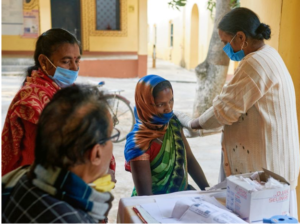
- 68.8% rural population underserved; urban bias in specialized hospitals.
- Rural areas lack early screening, travel incentives, post-op supp
Way Forward
- Recognize cleft as health issue; deformalize for grassroots management.
- Multi-level approaches: awareness, early detection, affordable comprehensive care via PPPs.