1. SC pause Aravalli ruling, moots new panel
GS paper I-Geography
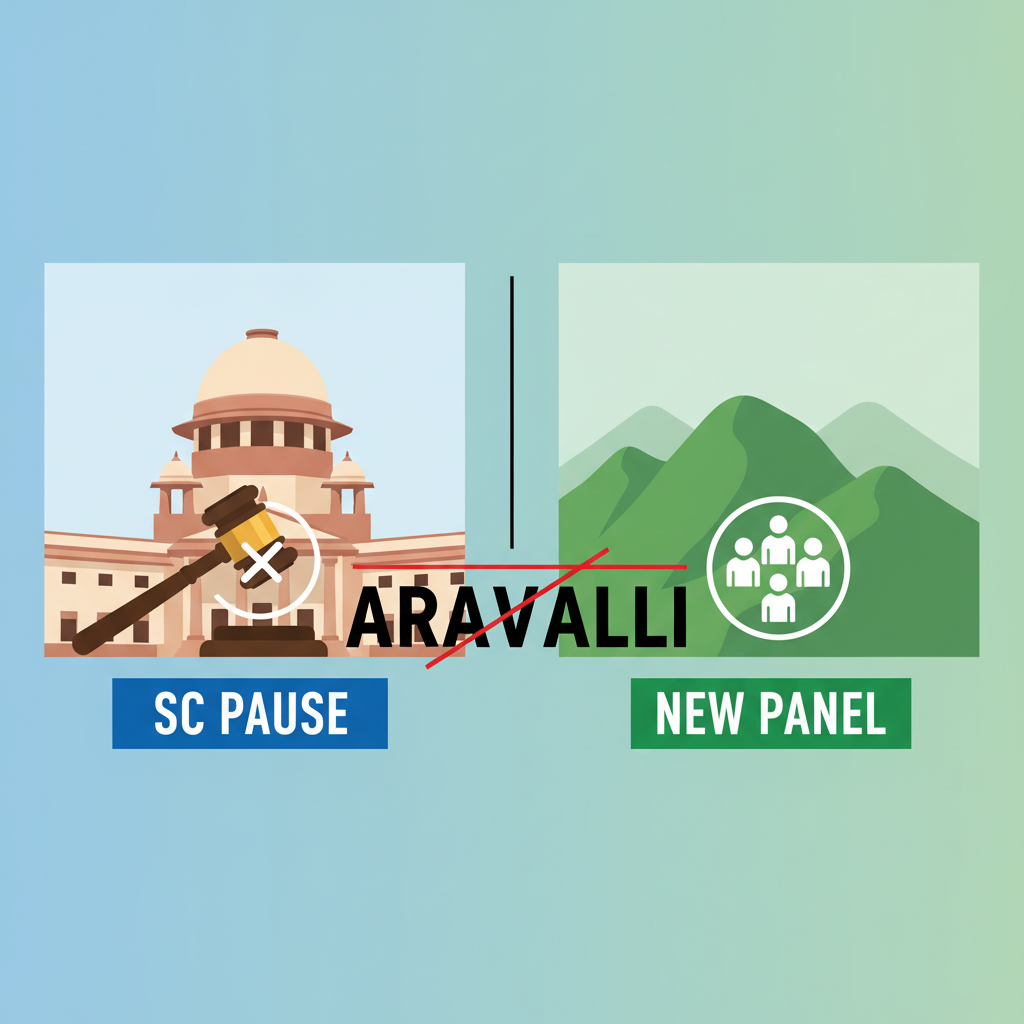
Context : SC has kept its 20 November 2025 Aravalli‑definition judgment in abeyance.
- Court has proposed a new high‑powered expert panel to re‑examine the definition.
Background: Aravalli Range
- One of the world’s oldest fold mountain systems in Gujarat, Rajasthan, Haryana, Delhi.
- Acts as a barrier to Thar desert expansion and dust‑laden winds.
- Provides groundwater recharge, forest cover and wildlife corridors near NCR.
The 20 November judgment
- SC accepted a government panel’s 100‑m elevation cut‑off for defining Aravalli hills.
- Hills within 500 m of each other were to be treated as a single “range”.
- It directed a sustainable mining management plan and paused new leases till then.
Why the judgment was problematic
- Only about 1,048 of 12,081 Rajasthan hills would qualify as Aravalli under 100‑m rule.
- Over 99% of earlier‑identified Aravalli hills nationwide risked losing protection.
- Gaps over 500 m could be opened for mining and construction (“structural paradox”).
- Environmentalists feared massive regulatory vacuum and habitat fragmentation.
Why SC paused its own verdict
- Court noted “public apprehension” and expert concern over the restrictive definition.
- It felt there would be “significant regulatory lacunae” in protecting Aravallis.
- Clarifications were needed on scientific criteria and ecological consequences.
Key interim observations
- Independent expert opinions must be obtained after stakeholder consultation.
- Definition must be nuanced, scientifically sound and ecology‑oriented.
- No fresh or renewed mining leases without prior permission of SC for now.
- Existing regulatory framework will continue during the interim period.
High‑powered expert committee: proposal
- Committee to be composed of geologists, ecologists, planners and other experts.
- It must review the current report and suggest a clearer, scientific definition.
- Panel to study short‑, medium‑ and long‑term impacts of any new criteria.
- It should examine feasibility of sustainable or regulated mining in mapped areas.
- Panel to address issues like structural paradox and treatment of hill gaps.
Key ecological concerns flagged
- Fragmentation could break ecological continuity and wildlife movement corridors.
- Increased mining may worsen air pollution and heat in NCR cities.
- Weakening of Aravalli barrier may accelerate desertification trends.
Government / committee stand
- Government panel argued 100‑m and 500‑m norms give objective, measurable criteria.
- It claimed the model balances environmental safeguards with sustainable mining.
- Centre cited economic and strategic need to mine certain critical minerals.
Why Aravallis are critical
- They shield the Indo‑Gangetic plains from advancing desert conditions.
- Act as major watersheds and recharge aquifers in semi‑arid regions.
- Support biodiversity, forests and climate regulation for NCR and adjoining states
2. DAC gives its nod for defence purchases worth ₹79,000
GS paper III-science and technology
Context :Defence Acquisition Council approved capital acquisition proposals worth about ₹79,000 crore for the three services.
- The package includes key systems for artillery, air defence, naval operations and air power.
What are DAC and AoN?
- Defence Acquisition Council is the apex defence‑procurement body chaired by the Defence Minister.
- Acceptance of Necessity is the formal approval that a military requirement exists, allowing procurement to proceed.
Navy‑specific approvals
- Bollard Pull tugs for assisting warships and submarines in berthing and harbour manoeuvres.
- High‑frequency software‑defined manpack radios for long‑range secure communications at sea.
- Leasing of High Altitude Long Endurance RPAS to strengthen maritime surveillance in the Indian Ocean.
Air Force‑specific approvals
- Automatic Take‑off and Landing Recording System to capture high‑definition, all‑weather flight data.
- Astra Mk‑II BVRAAM to give fighters longer‑range air‑to‑air engagement capability.
- Full Mission Simulator for LCA Tejas to provide realistic, cost‑effective training.
- SPICE‑100 precision‑guidance kits to turn standard bombs into accurate stand‑off weapons.
Strategic significance of ₹79,000‑crore approvals
- Sharply enhances deterrence by boosting strike, surveillance and air‑defence capabilities.
- Supports Atmanirbhar Bharat by emphasising indigenous design and production of advanced systems.
- Improves jointness and operational readiness across land borders and the Indian Ocean Region.
3. INS Kaundinya
GS paper III-Science and technology
Context :INSV Kaundinya has begun its maiden overseas voyage from Porbandar, Gujarat, to Muscat, Oman.
- The voyage marks India’s effort to revive and showcase its ancient maritime heritage and links with Oman.
What is INSV Kaundinya?
- An indigenously built, traditional stitched wooden sailing vessel of the Indian Navy.
- Uses age‑old “stitched shipbuilding” with natural materials instead of metal fastenings.
Historical inspiration
- Inspired by historical Indian sailing craft that once connected India’s western coast to the Gulf.
- Represents centuries‑old traditions of Indian oceanic navigation and coastal trade.
Historical significance of this voyage
- Retraces ancient maritime trade routes between Gujarat and Oman across the Arabian Sea.
- Demonstrates continuity of India–Oman sea links from antiquity to the present.
Strategic and cultural significance
- Aims to deepen cultural ties and civilisational connect between India and Oman.
- Supports broader diplomatic outreach in the Indian Ocean through heritage diplomacy.
Naval and strategic significance
- Highlights the Navy’s role in preserving maritime traditions alongside modern capabilities.
- Enhances India’s soft power and visibility in the wider Indian Ocean Region.
Who flagged the voyage?
- Voyage was flagged off by Vice‑Admiral Krishna Swaminathan, Flag Officer Commanding‑in‑Chief, Western Naval Command.
- Oman’s Ambassador to India and senior Indian Navy officers were present at the ceremony.
Crew and voyage details
- Vessel is skippered by Commander Vikas Sheoran of the Indian Navy.
- Commander Y. Hemant Kumar is Officer‑in‑Charge; crew includes four officers and 13 naval sailors.
4. The Quiet foundations for Indias next growth phase
GS Paper III Economy – Economic Reforms & Development.
Context :2025 reforms focus on reducing frictions, building trust-based governance, and enabling long-term investments in trade, logistics, energy, labour, and digital sectors.
Why Reforms Matter Now – Global Context
- Global slowdown, supply chain shifts, and energy transitions demand competitive edge.
- India hit $825.25B exports (2024-25); reforms boost formalisation, scale, and investor confidence vs. many economies losing steam.
Governance Reforms: Cutting Frictions
- Decriminalised 4,458 provisions; repealed 71 obsolete laws.
- Single Window System processed >8.29L approvals.
- District-level Business Reform Action Plan for predictable administration.
Better Legislation vs. Trust-Based Governance
- Shift from compliance-heavy to trust-based (e.g., self-certification, time-bound approvals).
- Enhances ease of doing business, attracts private capital.
Labour Reforms
- Consolidated 29 laws into 4 codes (effective Nov 2025).
- Covers wages, industrial relations, social security; enables formal jobs, scale in manufacturing/services.
Trade, Logistics & Maritime Reforms
- Ports Act 2025, Carriage of Goods by Sea Act 2025 modernise rules.
- ₹25,000Cr Maritime Fund; visible costs, push to 95% trade volume efficiency.
Trade Agreements & External Sector Strengthening
- New FTAs (UK, Oman); stronger platforms for exporters.
- ONDC (>326M transactions), startup ecosystem (>2L jobs).
Energy Reforms: Long-Cycle Growth Driver
- Oilfields Regulation Amendment Act 2025, new Petroleum Rules.
- Nuclear Energy Mission: ₹20,000Cr for SMRs, target 100GW by 2047.
- Reduces lease risks, boosts domestic exploration, offshore kilometres.
Digital Commerce & Startup Ecosystem
- ONDC, Government e-Marketplace growth.
- Startup recognition (>2L jobs); seamless digital processes.
Strategic Meaning of Reform Express 2025
- Cumulative quiet cleanup: decriminalisation, digitisation, market governance.
- Positions India for sustained high growth through resilience and competitiveness.
5. What is the India-New Zealand Free Trade Agreement ?
GS paper II-IR
Context :India and New Zealand have concluded negotiations for a comprehensive Free Trade Agreement (FTA) in 2025, one of India’s fastest‑sealed FTAs.
- The deal includes a New Zealand commitment to invest about USD 20 billion in India over 15 years and aims to double bilateral trade in five years.
Background and what is an FTA
- A Free Trade Agreement is a treaty where partner countries lower or remove tariffs on selected goods and services.
- FTAs also set rules on investment, services, standards and dispute resolution to ease cross‑border business.
Key objectives of India in the FTA
- Secure low‑ or zero‑duty access for labour‑intensive exports like textiles, engineering goods and processed food.
- Attract sizeable New Zealand investment into Indian manufacturing, infrastructure and clean energy sectors.
- Expand mobility and market access for Indian professionals, students and skilled workers in New Zealand.
- Strengthen India’s economic footprint in the wider Oceania and Pacific region through NZ partnership.
Major benefits for India
- Near‑universal duty‑free or reduced‑duty access for Indian products in the New Zealand market over time.
- Competitive edge for Indian MSMEs in garments, pharmaceuticals, auto components and food processing.
- Clearer rules and more liberal regimes for services, education and technology collaboration.
- Additional FDI inflows supporting jobs, technology transfer and export capacity in India.
Benefits for both India and New Zealand
- New Zealand gains phased tariff reductions on exports such as wood, wool, meat and some dairy lines to India.
- Consumers in both countries benefit from cheaper, more diverse goods and services.
- Deeper value‑chain links develop in agriculture, education, tourism and renewable energy.
- Cooperation chapters on digital trade, sustainability and standards reduce trade frictions.
Products not fully covered under the FTA
- India keeps highly sensitive farm items, especially key dairy products, outside full tariff elimination.
- Certain MSME‑intensive or politically sensitive products remain on exclusion or sensitive lists.
- Safeguard clauses allow temporary protection if import surges threaten domestic industries.
6. PM Modi praises ‘Flower Lady of Manipur’ Chokhone Krichena in Mann Ki Baat Also known as Flower Lady of Manipur-
GS Paper I : Role of women in economic development,Regional diversity and livelihood patterns in Northeast India.
Context :The Prime Minister recently praised Chokhone Krichena, the “Flower Lady of Manipur”, in Mann Ki Baat for turning floriculture into a pillar of self‑reliance and inclusive growth.
Who is Chokhone Krichena?
- A woman entrepreneur from Senapati district, Manipur, who combines traditional farm knowledge with modern business tools to promote floriculture in hill areas.
Major achievements
- Established Dianthe Private Limited in 2021 as a floriculture company for decorative flower cultivation and marketing.
- Shifted from subsistence farming to commercial floriculture, creating a viable rural enterprise model.
- Built a network of women farmers in Senapati, placing women at the centre of local value chains.
- Enabled flowers grown in Manipur’s hills to access markets in several other Indian States.
- Gained national recognition through mention in Mann Ki Baat, highlighting entrepreneurship from the Northeast.
Developmental significance
- Expands livelihood options and leadership opportunities for rural women farmers in a conflict‑affected, remote region.
- Encourages local production, value addition and organised marketing, boosting rural incomes and resilience.
- Demonstrates the untapped economic potential of hill agriculture and floriculture for the wider Northeast.
7. Passenger Assistance Control Room (PACR)
Context :The Ministry of Civil Aviation has set up a permanent 24×7 Passenger Assistance Control Room (PACR) to fast‑track aviation‑related passenger grievance redressal.
What is PACR?
- A round‑the‑clock integrated control centre that monitors aviation operations and ensures real‑time handling of passenger complaints about flights, airports and airlines.
- It is housed under the Ministry of Civil Aviation as a centralised hub for passenger assistance and crisis response.
Aims of PACR
- To put passengers at the core of India’s civil aviation ecosystem and improve their experience.
- To make grievance redressal faster, more transparent and clearly accountable.
- To institutionalise a coordinated mechanism for handling disruptions and aviation‑related crises.
Key features
- 24×7 monitoring: Continuous tracking of flights, disruptions and passenger calls for immediate intervention.
- Stakeholder convergence: Officials of MoCA, DGCA, AAI and airlines work under one roof for on‑the‑spot coordination.
- AirSewa linkage: Fully integrated with the AirSewa platform so that online complaints flow directly into the control room.
- Multi‑channel intake: Complaints received through calls and digital platforms are converted into actionable cases.
- Data‑driven dashboards: Live dashboards show complaint types, response times and actions taken to strengthen transparency.
- Passenger Charter adherence: Issues of delays, cancellations, refunds and baggage are resolved strictly as per Passenger Charter norms.
Significance
- Has already resolved over 13,000 grievances and handled 500+ call‑based interventions since December 2025.
- Builds public trust in India’s rapidly growing aviation sector by showing responsive, technology‑driven governance.