1. Russia likely placing new hypersonic missiles
GS Paper II – International Relations
GS Paper III – Security & Defence
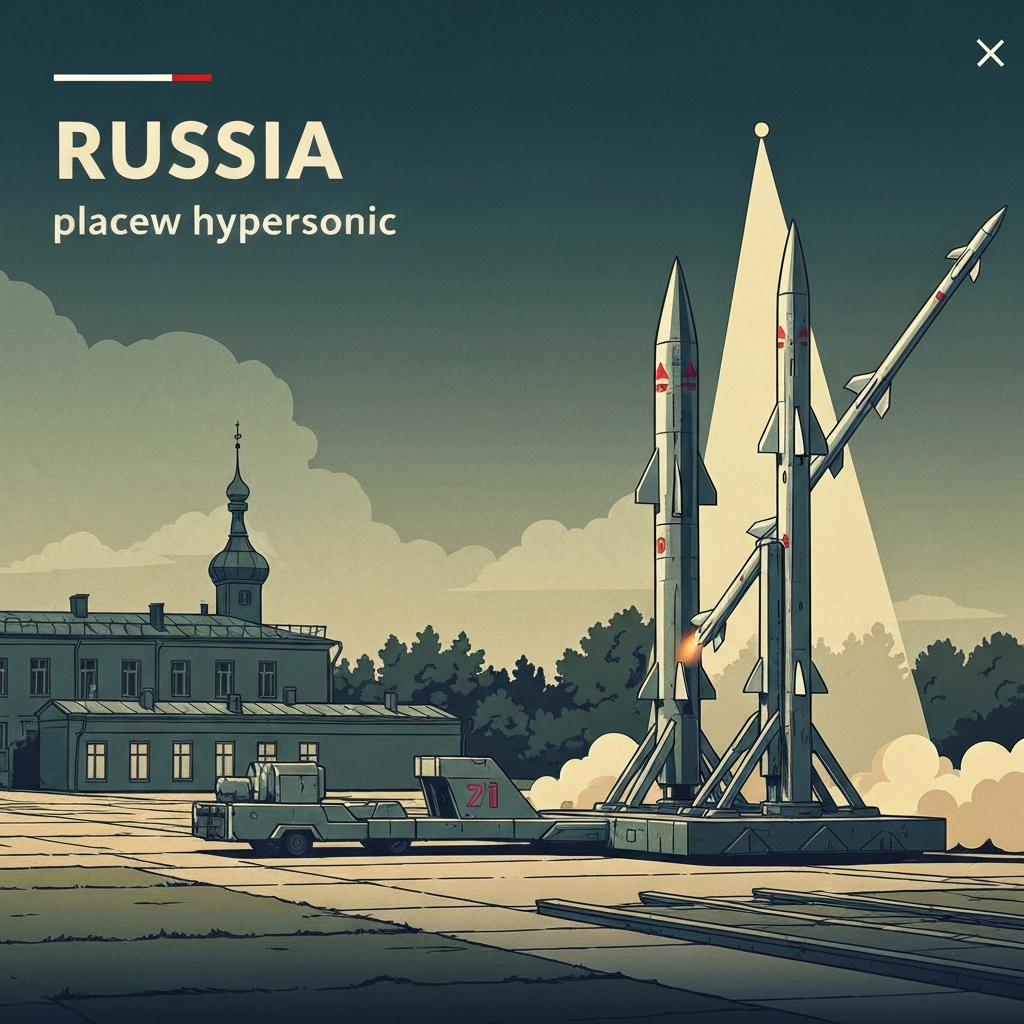
Context :Russia likely deploying nuclear-capable Oreshnik missiles in Belarus (near Krichev airbase), per satellite imagery and US researchers. First reported Dec 2025 amid Ukraine war tensions.
Key features
- Intermediate-range ballistic missile (IRBM)
- Speed: Mach 10+ (up to Mach 11)
- Range: up to 5,500 km
- Nuclear-capable, MIRV with 6 warheads (each with submunitions)
- Maneuverable reentry vehicles
- Road-mobile launcher
Why hard to intercept High speed + maneuverability + MIRV deployment Overwhelms current defenses Kinetic energy alone causes massive damage (even inert warheads)
Hypersonic ballistic missile vs traditional ballistic missile
| Aspect | Traditional Ballistic Missile | Oreshnik (Hypersonic Ballistic Missile) |
| Trajectory | Predictable parabolic arc | High-speed, maneuverable reentry |
| Speed | Mach 5–20 (reentry) | Mach 10+ sustained, highly maneuverable |
| Maneuverability | Limited (mostly fixed path) | High (evades interceptors) |
| Interception difficulty | Moderate (mid-course possible) | Extremely high (terminal phase unpredictable) |
| Payload | Single or basic MIRV | Advanced MIRV with submunitions |
| Primary threat | Speed + range | Speed + evasion + kinetic impact |
Strategic significance
- Extends Russia’s reach deeper into Europe
- Deters NATO aid to Ukraine (long-range weapons)
- First nuclear assets outside Russia since Cold War
- Counters US hypersonic deployments in Europe
- Boosts Belarus security (political reassurance)
- Signals reliance on nuclear threats amid New START expiry
2. A grand vision and the great Indian research defict
GS paper III- Economy and scienc and technology
Context : India has grand technological and economic vision but suffers from a massive, chronic R&D deficit that threatens its global power status.
Why R&D matters for a country
- Drives next-generation technology and economic growth
- Creates high-value jobs and intellectual property
- Ensures national security (defence, semiconductors, AI)
- Reduces dependence on foreign technology
- Builds global competitiveness and sovereign innovation
India’s R&D deficit explained through numbers
- Only 0.6–0.7% of GDP spent on R&D (slipping as GDP grows)
- China: ~2.4% | USA: ~3.5% | Israel: >5.4%
- India has 17.5% of world population but only 3% of global research output
- Patents per million residents: India ranks 44th globally
- India’s total R&D spending < Huawei’s single-company spending (₹23,400 crore vs Huawei’s ₹1.6 lakh crore)
- Private sector contributes only 36.4% (global norm: 65–70%)
Structural problems behind R&D deficit
- Government remains main funder; private sector risk-averse and short-term focused
- Bureaucratic delays in project approval and staggered fund release
- Weak academia-industry linkage; research stays theoretical
- Universities focus on teaching, not research excellence
- Brain drain: talented researchers move abroad for better facilities & pay
- Scattered efforts instead of concentrated missions in AI, quantum, semiconductors
- Low patent commercialization culture and slow technology transfer
- No strong incentives for private firms to invest in frontier R&D
The way forward
- Raise R&D spending to at least 2% of GDP in next 5–7 years
- Give big tax incentives to private sector to reach 50% of total R&D spend
- Reform universities: make them research centres with strong PhD funding
- Create mandatory industry-academia chairs and joint research centres
- Launch long-term, uninterrupted funding for national missions (semiconductors, AI, quantum)
- Simplify patent filing and offer financial rewards for commercialised patents
- Reduce bureaucratic delays in project approval and fund release
- Build world-class research infrastructure and competitive faculty salaries
- Reverse brain drain through attractive career paths in India
3. Linked civilization, a modern stratagic partnership
GS Paper II: International Relations
Context : India-Iran relations transcend modern diplomacy, rooted in ancient civilizational links, now evolving into a strategic partnership for energy, connectivity, security, and regional stability.
Civilizational foundations of India-Iran relations
- Shared Indo-Iranian linguistic and cultural roots from ancient Aryan migrations
- Common mythological and religious heritage (Avesta and Rigveda)
- Centuries of Persian cultural influence on India (language, art, poetry, architecture)
- Enduring Indo-Persian literary tradition (e.g., Mirza Abdul-Qadir Bedil)
Why this relationship matters today
- Provides India strategic access to Central Asia and Europe via INSTC and Chabahar Port
- Ensures energy security for India’s growing economy
- Counters extremism and terrorism in West and South Asia
- Strengthens multipolar axis for regional stability
Key pillars of modern India-Iran partnership
- Energy cooperation: Iran’s hydrocarbon reserves meet India’s oil/gas needs
- Connectivity: Chabahar Port and INSTC corridor (shorter, cheaper than Suez)
- Trade and economic ties: Diversification beyond oil, using local currencies
- Knowledge and technology: Collaboration in AI, nanotechnology, medical sciences
Security and strategic cooperation
- Joint fight against extremism and terrorism in West/South Asia
- Intelligence sharing and maritime security in Persian Gulf
- Countering third-party pressures through strategic prudence
- Mutual interest in stable West Asia
Challenges in India-Iran relations
- Third-party sanctions and geopolitical pressures (e.g., US sanctions on Iran)
- Regional rivalries and instability in West Asia
- Delays in Chabahar project implementation
- Volatility in energy trade due to global politics
The way forward – future-oriented cooperation
- Strengthen flexible financial mechanisms (local currency trade)
- Expand INSTC and Chabahar for multimodal connectivity
- Deepen tech and innovation collaboration (AI, quantum, biotech)
- Build resilient, independent partnership guided by shared legacy
- Transform historical goodwill into bold strategic alliance for 21st century
4. What are rare earth elements
GS paper I-Geography
Context :In news due to their role in EVs, wind turbines, defence, and a looming “mineral cold war” as big powers race to secure supplies.
- Rare earths are chemically similar metals used in magnets, lasers, catalysts, batteries, and optical fibres.
Why they are important
- Enable high‑performance permanent magnets used in EV motors, wind turbines, hard drives, and missiles.
- Provide luminescent and catalytic functions in LEDs, displays, fibre‑optic amplifiers, and catalytic converters.
Misconceptions about “rare earth”
- Misconception: they are geologically scarce; actually quite abundant but rarely found in rich, mineable concentrations.
- Name “rare earth” is historical; difficulty is economic and technological, not absolute scarcity.
Why rare earths have unique properties
- Unique properties arise from partially filled 4f electron shells that are shielded from the environment.
- These 4f electrons give strongly localized magnetic moments and sharp optical emission lines.
Magnetic properties
- Some rare earth ions (Nd, Dy, Sm) have many unpaired 4f electrons giving very large magnetic moments.
- Strong spin–orbit coupling and crystal‑field anisotropy make their magnets hard to demagnetize.
Two requirements of a good magnet
- High remanence: magnet should store large magnetic energy per unit volume.
- High coercivity: magnet should resist demagnetization at working temperatures.
Optical properties
- Many rare earth ions act as phosphors, emitting precise colours when excited by UV or electrons.
- Sharp emission lines make them ideal for red phosphors in displays and dopants in lasers and fibre‑optic amplifiers.
Rare earth vs oil: why processing matters more
- Oil: once extracted, refinery steps are standard and interchangeable globally.
- Rare earths: value lies in complex separation and refining chains; each ore needs customised circuits and thousands of solvent‑extraction stages.
Rare earth mining: environmental & technical issues
- Ores contain very low REE percentages, so huge volumes of rock and water must be processed.
- Deposits often contain radioactive thorium/uranium and toxic fluorides, creating long‑lived hazardous tailings.
The “midstream menace”
- Midstream (concentration, separation, refining) generates most waste, emissions, and technical bottlenecks.
- Failures or pollution here, as seen at Bayan Obo and Malaysian refineries, cause major local health and ecological crises.
Why separation is so hard
- All rare earth ions largely share the same +3 charge and very similar ionic radii and chemistry.
- Solvent‑extraction only slightly prefers one ion over another, requiring hundreds–thousands of repeated stages.
Why rare earths are geopolitically sensitive
- China controls about 70% of mining and nearly 85–90% of processing capacity, creating strategic dependence.
- US, EU, and others are scrambling to diversify supply, turning REEs into a tool of strategic leverage and trade conflicts.
5. Venezuela’s resource curse
GS Paper II: International Relations
CONTEXT:U.S. naval actions and tighter enforcement of oil sanctions, including seizures of Venezuelan tankers, which further strain its already fragile, oil‑dependent economy.
What is “resource curse”?
- Resource curse describes countries with abundant natural resources but weak growth, institutions and diversification due to over‑reliance on commodity rents.
- It leads to volatility, corruption, Dutch disease, conflict risks and neglect of human capital and non‑resource sectors.
Venezuela’s resource wealth
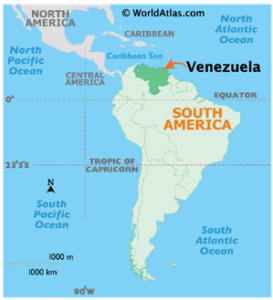
- Venezuela has the world’s largest proven crude oil reserves, around 303 billion barrels, mainly in the Orinoco Belt.
- Yet oil today contributes a small and volatile output as production has collapsed, even though petroleum still provides most export and fiscal revenue.
Structural reasons for economic decline
- Long‑term dependence on oil made Venezuela a rentier state, with the state distributing oil rents instead of building a productive, tax‑based economy.
- Weak institutions, centralised state control and politicisation of PDVSA encouraged corruption, under‑investment and macroeconomic mismanagement.
Nature of oil reserves: extra‑heavy crude
- Much of Venezuela’s oil is extra‑heavy, sour crude, technically difficult and expensive to extract and refine.
- This requires foreign capital, technology and stable contracts, which sanctions and policy uncertainty have discouraged.
Collapse of state oil company (PDVSA)
- PDVSA shifted from a technically driven company to a politicised arm of the state, losing managerial autonomy and professional staff.
- Revenue diversion to social spending without reinvestment led to decaying infrastructure, leakages and falling operational capacity.
Decline in oil production
- Crude output fell from about 3.2 million barrels per day in 2000 to roughly 735,000 barrels per day in 2023.
- Ageing fields, lack of maintenance, brain drain and limited access to finance and technology under sanctions drove this steep decline.
Boom to bust: historical context
- From the 1950s to early 1980s, high oil revenues gave Venezuela one of Latin America’s highest living standards.
- The 1980s oil price collapse, followed by later boom‑bust cycles, exposed structural weaknesses and triggered recurring crises and social unrest.
Role of sanctions
- U.S. and allied sanctions restricted PDVSA’s access to capital markets, equipment, diluents and key export markets.
- Recent stricter enforcement via tanker seizures threatens remaining export channels, intensifying fiscal stress and foreign‑exchange shortages.
Why sanctions are not full explanation
- Production and governance problems pre‑dated major sanctions, with mismanagement and under‑investment visible since the 2000s.
- Many oil‑rich states under sanctions have avoided such deep collapse when domestic institutions and macroeconomic management were stronger.
Failure to diversify the economy
- Non‑oil sectors such as agriculture and manufacturing remained underdeveloped as oil revenues appreciated the currency and crowded out other exports.
- Import dependence for food and manufactured goods made the economy highly vulnerable when oil earnings and foreign exchange shrank.
Collapse in global oil exports
- With falling output and sanctions, Venezuela’s crude exports and OPEC market share have dropped sharply since the mid‑2000s.
- Shadow fleets and discounted sales have replaced formal markets, yielding lower net revenue per barrel and greater leakages.
Rising debt despite resource wealth
- The state borrowed heavily against future oil income, increasing external and domestic public debt during boom years.
- When prices and production fell, debt service crowded out social and capital spending, while default shut Venezuela out of normal financing.
Venezuela as a classic resource‑curse case
- Abundant oil, weak institutions, macro‑populism and over‑reliance on a single commodity embody the classic resource‑curse pattern.
- The combination of extra‑heavy crude, politicised state oil company and sanctions magnified the usual risks into a full‑blown humanitarian and economic crisis.
Lessons for developing countries
- Build strong fiscal rules, sovereign wealth funds and transparent institutions to smooth commodity cycles and curb rent‑seeking.
- Diversify exports, invest in human capital and maintain professional, autonomous management of national resource companies instead of using them as cash‑cows.
6. Indian Pharmacopoeia Commission (IPC)
CONTEXT : The Union Health Minister recently reviewed IPC’s work and praised its role in strengthening drug standards and pharmacovigilance, supporting Atmanirbhar and Viksit Bharat.
- He also announced that the 10th edition of the Indian Pharmacopoeia (IP 2026) will be released in January 2026.
Nature and status of IPC
- IPC is an autonomous national body that publishes the Indian Pharmacopoeia, the official compendium of drug standards under the Drugs and Cosmetics Act, 1940.
- It has been operational since 1 January 2009 as a fully government‑funded institution under the Ministry of Health and Family Welfare.
- The Commission is headquartered in Ghaziabad, Uttar Pradesh.
Objectives
- To safeguard human and animal health by framing authoritative, scientifically sound standards for the identity, purity, strength and quality of medicines.
- To contribute to Atmanirbhar Bharat and Viksit Bharat by promoting self‑reliance in regulatory standards and aligning them with global benchmarks.
Main functions
- Regularly prepares and updates the Indian Pharmacopoeia, covering APIs, excipients, dosage forms, medical devices and herbal products.
- Publishes the National Formulary of India to guide rational, evidence‑based prescribing by healthcare professionals.
- Serves as the National Coordination Centre for the Pharmacovigilance Programme of India (PvPI), monitoring and analysing adverse drug reactions.
- Develops, certifies and supplies Indian Pharmacopoeia Reference Substances for use in quality‑control laboratories.
- Works with major international pharmacopoeias (USP, BP, Ph. Eur., JP, ChP) and WHO to harmonise standards.
- Organises training, research and awareness programmes on pharmacopoeial, quality‑control and regulatory issues.
Importance
- Helps ensure uniform quality, safety and efficacy of medicines manufactured and sold across India.
- International recognition of the Indian Pharmacopoeia in 19 countries enhances India’s credibility as the “pharmacy of the world”.
- Strengthens India’s position and reliability in global pharmaceutical supply chains by providing robust, internationally accepted standards.
7. Where is Somaliland? Israel recognizes it as an independent nation amid row
Subject: MAPPING
Context :Israel has become the first country to formally recognise Somaliland as an independent sovereign state in 2025.
- The move has drawn strong objections from Somalia, the African Union, and several key regional actors.
Basic profile
- Somaliland is a self‑declared independent entity in the Horn of Africa that broke away from Somalia in 1991.
- It has its own government, currency, security forces and institutions but has long lacked broad international recognition.
Location and neighbours
- Situated in the Horn of Africa along the Gulf of Aden, largely overlapping the former British Somaliland territory.
- Shares borders with Djibouti, Ethiopia, Somalia (including Puntland), and the Gulf of Aden coastline.
Historical background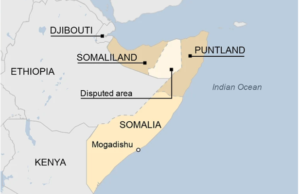
- Became a British protectorate in 1888, known as British Somaliland.
- Gained independence in 1960 and voluntarily united with Italian Somaliland to create the Somali Republic.
- Declared independence in 1991 after civil war and collapse of Siad Barre’s regime, arguing the 1960 union had failed.
- A 2001 referendum saw more than 97% of voters endorse the region’s independence claim.
Current political status
- Operates as a de facto state with comparatively higher stability and peace than much of Somalia.
- Not recognised by the UN, African Union, or most states; Somalia still treats it as part of its sovereign territory.
- Runs its own political institutions, conducts elections, issues the Somaliland shilling, and manages internal security.
Significance of Israel’s recognition
- Israel’s step is the first formal bilateral recognition of Somaliland’s sovereignty by any country.
- This could encourage other states to consider recognition but may also heighten tensions and instability in the wider region.