
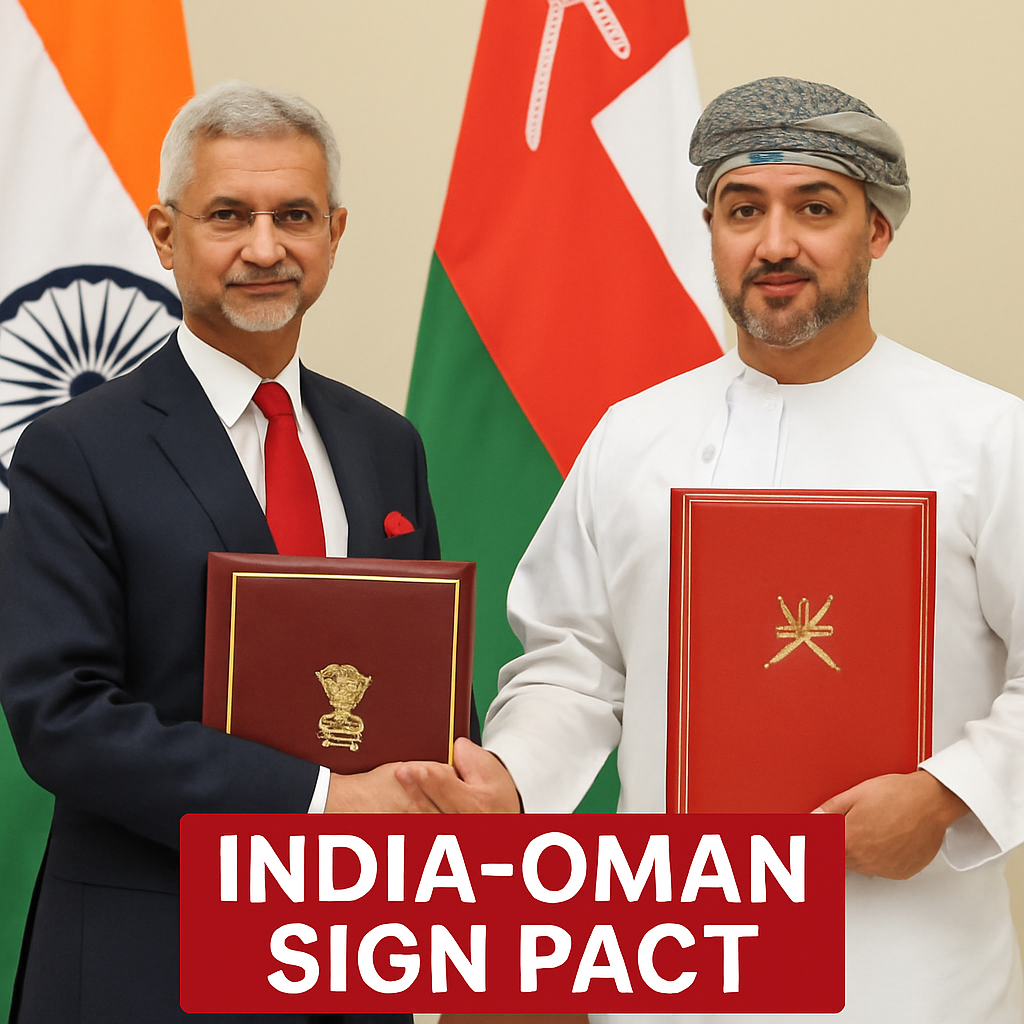
1. India-Oman sign pact
GS Paper‑II – International Relations (India and its neighbourhood; India and GCC/West Asia)
Context :India and Oman signed the CEPA in Muscat after almost two years of negotiations.
- Oman will give India duty‑free access on 98.08% of its tariff lines, covering 99.38% of India’s exports.
- This is Oman’s first such pact since its 2006 FTA with the US, and India’s second CEPA with a GCC country.
What is CEPA
- A Comprehensive Economic Partnership Agreement is a broad trade pact covering goods, services, investment and regulatory cooperation.
- It reduces or removes tariffs, eases customs and standards, and creates rules for services, investment and dispute settlement.
Key features of India–Oman CEPA
- Almost full tariff elimination by Oman on Indian goods; India offers substantial but lower liberalisation for Omani imports.
- Major labour‑intensive sectors like gems and jewellery, textiles, leather, footwear, sports goods, plastics, farm products, pharma, medical devices and autos get zero duty.
- Sensitive Indian sectors such as some agriculture and metals remain protected with limited or phased cuts.
- Strong disciplines on investment, customs cooperation, technical barriers to trade and digital trade facilitation.
Trade context
- Bilateral trade reached about USD 10.61 billion in FY 2024‑25, growing nearly 18.6% year‑on‑year.
- India exports refined petroleum, rice, machinery, iron and steel products etc. to Oman.
- India mainly imports crude oil, LNG, fertilisers and chemicals from Oman, making Oman a key energy supplier.
Services trade and labour mobility
- Oman has opened sectors like IT, professional and business services, education, health, R&D and audio‑visual for Indian service providers.
- Indian firms can establish commercial presence with up to 100% ownership in several service sectors.
- Mode‑4 access is widened: quota for intra‑corporate transferees raised from 20% to 50%.
- Stay of contractual service suppliers extended from 90 days to two years, with possibility of a further two‑year extension.
- Easier temporary entry for business visitors, independent professionals and various skilled specialists.
Strategic and geopolitical significance
- Oman sits near the Strait of Hormuz, so deeper ties enhance India’s maritime and energy security in the Western Indian Ocean.
- Stronger economic link supports India’s outreach to the Gulf Cooperation Council and wider West Asia region.
- Oman is an important interlocutor for India in GCC, Arab League and IORA, aiding regional diplomacy.
- The pact complements defence and maritime cooperation, including access to Duqm port for Indian naval operations.
2. India -Netherlands
GS Paper‑II – International Relations
Context :Dutch Foreign Minister met Defence Minister Rajnath Singh in New Delhi to expand defence ties.
- LoI on Defence Cooperation and plan for a Defence Industrial Roadmap were announced.
Background
- Bilateral ties are upgrading from trade‑centric to a broader strategic partnership.
- Earlier cooperation existed in maritime security, cyber and emerging technologies.
Key areas of discussion
- Co‑development and co‑production of defence equipment and platforms.
- Collaboration in niche, high‑tech and emerging defence technologies.
Military‑to‑military engagement
- Plan to intensify service‑level exchanges, training and exercises.
- Defence ties recognised as a central pillar of bilateral partnership.
Indo‑Pacific dimension
- Shared commitment to a free, open, inclusive, rules‑based Indo‑Pacific.
- Cooperation to address maritime security and regional stability challenges.
Letter of Intent (LoI)
- LoI signed between defence authorities to institutionalise cooperation.
- It provides a formal framework for advancing specific defence projects.
Defence industrial roadmap
- Roadmap to guide co‑production, co‑development and joint R&D initiatives.
- Aims to connect defence industries and integrate supply chains of both sides.
Strategic partnership and people ties
- Defence cooperation elevated as a key element of strategic partnership.
- Large Indian diaspora in the Netherlands strengthens people‑to‑people links.
Overall significance for India
- Helps access advanced European technologies and supports defence indigenisation.
- Bolsters India’s role with like‑minded partners in shaping Indo‑Pacific security order.
3. 900 Million people will have diabetes by 20250
GS Paper‑III – Science & Technology
CONTEXT :11th Edition of IDF Diabetes Atlas released in 2025 with updated global estimates.
- Warns diabetes cases may approach 900 million adults by 2050.
- Highlights epidemic has continued largely unchecked since early 2000s.
- Calls for stronger prevention, early detection and equitable care worldwide.
Background
- International Diabetes Federation (IDF) publishes a periodic, authoritative Diabetes Atlas.
- 11th edition uses data from 200+ countries to produce 2024 estimates.
- Projections factor in population growth, ageing and urbanisation patterns.
- Warns of huge health and economic impacts if current trends continue.
What is diabetes
- Chronic metabolic condition marked by persistently high blood glucose.
- Occurs when body makes too little insulin or cannot use it effectively.
- Main types: Type 1 (autoimmune, near‑complete insulin lack).
- Type 2 (insulin resistance/relative deficiency, lifestyle‑linked).
- Leads to heart disease, stroke, kidney failure, blindness, amputations.
Key global projections: 2024–2050
- About 589 million adults (20–79 years) living with diabetes in 2024.
- Global adult prevalence around 11.1% in 2024.
- Numbers projected to reach about 853 million adults by 2050.
- Prevalence expected to rise to roughly 13% by 2050.
- Overall global increase of roughly 45% between 2024 and 2050.
- Over 95% of additional cases predicted in low‑ and middle‑income countries.
Why this is alarming
- Diabetes estimated to cause around 3.4 million deaths in 2024.
- Over 250 million adults are living with undiagnosed diabetes.
- Global health‑care and productivity costs exceed USD 1 trillion annually.
- Complications cause disability, loss of income and deepening poverty.
- Atlas stresses epidemic remains uncontrolled without tailored action.
Urban–rural divide: situation in 2024
- Around 400 million cases reside in urban areas in 2024.
- Rural areas account for about 189 million cases.
- Higher prevalence in urban settings linked to diet and sedentary life.
- Pattern mirrors rapid urbanisation and associated risk behaviours.
Urban–rural divide: projections for 2050
- Urban diabetes burden projected to climb to about 655 million.
- Rural cases expected to stay almost flat near 198 million.
- Urban–rural gap widens sharply over coming decades.
- Urbanisation and city‑centric lifestyles drive most future increases.
Country‑wise burden: rankings for 2024
- China tops in numbers with roughly 148 million adults with diabetes.
- India ranks second with nearly 90 million affected adults.
- United States is third, Pakistan fourth by case numbers.
- Highest prevalence rates seen in Pakistan, Pacific islands, Middle East.
Country‑wise burden: projections for 2050
- China and India likely to retain first and second positions by numbers.
- Pakistan projected to move up to third place in total cases.
- Global adult caseload approaches nearly 900 million by 2050.
- Bulk of the rise will occur in low‑ and middle‑income countries.
India‑specific significance
- India already has around 90 million diabetic adults (second globally).
- Rapid urbanisation, obesity and lifestyle change accelerate incidence.
- High proportion of undiagnosed and poorly controlled diabetes persists.
- Large burden of cardiovascular, renal and eye complications emerging.
- Urgent need for prevention, mass screening and affordable long‑term care.
4. Inside the DHRUV64 microprocessor
GS paper III-Science and technology
Context :Announced on 15 December 2025 by MeitY as a major indigenous chip milestone.
- First India‑designed 1.0 GHz, 64‑bit dual‑core microprocessor in production‑ready form.
- Showcases progress of the Digital India RISC‑V (DIR‑V) initiative.
- Strengthens Aatmanirbhar Bharat push in the semiconductor value chain.
Background and significance
- Aims to cut dependence on imported processors in strategic and civilian sectors.
- Important as India consumes a large share of global microprocessors but designs few.
- Enables trusted computing platforms for defence, telecom and critical infrastructure.
- Helps build domestic design talent and a broader hardware innovation ecosystem.
Who developed DHRUV64
- Designed by Centre for Development of Advanced Computing (C‑DAC).
- Developed under MeitY’s Microprocessor Development Programme (MDP).
- Part of the VEGA processor family in the DIR‑V roadmap.
- Follows earlier indigenous cores like THEJAS32 and THEJAS64.
What is DHRUV64
- Fully indigenous 64‑bit, dual‑core RISC‑V processor clocked at about 1.0 GHz.
- Optimised for higher efficiency, multitasking and reliability in embedded systems.
- Supports Linux and other modern operating systems and toolchains.
- Targeted for 5G, automotive, IoT, industrial automation and consumer devices.
Technological positioning
- Uses open RISC‑V ISA, avoiding foreign IP licensing costs and constraints.
- Dual‑core, out‑of‑order design with contemporary pipeline and security features.
- Likely fabricated on a mature node (around 28 nm) suitable for embedded use.
- Positioned as a capable mid‑range embedded and edge‑computing processor.
- Next step is integration into Dhanush and Dhanush+ system‑on‑chips (SoCs).
Why India wants indigenous processors
- Reduces supply‑chain vulnerabilities and geopolitical dependencies.
- Ensures security and auditability for defence and other sensitive workloads.
- Capitalises on India’s strong chip‑design and EDA engineering base.
- Encourages local startups, lower‑cost prototyping and home‑grown IP.
- Aligns with long‑term national security and digital‑economy strategies.
India’s indigenous processor ecosystem
- SHAKTI (IIT Madras): RISC‑V cores for strategic and space programmes.
- AJIT (IIT Bombay): 32‑bit processor for industrial and robotics uses.
- VIKRAM (ISRO‑SCL): Space‑grade, radiation‑hardened controller chips.
- THEJAS64 (C‑DAC): 64‑bit core for industrial and embedded systems.
- DHRUV64 (C‑DAC): Broader commercial and strategic, DIR‑V flagship.
Information not yet disclosed
- Exact fabrication foundry and geographical location of the fab.
- Detailed benchmark scores versus global peers in its class.
- Power consumption figures and thermal envelope.
- Cache sizes, memory subsystem and I/O bandwidth specifics.
- Full availability timeline and long‑term supply roadmap.
Supporting government schemes
- Digital India RISC‑V (DIR‑V): Funds RISC‑V cores and SoC platforms.
- Chips to Startup (C2S): Trains VLSI talent and supports design startups.
- India Semiconductor Mission (ISM): Facilitates fabs and ATMP/OSAT units.
- Design Linked Incentive (DLI): Gives incentives for Indian chip design IP.
- INUP‑i2i: Provides shared nanoelectronics facilities for R&D and training.
5. Cleaning Delhi’s air requires a Delhi-specific plan
GS paper III-Environment and Ecology
CONTEXT :A recent analysis argues Delhi’s air crisis reflects deep governance design failures, not just winter smog events
- Lockdown experience showed that short‑term emission cuts alone cannot guarantee healthy air, prompting calls for predictive, preventive and participatory air‑governance.
Governance rethink: from reaction to prevention
- Move from short, emergency responses to continuous, year‑round planning guided by forecasts.
- Shift focus from “controlling” peaks to “preventing” build‑up of pollution through structural changes.
- Replace sporadic, fragmented orders with an integrated airshed‑level strategy involving multiple agencies.
Core elements of a Delhi‑specific air plan
- Use AI, IoT sensors and satellite data to model pollution and trigger early action before severe episodes.
- Ensure transparent decision‑making so citizens, RWAs and civil society can track actions and participate.
- Provide reliable grid power so institutions and households do not depend on diesel generators.
- Control road and construction dust via mechanised sweeping, water sprinkling and strict site management.
- Green open and barren spaces, pave kuccha stretches and scientifically manage landfills to cut dust and fires.
- Coordinate measures across the entire airshed, covering NCR towns and surrounding districts, not just Delhi.
- Tailor protections for vulnerable groups (children, elderly, outdoor workers) with advisories and support.
- Stagger or redesign office and school timings to reduce peak‑hour traffic congestion and emissions.
Key takeaway
- Delhi’s smog is framed as a symptom of weak institutional design rather than failure of alerts or enforcement alone.
- A Delhi‑specific, predictive, science‑driven and participatory air‑governance framework is seen as essential for long‑term, sustainable clean air.
6. Securities Market Code Bill, 2025
GS paper III-economy
CONTEXT :The Finance Minister has introduced the Securities Market Code Bill, 2025 in the Lok Sabha.
- The Bill, first announced in Budget 2021‑22, has now been sent to the Standing Committee on Finance for detailed scrutiny.
Core purpose of the SMC Bill
- Consolidates three separate securities laws into a single, coherent code to simplify regulation.
- Aims to modernise the legal framework in line with technology‑driven, algorithmic and digital markets.
- Seeks to reduce compliance complexity, improve regulatory governance and protect investors more effectively.
“Three laws into one” repeal
- Proposes repeal of the Securities Contracts (Regulation) Act, 1956 (SCRA).
- Replaces the Securities and Exchange Board of India Act, 1992 (SEBI Act).
- Substitutes the Depositories Act, 1996 with provisions folded into the unified Code.
Redesign of SEBI’s board structure
- Expands maximum board strength from 9 members to up to 15 members.
- Composition: Chairperson, two members nominated from the Union Government, one from RBI, and up to eleven other members.
- Mandates that at least five members should serve as whole‑time members for stronger executive capacity.
Conflict‑of‑interest and post‑tenure rules
- Introduces explicit conflict‑of‑interest norms, including disclosure of direct and indirect (family) interests.
- Requires recusal of members from meetings where they have any such interest.
- Bars former members from taking jobs with the Government or market entities for one year post‑tenure without prior approval.
7. Sahitya Akademi Awards
GS Paper‑I – Indian Art & Culture
Context Sahitya Akademi called off its press conference to declare annual awards after a Culture Ministry directive.
- The Ministry cited lack of prior approval/consultation required under an MoU signed in July 2025.
Restructuring of key cultural bodies
- A common restructuring framework is being applied to four major cultural institutions.
- These include Sahitya Akademi, Sangeet Natak Akademi, Lalit Kala Akademi and the National School of Drama.
- The move is part of a broader plan to standardise awards and governance across departments.
About Sahitya Akademi Awards
- Given for outstanding books of literary merit in Indian languages recognised by the Akademi.
- Cover 22 Constitution‑listed languages plus English and Rajasthani in Akademi programmes.
- Awardees receive a plaque, shawl and a cash prize of around ₹1 lakh.
Key facts about Sahitya Akademi
- National Academy of Letters formally set up by the Government of India in March 1954.
- Registered as a society under the Societies Registration Act, 1860.
- Premier national institution for literary dialogue, publication and promotion in 24 languages.
- Functions as an autonomous body under the Ministry of Culture with headquarters in New Delhi.