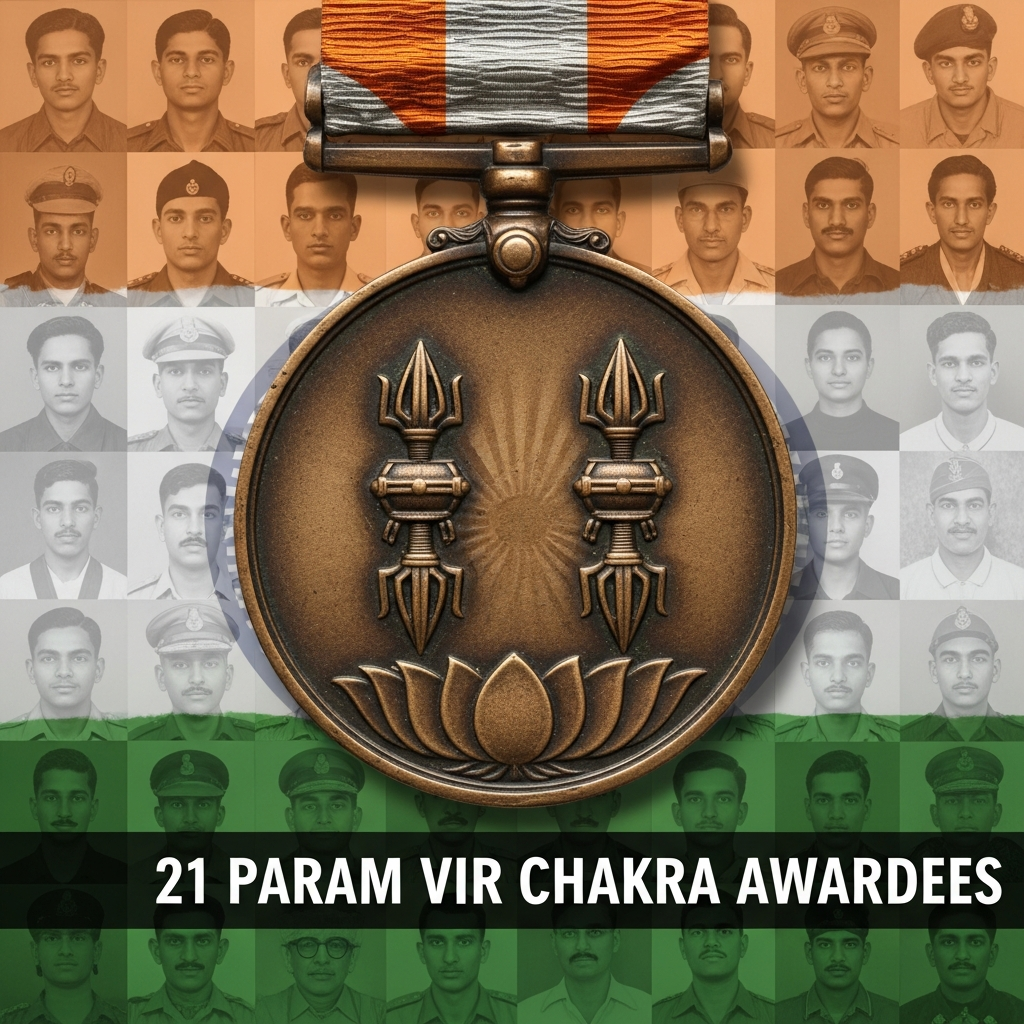
1. 21 param vir chakra awardees
GS PAPER II- Indian Polity and Governance
Context :President Droupadi Murmu has inaugurated the “Param Vir Dirgha” gallery, where portraits of all 21 Param Vir Chakra awardees now replace portraits of 96 British Aides-de-Camp in the corridors of Rashtrapati Bhavan on Vijay Diwas.
Background
Event: Inauguration of “Param Vir Dirgha” gallery at Rashtrapati Bhavan on Vijay Diwas.
- Location: Corridors of Rashtrapati Bhavan that earlier carried portraits of British Aides‑de‑Camp.
- Purpose: To honour PVC awardees and to symbolically shed colonial imagery in a key national institution.
Param Vir Chakra: meaning
- Meaning: “Param Vir Chakra” roughly means “Wheel/Medal of Supreme Bravery.”
- Nature: It is India’s highest military decoration for wartime gallantry.
Key features of PVC
- Criteria: Awarded for “most conspicuous bravery or pre‑eminent act of valour or self‑sacrifice” in the presence of the enemy on land, sea or air.
- Institution: Instituted on 26 January 1950 with effect from 15 August 1947 by the Government of India.
- Authority: Conferred by the President of India on members of all three armed forces without distinction of rank or gender.
Number of awards
- Total awards: 21 Param Vir Chakras have been awarded so far.
- Nature of awards: A large proportion have been awarded posthumously for supreme sacrifice in wars, mainly Indo‑Pak conflicts.
Significance of displaying PVC portraits
- a) Honouring national heroes
- Public recognition: Places the faces of all 21 PVC awardees in the nation’s highest constitutional residence, giving them pride of place in state ceremonial space.
- Institutional memory: Ensures that their acts of valour and sacrifice are formally woven into the visual memory of the Republic’s head of state.
- b) Educational value
- Civic education: Gallery aims to educate visitors, students and dignitaries about stories of courage, sacrifice and defence of sovereignty.
- Role‑model effect: Provides concrete biographies and battle narratives that can inspire youth towards service, discipline and patriotism.
- c) Psychological and cultural impact
- National pride: Replacing colonial officers with Indian heroes boosts collective self‑esteem and pride in indigenous military capability.
- Value transmission: Constant visual exposure in such a symbolic building reinforces values of bravery, duty and self‑sacrifice as core to Indian nationhood.
British Aides‑de‑Camp: who and why it matters
- Identity: British Aides‑de‑Camp were senior British military officers who served as personal staff and ceremonial assistants to the Viceroy and other colonial authorities.
- Earlier display: Their portraits reflected the colonial elite who once commanded Indian soldiers and symbolised imperial authority over India.
Significance of replacing ADC portraits
- Symbolic inversion: Shifts the visual narrative from foreign commanders to Indian soldiers who fought and died for independent India.
- Ownership of history: Asserts that the Rashtrapati Bhavan now celebrates those who defended the Republic, not those who represented colonial rule.
Decolonisation of India’s public space
- Policy trend: Replacement aligns with wider efforts like renaming islands, roads and institutions and redesigning symbols to shed colonial names and insignia.
- Constitutional fit: Supports the constitutional resolve to secure dignity and fraternity by reflecting India’s own culture, heritage and “sanatan values” in public spaces.
Constitutional and democratic perspective
- Sovereign identity: As the President is head of state and Supreme Commander of the Armed Forces, honouring PVC awardees in Rashtrapati Bhavan affirms sovereignty and democratic control over the military.
- Republican ethos: Visual culture of state buildings now centres citizens‑in‑uniform rather than imperial rulers, matching the Constitution’s break from colonialism and commitment to democratic, people‑centric governance.
2. Indian Army receives final batch of Apache helicopters
GS paper III-science and technology
Context :Final three AH‑64E Apaches handed over to the Indian Army, completing a six‑helicopter squadron.
- The helicopters will now be inducted and based at 451 Army Aviation Squadron, Jodhpur.
Background of the Apache deal
- Contract signed around February 2020 between India and the United States government/Boeing for six AH‑64E for the Army.
- Value is about 600 million USD, including helicopters, spares, weapons and support.
- First three helicopters delivered earlier this year; last three arrived recently after some delay due to supply‑chain issues.
What is AH‑64E Apache? (basics)
- Twin‑engine, tandem‑seat attack helicopter originally developed by the US; AH‑64E is its latest advanced variant.
- Designed for close air support, anti‑tank warfare, armed reconnaissance and high‑intensity battlefield roles.
Key features of AH‑64E
- Advanced sensors including mast‑mounted fire‑control radar and electro‑optical/infrared systems for all‑weather, day‑night operations.
- Armed with 30‑mm chain gun, Hellfire class anti‑tank missiles, rockets and air‑to‑air missiles.
- Network‑centric avionics, datalinks and improved engines give higher speed, range and payload.
- Better survivability due to armour, redundancy and electronic warfare/self‑protection suites.
Why Jodhpur is important (strategic)
- Located close to the Western front, enabling quick deployment towards Pakistan border sectors.
- Offers good infrastructure, existing airbase and connectivity for Army Aviation operations.
- Allows integration with other formations in Rajasthan desert sector for offensive and defensive roles.
Army vs Air Force Apache squadrons
- Indian Air Force already operates Apaches; role mainly deep strike, interdiction and air support from IAF bases.
- Army Apache squadron gives ground formations direct control of attack helicopters for close support.
- Enhances coordination with armoured and mechanised units in Western theatre.
India–US defence cooperation angle
- Apache deal is part of broader high‑end defence acquisitions from the US (C‑17, C‑130J, P‑8I, MH‑60R etc.).
- Reflects strategic partnership, interoperability and shared interest in Indo‑Pacific security.
- Involves not only platforms but also training, maintenance, and possible future joint projects.
Challenges highlighted
- Delivery delays due to global supply‑chain disruptions pushed back original timelines.
- High acquisition and life‑cycle costs place pressure on the defence budget.
- Need for adequate indigenous maintenance, spares management and crew training to avoid dependence.
3. Inhalable microplastics ,a hidden toxin worsening the air in our cities
GS paper III-Environment and Ecology
Context :First city‑scale study measured inhalable microplastics in ambient air across Delhi, Kolkata, Mumbai and other cities.
- Researchers showed these particles can carry toxic metals and chemicals deep into human lungs, worsening urban air‑pollution risks.
What are inhalable microplastics?
- Tiny plastic fragments or fibres, generally below about 100 micrometres, small enough to be breathed into the respiratory tract.
- They originate from breakdown of larger plastic products, synthetic textiles, tyres, packaging and other polymer materials.
Why are they dangerous?
- Size allows them to bypass upper‑airway defences and lodge deep inside bronchi and alveoli.
- Their surfaces adsorb heavy metals, persistent organic pollutants and microbes, acting as “toxic carriers.”
Key findings of IISER Kolkata study
- Cities like Kolkata and Delhi showed the highest atmospheric loads of inhalable microplastics.
- Detected particles ranged roughly from about 10–100 micrometres, with some even finer fragments.
- Many particles were fibres from textiles and tyres, plus fragments containing additives like phthalates.
Why more dangerous than expected
- Very low mass but very high numberof particles increases total lung‑deposited dose.
- Irregular shapes and fibrous forms make clearance by cilia and macrophages difficult.
- Ability to transport co‑pollutants means combined, not just individual, toxicity.
Health impacts identified
- Chronic exposure linked to inflammation of airways, reduced lung function and aggravated asthma or COPD.
- Potential cardiovascular effects through systemic inflammation and particle translocation into bloodstream.
- Endocrine‑disrupting chemicals like phthalates may affect reproductive and metabolic health over time.
Sources of inhalable microplastics
- Wear and tear of vehicle tyres and brake linings on roads.
- Synthetic clothing fibres shed during washing, drying and daily use.
- Degradation of plastic waste, packaging, paints and construction materials.
- Indoor sources like carpets, upholstery and household dust that can re‑suspend outdoors.
Why AQI fails to capture this threat
- AQI is built mainly around “criteria pollutants” like PM₂.₅, PM₁₀, SO₂, NO₂, CO and ozone.
- Microplastics are hidden insidethe PM fraction, but their composition and toxicity are not separately measured.
- AQI reports mass concentration, not number or type of particles, so plastic‑rich air and mineral‑dust‑rich air can show same value.
Policy and governance implications
- Need to expand monitoring protocols to characterise composition of particulate matter, including plastic content.
- Framing standards or guidelines for microplastic levels in air, similar to emerging norms for water and food.
- Stronger regulation of plastic production, waste management, tyre and textile shedding in urban areas.
- Urban planning must integrate plastic‑pollution control with clean‑air action plans and climate policies.
Broader significance
- Shows air pollution is not only about traditional gases and dust but also about “new age” contaminants like plastics.
- Highlights transboundary dimension, as microplastic‑laden air masses can cross city and national borders.
- Strengthens India’s case for global rules on plastic production, waste trade and microplastic emissions under multilateral forums.
4. FSSAI launches egg safety drive after ‘nitrofurans presence’ triggers uproar
GS paper III-science and technolog
Context :FSSAI has ordered nationwide sampling and testing of branded and unbranded eggs for nitrofuran residues after public uproar.
- The move follows social‑media claims that a major egg brand contained a carcinogenic, banned veterinary drug, prompting regulatory scrutiny.
Egg safety drive – what it is
- A targeted surveillance and laboratory‑testing campaign to detect banned veterinary‑drug residues, especially nitrofurans, in eggs.
- Aims to verify compliance with food‑safety standards, reassure consumers, and take enforcement action where violations are found.
Nitrofurans – nature and classification
- Nitrofurans are synthetic antimicrobial chemicals based on a nitrofuran ring structure.
- Major examples include nitrofurantoin, furazolidone, nitrofurazone and furaltadone.
- They are classified as chemotherapeutic antibacterial agents, rather than naturally derived antibiotics.
Origin and past use
- Historically used in veterinary practice to treat bacterial and some protozoal infections in food animals.
- Banned in food‑producing animals in India, the EU and several other jurisdictions because of cancer risk.
Key properties of nitrofurans
- Broad‑spectrum action against many gram‑positive and gram‑negative bacteria such as Salmonella and Giardia.
- Typically bacteriostatic at low doses, becoming bactericidal at higher concentrations.
- Show greater activity in acidic environments found in parts of the body and some food matrices.
- Resistance develops slowly overall, but there is complete cross‑resistance among nitrofuran compounds.
Health concerns for humans
- Carcinogenicity: Experimental data link certain nitrofurans and their metabolites with cancer, driving global prohibition in food animals.
- Other toxicity: Over‑exposure can produce nervous‑system effects, digestive upset and allergic reactions.
- Food‑safety issue: Detectable residues in eggs breach legal limits, damage consumer confidence and signal misuse of veterinary drugs.
- Public‑health risk: Chronic low‑dose intake through contaminated food may cause cumulative, long‑term health harms.
5. United Nations Alliance of Civilizations (UNAOC)
Context :India’s delegation, led by MEA Secretary (East), addressed the 11th UNAOC High‑Level Meeting in Riyadh.
- The statement stressed India’s ethos of seeing the world as one family and equal respect for all religions.
UNAOC – basic idea
- A United Nations political initiative to improve mutual understanding among cultures, religions and peoples.
- Focuses on countering extremism through dialogue, cooperation and inclusive policies.
Creation and set‑up
- Launched in 2005 as an initiative of UN Secretary‑General Kofi Annan, co‑sponsored by Spain and Türkiye.
- Headquartered in New York, operating as a UN platform for dialogue among civilizations.
Objectives and role
- Reduce polarization and mistrust between societies and cultural or religious groups.
- Promote peaceful coexistence, inclusive societies and respect for diversity.
Key work areas
- Education: Encouraging intercultural learning and dialogue‑sensitive curricula.
- Youth: Supporting youth‑led peace and dialogue initiatives.
- Migration: Fostering social cohesion and migrant inclusion.
- Media: Addressing stereotypes, hate speech and misinformation.
- Women and peace: Enhancing women’s role as mediators and peacebuilders.
- Partnerships: Working with states, civil society, faith leaders, academia, media, arts, sports and business.
11th UNAOC Forum 2025 (Riyadh)
- Host city: Riyadh, Saudi Arabia.
- Theme: “UNAOC: Two Decades of Dialogue for Humanity—Advancing a New Era of Mutual Respect and Understanding in a Multipolar World”.
Main outcomes and highlights
- Reaffirmed global commitment to dialogue, mutual respect and religious harmony during a period of conflicts and mistrust in multilateralism.
- Marked 20 years of UNAOC and outlined priorities for its third decade of action.
- Brought together leaders, international bodies, faith actors, youth, civil society, media, arts and sports to strengthen peacebuilding through dialogue.