

1. Indias UNESCO Ambassador reviews conservation works at Ramappa Temple
GS PAPER I -Art & Culture / Indian Heritage and Culture
Context :Vishal V. Sharma visited Ramappa (Rudreshwara) Temple at Palampet, Mulugu district, Telangana for on‑site review.
- Visit focused on preservation, conservation and coordination between ASI and state government at this World Heritage Site.
Role of Vishal V. Sharma
- Ambassador and Permanent Representative of India to UNESCO, leading India’s interface with UNESCO bodies.
- Has chaired UNESCO’s World Heritage Committee session and other key committees on heritage and culture.
- Supports Indian nominations and follows up on conservation commitments at inscribed sites like Ramappa.
Ramappa Temple: basic facts
- Official name: Kakatiya Rudreshwara (Ramappa) Temple, dedicated to Lord Shiva.
- Location: Palampet village, near Warangal, in present‑day Telangana.
- Period: Early 13th century; inscription dated 1214 CE under Kakatiya rule.
Patronage and historical background
- Commissioned under Kakatiya ruler Ganapati Deva, executed by general Recharla Rudra.
- Named after chief sculptor Ramappa, rare case where temple carries artisan’s name.
- Reflects Kakatiya Deccan power, Shaivism and flourishing temple‑centered urban culture.
Overall architectural character
- Star‑shaped (stellate) plan with raised jagati platform and axial mandapas.
- Sandstone, basalt and lightweight bricks combined for a complex multi‑material structure.
- Richly carved pillars, ceilings and bracket figures exemplify mature Kakatiya style.
Earthquake resistance & floating bricks
- Structure survived major historical earthquakes with comparatively limited structural failure.
- Shikhara and upper courses built with porous, lightweight “floating bricks” reducing dead load.
- Low weight and elasticity of materials help dissipate seismic energy effectively.
Sandbox construction technique
- Foundation pit filled with sand mixed with lime, jaggery and herbal additives creating a cushion.
- This “sand box” behaves like a dampener, absorbing and redistributing vibrations.
- Technique reduces differential settlement and prevents large cracks during ground movement.
Musical pillars and sculptural excellence
- Some stone pillars emit distinct notes when tapped, indicating precise acoustic design.
- Mandapa brackets feature dynamic dancing figures often compared to “Kakatiya madanikas”.
- Friezes show war scenes, musicians and narrative panels, revealing high sculptural sophistication.
UNESCO World Heritage inscription
- Inscribed in 2021 as “Kakatiya Rudreshwara (Ramappa) Temple, Telangana”.
- Listed under criteria highlighting creative engineering, temple architecture and cultural traditions.
- Became India’s 39th World Heritage Site, boosting global recognition of Kakatiya heritage.
Conservation and government angle
- Archaeological Survey of India undertakes structural repairs, chemical conservation and documentation.
- Telangana government works on access roads, visitor facilities and community‑linked tourism.
- India’s delegation at UNESCO periodically reports on state of conservation and management plans.
2. Indian Navy to Commission second MH-60R helicopter squadron in Goa
GS paper III- Science and Technology
context: Second MH‑60R squadron, INAS 335 (Ospreys), to be commissioned at INS Hansa, Goa.
- Ceremony attended by Chief of Naval Staff, highlighting its strategic importance.
What is the MH‑60R helicopter
- US‑origin multi‑role naval helicopter (Sea Hawk family) optimised for shipborne operations.
- Equipped for anti‑submarine warfare (ASW), anti‑surface warfare (ASuW) and maritime surveillance.
- Carries advanced sonar, radar, electronic support measures and data‑links.
- Can be armed with torpedoes, anti‑ship missiles and guns/rockets.
Importance of commissioning INAS 335
- Adds a second operational MH‑60R unit, increasing numbers available for deployment.
- Enhances persistent ASW cover around carrier battle groups and major task forces.
- Improves fleet protection for Western Seaboard, including Arabian Sea and approaches to IOR chokepoints.
- Provides flexible response for search and rescue, special operations and humanitarian tasks.
Strategic significance in the IOR
- Strengthens India’s “blue‑water” reach and sea‑control capability in the wider IOR.
- Improves ability to detect and track hostile submarines, especially extra‑regional navies.
- Supports protection of Sea Lines of Communication and energy shipping to Indian coasts.
- Acts as deterrent by raising risks for adversary surface and subsurface forces.
Continuity in naval modernisation
- Follows induction of the first MH‑60R squadron and other modern platforms (P‑8I, Scorpene, new destroyers).
- Aligns with doctrine of network‑centric warfare, integrating sensors across ships and aircraft.
- Shows shift from legacy Chetak/Seaking fleet to modern, multirole, high‑end helicopters.
- Signals long‑term plan to build a balanced fleet with strong air ASW and maritime strike capabilities.
3. India-Ethiopia ties
GS PAPER II-IR
Context :PM Narendra Modi’s upcoming visit to Ethiopia on December 16-17, 2025.
- First Indian PM visit since 2011, including address to Ethiopian Parliament.
- Follows 2023 Modi-Abiy meeting on BRICS sidelines and 2025 defence MoU.
Ethiopia’s Strategic Significance for India
- One of Africa’s fastest-growing economies with 109 million population.
- Hosts African Union headquarters, pivotal in continental diplomacy.
- Key Horn of Africa location near Red Sea, vital for trade and maritime security.
- Potential renewable energy powerhouse, especially hydropower.
- BRICS member, aligning with India’s Global South and multilateral goals.
- Supports India’s UNSC permanent seat bid and shares views on terrorism, UN reforms.
Internal Challenges and Strategic Transition
- Emerging from recent civil conflict traumas, building national consensus.
- Landlocked status, diversifying Red Sea access via Somaliland and Eritrea.
- Addressing investor concerns like forex availability, taxation, regulations.
- Reforming mining and economic policies amid IMF conditionalities.
- Shifting to manufacturing-led growth from agriculture dominance.
Historical Depth of India-Ethiopia Relations
- Ancient trade links over 2,000 years, via Axumite Empire and Red Sea routes.
- Indians traded spices/silk for Ethiopian gold/ivory since 1st century AD.
- Modern ties from 1948, Ethiopia first African country to open embassy in India.
- Indian teachers aided Ethiopian education under Haile Selassie era.
- Cultural exchanges formalized in 1983, ongoing scholarships and programs.
Investment Cooperation: Past and Present
- Indian investments surged post-2006, exceeding $4-5 billion historically.
- Focus on pharmaceuticals, agro-processing, light manufacturing, textiles.
- Past lines of credit for infrastructure, sugar factories, railways.
- Ethiopia repaid Indian loans responsibly, enabling new opportunities.
- Present trade near $3 billion, India second-largest partner for Ethiopia.
New Opportunities: Mining and Critical Minerals
- Ethiopia rich in gold, rare earths, potash, precious stones.
- Aligns with India’s needs for renewable energy, batteries, semiconductors.
- 2025 report launched on export opportunities to India.
- Indian survey identifies potential, despite regulatory/logistics hurdles.
- Calls for joint mining operations and updated bilateral agreements.
Defence Cooperation: An Old but Underexplored Pillar
- Roots in 1950s Indian military assistance and training.
- Harar Military Academy (1958), ongoing officer training support.
- 2025 MoU signed, first Joint Defence Committee meeting held.
- Focus on training, capacity building, joint exercises, medical cooperation.
- Potential for Indian defence exports to replace aging systems.
New Phase of Partnership
- Both entering development phases, Ethiopia in BRICS strengthens ties.
- Redefine via updated DTAA, Bilateral Investment Treaty.
- Enhance private sector engagement and people-to-people links.
- Multilateral alignment in G20 platforms, South-South cooperation.
Regional and Global Economic Context
- Ethiopia’s AfCFTA membership offers market access advantages.
- India’s duty-free scheme boosts Ethiopian exports amid global uncertainties.
- Opportunities in digital finance, innovation, vocational training.
- Strategic alignment counters adversaries, promotes profit-driven diplomacy.
- Potential for dynamic India-Africa relationship in coming decade.
4. Courts must protect ,not regulate free speech
GS paper II-polity
Context :Freedom of speech and expression under Article 19(1)(a) is central to India’s constitutional democracy. Threats to this freedom have largely arisen from executive and legislative actions such as censorship, criminalisation, and excessive regulation.
Existing statutory controls on online speech
- Provisions like Section 67 of the IT Act and Sections 294, 295, and 296 of the Bharatiya Nyaya Sanhita target obscene material.
- Sections 66, 66E, and 66F of the IT Act criminalise hacking, non-consensual publication of private images, and cyber terrorism.
- The Information Technology (Intermediary Guidelines and Digital Media Ethics Code) Rules, 2021 introduce central oversight and elements of prior restraint.
Judicial function and separation of powers
- Courts are meant to interpret and review laws, not design or run regulatory regimes.
- In Common Cause v. Union of India (2008), the Supreme Court warned against stepping into the domain of policy-making, recognising institutional constraints, lack of technical expertise, and the democratic mandate of legislatures.
Boundary between regulation and censorship
- There is a fine line between legitimate regulation of speech and unconstitutional suppression.
- The judiciary must steer clear of prior censorship of media and ensure that any curbs on expression are narrowly tailored, reasonable, and subject to strict scrutiny.
Constitutional limits on speech restrictions
- Article 19(2) exhaustively lists the grounds on which free speech may be curtailed, such as sovereignty, security of the State, public order, and defamation.
- In Kaushal Kishor (2023), the Court clarified that no additional grounds beyond those enumerated in Article 19(2) can be used to restrict free speech.
Global approaches to online content
- Democracies such as the EU (Digital Services Act, 2022), Germany (Network Enforcement Act, 2017), the UK (Online Safety Act, 2023), and Australia (Online Safety Act, 2021) focus on timely removal of unlawful or harmful content and penalties for non-compliance, rather than broad prior restraints.
- By contrast, states like China and Russia rely on sweeping, coercive laws involving surveillance and extensive pre-censorship of online content.
Need for judicial restraint in speech regulation
- Calls for stricter laws on internet content, especially when endorsed by both the Court and the executive, heighten the risk of chilling citizens’ speech.
- The Supreme Court’s role is to safeguard the freedom of expression, not to drive expansive regulatory controls that could undermine it.
5. Nubian ibex
GS paper III-Environment and Ecology
CONTEXT :Recent Israel Nature report highlights stable Nubian ibex populations despite 2025 drought and rising threats like wildlife smuggling and rabies.
- Successful reintroductions and births: Lebanon revival in June 2025; multiple births in Saudi reserves (March and July 2025).
- Yemen sanctuary efforts in May 2025 focus on brink-of-extinction recovery amid regional conservation pushes.
What is Nubian Ibex
- Wild goat species (Capra nubiana) native to arid regions, smallest ibex type.
- Desert-adapted ungulate known for agility on steep rocky terrain.
- Sexually dimorphic: males larger with prominent horns and beards.
Habitat and Distribution
- Prefers rocky desert mountains, steep slopes, canyons, wadis, and plateaus with sparse vegetation.
- Elevations from sea level to 3,000 meters in hot, arid zones.
- Range spans NE Africa (Egypt east of Nile, NE Sudan, N Ethiopia, W Eritrea) and Middle East (Israel, Jordan, Oman, Saudi Arabia, Yemen).
Adaptations for Extreme Terrain Survival
- Shiny tan coat reflects harsh sunlight, preventing overheating in 40°C+ deserts.
- Strong, flexible hind legs and rubbery hooves grip sheer cliffs and loose scree effortlessly.
- Horizontal slit pupils provide 320° vision to spot predators from afar.
- Efficient kidneys conserve water; browses toxin-rich desert plants via strong detoxification system.
- Nocturnal foraging and cliff retreats evade daytime heat and threats.
Physical Characteristics
- Shoulder height: 65-75 cm; body length: 1-1.3 m; tail short and dark.
- Weight: Males 52-75 kg, females 25-33 kg; compact, stocky build for balance.
- Coat: Glossy tan-brown, white underbelly/rump, black legs; thicker in winter.
- Horns: Both sexes; males’ scimitar-shaped, up to 1+ m with 24-36 knobs; females’ shorter (30-50 cm), thinner.
- Males feature chin beards, darker markings; agile climbers with pointed hooves.
Conservation Status
- IUCN: Vulnerable; global wild population under 10,000 mature individuals.
- Fragmented, isolated groups increase extinction risk in small pockets.
- Protected in reserves; reintroduction programs active in Lebanon, Saudi Arabia, Yemen.
Major Threats
- Habitat loss from agriculture, roads, and urban expansion fragments populations.
- Competition with domestic goats and feral camels over scarce forage and water.
- Illegal hunting for meat, trophies; poaching despite bans in many areas.
- Disease outbreaks like rabies; pollution and drought reduce food availability.
- Climate change intensifies arid conditions, stressing isolated herds.
Genetic and Taxonomic Importance
- Low genetic diversity in fragmented populations raises inbreeding risks.
- Recent studies reveal differences between wild (e.g., Oman) and captive groups, urging taxonomic review.
- Distinct from other Capra species; potential model for arid adaptation genes in livestock.
- Omani lineage isolated by deserts, highlighting need for targeted breeding/translocations.
- Genomic data supports conservation by identifying unique evolutionary lineages.
Comparison: Nubian Ibex vs Himalayan Ibex
| Feature | Nubian Ibex | Himalayan Ibex (Capra sibirica sakeen) |
| Size (Shoulder Height) | 65-75 cm; smallest ibex | 80-100 cm; larger build |
| Weight (Males) | 52-75 kg | 60-130 kg |
| Habitat | Hot arid deserts, rocky cliffs (sea-3,000m) | Cold alpine meadows, high mountains (2,000-5,500m) |
| Coat Color/Adaptation | Shiny tan; reflects heat | Grey-brown; insulates against cold |
| Horns (Males) | Scimitar-shaped, 70-100 cm, 24-36 knobs | Long scimitar, up to 145 cm, more prominent knobs |
| Distribution | NE Africa, Middle East | Himalayas, Central/South Asia (India, Pakistan, China) |
| Conservation Status | Vulnerable (IUCN) | Near Threatened (IUCN) |
| Key Threats | Poaching, livestock competition, drought | Hunting, habitat loss from herding |
6. Lunarcrete: concrete for the moon
GS paper III-science and technology
Context :Recent LSU study on lunarcrete’s insulation properties presented at AGU 2025 meeting in New Orleans.
- Aligns with US-China space race for long-term lunar bases amid Artemis and ILRS plans.
- China’s lunar soil bricks survived space exposure, returned via Shenzhou XXI in November 2025.
Meaning of Lunarcrete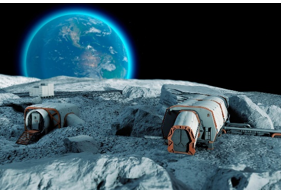
- Umbrella term for concrete produced on the Moon using local materials.
- Designed as building material for lunar habitats to shield from radiation and temperature extremes.
- Alternative to Earth-transported concrete, leveraging Moon’s resources for sustainability.
Why Lunarcrete is Needed
- Enables construction of protective structures for astronauts on lunar surface.
- Reduces high costs of shipping building materials from Earth to Moon.
- Supports long-term settlements in US-China race for lunar presence.
Challenges of Living on the Moon
- Hazardous radiation exposure without Earth’s atmosphere for shielding.
- Extreme temperature swings from -130°C to 120°C, risking equipment and health.
- Scarce water resources, limiting traditional construction methods.
- Fine, powdery lunar regolith poses handling and stability issues.
Key Raw Material: Lunar Regolith
- Grey, powdery soil covering Moon’s surface, used as aggregate in lunarcrete.
- Mimics sand and gravel but finer texture, as seen in Apollo 11 bootprint.
- Abundant on Moon, enabling in-situ resource utilization for building.
Major Challenges: Binder Without Water
- Traditional Portland cement requires lots of water for mixing and curing.
- Water is precious and limited on Moon, making standard methods impractical.
- Need alternatives to bind regolith without hydration to minimize resource use.
Methods of Making Lunarcrete
- Ship minimal cement from Earth, combine with regolith using little water inside sealed habitats.
- Melt sulfur, mix with regolith, cool into solid blocks; acts like cement but softens in heat.
- Heat regolith with microwaves or concentrated sunlight to partially melt and fuse grains into bricks.
Recent Scientific Findings (LSU Study)
- LSU researchers simulated dome-shaped habitat with lunarcrete walls for testing.
- Walls preserved internal temperature at 22°C during swings from -120°C to 130°C.
- Double-layer walls with empty space between excelled as insulators for lunar environments.
7. Policy for Auction of Coal Linkage for Seamless, Efficient & Transparent Utilisation (CoalSETU)
Context :The Union Cabinet has approved a new “CoalSETU” window under the existing Non-Regulated Sector (NRS) linkage policy, to auction long-term coal linkages for any industrial use and for export, with defined conditions.
- The move is part of ongoing coal sector reforms aimed at improving transparency in allocation, easing business operations and lowering dependence on imported coal.
What is CoalSETU?
- CoalSETU (Policy for Auction of Coal Linkage for Seamless, Efficient & Transparent Utilisation) is a new auction-based coal linkage mechanism within the NRS linkage framework.
- It allows any domestic industrial consumer to obtain long-term coal linkages for own use or export (up to a prescribed limit), while prohibiting resale within India.
Implementing ministry
- Nodal ministry: Ministry of Coal, Government of India.
- The policy supplements earlier reforms like commercial coal mining and changes in linkage policies.
Objectives of the policy
- Ensure efficient, transparent and seamless utilisation of India’s domestic coal reserves through auction-based allocation.
- Facilitate ease of doing business for industrial consumers and reduce dependence on imported coal.
- Enhance the supply and export potential of washed, cleaner coal.
Main design elements
- Creation of a separate CoalSETU window under the NRS linkage policy of 2016, in addition to existing NRS auctions for sectors such as cement, sponge iron, steel, aluminium and captive power.
- Existing specified end-use consumers can continue to participate in their dedicated NRS auctions and may also bid under the CoalSETU window.
Use and end-use conditions
- Coal obtained under CoalSETU can be used for own consumption, coal washing or export, subject to an upper cap (e.g., up to 50% of linkage quantity for export), but cannot be resold domestically.
- Coking coal is excluded from this window, and traders are barred from participation to prevent speculative hoarding and ensure genuine industrial usage.
Export and group flexibility
- Linkage holders are permitted to export a part of their allocated coal, including washed coal, in line with the specified percentage cap.
- Companies may flexibly allocate coal among their group entities, enabling better operational planning across plants and locations.
Impetus to washeries and cleaner coal
- By assuring coal linkages to washery operators, the policy encourages investments in coal washing infrastructure.
- This can increase availability of washed, cleaner coal domestically, reduce ash content and improve both domestic utilisation and export competitiveness.
Link with broader coal sector reforms
- CoalSETU aligns with the post-2020 reform that opened coal blocks for commercial mining without end-use restrictions, shifting towards a market-driven allocation regime.
- It further strengthens transparency, competition and resource efficiency in coal allocation, while supporting energy security.
Economic and industrial significance
- Transparent auction-based linkages widen access for small, medium and new industrial units that earlier struggled to secure assured coal supplies.
- Better availability of domestic and washed coal can lower import bills, reduce input costs for industry and support sustained industrial and export growth.
Conclusion
- CoalSETU represents a shift from restrictive, end-use–based coal allocation towards a more flexible, market-oriented and transparent system.
- For UPSC, the policy is relevant under topics like coal sector reforms, energy security, ease of doing business, industrial growth and resource efficiency.
rect?
(a) 1 and 2 only
(b) 2 and 3 only
(c) 1 and 3 only
(d) 1, 2 and 3
Answer: (a) 1 and 2 only.
- Statement 1 is correct: MH‑60R is a ship‑borne multi‑role helicopter whose primary missions include anti‑submarine warfare.
- Statement 2 is correct: the newly commissioned squadron INAS 335 is based at INS Hansa, Goa.
- Statement 3 is incorrect: MH‑60R is a US‑origin design (Sikorsky/Lockheed Martin), not an indigenous HAL product.
3.With reference to ‘Lunarcrete’, recently in the news, consider the following statements:
- It is a building material made using lunar regolith as the primary aggregate.
- A recent simulation by Louisiana State University researchers showed that double-layer lunarcrete walls with an empty space in between provide excellent thermal insulation for lunar habitats.
- Traditional Portland cement is ideally suited for lunarcrete production due to abundant water on the Moon.
Which of the statements given above is/are correct?
(a) 1 only
(b) 1 and 2 only
(c) 2 and 3 only
(d) 1, 2 and 3
Answer :B
Explanation
- Statement 1 is correct: Lunarcrete uses lunar regolith (Moon’s grey soil) as the main aggregate, similar to sand/gravel on Earth.
- Statement 2 is correct: LSU simulation tested dome-shaped habitat walls; double-layer design with empty space maintained stable 22°C internal temperature despite extreme swings.
- Statement 3 is incorrect: Portland cement requires abundant water for mixing/curing; water is scarce on Moon, making it unsuitable without alternatives.
4.With reference to the Nubian Ibex (Capra nubiana), recently highlighted in conservation reports, consider the following statements:
- It is classified as Vulnerable on the IUCN Red List due to a declining population of fewer than 10,000 mature individuals.
- The Nubian Ibex is adapted to arid desert mountains, with shiny tan coat for heat reflection and kidneys for water conservation.
- Compared to the Himalayan Ibex (Capra sibirica sakeen), the Nubian Ibex is larger in size with longer horns suited for cold alpine habitats.
Which of the statements given above is/are correct?
(a) 1 only
(b) 1 and 2 only
(c) 2 and 3 only
(d) 1, 2 and 3
Answer: (b) 1 and 2 only
Explanation
- Statement 1 is correct: IUCN lists it as Vulnerable with <10,000 mature individuals and declining trend.
- Statement 2 is correct: Desert adaptations include reflective coat, efficient kidneys, agile hooves for cliffs.
- Statement 3 is incorrect: Nubian is smaller (65-75 cm shoulder) with shorter horns; Himalayan is larger (80-100 cm) for cold high altitudes.
5.Under CoalSETU, which allocation mechanism best ensures transparent price discovery for non-regulated sectors purchasing coal linkage?
- Administrative allocation by ministry order
- Market-based e-auction with uniform rules
- First-come, first-served registration
- Bilateral negotiation between mines and buyers
Answer : B. Market-based e-auction with uniform rules.
Why option B is correct
CoalSETU has been designed explicitly as an auction-based, market-linked linkage mechanism for the Non-Regulated Sector (NRS), to ensure fairness, efficiency and transparency in coal allocation and pricing. A market-based e-auction with uniform rules allows discovery of coal prices through competitive bidding by all eligible buyers, which is considered the most transparent way to discover prices for such linkages.
Why other options are incorrect
- Administrative allocation by ministry order (A) reintroduces discretion and opacity, which CoalSETU is meant to remove by shifting to auctions.
- First-come, first-served registration (C) can lead to queue-jumping and does not reflect true demand–supply based pricing.
- Bilateral negotiation between mines and buyers (D) is inherently opaque and can lead to non-uniform pricing and favoritism, contrary to CoalSETU’s objective of seamless, efficient and transparent utilisation.