
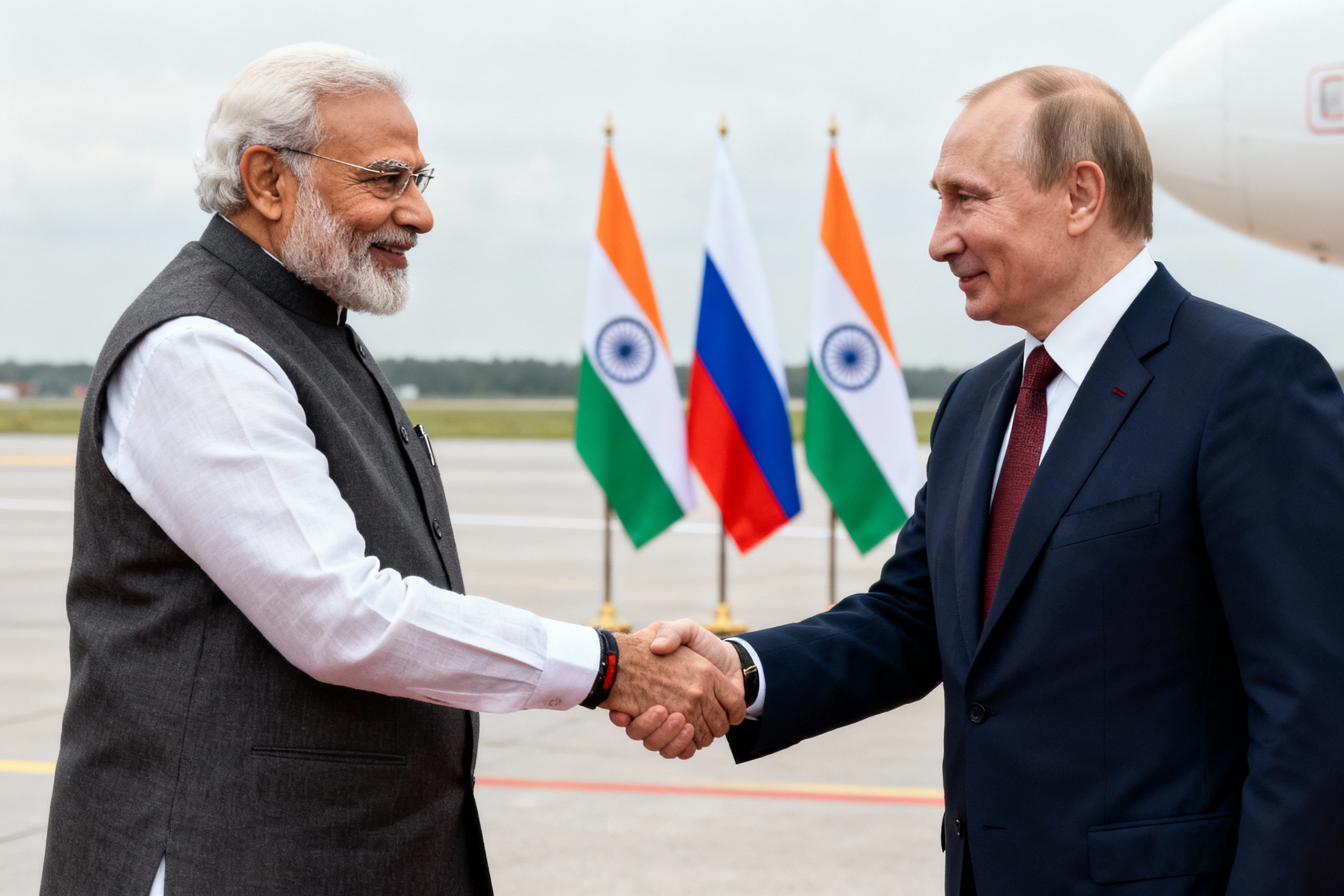
1. PM welcomes putin at airport in warm gesture,hails India -Russia Partnership
GS PAPER II-IR
CONTEXT :Russian President Vladimir Putin arrived in Delhi for a short but intensive official visit after a gap of four years.
- The visit occurs amid the Ukraine war, Western sanctions on Russia and scrutiny of India’s close ties with Moscow.
High‑level engagement & protocol
- PM Modi breaking usual protocol to receive Putin at Palam air base indicates exceptional warmth and priority status.
- A private dinner at 7 Lok Kalyan Marg before formal talks shows high political comfort and room for candid discussions.
- Full ceremonial reception at Rashtrapati Bhavan, wreath‑laying at Rajghat and state banquet elevate the visit to top‑tier state protocol.
23rd India‑Russia Annual Summit
- The Hyderabad House summit is the institutional anchor of the “Special and Privileged Strategic Partnership”.
- Agenda includes defence ties, energy, trade settlement, nuclear cooperation and regional issues including Ukraine and Indo‑Pacific.
Defence cooperation focus
- Russia remains one of India’s largest defence suppliers, accounting for around one‑third of recent imports.
- Talks likely cover S‑400 deliveries, possible fighter and submarine projects, spares, maintenance and joint production under Make in India.
- Both sides emphasise shifting from pure buyer‑seller to technology transfer, co‑development and local manufacturing.
Economic & energy dimensions
- Discussions aim to stabilise trade hit by sanctions, using national currencies and alternative payment systems.
- Oil, gas, fertilisers and nuclear energy (including small modular reactors) are key pillars for India’s energy security.
- Sberbank and Indian authorities explore expanding financial links, including routes for Russian investment in Indian markets.
Geo‑political significance
- Visit signals that India will preserve strategic autonomy and multi‑alignment despite Western pressure on Russia.
- For Moscow, Delhi optics demonstrate it is not diplomatically isolated and still has major partners in Asia.
- Strong India‑Russia ties help New Delhi balance China, retain leverage in Eurasia and maintain options in a fluid world order.
What this visit signals for ties
- Continuity: Partnership remains “time‑tested” and resilient, even as India diversifies with US, Europe and others.
- Adaptation: Shift towards joint manufacturing, high‑tech, connectivity and financial innovation to bypass sanctions constraints.
- High trust: Unusual protocol, direct leadership engagement and dense agenda show political trust remains strong at the top level.
2. Wildlife body BNHS to release 6 critically endangered vultures in Assam in 2026
GS PAPER III-ENVIRONMENT AND ECOLOGY
CONTEXT :BNHS plans to release six captive‑bred critically endangered vultures in Assam in Jan 2026.
- They are slender‑billed and white‑rumped vultures bred at BNHS Vulture Conservation Breeding Centre, Rani, Kamrup.
Why Kamrup and Biswanath districts?
- Sites fall within natural range of slender‑billed and white‑rumped vultures.
- Landscape lies close to Kaziranga NP, offering suitable grassland–wetland–riverine habitat.
- Area still has small wild vulture flocks, aiding social integration of released birds.
- Forest department and local community networks already engaged in vulture conservation.
Process before final release (soft release)
- Birds kept in large pre‑release aviaries at chosen sites for minimum about three months.
- This allows acclimatisation to local climate, food sources and topography.
- During this period they observe wild scavengers and learn to locate carcasses.
- Human contact is minimized to reduce tameness and promote natural behaviour.
- After aviary phase, doors are opened; supplementary food may be provided initially.
- Post‑release, birds are usually monitored using wing tags or telemetry where available.
Biology and life cycle of vultures (general Old‑World vultures)
- Large soaring raptors, specialised scavengers feeding mainly on carrion.
- Excellent eyesight; locate carcasses visually, often using thermal air currents.
- Social birds, often roost, feed and breed in colonies.
- Sexual maturity typically around 4–6 years of age.
- Nesting on cliffs or tall trees; usually 1 egg per breeding season.
- Both parents share incubation and chick‑rearing duties.
- Long‑lived species; some can survive 40–50+ years in the wild.
- Play key ecosystem role by rapidly disposing of carcasses and controlling disease spread.
Species being released (slender‑billed and white‑rumped)
- Slender‑billed vulture (Gyps tenuirostris):
- Critically Endangered; once widespread in Gangetic plains and Southeast Asia.
- Identified by long thin bill and largely pale plumage with dark flight feathers.
- Population crashed mainly due to diclofenac poisoning from livestock carcasses.
- White‑rumped vulture (Gyps bengalensis):
- Critically Endangered; historically the most abundant vulture in South Asia.
- Medium‑sized Gyps vulture with white rump patch and contrasting dark body.
- Suffered >90% decline due to veterinary diclofenac; also impacted by habitat loss.
Vultures in India – overall status and threats
- India has 9 vulture species; 3 are Critically Endangered (white‑rumped, slender‑billed, Indian vulture).
- Populations collapsed from tens of millions in 1980s–90s to small remnant numbers.
- Main threat was veterinary diclofenac; causes kidney failure when vultures eat treated carcasses.
- Other threats: other toxic NSAIDs, poisoning from carcasses laced to kill predators, power‑line collisions.
- Conservation response: ban on veterinary diclofenac, promotion of vulture‑safe drugs like meloxicam.
- Establishment of Vulture Safe Zones and captive‑breeding centres (like BNHS facilities).
- Release programmes aim to rebuild wild, self‑sustaining vulture populations in key landscapes.
Causes of vulture decline in India
- Widespread veterinary use of diclofenac in cattle; vultures died of kidney failure after eating treated carcasses.
- Later, other toxic NSAIDs (ketoprofen, aceclofenac, etc.) also posed similar risk.
- Loss of nesting trees and disturbance around colonies due to felling, development and traffic.
- Food scarcity where traditional carcass‑dumping practices changed or carcasses are buried/burnt.
- Electrocution and collisions with power lines and wind turbines in some areas.
- Poisoning from carcasses laced to kill feral dogs or carnivores.
BNHS and partners – key conservation efforts
- Captive breeding:
- BNHS set up Vulture Conservation Breeding Centres (e.g., Pinjore, Rani‑Kamrup, others) to breed Critically Endangered species.
- Hundreds of chicks reared in captivity as a safety population for future releases.
- Reintroduction and vulture‑safe zones:
- Soft‑release of captive‑bred birds in selected landscapes with safe food and reduced threats.
- Creation of large “vulture‑safe zones” (100–150 km radius) around colonies with strict NSAID control.
- Drug policy and advocacy:
- Scientific work helped prove link between diclofenac and vulture deaths.
- Supported government bans on veterinary diclofenac and promotion of meloxicam and other safe alternatives.
- Community and state partnerships:
- Working with state Forest Departments (e.g., Assam, Haryana, MP) for protection and monitoring.
- Village meetings to educate livestock owners, vets and carcass handlers on vulture‑safe drugs.
- Support for community‑run “Jatayu restaurants”/carcass‑dumps providing safe food.
- Research and monitoring:
- Tagging vultures with rings and transmitters to track movements and survival.
- Regular population surveys to assess recovery trends and effectiveness of bans.
3. India’s Climate Ambitions
GS paper III-ENVIRONMENT AND ECOLOGY
Context :India is preparing to submit its updated Nationally Determined Contributions (NDCs) for the 2035 target year, focusing on more ambitious emissions and renewable energy goals. Experts stress the need for a clear, economy-wide climate transition plan to meet global expectations and maintain India’s leadership credibility.
What Are Nationally Determined Contributions (NDCs)?
- Climate commitments each country sets under the Paris Agreement.
- India updates its targets every five years.
- Encompass emissions reduction, renewable capacity, adaptation measures, climate finance, and technology transfer.
India’s Current Climate Targets under NDCs
- Reduce carbon emissions intensity by 45% by 2030, compared to 2005.
- Ensure 50% of installed power capacity from non-fossil sources (solar, wind, hydro, nuclear, biomass) by 2030.
- Create an additional carbon sink of 2.5–3 billion tonnes CO₂ through afforestation.
- Promote sustainable lifestyles via the LIFE Movement.
- Boost climate adaptation strategies in vulnerable sectors like agriculture and water.
- Mobilize domestic and international climate finance and technology.
Recent Performance Highlights
- Achieved the 50% non-fossil power capacity target ahead of schedule (June 2025).
- Renewables supplied over half of daily electricity demand for the first time (July 2025).
- Emission intensity reduced by 36%, surpassing interim goals.
- India ranks globally among the top in renewable capacity.
- Rapid electrification of transport, especially railways and urban buses, aiding emission cuts.
Challenges Facing India’s Climate Goals
- Absolute emissions continue rising due to economic growth; peak emissions expected only by about 2035.
- Heavy reliance on coal complicates rapid emissions reduction without alternatives.
- Annual investment needs of approximately $62 billion stretch fiscal capacities.
- Technology gaps remain in long-duration storage, green hydrogen, and carbon capture.
- Global climate finance commitments lag, increasing India’s self-reliance burden.
- Transitioning coal-dependent states requires socio-economic adjustments.
- Adaptation efforts lag behind rising climate risks such as heatwaves and extreme weather.
Strategic Steps Ahead for India
- Officially announce an emissions peak around 2035 to strengthen credibility.
- Aim for 80% non-fossil power capacity by 2035 with expanded solar, wind, and storage.
- Phase out new unabated coal plants from 2030 and retire aging coal units progressively.
- Accelerate the electrification of transport modes to reduce oil imports and urban pollution.
- Enhance the carbon credit trading scheme with stricter rules and broader coverage.
- Reform electricity pricing to support renewable integration and grid flexibility.
- Re-establish the Prime Minister’s Council on Climate Change for better federal coordination.
4. A day to pause and come down to earth
GS Paper III :Environment & Ecology
Context :Observed every year on 5 December, led by FAO/UN, to raise awareness on soil’s importance for life.
- It focuses each year on a specific theme to promote sustainable soil management and policy action.
Theme 2025: “Healthy Soils for Healthy Cities”
- Shifts attention from rural farmlands to urban landscapes and city ecosystems.
- Emphasises that beneath concrete lies living soil crucial for food, water, climate resilience and wellbeing.
Why urban soil matters?
- Acts as a “natural air‑conditioner”, moderating urban heat and reducing “heat island” effects.
- Functions like a sponge, absorbing rainwater, reducing floods and recharging groundwater.
- Supports urban biodiversity and food systems, including trees, parks, community and rooftop gardens.
- Enhances mental and physical health by enabling green spaces that reduce stress and encourage activity.
Threats to urban soil
- Sealing by concrete and asphalt blocks air–water flow, suffocating soil life.
- Pollution from construction debris, industrial waste and vehicle emissions contaminates soil.
- Loss of organic matter and compaction weaken soil structure and plant growth.
- Excessive chemical fertilisers and pesticides degrade soil biology and water quality.
Blueprint for healthy urban soil
- Restore and protect urban soils through organic amendments, reduced sealing and rehabilitation of degraded land.
- Replace hard surfaces with soil‑based green infrastructure such as parks, rain gardens and tree belts.
- Promote urban agriculture via community and backyard gardens, even container gardening on balconies.
- Adopt eco‑friendly soil management: fewer chemicals, more mulching, conservation tillage, native plants.
- Improve soil literacy: school activities, citizen science, composting of kitchen waste into urban compost.
Core message: healthy cities need healthy soil
- Resilient cities depend not just on steel and concrete but on living, breathing soil systems.
- Caring for urban soil improves climate resilience, food security, water management and public health together.
- Urban policy, planning and citizen behaviour must treat soil as critical infrastructure, not an expendable substrate.
5. Academics protest against Bill to revamp Indian Statistical Institute
GS paper II-POLITY
Context :Draft Indian Statistical Institute Bill 2025 proposes repealing 1959 Act, sparking protests in Kolkata.
- Over 1,500 academics and global petition with 1,800 signatures oppose the changes.
- Protests by students, faculty, staff since September 2025 over governance overhaul.
Background
- ISI founded in 1931 as statistical lab at Presidency College, Kolkata, for advancing statistics.
- Declared Institution of National Importance in 1959 via Parliamentary Act for research and training.
- Headquarters in Kolkata; centres in Delhi, Bengaluru, Chennai, Tezpur; focuses on stats, math, economics.
Origin of ISI
- Founded December 17, 1931, by Prof. P.C. Mahalanobis with economists and mathematicians.
- Registered April 28, 1932, as non-profit society under Societies Registration Act 1860.
- Evolved from Mahalanobis’s 1920s lab to promote theoretical/applied statistics in India.
ISI Act 1959 Purpose
- Grant ISI status as Institution of National Importance for national grants and degree powers.
- Enable statistical research, training, and applications in planning, agriculture, economics.
- Retain autonomous society structure under West Bengal Societies Act for internal governance.
Salient Features of ISI Act 1959
- Establishes 33-member Council as highest body with elected members, govt reps, UGC nominee.
- Director appointed by Council; ensures academic/admin autonomy in appointments, operations.
- Authorizes degrees/diplomas in stats, math; publishes Sankhya journal; zero tuition fees.
Why Academics Protesting the Repeal
- Bill strips autonomy by empowering BoG (govt-dominated) to override Academic Council decisions.
- Converts autonomous society to statutory body under full Union control, eroding federal balance.
- No consultation with stakeholders; ignores review committees’ amendment suggestions.
6. Mahad Satyagraha
GS PAPER I-Indian history
CONTEXT :98th anniversary of Mahad Satyagraha observed on Dec 6, 2025 amid Ambedkar death anniversary events.
- The Hindu article highlights its role in shaping India’s constitutional morality against caste.
Background
- Mahad town in pre-independence Bombay Province was centre of caste discrimination.
- 1923 municipal resolution allowed Dalits water access, later revoked under upper-caste pressure.
- Dr. Ambedkar led first mass protest in 1927 for public tank rights.
What is Mahad Satyagraha
- Non-violent civil disobedience on 19-20 March 1927 at Chavdar Tank, Mahad.
- ~3,000 Dalits led by Ambedkar drank water, asserting human right to public resources.
- Second phase (Dec 1927): Manusmriti burnt, demanding gender equality and social justice.
How the Mahad Satyagraha(s) Shaped Constitutional Discourse
- United depressed classes, laid foundation for anti-untouchability laws.
- Influenced Article 17 (abolition of untouchability) and equality provisions in Constitution.
- Promoted women’s rights, inheritance equality, and rejection of caste-based texts.
- Established constitutional remedies over religious sanctions for social reform.
7. DRDO conducted a high‑speed rocket‑sled test of a fighter aircraft escape
GS PAPER III-SCIENCE AND TECHNOLOGY
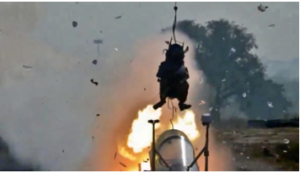
CONTEXT :DRDO conducted a high‑speed rocket‑sled test of a fighter aircraft escape system at ~800 km/h.
- The trial validated critical safety functions and was hailed by the Defence Minister as a major self‑reliance milestone.
What was tested?
- A full fighter aircraft escape system mounted on a rocket‑propelled sled.
- Dynamic performance of canopy‑cutting, ejection seat, and pilot‑recovery mechanisms under high speed.
What is an aircraft escape system?
- An integrated safety system that allows a pilot to exit a disabled aircraft in an emergency.
- It includes the ejection seat, canopy severance device, restraint systems, survival pack and parachute.
Ejection system – key elements
- Explosive/rocket charges that propel the ejection seat (with pilot) clear of the aircraft.
- Timers and sensors that control seat trajectory, separation, and parachute deployment.
- Life‑support and survival gear to keep the aircrew safe till ground or water recovery.
What did this test validate?
- Canopy severance: Ability to fracture and clear the cockpit canopy fast without injuring the pilot.
- Ejection sequencing: Correct order and timing of canopy break, seat firing, and separation events.
- Complete aircrew recovery: Safe trajectory and simulated landing of an instrumented dummy “pilot”.
What is the Rail Track Rocket Sled facility?
- A long ground track where test articles are mounted on sleds driven by rocket motors.
- Allows replication of high flight speeds and loads while keeping tests observable and instrumented.
- Used to test escape systems, missiles, warhead effects and other dynamic events safely on ground.
Significance for India
- Demonstrates indigenous capability to design and dynamically test advanced ejection systems.
- Enhances pilot safety for current and future fighters (LCA Mk‑1/2, AMCA, trainers, etc.).
- Reduces dependence on foreign escape‑system vendors and associated testing infrastructure.
- Strengthens India’s position as a defence technology developer and supports export potential of combat aircraft.
8. PM-WANI Scheme
Context :Government informed Lok Sabha that 3.91 lakh+ PM‑WANI Wi‑Fi hotspots are active across India as of 26 November 2025, with Delhi and Uttar Pradesh having the highest numbers.
Scheme overview
- Nature of scheme: National public Wi‑Fi framework to provide cheap broadband via decentralised hotspots run by small entrepreneurs.
- Nodal ministry: Department of Telecommunications (DoT), Ministry of Communications.
- Launch approval: Cleared by Union Cabinet on 9 December 2020.
- Core objective: Democratise internet access and advance NDCP‑2018 goals of universal, affordable broadband.
Institutional design
Key stakeholders and roles
- Public Data Offices (PDOs): Local shops or establishments that actually run Wi‑Fi hotspots and sell access to users.
- Public Data Office Aggregators (PDOAs): Back‑end entities providing authentication, accounting and support to many PDOs.
- App Providers: Develop apps through which users discover PM‑WANI hotspots and authenticate or pay.
- Central Registry (managed by C‑DoT): Maintains records of PDOs, PDOAs and App Providers for interoperability and oversight.
Liberal regulatory framework
- No licence or fee: Anyone can become a PDO without telecom licence, spectrum charges or complex compliance.
- Use of FTTH connections: PDOs may backhaul their hotspot using ordinary FTTH broadband plans, lowering entry cost.
- Roaming across PDOAs: Users can move between hotspots of different PDOAs with seamless authentication like roaming.
- Mobile data offload: Telecom operators may route part of cellular traffic to PM‑WANI Wi‑Fi to decongest mobile networks.
Tariff and consumer protection measures
- TRAI tariff cap: FTTH plans up to 200 Mbps must be sold to PDOs at not more than twice the corresponding retail price.
- Consent‑based promotions: Any advertising or promotional content by apps/PDOAs requires explicit user consent.
Developmental significance
Digital inclusion and local economy
- Bridging digital divide: Public hotspots extend internet access to rural areas, small towns and low‑income urban settlements.
- Micro‑entrepreneurship: Creates lakhs of small Wi‑Fi businesses at kirana shops, CSCs, eateries and transport hubs.
Governance and services
- Boost to digital services: Enables digital payments, online education, telemedicine, e‑governance and e‑commerce in underserved areas.
- Support to NDCP‑2018 vision: Contributes to targets of high‑speed broadband for all citizens and key institutions.