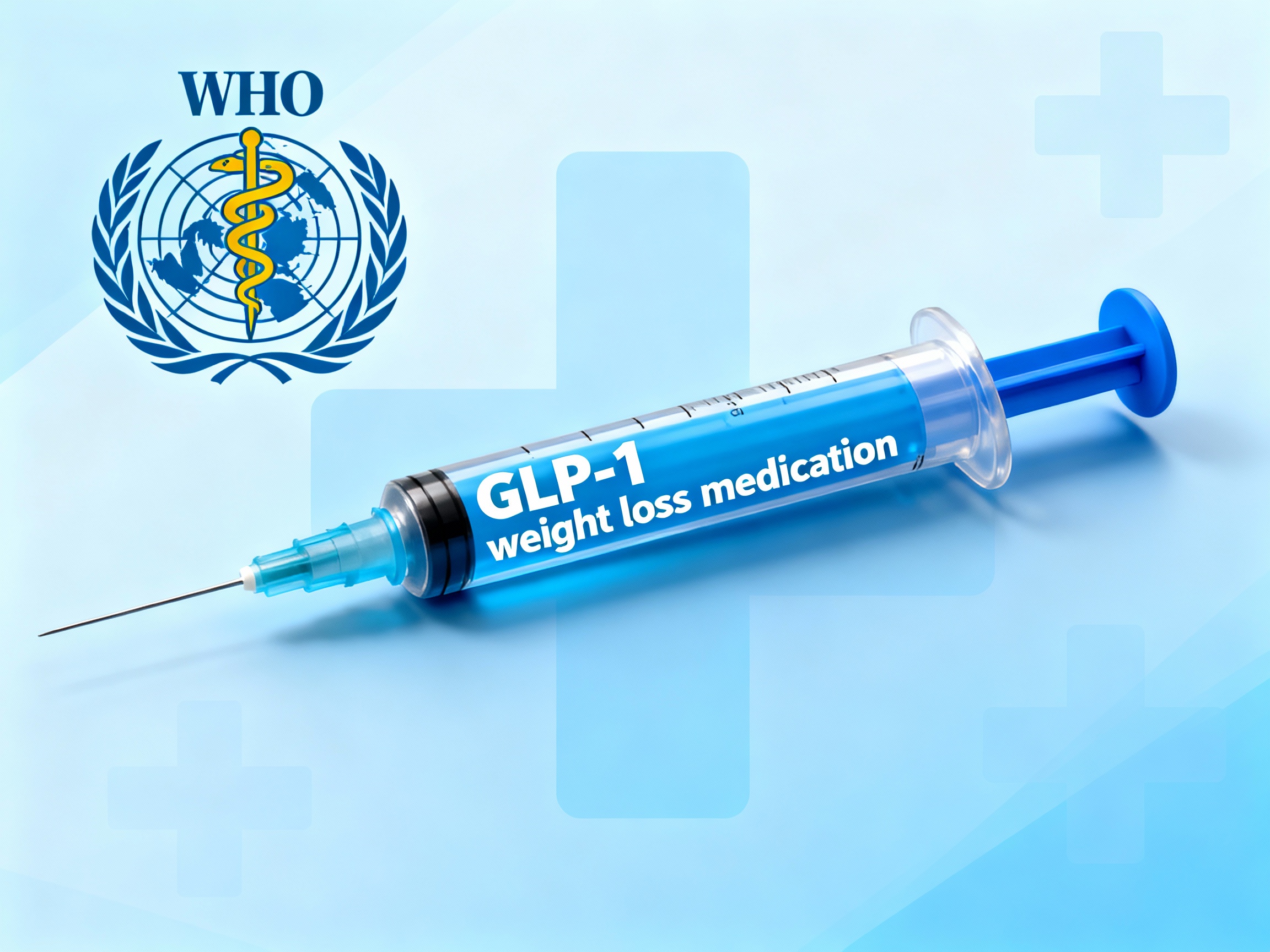
1. WHO backs use of GLP-1 drugs for weight loss
GS II (Governance & Social Justice): Issues relating to health, nutrition and human resources; health sector schemes and policies; role of international organisations (WHO) in health governance.
Context :First-ever global WHO guideline on GLP‑1 use for obesity, released end‑November 2025.
- Comes amid rapid worldwide uptake of GLP‑1 drugs and concern about high costs and unequal access.
WHO: key evidence behind guideline
- Trials show GLP‑1 drugs achieve clinically meaningful, sustained weight loss versus placebo or lifestyle alone.
- Evidence demonstrates improvements in HbA1c, blood pressure, lipids and other cardiometabolic risk markers.
- Some agents show reduced risk of major cardiovascular events in high‑risk patients with obesity or diabetes.
- Behavioural programmes plus GLP‑1 give slightly greater weight loss and metabolic benefits than drugs alone.
Main safety and long‑term data gaps
- Limited data beyond a few years on durability of weight loss and cardiometabolic benefits.
- Uncertain effects of long‑term continuous exposure on pancreas, gallbladder, kidneys and thyroid.
- Insufficient evidence on outcomes after stopping drugs, including weight regain and psychological effects.
- Sparse data in specific groups: older adults, adolescents, pregnancy, severe mental illness, multiple comorbidities.
- Real‑world safety signals (e.g., rare pancreatitis, bowel obstruction, suicidal ideation) need better quantification.
How GLP‑1 use could evolve (policy and practice)
- Countries may prioritize GLP‑1s for adults with high BMI plus serious comorbidities, not for cosmetic weight loss.
- Health systems will need obesity clinics, monitoring protocols and training for safe, long‑term GLP‑1 use.
- Governments could negotiate prices, encourage generic/biosimilar production and use pooled procurement.
- Insurers may cover GLP‑1 only when combined with structured diet‑exercise programmes and follow‑up.
- Stronger population policies (taxes on unhealthy foods, marketing curbs, urban design for activity) must run in parallel.
- Equity lens: ensure availability in public sector and LMICs so benefits are not confined to wealthy populations.
2. Military presence in Lakshadweep to increase with new naval detachment
GS Paper II & III : India’s security challenges and their management in border areas; role of armed forces in coastal and island security.
Context :Navy setting up a new naval detachment at Bitra Island, to be fully operational next year.
- IAF expanding Agatti airstrip, planning a new air base at Minicoy and inducting cargo/armed drones for Lakshadweep operations.
Strategic importance of Lakshadweep
- Western gateway: Island chain lies off Kerala coast, astride approaches from Persian Gulf and Red Sea to western coast of India.
- Sea‑lane monitoring: Near the Nine‑Degree Channel, through which major West Asia–East Asia and Europe–Asia shipping traffic passes.
- Anti‑piracy and maritime security: Ideal vantage for surveillance of Arabian Sea piracy, smuggling and hostile naval movement.
New naval detachment at Bitra
- Location: Bitra is a tiny coral island in northern Lakshadweep, close to busy shipping routes in the Arabian Sea.
- What is being built: A naval detachment with infrastructure, weapon systems and personnel to extend sea‑air surveillance and response.
Indian Air Force expansion
- Agatti airstrip: Runway and facilities being expanded to handle larger aircraft and sustained military logistics.
- New air base at Minicoy: Government has cleared a new airport/air base on Minicoy to project air power and support naval ops.
- Future drones: IAF planning 500‑kg cargo drones from mainland to Lakshadweep, capable of logistics and potential weapon carriage.
Environmental concerns
- Lakshadweep is a fragile coral ecosystem; expansion risks reef damage, coastal erosion and stress on limited land and freshwater.
- Navy has publicly said development will be “measured” to avoid upsetting the ecosystem, implying need for strict environmental safeguards.
Why India is doing this now
- Rising Chinese naval presence and “extra‑regional” interest in Indian Ocean sea‑lanes heighten India’s security concerns.
- Increased commercial shipping and renewed Arabian Sea piracy attempts demand stronger surveillance and quick‑reaction capability.
- Upgraded Lakshadweep bases, airfields and drones together deepen India’s ability to dominate the western Indian Ocean approaches.
3. Uranium Contamination in Delhi
GS Paper 1 –Geography : Groundwater resources, aquifer systems, water scarcity, water pollution trends in India.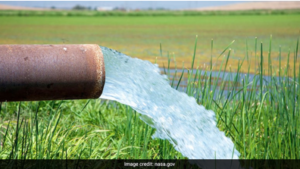
Context :New CGWB tests in Delhi show uranium levels rising in groundwater, with about 13–15% samples above safe limits.
- This raises health concerns for residents dependent on borewells and highlights gaps in urban groundwater management.
What is uranium contamination?
- Presence of naturally radioactive metal uranium in groundwater above the permissible limit for drinking use.
- Safe limit: 30 micrograms per litre (µg/L) or 0.03 milligrams per litre (mg/L), as per WHO and BIS standards.
Causes of rising uranium in Delhi groundwater
- Overuse of phosphate fertilisers that contain trace uranium, which leaches down to aquifers over time.
- Industrial and urban effluents carrying uranium and other heavy metals into subsurface water.
- Natural leaching from uranium‑bearing rocks, intensified by deep and excessive groundwater extraction.
Health impacts
- Chronic ingestion can damage kidneys and impair renal function over time.
- Higher risk of kidney and urinary tract cancers with long‑term exposure.
- Uranium deposition in bone may affect bone strength and long‑term skeletal health.
Environmental implications
- Persistent contamination lowers aquifer quality and reduces usable freshwater reserves.
- Often co‑exists with nitrate and fluoride, creating multiple‑pollutant stress on groundwater systems.
Policy and governance relevance
- Points to need for source control (fertiliser, industrial effluent) and strict groundwater regulation.
- Calls for expanded monitoring, public disclosure of water‑quality data and provision of safe alternative sources.
4. Jal Jeevan mission projects
GS II: Government policies and interventions in social sector; issues relating to health, drinking water and service delivery.
Context :Centre informed Parliament that nearly 17,000 complaints were received on JJM works across States/UTs.
- About 84% of these complaints came from Uttar Pradesh, mainly on irregularities and poor‑quality work.
Institutional framework of JJM
- Nodal ministry: Ministry of Jal Shakti, Department of Drinking Water and Sanitation.
- Implementation: States via State Water & Sanitation Missions, DWSMs, and Gram Panchayats/VWSCs.
- Funds: Shared between Centre and States; convergence with other rural schemes allowed.
Background – key findings from reply
- Total complaints reported from 32 States/UTs regarding JJM projects.
- Sources included media reports, suo‑motu cognizance, citizen grievances, vigilance inputs.
- Action initiated against officials, contractors and third‑party inspection agencies.
Uttar Pradesh – highest complaints
- UP accounted for roughly four‑fifths of total JJM complaints nationwide.
- Allegations centred on financial irregularities and sub‑standard construction of water works.
- State reported that enquiries were initiated in almost all registered complaints.
Action taken (overall and in UP)
- Disciplinary action against hundreds of departmental officials at various levels.
- Blacklisting/penal action against many contractors and several third‑party inspection agencies.
- In UP, enquiries completed in most cases with departmental and contractual penalties imposed.
Types of complaints
- Poor work quality: leaking pipelines, non‑functional taps, incomplete schemes.
- Financial irregularities: over‑billing, ghost assets, collusion in contracts.
- Service delivery issues: irregular water supply, low pressure, unsafe or contaminated water.
Detailed situation in Uttar Pradesh
- Large state with massive JJM rollout, leading to high volume of contracts and worksites.
- Many complaints came through multiple channels – public representatives, citizens, vigilance.
- State claims most complaints have been probed; some found valid, others closed as not proved.
Situation in other States
- After UP, Assam and Tripura reported the next highest number of complaints.
- Several other States/UTs reported relatively small complaint numbers.
- Action included warnings, recovery of funds, termination of poor‑performing contractors.
Why are complaints so high?
- Scale and speed: very rapid expansion of rural tap connections can overstretch supervision.
- Weak local capacity: technical and financial monitoring at district/village level often inadequate.
- Incentive issues: pressure to show connection numbers may lead to compromised quality.
- Rising awareness: citizens increasingly report defects as expectations from JJM grow.
What is Jal Jeevan Mission?
- Flagship programme launched in 2019 to provide Functional Household Tap Connection (FHTC) to all rural households.
- Focus on “Har Ghar Jal” with adequate, regular, safe drinking water supply.
- Time‑bound mission with significant central funding and state participation.
Why JJM matters ?
- Addresses rural drinking‑water scarcity and women’s drudgery in water collection.
- Critical for health, reducing water‑borne diseases and improving nutrition outcomes.
- Supports SDG‑6 (clean water and sanitation) and overall rural development.
Key features of JJM
Village‑level planning
- Each village prepares a Village Action Plan (VAP) covering water sources, supply systems and O&M.
- Plans are integrated with district and state water‑supply strategies.
Community participation
- Gram Panchayat/ Village Water and Sanitation Committee (VWSC) leads planning and implementation.
- Users involved in selecting schemes, supervising works, and deciding user charges.
- Emphasis on community ownership for long‑term sustainability and O&M.
Water‑quality monitoring
- Provision for village‑level testing kits and training of local women volunteers.
- Setting up and strengthening of district/sub‑divisional water‑quality laboratories.
- Protocols for periodic surveillance, reporting contamination and taking corrective action.
Overall significance of the complaints
- High complaint numbers indicate serious implementation gaps but also active grievance reporting.
- Effective follow‑up can improve accountability, enhance community trust and strengthen JJM outcomes.
5. A template for security cooperation in the Indian ocean
GS Paper-2 : International Relations:
Context :India hosted the 7th NSA-level CSC summit on November 20, 2025, in New Delhi, marking Seychelles’ full membership.
- Summit highlighted deepening regional ties amid evolving Indian Ocean threats like terrorism and trafficking.
What is Colombo Security Conclave?
- CSC is a regional security forum of Indian Ocean littoral states focused on maritime cooperation and countering transnational threats.
- Members include India, Sri Lanka, Maldives, Mauritius, Bangladesh, and now Seychelles; operates via NSA-level meetings.
Origin & Evolution
- Originated in 2011 as Trilateral Maritime Security Dialogue among India, Sri Lanka, and Maldives for joint patrols and info-sharing.
- Paused post-2014 due to political transitions; revived in 2020 with expanded agenda on counter-terrorism and HADR.
- Evolved in 2022 with Mauritius joining; Bangladesh in 2024; Seychelles as full member in 2025, broadening to six states.
Why the 2025 Summit Important?
- Comes at pivotal moment for India amid shifting Indo-Pacific dynamics, reinforcing CSC as key bilateral-multilateral bridge.
- Seychelles’ accession signals deep commitment to expanding forum, countering fragmentation in regional security.
- Addresses urgent needs like maritime stability, vital for India’s SAGAR vision and neighborhood outreach.
Why is the Indian Ocean Security Architecture Fragmented?
- Lacks singular institutional framework; multiple overlapping groups like IORA and QUAD create silos and minimal actor synergy.
- State-centric, exclusive approaches prioritize bilateral ties over inclusive regional mechanisms, hindering cohesive responses.
Why Maritime Security-Development for IOR Countries?
- Security challenges like piracy and trafficking directly impact economic progress, livelihoods, and sea-borne trade globalization.
- Littoral states’ development priorities intertwined with maritime domain stability, enabling sustainable blue economies.
Key Outcomes of the 2025 CSC Summit
- Strengthened commitments to maritime safety, counter-terrorism, and anti-trafficking via enhanced info-sharing and joint exercises.
- Formalized Seychelles’ full membership and explored Malaysia’s observer role, expanding group’s footprint.
- Endorsed NSA-level institutional structure for policy alignment and actionable cooperation pathways.
Major Challenges Ahead
- Navigating China’s growing presence in IOR without alienating CSC members reliant on Beijing for development aid.
- Balancing agenda expansion on non-traditional threats like cyber while maintaining focus on core maritime issues.
- Building synergies with broader forums like BIMSTEC to avoid duplication and foster inclusive growth.
Overall Significance
- Acts as “region’s 911” for rapid crisis response, institutionalizing cooperation on shared IOR threats.
- Bolsters India’s leadership in neighborhood security, promoting stability vital for 25% of global trade routes.
6. Privacy in a fishbowl society
GS‑II (Fundamental Rights, governance, vulnerable sections, women’s safety) and GS‑III (science‑tech, cyber security).
Context :Debate on India’s “big data–AI” future, new 2025 data‑protection rules and concern over non‑consensual intimate images (NCII).
- Articles warn that India risks becoming a “fishbowl society” with pervasive surveillance and weak social preparedness.
Big data and “fishbowl society”
- Big data = massive, continuously collected digital traces (location, biometrics, browsing, CCTV, Aadhaar‑linked data).
- Fishbowl society = citizens live under constant visibility; everything can be observed, tracked, profiled in real time.
India’s privacy framework
- Constitutional backing: Right to privacy recognised as a fundamental right (Puttaswamy judgment).
- Statutory layer: Digital Personal Data Protection (DPDP) Act, 2023 and DPDP Rules, 2025 for digital personal data.
- Sectoral rules: RBI, TRAI, IRDAI, IT Rules, CERT‑In directions, etc., for specific industries and cyber incidents.
Privacy challenges in the age of AI
- AI thrives on huge datasets; pushes constant data collection, profiling and predictive analytics.
- Opaque algorithms make it hard to know how decisions are taken or to challenge them.
- Facial recognition, voice recognition and gait analysis expand surveillance beyond traditional IDs.
- Data brokers and ad‑tech ecosystems can re‑identify “anonymised” data and create detailed dossiers.
Why NCII is a major issue in India
- Easy creation and circulation of intimate photos/videos via smartphones and cheap data.
- Deepfakes make it possible to fabricate explicit content without the victim’s participation.
- Social stigma, victim‑blaming and slow police response discourage reporting, especially for women.
- Once online, content spreads across platforms, causing repeated trauma and extortion.
Government response – 2025 NCII SOP
- New Standard Operating Procedure (SOP) issued for swift removal of NCII from social media and websites.
- Lays down steps for prompt reporting, platform takedown and law‑enforcement coordination.
- Seeks to make “first response” victim‑centric: speed, confidentiality and minimal re‑victimisation.
Major limitations highlighted
- SOP is administrative; rights and remedies still depend on scattered laws (IT Act, IPC/BNS, DPDP).
- Focuses on takedown, but weaker on long‑term support like counselling, compensation, witness protection.
- Implementation gaps: low awareness in police, victims and platforms; uneven capacity across States.
- Does not fully address cross‑border hosting, encrypted apps and small porn/mirror sites.
Larger problems – laws exist, society unprepared
- Legal framework is improving, but digital literacy about consent, privacy and NCII remains low.
- Families, schools and workplaces often react with moral judgment instead of support.
- Victims fear honour‑based violence or social ostracism, so they stay silent despite formal remedies.
- Power asymmetries (gender, caste, class) make misuse of private images a tool of control and harassment.
7. International IDEA – 30 years of supporting Democracy Worldwide
Context :India will chair the governing Council of International IDEA for the coming year.
- The CEC’s role will involve steering the body’s agenda on electoral integrity and democracy support.
Nature of International IDEA
- Intergovernmental organisation focused solely on supporting and deepening democracy worldwide.
- Established in 1995, with headquarters in Stockholm, Sweden.
Membership and status
- Began with 14 founding states including India, Spain, Norway, Australia and South Africa.
- Now has around 35 member states; United States and Japan participate as observers.
- Holds observer status at the UN General Assembly since 2003.
Aims and objectives
- Promote sustainable democracy as a universal aspiration and enabler of development.
- Safeguard democratic norms such as rule of law, participation, inclusion and accountability.
Key functions
Knowledge and research
- Produces comparative studies on elections, political parties, constitutions and governance.
- Develops global indices and tools to assess quality of democracy and electoral processes.
Capacity‑building support
- Trains Election Management Bodies, legislatures, parties and civil society actors.
- Helps countries design and implement reforms in electoral laws and democratic institutions.
Advocacy and norm‑setting
- Promotes international standards on electoral integrity, political finance and inclusion.
- Contributes to global debates on democracy, digital technologies and disinformation.
Dialogue and convening
- Organises forums and dialogues among policymakers, EMBs, academics and NGOs.
- Provides platforms for South–South and triangular cooperation on democratic practices.
Technical assistance
- Advises on constitution‑making, electoral system design and conflict‑sensitive transitions.
- Supports resilience of democracies facing backsliding, fragility or post‑conflict challenges.
Significance and India’s role
- Only global intergovernmental body with democracy promotion as its exclusive mandate.
- Its model links research, training and advocacy to concrete institutional reforms.
- India’s chairship showcases its experience in managing elections for over 90 crore voters and strengthens its soft‑power leadership on democratic governance.