
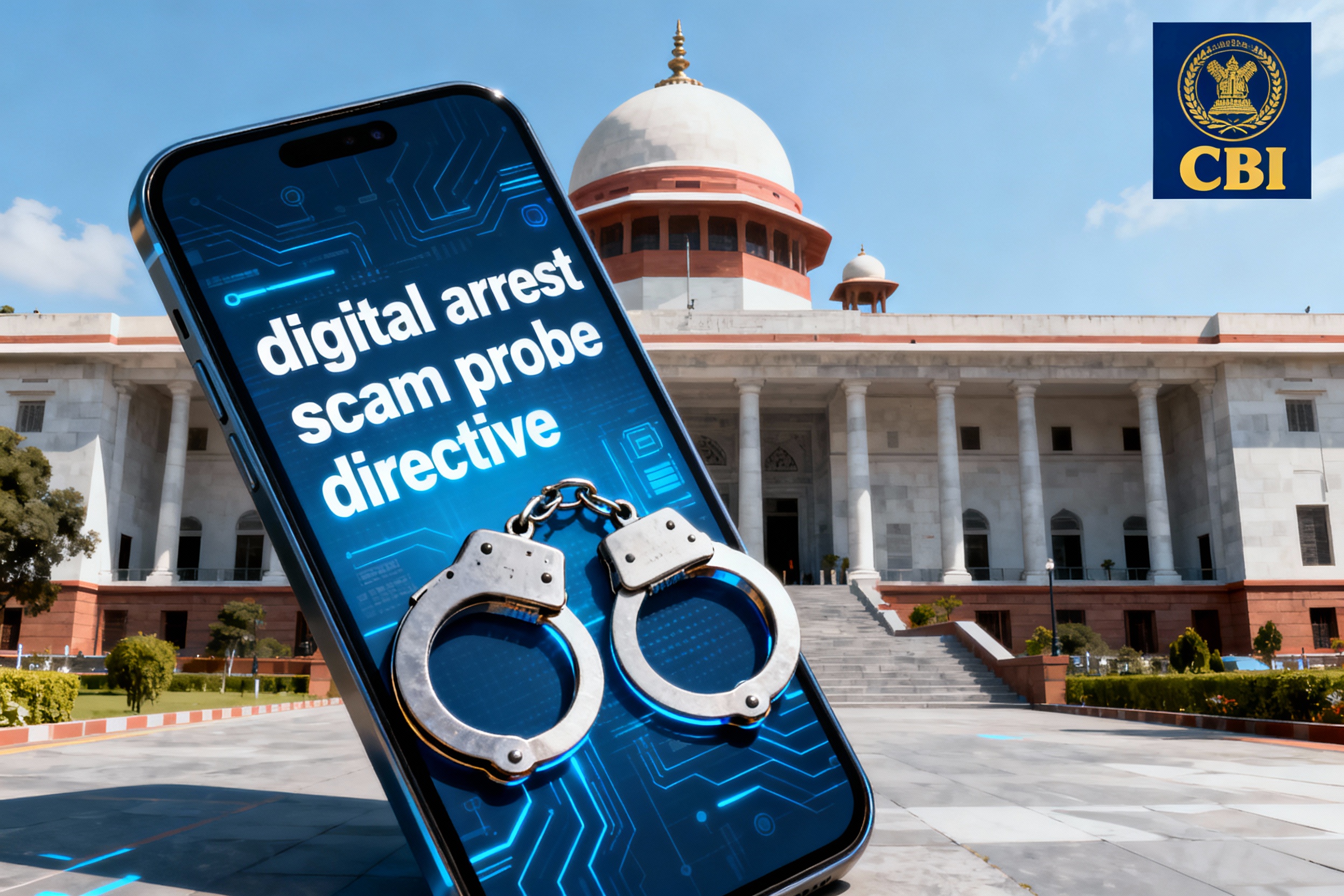
1. SC tasks CBI to tackle Digital arrests
GS Paper III – Internal Security;
Context :SC took suo motu cognisance of rising cyber frauds after cases where elderly citizens were extorted through fake “digital arrests”.
- Data placed before the Court showed victims, mainly senior citizens, have already lost over ₹3,000 crore in such scams, raising grave concern for public faith in law‑enforcement and the justice system.
What are digital arrests?
- A “digital arrest” is a cyber‑crime where fraudsters impersonate police, CBI, ED, courts, RBI or other authorities via phone or video calls, claiming the victim is accused in serious offences like drugs or money‑laundering.
- Victims are kept on continuous video calls, threatened with jail or social disgrace, and coerced to transfer money to specified bank/wallet accounts as alleged “verification”, “security deposit” or “penalty”.
Three categories of cyber scams identified by SC
Digital arrest scams
- Victims are made to believe that government or law‑enforcement authorities are entitled to seize their money and are forced to pay under threat of arrest, FIR or property attachment.
- SC classified this as coercive extortion using forged court orders and official seals, and directed that it be treated as a top‑priority category for investigation.
Investment scams
- Fraudsters offer high‑return investment schemes through apps, social media, or messaging groups, projecting fake profits to lure deposits.
- Once large sums are collected in mule accounts, the platform or group is shut down and investors are left without recourse or trace of operators.
Part‑time job scams
- Victims are promised easy online “part‑time jobs” like liking videos or writing reviews and receive small initial payments to build credibility.
- Later they are asked to pay “advance”, “upgrade” or “service” charges for higher tasks, after which communication stops and the victims lose their money.
Why the Supreme Court stepped in ?
- The Court found that such scams are operating pan‑India and from foreign “scam hubs” like Myanmar and Cambodia, beyond the capacity of isolated state police investigations.
- It held that these frauds undermine trust in the judiciary and financial system, particularly harming senior citizens, and therefore require centralised investigation plus systemic reforms.
Supreme Court directions – key points
CBI gets a “free hand”
- CBI has been ordered to conduct a nationwide probe, beginning with digital arrest cases and later covering investment and part‑time job scams.
- The agency can examine the role of bankers and public servants under the Prevention of Corruption Act, freeze accounts, trace layering of funds and seek Interpol help where needed.
States must grant consent
- All States and UTs must give general consent under the Delhi Special Police Establishment Act for CBI to investigate these cyber‑fraud cases in their territories.
- State police have to share data, appoint nodal officers and fully cooperate so that investigations are seamless and not blocked by jurisdictional objections.
International coordination & RBI’s role
- CBI has been asked to coordinate with Interpol and foreign agencies to identify and act against overseas cybercrime hubs running these call‑centre scams.
- RBI has been issued notice to assist with AI/ML‑based tools to flag mule accounts, enable quick freezing of suspicious accounts and tighten KYC and monitoring norms in banks and payment systems.
Online intermediaries must cooperate
- Online intermediaries under the 2021 IT Rules—social media, messaging apps, digital platforms—must cooperate with CBI in investigations.
- They are required to promptly provide lawful access to relevant data, logs and content so that fake profiles, channels and scam networks can be tracked and blocked quickly.
Strengthening cyber infrastructure & coordination
- Investigations are to be linked with the Indian Cybercrime Coordination Centre (I4C) and regional cyber coordination centres for shared databases and analytics.
- The Court stressed the need for specialised cyber experts, stronger digital forensics and integrated complaint‑handling platforms to systematically counter evolving cyber scams.
2. Centre moves Bills to raise pan masala cess ,increase excise duties on tobacco products
GS‑III: Indian Economy
Context :The Union government has introduced two Bills in Parliament to:
-
- Replace the existing GST Compensation Cess on tobacco products.
- Raise central excise duty on tobacco and introduce a new cess linked to pan masala manufacturing equipment to mobilise resources for health and national security.
Why this was needed – GST Compensation Cess
- What was GST Compensation Cess?
- A temporary cess (2017–2022) on “sin and luxury” goods like tobacco, coal, aerated drinks, etc. meant to compensate States for GST‑related revenue loss for five years.
- Why change now?
- The five‑year compensation period is over; proceeds from the cess are now mainly used to repay loans taken during COVID‑19 to compensate States.
- As the compensation regime winds down, the Centre needs a new, more permanent revenue mechanism on tobacco and pan masala to:
- Maintain a high tax burden on harmful products.
- Support health and security‑related spending once the old cess is phased out.
Bill 1: Central Excise (Amendment) Bill, 2025
Objective
- To increase the rate of Central excise duty on tobacco and tobacco products after the end/phase‑out of the GST Compensation Cess.
- To protect and, if possible, enhance the overall tax incidence on tobacco so that public‑health objectives are not diluted.
What the amendment does
- Empowers the Centre to revise upward the specific excise duty on cigarettes and other tobacco products.
- Ensures there is no revenue shortfall for the Union government when the old compensation cess collections taper off.
- Helps keep effective tax incidence on tobacco high, which is consistent with WHO‑style recommendations for discouraging consumption.
Bill 2: Health Security se National Security Cess Bill, 2025
Objective
- To create a new “Health Security se National Security Cess” to fund:
- Expenditure on public health programmes.
- Expenditure on national security and related infrastructure.
Why this new cess?
- Pan masala and similar products cause significant health burdens; taxing the manufacturing process allows targeted resource mobilisation.
- By explicitly linking “health security” with “national security”, the government justifies a dedicated, flexible pool of revenue that can be used for both preventive health measures and security preparedness.
Key features of the Bill
- Levy base:
- Cess is imposed on “machines installed or other processes undertaken” in the manufacture of pan masala (and other notified goods).
- Coverage expansion:
- Allows the Centre to extend the cess to “other goods which may be notified” later, giving flexibility to cover similar harmful products.
- Self‑declaration mechanism:
- Taxable persons must self‑declare all machines/processes in each factory or premises, and cess is calculated in aggregate for each location.
- Purpose of proceeds:
- Collections are earmarked for meeting expenditure on national security and public health, effectively replacing the role earlier played (indirectly) by part of the GST Compensation Cess on these products
3. Armed forces to procure additional Heron MK II UAVs
GS paper III-Science and Technology
CONTEXT: Indian armed forces began emergency procurement of additional Heron Mk II UAVs on Dec 1, 2025, after their key role in Operation Sindoor.
- The deal involves all three services, with the Navy acquiring these UAVs for the first time amid heightened border tensions with China and Pakistan.
- A parallel tender for 87 MALE UAVs under a Rs 20,000 crore Make in India project is ongoing, with Israel as the frontrunner.
- Talks for local manufacturing with HAL and Elcom aim for 60% indigenous content, supporting Atmanirbhar Bharat goals.
What is the Heron Mk II UAV?
- The Heron Mk II is a Medium Altitude Long Endurance (MALE) UAV developed by Israel Aerospace Industries (IAI).
- It measures about 8.5-9.7m in length with a wingspan of 16.6-17m and max takeoff weight of 1,430kg.
- Powered by a Rotax 915 iS turbocharged engine delivering 141-160 hp, it has 50% faster climb rate and max speed of 140-150 knots.
- It can remain aloft up to 45 hours at 35,000 ft ceiling, with advanced sensors including SAR, electro-optical/IR, SIGINT, ELINT, and COMINT.
- The UAV supports standoff ISR with over 1,000 km operational range and autonomous takeoff and landing features.
Operation Sindoor: Why This Matters
- The May 2025 Operation Sindoor involved missile strikes on terror sites in Pakistan.
- Heron Mk II drones provided real-time ISR, documented strikes, and penetrated enemy airspace undetected.
- Their success proved UAVs’ key role in asymmetric warfare by detecting and neutralizing threats while safeguarding manned assets.
- This led to emergency procurement and plans to arm Heron Mk IIs with Spike missiles, boosting drone doctrine for border operations.
Which Forces Are Getting Drones?
- Indian Army is augmenting its initial 4 Heron Mk IIs deployed for northern sector LAC surveillance.
- Indian Air Force expanding 6-10 units focusing on combat upgrades and satellite communication (Project Cheetah).
- Indian Navy acquiring Heron Mk IIs for the first time to replace older Searcher UAVs, enhancing maritime domain awareness and EEZ patrol.
Emergency Procurement Explained
- Emergency procurement allows direct contracting for urgent needs up to Rs 300 crore, bypassing lengthy procedures.
- It was invoked after Operation Sindoor to rapidly expand UAV fleets amid operational urgency.
- It complements the longer-term Rs 20,000-crore MALE UAV tender focused on indigenous manufacturing.
Indigenous Angle
- Local production planned through joint ventures with HAL and Elcom to transfer full technology and achieve 60% homegrown content.
- Builds on existing UAV manufacturing facilities like Adani-Elbit complex in Hyderabad for the Hermes series.
- Supports Atmanirbhar Bharat by reducing imports and fostering a domestic UAV ecosystem, including missile integration.
Strategic Significance for India
- Enhances persistent border and maritime surveillance with all-weather ISR sensors (SAR, SIGINT).
- Strengthens tri-service deterrence through credible precision strike capability integrating missiles like BrahMos and Spike.
- Complements indigenous UAV projects like DRDO’s Tapas and Ghatak, accelerating domestic tech maturation.
- Marks a shift towards unmanned warfare dominance, improving operational response time and lowering soldier risks in contested zones.
4. Sanchar Saathi app
GS Paper II -Polity & Governance
Context :DoT has ordered all smartphone manufacturers to pre-install the Sanchar Saathi app on new phones sold from March 2026.
- The move is part of a wider crackdown on telecom scams, misuse of SIMs and circulation of non-genuine/illegal handsets.
What is Sanchar Saathi?
- A citizen‑centric telecom portal and app launched by DoT to help users manage and secure their mobile connections.
- It links mobile numbers with a user’s identity and IMEI to detect misuse, fraud and unauthorised connections.
Why It Is Important – Key Functions
- Lets users check all mobile connections taken on their ID and report suspicious or unauthorised numbers.
- Enables blocking of lost/stolen phones using IMEI, helping curb their resale and criminal use.
- Facilitates tracking and recovery of lost phones when they reappear on networks.
- Helps report spam or fraudulent calls/SMS to telecom authorities in a structured way.
Why DoT Is Making It Mandatory ?
- To ensure every new smartphone has an in‑built tool for quick reporting of theft, fraud and misuse.
- To improve effectiveness of the Central Equipment Identity Register (CEIR) by directly linking users and devices.
- To close loopholes exploited by cyber criminals using anonymous, cloned or bulk SIMs and devices.
Combating Fake, Cloned and Tampered IMEIs
- App supports verification of device IMEI, helping users avoid buying non‑genuine or tampered phones.
- Blocking of blacklisted or spoofed IMEIs reduces use of such devices in crime and grey markets.
- Detection of same IMEI active in multiple locations aids investigation of cloning networks.
Data Privacy Concerns
- Centralised collection of subscriber and device data raises worries about surveillance and misuse.
- Risks include potential data breaches, profiling, or access by third parties without adequate safeguards.
- Need for clear legal framework, purpose limitation, minimal data collection and strong encryption.
Industry Resistance
- Some smartphone makers fear extra compliance burden, cost of integration and possible user backlash.
- Concerns about pre‑installed apps affecting user experience, storage, and competition with their own services.
- Global brands wary of precedents where regulators demand mandatory local apps or access to device data.
Border and Security Significance for India
- Helps track mobiles used by cross‑border criminals, terror networks and drug/arms smugglers.
- Makes it harder to circulate illegal phones and SIMs across porous borders with Pakistan, Nepal, Bangladesh and Myanmar.
- Strengthens digital evidence and attribution in national security investigations involving telecom resources.
5. Bioterrorism a serious threat ,world not ready :Jaishankar
GS Paper- III-Science & Technology
Context: Jaishankar’s strong warning on bioterrorism made global headlines on 1–2 Dec 2025
- Two-day international conference held in New Delhi on “50 Years of BWC: Strengthening Biosecurity for the Global South”
- Over 80 countries and top experts attended the event
- Timing coincides with BWC completing 50 years in 2025
- Rising biotech advances + non-state actor threats triggered urgent discussion
- India positioned itself as leader of Global South on biosecurity issues
What is Bioterrorism?
- Intentional release of viruses, bacteria, or toxins to harm people or create panic
- Agents: Anthrax, smallpox, plague, botulinum toxin, etc.
- Delivery: Aerosols, contaminated food/water, mail, insect vectors
- Special danger: Silent spread, long incubation, can trigger pandemics
- Usually done by terrorists (non-state actors), not armies
Jaishankar’s Key Warnings
- World is “not yet adequately prepared” for bioterrorism
- Non-state actors can now easily misuse modern biotech tools
- Threats cannot be handled by any single country – need global cooperation
- Science is moving faster than rules and governance
- “Disease must never be used as a weapon again”
Biological Weapons Convention (BWC): Main Problems
- Entered into force in 1975; bans all biological weapons
- 185+ countries are members
- No verification system – no inspections allowed
- No permanent organisation or secretariat
- Cannot handle new tech like gene-editing (CRISPR) or synthetic biology
- Weak help mechanism for poor countries during outbreaks
- Failed to create binding verification protocol in 1990s–2000s
India’s Proposal: National Implementation Framework
- Create strong national laws and systems in every country
- Identify and track high-risk pathogens in labs
- Strict oversight of dual-use biological research
- Mandatory reporting of biological activities
- Rapid outbreak response and incident management plans
- Regular training of scientists and security forces
- India offered its own strong laws as a model for others
Role of Global South
- Developing countries suffer most from outbreaks and vaccine inequality
- COVID-19 exposed unfair access to medicines and vaccines
- Global South must be at the centre of new BWC rules
- India highlighted its Vaccine Maitri – supplied vaccines to 100+ nations
- Southern nations can push for fair, modern, and stronger BWC in next 50 years
6. Why does India need bioremediation?
GS paper III-Environemnt and Ecology
Context :bioremediation’s role amid India’s pollution crisis and biotech advancements
- MCD’s final biomining phase at Bhalswa landfill launched Sep 2025, targeting 40 lakh MT waste clearance by Dec 2026
- DDA’s ₹1.2-cr Bhalswa lake cleanup project announced Nov 29, 2025, using bioremediation for water quality improvement
- Mumbai’s Deonar landfill bioremediation contract approved Oct 2025, repurposing waste for cement plants and Dharavi redevelopment
- DBT’s Clean Technology Programme funding pilot projects, pushing for national standards and industry partnerships
What is Bioremediation?
- Process using living organisms like microbes, fungi, plants, or enzymes to degrade or transform pollutants into harmless substances
- Targets contaminants in soil, water, air such as heavy metals, oils, pesticides, plastics, and industrial effluents
- Eco-friendly alternative to chemical/physical methods, restoring sites without generating secondary waste
- Involves natural or engineered biological agents to detoxify environments affected by human activities
Types of Bioremediation
- In Situ Bioremediation
- Treatment at contaminated site without excavation, e.g., bioventing injects air to stimulate microbial degradation of hydrocarbons
- Ideal for large areas like wetlands or groundwater; minimally invasive and cost-effective
- Examples: Natural attenuation in oil spills or phytoremediation using plants to absorb metals
- Ex Situ Bioremediation
- Involves removing contaminated material to a controlled site for treatment, e.g., landfarming spreads soil for microbial action
- Suitable for heavily polluted hotspots; allows faster processing but higher logistics costs
- Techniques: Biopiles aerate excavated soil; bioreactor systems treat sludge or wastewater
- Modern Bioremediation (Microbiology + Biotechnology)
- Combines engineered microbes/enzymes with tools like CRISPR for targeted pollutant breakdown
- Uses GMOs or nanomaterials to enhance efficiency against complex toxins like plastics or heavy metals
- Includes mycoremediation (fungi) and enzymatic treatments; scalable for industrial effluents
Why India Needs Bioremediation ?
- High Pollution Load
- Rapid industrialisation pollutes rivers like Ganga/Yamuna with untreated effluents and heavy metals
- Legacy waste in landfills (e.g., Delhi’s 3 sites hold 1.5 crore MT) contaminates soil/groundwater
- Urban sewage and agricultural runoff add pesticides/plastics, affecting 70% of surface water
- Traditional Clean-Up Methods Are Problematic
- Chemical treatments generate toxic byproducts and high disposal costs (up to ₹50,000/tonne)
- Physical excavation disrupts ecosystems and communities; incineration emits harmful gases
- Ineffective for diffuse pollutants; legacy methods fail to restore biodiversity in vast areas
- Bioremediation is Ideal for India
- Cost-effective (₹5,000-10,000/tonne) and sustainable for resource-constrained developing nation
- Leverages local microbes/plants; aligns with Swachh Bharat and Namami Gange initiatives
- Creates green jobs in biotech; supports circular economy by converting waste to bioenergy/fertilisers
Challenges to Adaptation in India
- Lack of site-specific microbial data; one-size-fits-all approaches fail against diverse pollutants
- Regulatory gaps with no unified national standards for GMO releases or efficacy monitoring
- High initial R&D costs and limited skilled personnel for scaling pilot projects
- Public resistance to GM tech due to ecological risks; needs strict protocols for open releases
- Complex pollutants like mixed industrial waste resist breakdown; requires hybrid tech integration
7. Project 17A | Delivery of ‘Taragiri’
GS paper III-science and technology
Context :Taragiri, the fourth Nilgiri‑class (Project 17A) indigenous stealth frigate, was handed over to the Indian Navy by Mazagon Dock Shipbuilders Ltd., Mumbai, on 28 November 2025.
- Its delivery marks a major boost to India’s blue‑water capabilities and self‑reliance in complex warship design and construction.
Key Facts about Taragiri
- Taragiri (Yard 12653) is the third Project 17A frigate constructed by MDL under this series.
- The ship is named after the earlier INS Taragiri, a Leander‑class frigate that served the Navy from 1980 to 2013.
- It embodies Aatmanirbhar Bharat, with roughly three‑fourths of the ship’s content sourced from Indian industry.
- Construction has involved over 200 MSMEs, generating around 4,000 direct and more than 10,000 indirect jobs.
Project 17A Overview
- Project 17A is the follow‑on programme to the earlier Shivalik‑class (Project 17) stealth frigates.
- A total of seven frigates are being built: four at MDL, Mumbai, and three at GRSE, Kolkata.
- The class aims to provide advanced stealth features, multi‑mission flexibility and sustained blue‑water operations for the Indian Navy.