

1. Heavy fines for polygamy
GS PAPER II -Indian Polity and Governance
Context: Assam’s government tabled the Assam Prohibition of Polygamy Bill, 2025 in the State Assembly, making polygamy a criminal offence.
- The Bill aims to protect women, prohibit multiple simultaneous marriages, and streamline social practices.
What is Polygamy?
- Polygamy refers to the practice of marrying more than one spouse while the first marriage is still legally valid.
- The Bill addresses polygamy as entering into, or attempting to enter into, another marriage while already married.
Key Provisions of the Assam Bill
Making Polygamy a Criminal Offence
- The Bill prescribes imprisonment of up to seven years and fines up to ₹5 lakh for individuals entering into, or hiding, a second marriage while the first remains valid.
- Repeat offenders face up to ten years’ imprisonment and steeper fines.
Applies Even if Second Marriage is Outside Assam
- The law covers Assam residents entering polygamous marriages anywhere in India, as well as those outside Assam who own property or benefit from State-supported schemes.
Not Applicable to Whom
- Scheduled Tribes under Article 342 of the Constitution.
- Areas covered under the Sixth Schedule.
Who Else Can Be Punished?
Priests, Qazis, Village Heads
- Religious officials or village heads solemnizing such marriages knowingly can face fines up to ₹1.5 lakh.
Parents/Guardians
- Parents or legal guardians involved in facilitating or hiding polygamous marriages may be penalized.
Anyone Hiding Information
- Anyone who wilfully hides, neglects, or delays providing information about such marriages is punishable by jail up to two years and fines up to ₹1 lakh.
Additional Penalties and Women’s Protection
- Repeat offenders face higher jail terms and fines.
- The Bill provides a compensation mechanism for women affected by polygamous marriages.
- It aims to make those convicted under the law ineligible for government jobs, government schemes or welfare support, and from contesting elections.
What About Older Polygamous Marriages?
- Polygamous marriages contracted before the Bill’s enforcement are not penalized, if they conform to existing personal laws and are valid.
- Police intervention only applies if a new polygamous marriage takes place after the law is enacted.
Why Did the Government Bring This Bill?
- To “prohibit and eliminate practices of polygamy” and “protect women from hardship.”
- Streamline marriage regulations and move towards gender equality.
- Respond to public demands and align with broader civil code reforms.
Constitutional Angle
- Bill invokes Article 342, Sixth Schedule, and personal law exemptions.
- Raises questions about the balance between personal law rights (Article 25: freedom of religion) and equality (Article 14, 15).
- Assam’s law follows Supreme Court observations upholding gender justice and the state’s power to regulate personal laws for social reform.
The Assam Bill sets a landmark legislative move to criminalize polygamy, with provisions to penalize not only individuals but also those solemnizing, facilitating, or hiding such marriages, while carving out exceptions for pre-existing unions and protected communities.
2. HAMMER Precision Weapon System
GS paper III-science and technology
Context: Bharat Electronics Limited (BEL) and France’s Safran Electronics & Defence have signed a joint venture to manufacture the HAMMER air-to-ground precision weapon system in India to meet operational needs of the Indian Air Force and Navy.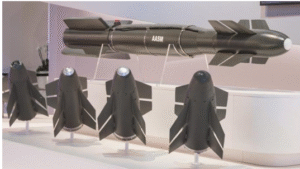
What is HAMMER?
- HAMMER (Highly Agile Modular Munition Extended Range) is a smart, precision air-to-ground munition designed for accurate strikes on hardened or high-value targets from standoff ranges.
Origin and Development
- Developed by Safran (Sagem), France; the new venture brings joint manufacturing with BEL in India to support ‘Make in India’.
Core Features
- Modular Kit: Guidance and range-extension kits fit onto various bomb types, enabling mission flexibility and reduced logistics.
- Triple Guidance: Uses GPS/INS, infrared, and optional laser guidance for precise targeting in challenging conditions.
- Stand-Off Strike: Engages targets up to 70 km, keeping aircraft outside high-risk airspace.
- High Agility: Suited for mountain warfare and harsh terrain, including high-altitude areas like Ladakh.
- Multi-Platform: Compatible with Rafale, Mirage 2000D, and planned for Tejas; adaptable across IAF and Navy platforms.
- Indigenisation: Joint manufacturing aims for up to 60% local content with BEL leading assembly, testing, and QA in India.
Defence Significance
- Operational Advantage: Provides rapid, combat-ready capability against bunkers, shelters, and fortified targets.
- Faster and Cheaper: Domestic production ensures quicker access and lower costs than emergency imports or foreign procurement.
- Enhanced Self-Reliance: Supports India’s indigenous defence sector and export potential.
Conclusion
The HAMMER JV marks a major boost for India’s precision strike capabilities and defence manufacturing, reinforcing deterrence and operational flexibility in sensitive regions.
3. Custodial torture: SC raps Govt over CCTV Compliance
GS Paper II-Indian polity
Context: The Supreme Court has criticized the Centre’s lack of response regarding mandatory installation of CCTV cameras in police stations and offices of law enforcement agencies to prevent custodial torture.
- Five years after its landmark judgment, the Court found compliance to be poor among States and the Centre, especially in major agencies like the CBI, ED, and NIA.
Background: What’s Happening?
- Despite a 2020 Supreme Court order, implementation of CCTV cameras in police stations and interrogation offices remains incomplete.
- Recent reports indicate 11 custodial deaths in Rajasthan over eight months, highlighting persistent issues of custodial violence.
Reasons for Supreme Court’s Anger
- The Centre and most States have failed to file proper compliance reports; only 11 gave lukewarm, incomplete responses.
- Custodial deaths and torture continue despite clear judicial directions, signaling disregard for the Court.
Current Supreme Court Actions
- The Court has ordered senior officials to file compliance personally before the next hearing.
- It is re-examining and monitoring the level of adherence to its 2020 judgment and demanding strict accountability from the Centre and States.
Arguments and Exchanges in Court
- Justices expressed frustration that the Union was “taking the court lightly.”
- The Solicitor-General claimed compliance would be shown in affidavits, but the Bench insisted on actual implementation, not paperwork.
- Justice Mehta sarcastically referenced the US model to highlight India’s sufficient legal requirements and the need for genuine action rather than excuses.
2020 Supreme Court Judgment: Key Points
- Mandated installation of CCTV cameras in all police stations and interrogation offices with powers of “interrogation.”
- Directed Centre and States to ensure surveillance and recording, to safeguard detainees and prevent torture.
Why CCTV Matters for Preventing Custodial Torture
- CCTV cameras provide visual evidence and deter police from engaging in torture or illegal acts.
- Ensures transparency and accountability, facilitating prompt investigation of allegations.
Constitutional Significance
- Linked to Article 21 (Right to Life and Personal Liberty), which includes protection from torture and abuse by State authorities.
- Upholds constitutional duty of the State to prevent cruel, inhuman, or degrading treatment in custody.
Why Non-Compliance Is Serious
- Shows disregard for Supreme Court orders and the rule of law.
- Curbs public faith in legal safeguards against custodial violence and undermines fundamental rights.
- Reflects poor governance and lapses in police reforms, endangering vulnerable citizens.
-
- INS Sahyadri and HMAS Ballarat take part in AUSINDEX 2025 exercise
4. INS Sahyadri and HMAS Ballarat take part in AUSINDEX 2025 exercise
GS paper III-SCIENCE AND TECHNOLOG
Context: INS Sahyadri (Indian Navy) and HMAS Ballarat (Royal Australian Navy) participated in AUSINDEX 2025, held in the Northern Pacific, marking a key milestone in strengthening defence cooperation between India and Australia.
What is AUSINDEX?
- AUSINDEX is a bilateral naval exercise between India and Australia, first held in 2015.
- Conducted alternately in India, Australia, or designated maritime regions to foster security and mutual understanding.
AUSINDEX 2025: Key Details
Location and Participants
- Conducted in the Northern Pacific region.
- INS Sahyadri (Shivalik-class stealth frigate) and HMAS Ballarat (Anzac-class frigate) took part.
Focus Areas and Activities
- Anti-submarine warfare drills enhanced strategies for submarine threats.
- Gunnery exercises tested surface combat readiness.
- Advanced flying operations promoted joint maritime aviation skills.
- Joint manoeuvres showcased coordinated naval tactics and operational synergy.
Strategic Objective
- The exercise aims to boost interoperability and reaffirm both nations’ commitment to a free, open, and inclusive Indo-Pacific.
Conclusion
AUSINDEX 2025 demonstrates the growing depth of the India–Australia defence partnership, enhancing maritime security and operational readiness in the Indo-Pacific region.
5. Decoding personality rights in the age of AI
GS PAPER II-Polity
Context: Indian celebrities, including Abhishek Bachchan and Aishwarya Rai Bachchan, filed lawsuits against Google and YouTube over AI-generated videos that allegedly infringed their personality rights and caused reputational and financial damage.
- This brings focus to legal and ethical challenges about personality rights in the age of generative AI, especially deepfakes and synthetic media.
What Are Personality Rights?
- Personality rights allow individuals to control and protect their name, image, likeness, voice, and other attributes from unauthorized exploitation.
- These rights evolved to protect privacy, dignity, and economic interests, particularly against commercial misuse and reputation harm.
- Key entitlement: The right to prevent others from profiting off one’s persona without consent.
How Does AI Complicate Personality Rights?
- Generative technologies like AI can create realistic deepfakes and synthetic content that mimic or swap faces and voices, leading to reputational risk, misinformation, and emotional harm.
- Content can be used without consent, easily replicated, and propagated worldwide, making enforcement difficult with fragmented national laws.
- AI exposes vulnerabilities such as authenticity versus deception and amplifies legal gaps around user consent and accountability.
Legal Framework: Comparative Study
India
- Draws from Article 21 of the Constitution (right to life, privacy, dignity).
- Personality rights have been recognized through Supreme Court judgments such as Justice K.S. Puttaswamy v. Union of India and landmark cases involving celebrities.
- Legal protections involve Information Technology Act, 2000, and Intermediary Guidelines (2024), but gaps remain in enforcement and cross-border data sharing.
United States
- Follows a “right of publicity” doctrine, treating personality rights as a transferable property right varying by state.
- Stronger frameworks for monetizing identity and prohibiting unauthorized likeness use, including bans on deepfakes.
European Union
- Adopts a dignity-based model through General Data Protection Regulation (GDPR), emphasizing consent for processing personal and biometric data.
- EU AI Act (2024) classifies deepfake technologies as high risk, sets transparency and labelling mandates.
China
- Recent legislation requires synthetic voices and media not deceive users; mandates clear AI labelling and liability for damages when bots impersonate real people.
Global Problems: Fragmented Laws
- Personality rights are not harmonized globally; AI’s transnational nature exposes gaps across countries.
- Fragmented regulation means creators and individuals have limited recourse when content crosses borders or is used by foreign platforms.
Ethical Debates: Human vs AI Identity
- AI blurs the line between human and synthetic identity, expanding debates on consent, commodification, and harm (especially for creators, artists, and victims of deepfakes).
- Ethical frameworks, such as UNESCO’s recommendations, advocate for human-centered rights—AI should not exploit individuals without meaningful safeguards.
What India Needs
- Comprehensive legislation defining and protecting personality rights, deepfake regulation, and cross-border enforcement.
- Mandatory watermarking, platform accountability, transparency, and remedies for individuals harmed by AI-generated misuse.
Constitutional Angle
- Anchored in Article 21: Right to life, dignity, and privacy, recognized as fundamental rights by the Supreme Court.
- Personality rights litigation flows from these constitutional protections, demanding statutory reform for contemporary digital challenges.
6. Bridging India’s numeracy gap
GS paper II-polity
Context: The Annual Status of Education Report (ASER) 2024 highlights a sharp gap between foundational literacy and numeracy, with 48.7% of Class 5 students reading fluently but only 30.7% solving basic division.
- Across India, no State has higher numeracy than literacy, exposing a nationwide stagnation in mathematics skills, despite classroom instruction.
- Nearly 70% of Class 8 and over 50% of Class 5 students cannot solve basic division, threatening progression to higher education and skill development.
Origins of India’s Numeracy Gap
- Mathematics is hierarchical; incomplete mastery in basic concepts undermines future learning.
- Errors accumulate over grades, rarely corrected, unlike in language acquisition.
- Syllabus-based teaching advances students regardless of foundational gaps, limiting conceptual clarity.
Classroom vs Real-World Mathematics
- Students performing well in tests often fail to use math in daily scenarios, as evidenced by Poverty Action Lab studies.
- Real-world skills (e.g., handling money) do not translate to textbook problems.
- Learning pace outstrips student consolidation, widening the disconnection.
Consequences of Numeracy Stagnation
- Students face hurdles in science and math-intensive subjects dominating board exams.
- Many teens drop out before Class 10, fearing math challenges.
- Human capital and employment prospects shrink as numeracy remains weak.
Need to Broaden Foundational Literacy and Numeracy (FLN)
- Persistent deficits post-Grade 3: majority of students in Classes 5 and 8 lack core division skills.
- COVID-19 magnified learning gaps; many reached higher grades without basic math.
- Extending FLN pedagogy to higher grades is urgently needed.
Components of an Effective Response
- Strengthen support for Classes 5–8 to stem permanent numeracy losses.
- Teach math using daily activities (bills, percentages, measurements).
- Use activity-based, child-friendly lessons tuned to real literacy levels.
- Integrate numeracy skills across subjects for holistic learning.
Conclusion
India has achieved foundational literacy but not numeracy. Bridging this gap in middle grades is essential to turn classroom success into real-world mathematical competence and future opportunity.
7. OVER 80% Nations got loans from China in the last two decades
GS Paper II -International Relations; global economic institutions
GS Paper III Economy; international trade and security; external debt.
Context: China now lends more to high-income nations and sensitive sectors, breaking the myth of a sole focus on developing countries via BRI.
- The US emerged as the top recipient, fueling global debate on debt transparency and geopolitical leverage.
Why the US Is the Biggest Beneficiary?
- US received $200+ billion for ~2,500 projects, including infrastructure (LNG terminals, airports, data centers) and high-tech acquisitions.
- Loans enabled Chinese firms to buy US technology assets (semiconductors, robotics, electronics).
- Most funds routed via offshore shell companies, obscuring transparency; US warnings of “debt traps” contrast with its own benefit.
Other Major Beneficiaries
- China’s top lending partners: US ($200B+), EU ($161B), Russia ($169B), UK (~$50B), Australia (~$40B), Pakistan ($60B+), Indonesia ($50B+), Brazil ($40B+), DRC ($30B+), Angola ($40B+).
- High-income nations now get 76% of China’s external finance, up from 12% in 2000.
High-Income vs. Low-Income Countries
| Category | Share (2000) | Share (2023) | Financing ($B) | Main Feature |
| High-income (e.g., US) | 12% | 76% | 943 | Tech, strategic infra |
| Low/middle-income | 88% | 24% | 1,220 | BRI, resources |
- Lending to poorer countries now mostly emergency/collateralized; BRI infrastructure fell below 25%.
China Shifts Away from Traditional Aid
- 2000–2013: Aid focus, 75% to low-income infra, higher ODA and grants.
- 2013–2023: Strategic lending, 76% to wealthy nations, 94% as loans, ODA dropped to $1.9B.
Why Has China Shifted Lending Pattern?
- Geopolitical rivalry drives focus on national security, competitiveness.
- Risk management after debt crises; more collateral loans and syndicates.
- Aligns with “Made in China 2025” for tech and supply chain dominance.
- High-income offers stable returns, less exposure to volatility.
China’s Lending Method
- Hybrid: policy plus commercial, 94% loans (collateralized when possible), 6% grants.
- Policy banks (EximBank, CDB) for strategy; commercial banks for high-income.
- Uses shell companies to route US loans; syndicates with global banks obscure funding origin.
India Borrowing from China
- India is top AIIB borrower: ~$4.5B plus $1B pipeline; key loans for COVID, infra (metros, rail).
- Direct bilateral loans minimal; mostly via AIIB where China holds 26.6%, India 7.6%.
- Risks: Debt, trade deficit, border tensions, national security (tech/data exposure).
- Opportunities: Infrastructure financing, multilateral access, bargaining power as major AIIB beneficiary.
8. DRI Seizes 32 kg Methamphetamine in North East
Context: The Directorate of Revenue Intelligence (DRI) seized 32 kg of methamphetamine tablets worth ₹32 crore in Assam and Tripura, highlighting continued trafficking via the Indo–Myanmar route.
- Three persons were arrested under the NDPS Act, 1985 for these crimes.
Methamphetamine: Key Facts
- Methamphetamine is a synthetic psychostimulant, highly addictive and traded as Ya Ba/Speed pills in Southeast Asia.
- It is listed as a controlled substance under the NDPS Act, 1985, making its production and sale illegal in India.
Hydroponic Weed
- Hydroponic weed refers to marijuana grown in nutrient-rich water, offering higher potency due to controlled conditions.
- Smuggling trend: air passengers now bring these products into Northeast India, increasing detection challenges.
NDPS Act, 1985: Enforcement and Provisions
- Regulates narcotic and psychotropic substances, providing for seizure, arrest, and punishment.
- Offences involving commercial quantity mandate imprisonment of 10–20 years.
- Multiple agencies (DRI, NCB, Customs, State Police, BSF, Assam Rifles) are empowered for enforcement and interdiction efforts.
Conclusion
The recent DRI operations underscore the persistent drug trafficking threat along Northeast India’s borders, the evolving risks with synthetic and hydroponic drugs, and the robust legal response enabled by the NDPS Act.