1. Four new labour codes
GS Paper-2 (Polity & Governance): Government policies and interventions for development in various sectors
Context :The four new Labour Codes were officially implemented across India on November 21, 2025, replacing 29 outdated laws from the 1930s–1950s.
- This marks the biggest labour law overhaul since Independence, aiming to modernize regulations amid unemployment, gig economy growth, and FDI needs.
- The government calls it “future-ready” for workers and businesses, but trade unions label it “anti-worker,” sparking planned nationwide protests on November 26, 2025.
- PM Modi hailed it as empowering workers while simplifying compliance. Industry bodies like CII endorse it for boosting productivity and “Make in India.”
Code on Wages (2019)
What It Does
- Consolidates laws on wages, bonus, and equal remuneration for all sectors.
- Extends minimum wage and timely payment protections universally.
Impact
- Positive: Ensures gender pay parity; boosts formalization and social security coverage to 64%+.
- Challenges: Redefines “wages” excluding >50% allowances, potentially cutting take-home pay.
Industrial Relations (IR) Code (2020)
What It Consolidates
- Merges Trade Unions Act (1926), Industrial Employment Act (1946), and Industrial Disputes Act (1947).
- Regulates unions, conditions, disputes, strikes, layoffs, and closures.
Key Provisions
- Broadens worker definition to include journalists and sales staff.
- Introduces fixed-term employment with pro-rata benefits like gratuity.
- Raises layoff approval threshold from 100 to 300 workers.
- Bans strikes/lockouts during 60-day conciliation; mandates 14-day notice.
- Creates two-member tribunals and Negotiating Councils for faster resolutions.
Impact
- Positive: Simplifies compliance; may increase manufacturing jobs by 1–2% in reform states.
- Challenges: Eases layoffs, risking job insecurity; strike limits may weaken bargaining power.
Code on Social Security (2020)
What It Does
- Merges nine laws like EPF Act (1952) and ESI Act (1948) for comprehensive benefits.
- Provides portable PF, ESI, gratuity, and maternity coverage to all workers, including gig workers.
Major Reforms
- Covers gig workers with insurance and health benefits; aggregators pay 1–2% turnover.
- Lowers ESI threshold to 1 hazardous worker; enables Aadhaar-linked portability.
- Raises gratuity eligibility to 5 years; adds free check-ups for workers over 40.
- Includes National Career Service Centres and treats commuting accidents as work-related.
Impact
- Positive: Extends benefits to 7.7M+ gig workers; raises coverage to 80%+ and women’s participation.
- Challenges: Unclear funding for unorganized sector; Aadhaar mandate risks excluding 10–15% without it.
Occupational Safety, Health and Working Conditions (OSHWC) Code (2020)
What It Merges
- Integrates 13 laws like Factories Act (1948) and Mines Act (1952).
- Covers safety, health, and conditions in factories, mines, plantations, and more.
Key Provisions
- Applies to 10+ worker establishments (20+ for factories); requires safety committees at 500+.
- Mandates free PPE and medical exams; allows women night shifts with consent.
- Forms National OSH Board; shifts to inspector-facilitator model for guidance.
- Caps overtime at 12 days/year with double pay; free check-ups for hazardous roles.
Impact
- Positive: Cuts accidents by 20% in hazardous sectors; improves MSME formalization and women’s safety.
- Challenges: Exemptions for new setups weaken protections; raises small firm costs by 5–7%.
Major Systematic Reforms Under the Codes
- Consolidation: Reduces 2,000+ pages of rules to ~500 with single registration/returns.
- Universal Coverage: Sets national floor wage; mandates appointment letters for all.
- Flexibility with Protections: Enables fixed-term jobs; speeds disputes via tribunals.
- Gender/Equity Focus: Promotes pay parity; adds transgender facilities and night shift options.
- Digital Tools: Uses Aadhaar for benefits; tech for inspections and OSH standards.
- Economic Goals: Targets 25% GDP from manufacturing; 10–15M jobs/year via formalization.
Why Controversial? Trade Union Opposition
- Prioritizes employer flexibility over rights, lacking tripartite consensus.
- Enables “hire-and-fire” with 300-worker layoff threshold.
- Curbs strikes via 60-day bans, undermining collective action.
- Fixed-term jobs erode permanency; gig funding vague and unenforceable.
- Ignores protests since 2019, including 2025 July strike of 250M workers.
- Unions like AITUC plan November 26 protests against “exploitation era” amid 8% unemployment.
Why Industry Supports It?
- Simplifies archaic rules, cutting compliance costs by 30–40%.
- Unified framework aids scalability and reduces contractualization.
- Clear rules boost talent mobility in sectors like IT.
- Aligns safety with global norms, supporting exports and FDI (20% rise in reform states).
- Promises 1–2% productivity gains for “Make in India” and Viksit Bharat 2047.
- CII’s Banerjee calls it a “transformative leap” for resilient industries.
2. Japan local authorities approves restart of world’s biggest nuclear plant
GS paper III-Science and technology
Context :Niigata Prefecture governor approved partial restart of Kashiwazaki-Kariwa (KK) nuclear plant.
- Restart covers Units 6 and 7, awaiting prefectural assembly’s endorsement.
- TEPCO’s first nuclear restart since 2011 Fukushima disaster.
- This approval is crucial for reviving Japan’s nuclear energy sector and reducing fossil fuel reliance.
Why Is Japan Restarting Nuclear Power Now?
- Reducing dependence on 90% energy imports, vulnerable to price shocks and geopolitical issues.
- Economic benefits: save billions on fossil fuel imports, stabilize energy costs.
- Climate change goals: nuclear supports Japan’s 2050 carbon neutrality target.
- Post-Fukushima safety improvements restored public & regulatory confidence.
- Enhancing energy security amid global instability like US-China tensions.
New Safety Measures at the Plant
- Installation of 15-meter tsunami seawall exceeding previous standards.
- Elevated emergency backup power with advanced generators to avoid blackouts.
- Enhanced anti-terrorism features: reinforced gates, surveillance, controlled access.
- Successful seismic and stress testing under Nuclear Regulation Authority (NRA).
- Fuel loading resumed after compliance upgrades; ongoing safety monitoring.
Japan Nuclear Energy Today
- Only 12 of 33 operable reactors active, accounting for ~10% share in power mix.
- Targets: increase nuclear’s share to 20-22% by 2030 under the 7th Strategic Energy Plan.
- Shift from “reducing dependence” to “maximizing utilization” of nuclear.
- Challenges: public skepticism, aging reactors, decommissioning plans.
- Exploring small modular reactors (SMRs) for future efficiency and innovation.
TEPCO’s Return to Nuclear Power
- Kashiwazaki-Kariwa Units 6 and 7 restart is TEPCO’s first since Fukushima disaster.
- No new nuclear plants planned; focus on restarting existing reactors to stabilize supply.
- TEPCO committed substantial community investments (~100 billion yen) to rebuild trust.
- Full regulatory clearance after fixing earlier safety and security flaws.
- Restart timeline: Units ready technically by mid-2025, pending full local approvals.
Geopolitical Significance
Energy Security
- Restart reduces vulnerabilities due to Japan’s heavy energy import reliance.
- Provides stable baseload power supporting Tokyo’s industrial grid needs.
- Eases global LNG demand pressures, aiding allied energy diversification efforts.
Climate Diplomacy
- Aligns with Japan’s global net-zero emission commitments by 2050.
- Nuclear complements intermittent renewables, ensuring grid stability.
- Enhances Japan’s leverage in international climate forums (COP, G7).
- Potential to export SMR technology fostering regional cooperation and energy security.
3. The new direction for India should be toward Asia
GS II paper: India and its neighborhood – relations
Context :India’s foreign policy is at a crossroads amid shifting global alliances and changing power centers.
- Recent diplomatic exchanges highlight Asia’s geopolitical importance, with India increasingly engaging Russia and China instead of solely the U.S.
Changing Global Geopolitics: Asia Takes Center Stage
- Asia now contains two-thirds of the world’s population and wealth.
- U.S. is recalibrating priorities, emphasizing ‘pull India’ from China and Russia’s orbit.
- Multilateral Asian groupings (like BRICS, SCO, ASEAN) are shaping global policy frameworks.
India at an Inflection Point
- India’s growth, innovation, labor potential, and security needs are reshaping its foreign policy.
- Decisions on strategic autonomy reflect a move from developing country hesitations to confident global engagement.
Why India Should Look Towards Asia
- Asia offers larger markets and dynamic partnerships less reliant on Western priorities.
- Strengthening ties with Asia can help India balance technological and security demands.
- Re-entering regionally driven alliances like RCEP offers new trade and economic opportunities.
Hard Decisions Ahead: Redefining Strategic Autonomy
- India must define ‘strategic autonomy’ based on its dual agenda: rapid growth and poverty reduction.
- Accepting hard decisions means prioritizing Indian interests rather than following external frameworks.
- India’s partnerships should emphasize high-value linkages (innovation, supply chains) without diluting its operational freedom.
New Global Rules Are Emerging
- Old Western-led models lose relevance in interconnected digital economies.
- Asia’s technopolitical advantage and interdependence empower new regional coalitions.
- Innovation, economic reforms, and defense investments are driving new frameworks for cooperation.
Cyber Warfare, Not Theater Commands, Should Lead
- Cyber capabilities are now central in national security over traditional command structures.
- India’s comparative digital advantage and AI investments demand a pivot to technology-led defense strategy.
- Regional and global cyber diplomacy shapes future strategic debates.
India stands at a critical juncture, requiring strategic adjustments towards Asia-centered diplomacy, economic partnerships, and defense strategies to secure its interests amid changing global geopolitics.
4. Defence Atmanirbharta: Record Production and Exports
Context : India recorded its highest-ever defence production and exports in FY 2024–25 under the Atmanirbhar Bharat initiative, signaling a significant shift towards indigenous manufacturing and global export leadership.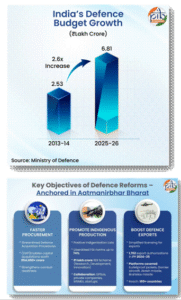
- The government targets ₹3 lakh crore production and ₹50,000 crore exports by 2029, marking India’s emergence as a major defence exporter.
Key Patterns and Trends
- Indigenous defence production rose to ₹1,54,000 crore in FY 2024–25, demonstrating robust annual growth driven by consistent reforms.
- Defence exports reached ₹23,622 crore, increasing from less than ₹1,000 crore in 2014, reflecting India’s rising global competitiveness.
- Private sector’s role expanded to 23%, with 16,000 MSMEs supplying vital components and technology.
- The Ministry of Defence signed 193 contracts worth ₹2.09 lakh crore, 177 of which were awarded to domestic companies, highlighting increased self-reliance.
Opportunities for Indian Defence Industry
- Defence Industrial Corridors in Uttar Pradesh and Tamil Nadu attracted ₹9,145 crore investment, creating advanced manufacturing clusters.
- India exports defence goods to 80–100 countries, expanding international partnerships and diplomatic engagement.
- Liberalized FDI norms allow 74% automatic and up to 100% government-approved foreign investment, boosting technology transfer and OEM collaborations.
- Digital export authorization portals issued 1,762 approvals in FY 2024–25, improving transparency and exporter participation.
- Innovation schemes like the ₹1 lakh crore RDI Scheme and DRDO’s TDF fund provide major opportunities for start-ups and academia.
Government Reforms
- Defence Acquisition Procedure (DAP) 2020 prioritizes ‘Buy Indian–IDDM’, clearances, and integration of new technologies such as AI and robotics.
- Defence Procurement Manual (DPM) 2025 streamlines ₹1 lakh crore revenue procurement with digital processes and uniform rules.
- Positive Indigenisation Lists restrict imports and promote local manufacturing of defence items.
- Ordnance Factories have been reorganized into seven DPSUs for improved autonomy and efficiency.
- Export reforms include Open General Export Licences and a dedicated export promotion cell.
Industry Challenges
- Limited indigenous capability in high-end technology areas still poses challenges, with 58% of procurement mainly through licensed production.
- Domestic production scale remains insufficient to meet total procurement needs, leading to reliance on foreign platforms for complex systems.
- DPSU export competitiveness is low, with some global tenders lost to foreign players.
- Many reforms face slow on-ground implementation due to bureaucratic and procedural delays.
- Supply chain vulnerabilities persist due to dependence on imported specialty components.
Way Forward
- Enhance deep-tech investments for advanced propulsion, sensors, and materials to boost export competitiveness.
- Strengthen private industry via long-term procurement, robust testing infrastructure, and competitive transparency.
- Increase R&D spending to 8–10% of the defence budget for next-gen strategic platforms.
- Expand export diplomacy using finance, maintenance hubs, and joint training to strengthen India’s international appeal.
- Accelerate procurement with single-window clearances and real-time monitoring for timely deliveries.
Conclusion
- India’s defence sector now demonstrates record-breaking self-reliance and growth, but greater investments in technology, private sector, and global partnerships are critical for sustaining momentum and cementing India’s position as a top defence manufacturing hub by 2030.
5. Himachal Pradesh’s traditional Raulane FestivaL
General Studies Paper I: Indian Culture, Art & Heritage, Indigenous Traditions, Festivals of North India
CONTEXT :Recent weeks have seen striking, vividly coloured photos of the Raulane festival in Himachal Pradesh go viral on social media, igniting public discussion about its rare rituals and centuries-old cultural richness.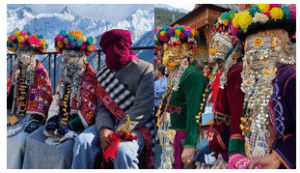
About Festival
Location & Season
- Raulane is celebrated in Kalpa, Kinnaur district of Himachal Pradesh during winter or early spring, as locals bid farewell to harsh weather and honour celestial protectors.
Ancient Heritage
- With origins dating back roughly 5,000 years, Raulane is among the oldest living traditions in the Himalayas, deeply intertwined with mountain mythology and ancestor worship.
Celestial Spirits (Saunis)
- The festival centres on reverence for Saunis, believed to be gentle, radiant mountain fairies who guide and protect villagers through winter’s hardships.
Symbolic Wedding
- The main ritual involves two men enacting a symbolic marriage as the Raula (groom) and Raulane (bride), representing the divine union and acting as vessels for Sauni spirits.
Ceremonial Attire & Dance
- Chosen participants wear heavy woollen robes and distinctive masks, and perform a slow, meditative dance—often at the Nagin Narayan Temple—before the gathered community.
Cultural Impact
- Raulane isn’t staged for tourists but is a living ritual, preserving endangered local culture while reaffirming communal bonds and spiritual legacy.
The global buzz around the Raulane festival stems from its profound history, mysterious masked ceremonies, and authentic ties to Himalayan tradition—now revealed to wider audiences by viral media coverage.
6. Drain water contamination endangering aquatic life: CPCB to monitor Yamuna with Delhi, Haryana every quarter
General Studies Paper I & III: Environment, Pollution Control, Government Bodies and Schemes (NMCG, CPCB, NGT)
Context :Drain water outflow is seriously contaminating the Yamuna river, endangering aquatic life and public health.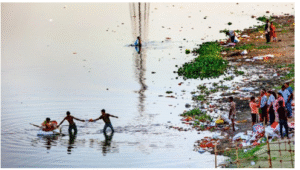
- The National Mission for Clean Ganga (NMCG) informed the National Green Tribunal (NGT) that the Central Pollution Control Board (CPCB), Delhi Pollution Control Committee (DPCC), and Haryana State Pollution Control Board (HSPCB) will now conduct quarterly joint monitoring to track pollution and coordinate interventions.
About National Mission for Clean Ganga (NMCG)
- Legal Status: Registered society under Ministry of Jal Shakti, responsible for Ganga pollution control and ecological flow.
- Origin: Former implementation arm of National Ganga River Basin Authority (NGRBA); replaced by National Ganga Council in 2016, under Environment Protection Act, 1986.
- Objectives: Abatement of pollution and rejuvenation of Ganga basin via integrated river approach.
- Structure: Two-tier setup—Governing Council and Executive Committee, led by Director General (DG, Additional Secretary rank); state arms (SPMGs) implement projects locally.
- Powers: Executive Committee can approve projects up to ₹1000 crore.
About National Green Tribunal (NGT)
- Mandate: Ensures quick, expert resolution of environmental disputes, aiming for disposal within six months.
- Operations: Functions on principles of natural justice, not Civil Procedure Code; began in 2011 with principal and regional benches.
- Composition: Chairperson (retired Supreme Court judge/Chief Justice), 10–20 judicial and expert members.
- Jurisdiction: Acts under laws like Water Act, Air Act, Environment Protection Act, Forest Conservation Act, etc.
- Powers: Can impose penalties, award compensation, order remediation, and act suo motu on environmental issues.
About Central Pollution Control Board (CPCB)
- Formation: Statutory body, set up under Water Act, 1974; also empowered via Air Act, 1981.
- Role: Technical advisory agency to MoEFCC, enforces pollution control laws, resolves conflicts with SPCBs.
- Functions: Promote stream/well cleanliness, monitor water and air quality, set standards, and offer technical guidance.
- Delegated Authority: Delegates powers to Union Territories for local enforcement.
- Standards: Develops national norms for water, air, industry, and issues guidelines for sewage treatment, effluent discharge, and pollution abatement.
By strengthening inter-agency monitoring and coordination, the CPCB and partners seek to address Yamuna’s persistent pollution, ensure compliance, and restore river health.
7. 7th NSA-level Colombo Security Conclave
GS paper II :IR
Context :The 7th NSA-level Colombo Security Conclave (CSC) meeting prioritised cooperation across five pillars: maritime security, counterterrorism and radicalisation, combating trafficking and transnational crime, cybersecurity and critical infrastructure protection, and humanitarian assistance/disaster relief. This aims to reinforce regional coordination and collective security among member states.
About Colombo Security Conclave (CSC)
Regional Security Platform
- CSC is a multilateral security grouping in the Indian Ocean region, currently comprising India, Bangladesh, Sri Lanka, Maldives, Mauritius, and Seychelles (recently upgraded from observer to member).
Purpose & Evolution
- Objective: Enhance regional security and address common transnational threats for member states.
- Began as Trilateral Maritime Security Cooperation (India, Maldives, Sri Lanka) in 2011.
- Experienced a period of inactivity post-2014 due to regional tensions.
- Revived and expanded in 2020 as CSC, with Mauritius and later Bangladesh joining; Seychelles is now a full member.
Institutional Features
- Participation at NSA and Deputy NSA level, with CSC Secretariat located in Colombo, Sri Lanka.
- Expanding agenda and membership (Malaysia was recently present as a guest), reflecting deeper Indo-Pacific partnership.
Key Areas of Cooperation
- Maritime safety and security—critical for trade and anti-piracy operations.
- Counterterrorism and radicalisation—joint effort against extremism and threats.
- Combating trafficking and transnational crime—addressing illegal trafficking and criminal networks.
- Cybersecurity and critical infrastructure protection—information sharing and defense against cyber-attacks.
- Humanitarian assistance and disaster relief (HADR)—regional readiness coordination for emergencies.
This strengthening of the CSC’s commitment is set to improve regional trust-building, resilience to transnational challenges, and coordinated responses among Indian Ocean littoral states.