
1. High levels of chromium, mercury in residents; NGT directs U.P govt to map affected people
GS PAPER III- Environment & Ecology: Environmental Pollution (Water Pollution, Heavy Metal Contamination).
Context: NGT has intervened after alarming heavy metal (chromium, mercury) contamination in Kanpur Nagar, Fatehpur, Kanpur Dehat and nearby areas.
- Factories dumping chromium have caused widespread groundwater pollution, depriving locals of safe drinking water.
What Is the Issue?
- Chrome tanneries/industries dumping waste polluting groundwater, surface water.
- Major areas: Kanpur Nagar, Fatehpur, Kanpur Dehat, and nearby districts.
- Over 95% in Kanpur Nagar, 71.9% in Kanpur Dehat, and 85.9% in Fatehpur tested with excess metals.
- Serious public health threat—long-term toxic exposure risks.
What Did the NGT Observe?
- Alarming presence of chromium in most tested residents; mercury above norms in 70–85%.
- Pollution is directly linked to industrial activities, especially tanneries.
- Impact spreads beyond direct factory exposure, signaling widespread contamination.
- State authorities lag in compliance with earlier orders; urgent mapping needed.
NGT Orders to Uttar Pradesh Govt
- Map affected population: Identify and record all exposed individuals.
- Submit detailed action plan (2 weeks): Timeline for region-wide remediation and compliance.
- Map all contamination types: Survey groundwater, surface water, food chain, and air pathways.
- Implement previous recommendations: Ensure steps outlined in July 2025 order are acted on.Disclose medical facilities, health staff, and laboratory access for the affected.
Why This Is Important?
- Environmental Pollution: Shows deep industrial impact on water, soil, and ecology.
- Health Impacts: High risk of chronic diseases, neurological, and kidney damage for many.
- Governance & Regulation: Highlights accountability gaps, driving legal-regulatory reforms and stronger enforcement.
- Industrial Regulation Failure: Demonstrates failure of industrial units to follow safe disposal norms; underlines urgent need for strict industrial waste management.
2. Tuberculosis incidence falling in India by 21% year
GS PAPER III- S&T- Biotechnology -health
Context: WHO Global TB Report 2025 released on Nov 12, 2025; spotlights India’s progress in TB control.
- India’s TB incidence fell sharply; now seen as a global model for TB elimination.
Key Figures About India
- TB incidence: Down 21%, from 237/lakh (2015) to 187/lakh (2024).
- Detection & Treatment: Coverage rose from 53% to over 92% between 2015 and 2024.
- Missing Cases: Dropped from 15 lakh to under 1 lakh in a decade.
- Mortality: TB deaths fell 25%, to 21 per lakh in 2024.
- Global share: India still has 25% of new TB cases, 28% of global TB deaths.
TB Incidence Falling Rapidly
- 21% decline in new TB cases; nearly double global average.
Why Is India Improving So Fast?
- Innovative Case-Finding: Proactive screening (mobile X-ray, molecular diagnostics) enables early TB detection.
Reduced undetected cases, interrupts TB transmission chain.
- Rapid Tech Adoption: Digital surveillance and new diagnostics hasten detection and treatment.
Real-time tracking lowers “missing cases” significantly.
- Decentralised Services: Diagnostics/treatment at local level boosts coverage, even in remote regions.
Quick interventions prevent care delays, raise success rates.
- Community Mobilisation: Nationwide drives screened 19 crore people; found 8.61 lakh asymptomatic TB cases.
Community support addresses stigma and ensures adherence.
Treatment Outcomes
- Coverage: Rose from 53% to over 92% (2015-2024).
- Missing cases: From 15 lakh to under 1 lakh.
- Treatment success rate: Touched 90% in 2024, above global average.
MDR-TB (Drug-Resistant TB)
- MDR-TB cases stable; early detection and strict regimens control spread.
Mortality Decline
- Deaths dropped 25%; improved detection/treatment key drivers.
TB Mukt Bharat Abhiyan
- Launched Dec 2024, aims for TB-free India by 2025.
- Campaign detected 24.5 lakh new cases, huge community involvement.
Why This Matters
- Public Health: Less TB means fewer outbreaks, protects 1.4 billion population.
- Economic Benefits Lower disease burden saves costs, raises productivity.
- Global Leadership: India’s rapid TB control sets a global standard, helps UN SDG-3 goals.
- Equity and Inclusion: Focus on vulnerable groups ensures no one is left behind.
3. GI tag application fee
General Studies Paper I: Indian Society, Diversity, and Culture;
Why in News
- Government reduced GI tag application fee from ₹5,000 to ₹1,000 to boost traditional product protection.
- Announcement made at Tribal Business Conclave to empower tribal artisans.
Government’s Announcement
- Application fee for Geographical Indications (GI) tag slashed to ₹1,000.
- Full ministry support for tribal product registration, marketing, and global reach.
Why Is This Important Now?
- Move aims to mark the 150th birth anniversary of Birsa Munda (Janjatiya Gaurav Varsh).
- Facilitates easier access for tribal and traditional product makers to protect and market their goods.
GI Tag: Concept Revision
- GI tag identifies goods originating from a specific place, indicating quality and reputation linked to that region.
- Protects traditional knowledge, ensures premium value, and prevents misuse of names.
Tribal Business Conclave
- Inaugural event organized by Ministries of Tribal Affairs, Culture, and DPIIT at Yashobhoomi Convention Centre.
- Platform for tribal entrepreneurs to showcase, network, and learn best practices.
Support Promised to Tribal Artisans
- Export linkages will be created for tribal goods’ international reach.
- E-commerce platforms to provide market access and visibility.
- International warehouses to support global exports.
- Schools, universities, and industries encouraged to collaborate for innovation and market access.
Janjatiya Gaurav Varsh
- Initiative celebrates tribal heritage, coinciding with significant commemorations for Birsa Munda.
GI Tags Distributed at the Event
| Product | State |
| Kannadippaya (bamboo mat) | Kerala |
| Apatani textile | Arunachal Pradesh |
| Marthandam honey | Tamil Nadu |
| Lepcha Tungbuk | Sikkim |
| Bodo Aronai | Assam |
| Ambaji white marble | Gujarat |
| Bedu and Badri cow ghee | Uttarakhand |
Tribal Affairs Challenge
- Announced to encourage tribal enterprises to design community solutions and boost entrepreneurship.
Why This Matters
- Ensures tribal knowledge is preserved and leveraged for economic growth.
- Reduces costs and barriers for traditional craftspersons to gain global recognition.
- Strengthens rural livelihoods, encourages collaboration, and boosts exports.
4. India ninth worst affected by extreme weather: study
GS paper III-environment and ecology
Context: Climate Risk Index (CRI) 2026 by Germanwatch released at COP30 ranks India 9th worst affected by extreme weather events (1995–2024).
Key Findings of the Report
- Over 832,000 deaths, nearly 5.7 billion affected globally by more than 9,700 extreme weather events (1995–2024).
- Economic losses exceeded $4.5 trillion (inflation-adjusted) worldwide.
- India ranks 9th globally for weather-related impacts.
India’s Ranking and Extreme Weather Impact
- India is 9th among the most affected countries during 1995–2024.
- Recurring floods, cyclones, droughts, and severe heatwaves identified as core drivers.
Why Is India Most Affected
- High frequency of floods, cyclones, droughts, and heatwaves.
- Vulnerable population, densely inhabited and climate-sensitive regions.
- Impact cycles prevent effective recovery between disasters.
What Germanwatch Says About India
- India faces particular challenges due to the regularity and severity of extreme events.
- Entire regions struggle to recover before encountering the next disaster.
- Stresses on adaptation, human rights, and prioritizing protection for vulnerable populations.
About Germanwatch
- Bonn-based nonprofit advocating for global equity, sustainability, and climate policy reforms.
- Focuses on climate risk, adaptation, and human rights worldwide.
Significance for India & Global Climate Policy
For India
- Highlights urgent need for robust disaster management, climate adaptation, and resilient infrastructure.
- Urges Indian policymakers to strengthen climate response and protect at-risk populations.
For Global Climate Justice
- Reinforces need for international cooperation, funding, and technology transfer to support affected regions.
- Stresses equity in climate action, prioritizing vulnerable nations in global climate frameworks.
5. India’s First MWh-Scale Vanadium Redox Flow Battery at NTPC NETRA
CONTEXT: India’s first large-scale (3 MWh) Vanadium Redox Flow Battery (VRFB) inaugurated at NTPC NETRA, Greater Noida, marking a key milestone in grid-scale renewable energy storage.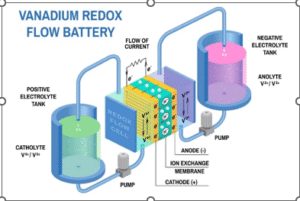
About Vanadium Redox Flow Battery (VRFB)
- Basic Concept: Rechargeable flow battery storing energy in liquid electrolytes with vanadium ions in multiple oxidation states.
- Working Mechanism: Oxidation-reduction reactions occur in separate electrolyte tanks, separated by an ion-selective membrane, allowing ion exchange without mixing.
- Scalability: Energy capacity depends on electrolyte volume, power output on cell stack size; this enables flexible scaling for different grid needs.
- Applications: Stationary, grid-scale energy storage, renewable integration, and backup power systems.
Advantages over Traditional Batteries
- Independent Scalability: Power and energy capacities can be scaled separately, ideal for utility storage.
- Long Life: Electrolytes don’t degrade or cross-contaminate, enabling thousands of charge-discharge cycles.
- Safety: Non-flammable, water-based electrolytes remove fire and explosion risk.
- Eco-Friendly: Electrolytes are recyclable and non-toxic, with low environmental impact.
- Long-Duration Storage: Can provide 6–10+ hours of continuous energy, stabilizing solar and wind variability.
- Fast Response: Reacts quickly to grid fluctuations for reliability.
Limitations
- High Initial Cost: Vanadium electrolytes and specialized components make upfront costs higher than lithium-ion batteries.
- Lower Energy Density: Less energy stored per unit volume, unsuitable for mobile or space-constrained uses like EVs.
- Complex Infrastructure: Requires large tanks, pumps, and control systems, leading to operational complexity and space needs.
This technology is crucial for India’s renewable energy goals and grid stability, especially for integrating solar and wind power effectively.6.
6. Exploited workers, a labour policy’s empty promises
Why in the News
- India’s largest informal workforce makes up about 80% of the total labour force, facing poor job security, low wages, and lack of social protection.
Current Situation of Informal Labour in India
- Informal workers without contracts, benefits, or occupational safety, especially in construction, seafood, textiles, and stone quarrying sectors.
- Around 12 million gig workers face exclusion from social protection.
- Migrant workers in informal sectors lack housing and job security, predominantly from states like Bihar, UP, Odisha, Jharkhand.
- Despite formalization efforts, 80% remain vulnerable due to low wages and unsafe working conditions.
Significance of Draft Shram Shakti Niti 2025
- First comprehensive labour and employment policy aimed at inclusive and dignified work aligned with India@2047 goals.
- Draft promotes digital skilling and employment via AI-driven platforms, but most informal workers remain digitally excluded.
- Raises concerns over employer-biased flexibility, constitutional dilution, insufficient enforcement, and lack of gender-sensitive measures.
Key Concerns and Gaps in the Draft Policy
- Institutional weakening of labour inspectorates and union representation.
- Use of cultural texts like Manusmriti is seen as regressive in modern labour context.
- Failure to align with ILO and OECD standards on worker protections and collective bargaining.
- Digital platforms risk perpetuating caste/gender bias without accountability.
What Should Guide the Final Labour Policy Framework?
- Universal social protection covering informal, gig workers (extend ESI, EPFO).
- Reinstate independent labour inspections and audits for safety and wage compliance.
- Gender-responsive budgeting and enforceable constitutional rights to worker dignity.
- Digital inclusion with safeguards for privacy, fairness, and access.
Conclusion
- The draft’s future-ready vision must integrate strong safeguards, union empowerment, and constitutional morality to truly uplift India’s informal workforce.
7. Can lawyers break client confidentiality?
GS PAPER II-Polity & Governance
Context: The Supreme Court of India, in a suo motu judgment on October 31, 2025, reaffirmed lawyer-client privilege under Sections 126–134 of the Bharatiya Sakshya Adhiniyam, 2023 (BSA).
Background
- Judgment addressed concerns about investigative agencies summoning lawyers to compel disclosure of confidential client communications without proper oversight.
- Triggered by complaints from Bar Council of India and advocates’ associations alleging violations during probes, including UAPA cases.
Supreme Court Observations
- Investigative agencies cannot summon lawyers just for advice or representation unless exceptions under Section 132 BSA apply.
- Lawyer-client confidentiality is a professional duty protected even after lawyer-client relationship ends.
- Agencies’ power to summon witnesses under BNSS cannot override privilege without express exemptions and senior officer vetting.
- Privilege excludes physical/digital document production and does not cover in-house counsel (not practising advocates).
Constitutional and Legal Importance
- Protects Article 21 rights (life, liberty) ensuring effective legal representation and fair trial.
- Ensures independence of lawyers as “officers of the court” preventing harassment.
- Balances investigative powers with legal profession autonomy.
Significance
- Supports equality before law under Article 14 and advocates’ role as constitutional actors, not private agents.
- Draws on global precedents to underline privilege as vital for trust and justice.
- Sets legal and ethical standards for protection of legal communication in criminal investigations.
8. Why does India’s road safety system keep failing?
GS paper -II: Governance
Context: India’s roads remain among the deadliest in the world. Despite growing infrastructure and vehicle modernization, over 1.7 lakh lives were lost to road crashes in 2023 alone roughly 450 deaths every day.
Problems in Licensing
- Licensing as a Mere Formality: The licensing system, intended to filter out unfit drivers, often operates as a simple administrative procedure.
- Lack of Formal Training: Many individuals obtain driving licenses without undergoing proper training.
- Perfunctory Driving Tests: Driving tests are often superficial, involving basic maneuvers on small tracks, failing to assess real-world driving skills.
- Absence of Standardized Training for Commercial Drivers: There is a lack of structured and standardized safety training for commercial drivers, who operate heavy vehicles carrying significant loads and passengers.
Role of Enforcement
- Top Causes of Crashes: Speeding, overloading, lane violations, and driving under the influence are major contributors to fatal crashes.
- Limited Technology Adoption: Even where technology like automated cameras and digital challan systems exists, coverage is limited, data integration is weak, and penalties are often not recovered.
- Need for Electronic Enforcement: The Supreme Court has emphasized the need for electronic enforcement standards and technology-based deterrence, but adoption remains inconsistent across states.
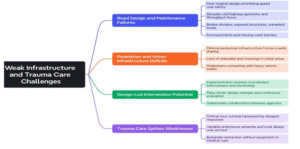
India’s road safety crisis reflects governance failure, driven by poor training, weak enforcement, unsafe roads, and inadequate trauma care. A coordinated, accountable systems approach is essential to prevent rising fatalities.