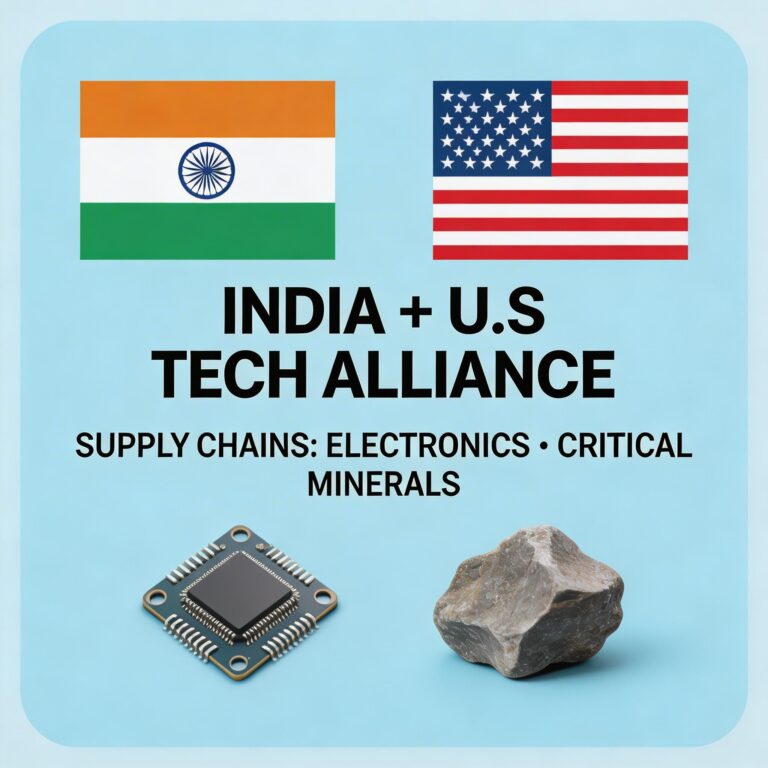
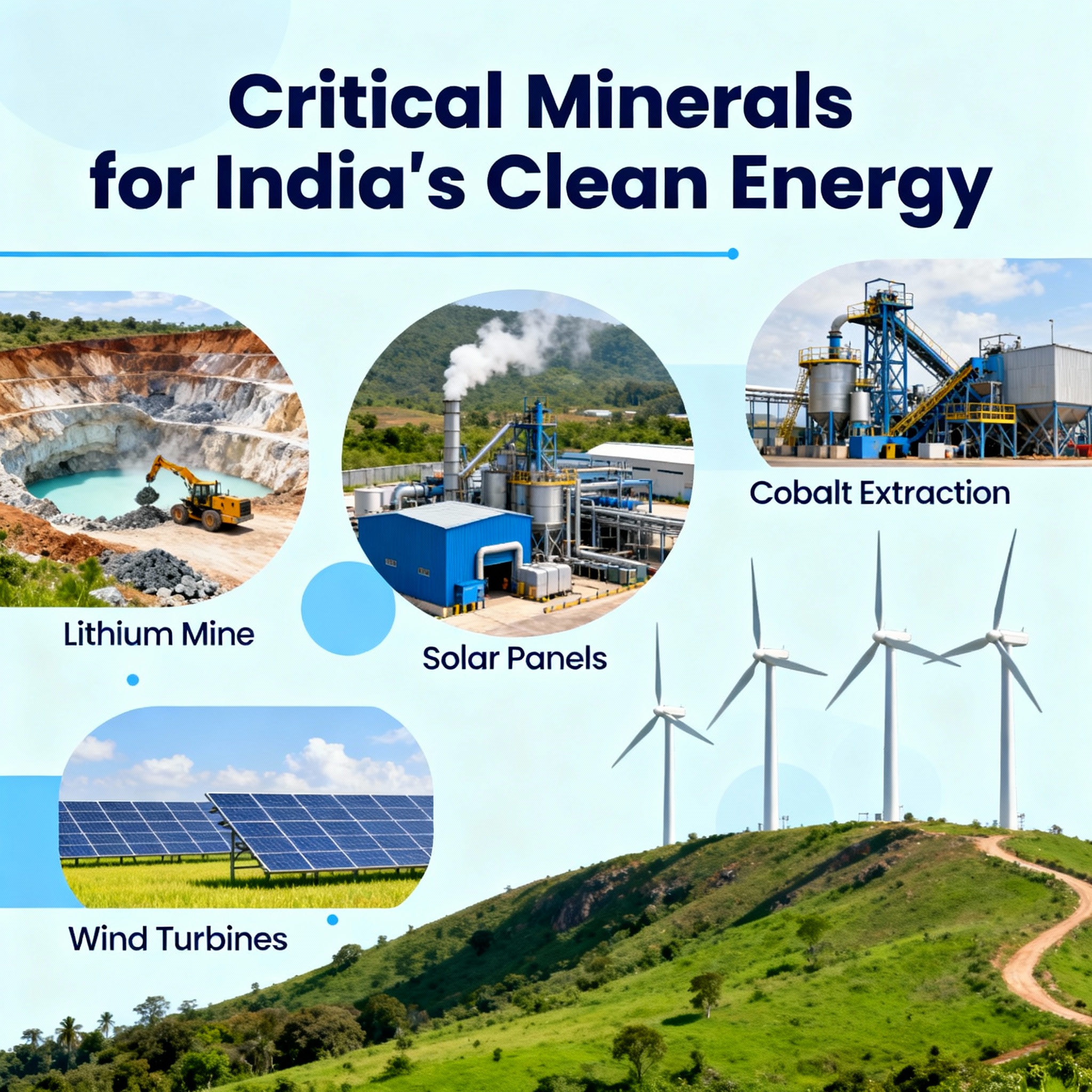
1. Critical Minerals for India’s Clean Energy Ambitions
GS Paper III – Indian Economy & Environment: Infrastructure (Energy), Resource Mobilization, Growth.
CONTEXT: India’s ambitious clean energy transition, targeting 500 GW of non-fossil capacity by 2030, is heavily dependent on a stable supply of Critical Minerals, making their sourcing the pivotal ‘critical factor’ for success.
Key Data Points & Pre-Pointers:
- Import Dependency: India is 100% dependent on imports for Lithium and Cobalt, and about 93% for Copper.
- China’s Dominance: China controls ~100% of Rare Earth Elements (REE) processing, ~80% of global solar module manufacturing, and ~77% of battery cell production capacity.
- Projected Demand (IEA): Global demand for critical minerals is set to increase by 3.5x by 2030, with Lithium demand alone projected to rise over 40-fold by 2040 to meet climate targets.
- Domestic Reserves: The 5.9 million-tonne lithium reserve discovered in Reasi, J&K (2023) is a positive step, but extraction and processing remain long-term challenges.
Why are they Critical for India?
- Solar PV & Wind: Silicon, Copper, and REEs are vital for manufacturing photovoltaic cells and permanent magnets in wind turbines.
- Energy Storage: Lithium, Cobalt, and Nickel are the backbone of Lithium-ion batteries, crucial for grid stability and electric vehicles (EVs). India’s Advanced Chemistry Cell (ACC) PLI scheme is directly linked to securing these minerals.
- Strategic Independence: Over-reliance on a single country (China) creates a strategic vulnerability for India’s energy security and its ‘Atmanirbhar Bharat’ (Self-reliant India) mission.
Government Initiatives & The Road Ahead
- Khanij Bidesh India Ltd. (KABIL): A joint venture (by NALCO, HCL, and MECL) to scout and secure mineral assets abroad. Its first major deal was for lithium blocks in Argentina.
- Critical Minerals List: India’s first list identifies 30 critical minerals for strategic focus.
- Auction of Blocks: The government has initiated the auction of 20 critical mineral blocks, including lithium and REEs.
- The Road Ahead: The focus must be on boosting exploration via PPPs, investing in R&D for recycling and extraction technologies, diversifying imports through partnerships (e.g., with Australia under the Critical Minerals Investment Partnership), and promoting a circular economy for Li-ion batteries.
2. The Future of the IMEC
GS Paper II – International Relations: Bilateral & Global Groupings, India & its Neighborhood.
CONTEXT: The India-Middle East-Europe Economic Corridor (IMEC), announced at the G20 Summit in 2023, is a visionary project whose future is now clouded by geopolitical tensions, particularly the Israel-Hamas conflict.
Key Data Points & Pre-Pointers:
- Announcement: Launched on the sidelines of the G20 New Delhi Summit (Sept 2023) by a partnership including India, the USA, the UAE, Saudi Arabia, the EU, France, Germany, and Italy.
- Strategic Aim: To create a reliable and cost-effective alternative to traditional sea routes, boost economic integration, and counter China’s Belt and Road Initiative (BRI).
- Economic Potential: Aims to reduce transit time by 40% and increase trade efficiency between India and Europe. A Citi GPS report estimated it could cut goods transit times between India and Europe by up to 12 days.
- Geopolitical Hurdle: The core rail link requires diplomatic normalization between Saudi Arabia and Israel, a process that was underway but has been frozen due to the war.
Strategic Significance
- Trade & Connectivity: A multi-modal corridor (ship-rail-ship) connecting India to Europe via the UAE, Saudi Arabia, Jordan, and Israel.
- Energy Security: Would secure energy supplies and facilitate green energy exports (e.g., Hydrogen).
- Countering BRI: Presents a values-based, transparent alternative to China’s infrastructure diplomacy.
Challenges and The Path Forward
- Major Challenges:
- Geopolitical Roadblock: The Israel-Hamas war has directly impacted the corridor’s most critical overland link.
- Funding & Execution: Requires an estimated $20-25 billion in infrastructure investment.
- Regional Instability: Persistent conflict poses a perpetual risk.
- The Path Forward:
- Diplomatic Perseverance: Reviving the Saudi-Israel normalization process is key.
- Phased Implementation: Focus on building the currently viable India-UAE segment.
- Strengthening Bilateral Ties: Deepen economic partnerships with individual IMEC countries to keep the project’s spirit alive.
3. Why is the Fiscal Architecture of Municipalities Flawed?
GS Paper II – Governance & Polity: Functions & Responsibilities of Municipalities.
CONTEXT: Indian municipalities are financially crippled, unable to perform their basic functions effectively, due to a fundamentally flawed fiscal architecture that limits their revenue generation and creates dependency.
Key Data Points & Pre-Pointers:
- Low Own-Source Revenue (OSR): OSR for Indian ULBs is only ~0.5% of GDP, compared to ~6% in South Africa and ~7% in Brazil.
- Property Tax Inefficiency: Property tax collection efficiency is abysmally low, at ~37% on average. It contributes only ~0.15% of GDP, compared to 2-3% in developed nations.
- Dependency on Transfers: Transfers from state and central governments constitute over 40% of total municipal revenues, undermining autonomy.
- Poor Creditworthiness: Only ~15 Indian cities have been able to issue municipal bonds since the first issue in 1997, raising a meager ~₹4,500 crore collectively.
The Core Flaws in the Architecture
- Limited Tax Powers: ULBs have very limited power to introduce new taxes. The 74th Constitutional Amendment Act left critical aspects like taxation powers to the discretion of state governments.
- Weak State Finance Commissions (SFCs): SFCs, which recommend fund devolution, are often not constituted on time, and their recommendations are mostly non-binding.
- Inability to Leverage Assets: Municipalities own vast land assets but lack the legal and financial capacity to monetize them effectively for revenue generation.
Consequences & The Way Forward
- Consequences: Poor service delivery (solid waste management, water supply), stunted urban development, and increased dependency on higher tiers of government.
- The Way Forward:
- Boost OSR: Use GIS mapping for 100% property tax coverage and explore land-based financing tools like Tax Increment Financing (TIF).
- Strengthen SFCs: Make SFCs permanent bodies and their recommendations legally binding.
- Enable Borrowing: Build municipal capacity for financial management and credit ratings. The central government can provide credit enhancement guarantees.
- Implement 74th CAA in Spirit: States must genuinely devolve the “3 Fs: Functions, Functionaries, and Funds” as per the 12th Schedule.