1.Industrial ouput growth slows to 4%in August
Economy (GS Paper III – Indian Economy and issues relating to planning, mobilization of resources, growth, development and employment).
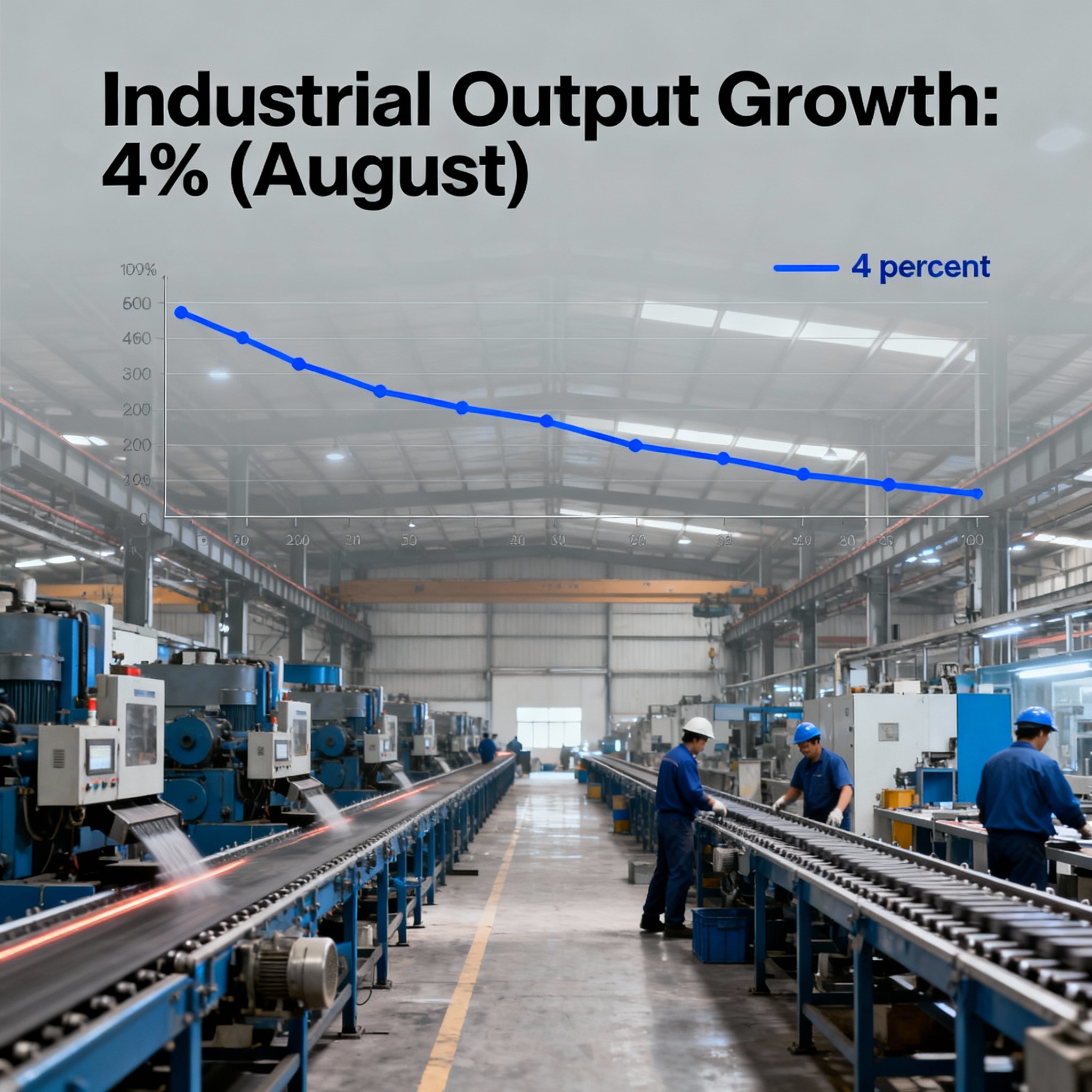
Context: India’s IIP growth fell to 4% in August 2025 from 4.3% in July, pressured by weaker consumer demand and slower manufacturing growth.
- The primary goods sector rebounded to 5.2% (seven-month high); mining surged 6% (14-month high), electricity hit 4.1% (five-month high).
- Manufacturing dipped to 3.8% (from 6%); capital goods at 4.4% (from 6.7%); consumer durables reported the lowest at 3.5% in eight months.
- No GST reform impact evident; MoSPI data signals industrial slowdown needing policy attention.
What is IIP
- IIP is a composite index that tracks short-term changes in India’s industrial output volume.
- It measures growth in mining, manufacturing, and electricity against a fixed base year.
Purpose of IIP
- Economic Indicator: Early signal of industrial health and cyclical trends.
- Short-Term Measurement: Captures monthly production shifts for timely policies.
- Relative Change: Shows output percentage change versus base period.
- Compiled by CSO/MoSPI: Ensures standardized national data.
- Frequency: Published monthly for real-time assessment.
Calculation of IIP
- Quantum Index: Uses Laspeyres formula, a weighted mean of production relatives.
- Production Relatives: Computed as (Current output / Base output) × 100.
- Base Year: 2011-12 is current standard; weights fixed to base year.
Interpreting IIP Data
- YoY growth above 5% suggests strong expansion; below 3% signals slowdown.
- Sectoral analysis highlights demand drivers and drags.
- Index values over 100 mean output exceeds base year; revisions may occur later.
Components of IIP
- Mining (14.37%): Includes extractive industries; August 2025 growth 6%.
- Manufacturing (77.63%): Largest segment; consumer durables at 3.5% in August.
- Electricity (7.99%): Power generation; grew 4.1% in August.
- Use-Based: Primary (5.2%), Capital (4.4%), Consumer Durables (3.5%), Non-Durables (-6.3%).
Importance in Policy & Economy
- Guides RBI monetary policy (rate changes) and government steps.
- Leads GDP estimates, informs investments, benchmarks India globally.
- Critical for UPSC/eco exams, highlighting sectoral shifts like manufacturing.
Limitations of IIP
- Does not cover unorganized sector (~80% of workforce).
- Relies on selective item sampling; subject to revision and outdated base year.
- Focus on volume omits price/quality and service sector data.
IIP and Economic Growth
- IIP leads industrial GDP, typically 25-30% of total output.
- Sustained growth above 5% supports GDP expansion goals.
- Slowdowns warn of wider weakness, triggering policy action.
- Historical link: Strong IIP precedes booms; low IIP aligns with economic recessions.
Conclusion
- IIP is a vital high-frequency measure of India’s industrial health, despite coverage limits.
- The recent slowdown points to need for deeper reforms and demand revival interventions.
- Remains essential for policy and exam readiness as a key proxy for economic strength and direction.
2.”India-Bhutan Rail Links: Boosting Connectivity, Trade, and Strategic Ties in 2025″
International Relations (GS Paper II – India and its neighbourhood relations;
Context: India announced two new railway links with Bhutan: Kokrajhar-Gelephu (Assam-Bhutan) and Banarhat-Samtse (West Bengal-Bhutan), totaling 89 km, at a cost of ₹4,033 crore.
- The projects were formalized during Bhutan’s King’s visit to India and coincide with Foreign Secretary-level talks.
Project Details
Kokrajhar-Gelephu Line (Assam-Bhutan)
- Connects Kokrajhar in Assam to Gelephu in Bhutan.
- Will be developed over four years as part of the first direct rail link from India’s northeast to Bhutan.
- Facilitates Bhutan’s access to the Indian railway network.
Banarhat-Samtse Line (West Bengal-Bhutan)
- Connects Banarhat in West Bengal to Samtse in Bhutan.
- Planned to be completed in three years.
- Designed to support Vande Bharat trains for faster, efficient service.
Strategic and Economic Importance
Trade and Connectivity
- Enables seamless connectivity for Bhutan’s EXIM trade, as most Bhutanese imports and exports move via India.
- Provides Bhutan access to India’s 1,50,000 km rail network, promoting regional integration.
Tourism, People-to-People Ties
- Enhanced rail services encourage tourism between both countries.
- Easier travel fosters stronger social and cultural exchanges and supports the “Neighborhood First” policy.
Industrial and Economic Growth
- Rail links will boost industrial corridors and improve goods movement, aiding manufacturing and supply chains.
- Supports Bhutan’s economic development through better infrastructure and logistics.
Geostrategic Angle
- Deepens India’s strategic partnership with Bhutan, countering regional competition and ensuring connectivity in sensitive border areas.
- Strengthens India’s influence in the region under broader Indo-Pacific objectives.
Wider India-Bhutan Cooperation
Development and Assistance
- India pledged ₹10,000 crore for Bhutan’s 13th Five-Year Plan (2024-2029), supplementing grants from earlier plans.
- Recent cooperation includes the opening of the Jogighopa Inland Waterways Terminal, boosting logistics options for Bhutan.
Hydropower Cooperation
- Collaboration on major hydropower projects like Chukha, Tala, Mangdechhu, Kurichhu, and the upcoming Punatsangchhu-II strengthens energy ties.
- Bilateral cooperation in power trading supports energy security and clean energy goals for both nations.
Inland Waterways
- Bhutan gains alternative trade routes for heavy cargo through Indian waterways, reducing costs and improving access.
These new rail links represent a significant step in advancing India-Bhutan connectivity, economic growth, and bilateral cooperation across multiple sectors.
3.”Flood Threat in Andhra Pradesh: Managing Krishna and Godavari River.
Geography (GS Paper I – Topic: River Systems of India; Water Resource Management; Flood Management and Disaster Mitigation; Major Irrigation and Hydropower Projects.
Context: Continued flood threat in Andhra Pradesh due to swollen Krishna and Godavari rivers after heavy inflows and surplus water release.
Krishna River – Basic Information
Origin and Course
- Originates in Mahabaleshwar, Maharashtra (Western Ghats).
- Flows southeast through Maharashtra, Karnataka, Telangana, Andhra Pradesh; empties into the Bay of Bengal near Hamsaladeevi.
Basin
- Covers ~2,58,948 sq km (8% of India’s area); supports dense agriculture in several states.
- Flows through four states: Maharashtra, Karnataka, Telangana, Andhra Pradesh.
Tributaries
- Right bank: Ghataprabha, Malaprabha, Koyna, Tungabhadra, Panchganga, Dudhganga, Venna.
- Left bank: Bhima, Dindi, Peddavagu, Halia, Musi, Paleru, Munneru.
- Major tributaries: Tungabhadra (formed by Tunga & Bhadra), Bhima, Musi.
Godavari River Basin (“Dakshina Ganga”)
About Godavari River
- Second-longest River in India (“Dakshina Ganga”).
- Provides water for agriculture, industry, and drinking, enriching the Deccan plateau.
Source and Drainage Basin
- Source: Trimbakeshwar (Nashik, Maharashtra, Western Ghats).
- Empties into the Bay of Bengal at Antarvedi (Andhra Pradesh).
- Basin size: ~3,12,812 sq km (nearly 10% of India’s area), making it the largest Peninsular basin.
Boundaries of the Basin
- Bounded by Satmala hills (north), Ajanta and Mahadeo hills (south), the Eastern Ghats (east).
- Basin covers Maharashtra, Telangana, Andhra Pradesh, Chhattisgarh, Odisha, Madhya Pradesh, Karnataka, Puducherry.
Major Tributaries
- Left bank: Purna, Pranhita, Indravati, Sabari.
- Right bank: Pravara, Manjira, Manair, Penganga, Wardha, Wainganga.
Cultural and Religious Significance
- Considered sacred; holds several pilgrimage sites (Trimbakeshwar, Nashik Kumbh Mela).
- Referred to as “Dakshina Ganga” for its scale and sanctity.
Major Projects on Godavari
- Notable dams/projects: Jayakwadi, Sriramsagar, Dowleswaram (Sir Arthur Cotton Barrage), Polavaram, Upper Indravati, Pranahita-Chevella, Godavari canal projects.
- Polavaram is a nationally important multipurpose irrigation and hydropower project.
These river systems are central to South India’s water security, agriculture, and regional culture, with multiple large-scale engineering and conservation projects vital to the region’s livelihood and flood management.
4.”India’s Leadership in South-South Cooperation: A New Era of Global Partnership”.
SSTC is more than a diplomatic phrase
General Studies Paper II (International Relations) or Paper III (Economy/Development).
Context: UN Day for South-South and Triangular Cooperation was observed on September 12, 2025, themed “New Opportunities and Innovation through SSTC” at the UN Headquarters.
- The Hindu op-ed focused on India’s SSTC leadership amidst declining humanitarian aid and rising global challenges.
Background of SSTC
- SSTC emerged with the 1978 Buenos Aires Plan of Action (BAPA), aiming for technical cooperation among developing countries.
- The UN Day for SSTC was established in 2011; Triangular Cooperation broadened the model post-2009.
What is SSTC?
- South-South Cooperation (SSC): Horizontal sharing of resources, expertise, and solutions among developing nations for mutual progress.
- Triangular Cooperation: Developed partners provide funds/expertise while respecting southern country priorities.
- SSTC emphasizes demand-led, scalable projects in health, digital, and agriculture, adaptable across countries.
Why SSTC Matters Today?
- Offers South-led alternatives as UN funding for humanitarian development drops and geopolitical divides rise.
- SSTC’s locally-driven models address inequalities, climate resilience, and food insecurity more effectively.
- Empowers innovation, trust, and resources within the Global South, supporting SDGs amid mounting divides.
India’s Role and Philosophy
Diplomacy and Multilateralism
- India champions Vasudhaiva Kutumbakam (“world as one family”), promoting sovereignty and shared benefits.
- Leads Voice of Global South Summits and funds the India-UN Development Partnership for 75+ projects in 60 nations.
Capacity Building
- Runs ITEC programme, training over 200,000 global officials in key domains.
- Share’s disaster management expertise through NDMA-led workshops in Africa and Asia.
Technology and Innovation
- Exports digital platforms (Aadhaar, UPI) to 100+ nations; hosts UNDP hubs to scale health tech globally.
- Fosters digital public goods and vaccine cold-chain solutions for equitable access.
Food Security Partnership
- Collaborates with WFP on models like Annapurna grain ATM and Take-Home Ration, enhancing nutrition for millions.
- Pilots’ climate-resilient farming and replicable supply chain technologies for the Global South.
Conclusion
- SSTC is a powerful, replicable pathway for equitable development, moving beyond diplomacy to transform billions of lives.
- India’s philosophy and actions prove how innovation through partnerships drives sustained progress for all.
5. The Wassenaar Arrangement: need to reform export control regimes
GS paper II:IR Bilateral, Regional and Global Groupings and agreements involving India
Context: Protests have erupted against Microsoft over allegations that its Azure cloud services are supporting Israeli military operations, potentially harming Palestinian civilians and triggering concerns under the Wassenaar Arrangement.
What is the Wassenaar Arrangement?
- Establishment: Formed in 1996, succeeding the Cold War-era COCOM controls.
- Name Origin: Named after Wassenaar, near The Hague, where the agreement was reached in 1995.
- Headquarters: Based in Vienna, Austria.
- Membership: Comprises 42 countries including India (joined 2017); includes most NATO/EU states and UNSC P5 except China.
- Objective: Promotes transparency, responsibility, and control in transfers of conventional arms and dual-use technologies.
- Mechanism: Operates by voluntary sharing of information, notifications of export denials, and maintenance of control lists.
Control Lists under the Arrangement
- Munitions List: Covers conventional arms—tanks, aircraft, UAVs, helicopters, missiles, small arms, etc.
- Dual-Use List: Encompasses sensitive technologies and equipment with both civilian and military applications.
Wassenaar Arrangement and Software/Cloud
- Initial Scope: Focused on hardware exports.
- 2013 Expansion: Added “intrusion software” capable of bypassing cyber protections.
- Current Challenges: Ambiguities exist regarding cloud services, remote access, and cross-border software transfers; inconsistent member interpretations.
- Gap: Rapid developments in AI, cloud, biometrics have surpassed the Arrangement’s traditional framework.
Suggested Reforms
- Modernize Lists: Cover cloud, AI, surveillance, and biometrics explicitly.
- Remote Access: Recognize software exports via cloud as export activities.
- Agility: Set up technical committees for regular updates to control lists.
Wassenaar Arrangement and India
- Membership (2017): Raised India’s profile in arms control and non-proliferation, strengthening its Nuclear Suppliers Group (NSG) bid.
- Export Controls: Aligns India’s SCOMET list to the Arrangement’s standards for better oversight.
- Technology Access: Aids Indian access to sensitive dual-use tech for space, defence, and digital industries.
- Diplomatic Impact: Enhances India’s stance on counter-terrorism and global security by aligning with initiatives like the “No Money for Terrorism” summit.
6.World’s highest bridge opens to traffic in China
GS PAPER III: ECONOMICS -Infrastructure: Energy, Ports, Roads, Airports, Railways Etc.
Why in the News?
- The Huajiang Grand Canyon Bridge in Guizhou province, China, has opened as the world’s tallest bridge, standing 625 meters above the Beipan River.
About Huajiang Grand Canyon Bridge
Height and Records
- The bridge rises 625 meters above the Beipan River, surpassing the previous record-holder Beipanjiang Bridge (565 m).
- Holds the world record for tallest deck-to-water clearance and the largest span built in a mountainous area.
Connectivity and Network
- Links Liuzhi Special District and Anlong Special District, cutting travel time from two hours to two minutes.
- Forms an integral part of the Guizhou S57 Expressway and 190-km Shantian–Puxi Expressway.
Engineering Marvel
- Guizhou is renowned as the “bridge museum of the world”, hosting nearly half of the world’s 100 tallest bridges.
- The bridge’s total length is 2,890 m, with a main suspension span of 1,420 m—world’s longest main span in mountainous terrain.
Construction Highlights
- Construction began in January 2022 and was completed in just over three years.
- Final truss installed in January 2025; load testing done with 96 trucks for structural integrity.
Conclusion: The Huajiang Grand Canyon Bridge sets new global benchmarks in civil engineering and connectivity, boosting local transport, economy, and tourism while highlighting China’s leadership in high-altitude infrastructure.
7. Bihar adds 2 more Wetlands to Ramsar List
GS paper III: Enviro & Biodiversity
Context: India designated two new wetlands — Gokul Jalashay (Buxar) and Udaipur Jheel (West Champaran) in Bihar — as Ramsar sites.
- With these additions, India now has 93 Ramsar sites, ranking first in Asia and third glo
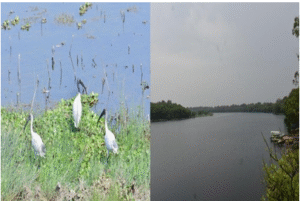 bally after the UK (176) and Mexico (144).
Key Facts on India’s Ramsar Sites
- Since 2012, the number of Ramsar sites in India grew from 26 to 93, covering 13.6 lakh hectares; 51 sites added since 2020.
- Largest wetland area globally: Bolivia, Llanos de Moxos (6.9 million ha).
- Tamil Nadu has the highest number (20), followed by Uttar Pradesh (10).
- About 10% of India’s wetland area falls under Ramsar protection.
- India joined the Ramsar Convention in 1982; first site: Chilika Lake, Odisha (1981).
- Currently, there are 2,544 Ramsar sites worldwide.
Wetland Highlights
Gokul Jalashay (Buxar)
- 448-hectare oxbow lake on the Ganga’s southern edge.
- Acts as a flood buffer, supporting 50+ bird species and local livelihoods via fishing and farming.
Udaipur Jheel (West Champaran)
- 319-hectare oxbow lake, part of Udaipur Wildlife Sanctuary, formed by the Gandaki River.
- Enhances connectivity for migratory birds along the Central Asian Flyway.
Ramsar Convention: Overview
- Signed in 1971 at Ramsar, Iran; currently 173 member countries.
- Objective: Framework for conservation and wise use of wetlands and resources.
- Functions: Identification/designation of sites, management promotion, and international conservation cooperation.
- Montreux Record: List of globally threatened sites — includes 2 from India (Keoladeo and Loktak Lake).
World Wetlands Day
- Observed on February 2 globally; 2025 theme: “Protecting Wetlands for Our Common Future”.
Criteria for Ramsar Site Declaration (Any 1 of 9 Needed)
- Unique or rare wetland type.
- Supports endangered or endemic species.
- Critical migratory bird habitat.
- Notable ecological, botanical, zoological, hydrological features.
- Biodiversity, scientific research, and ecosystem services (flood control, groundwater recharge, water purification).
- Cultural or livelihood significance.