1. Equalising primary food consumption in India
General Studies Paper 1 (Indian Society) :Topic: Issues related to Poverty and Vulnerability
General Studies Paper 2 :Topic: Poverty, Social Justice and Social Empowerment
General Studies Paper 3 (Economy and Development) :Topic: Inclusive Growth and Issues Arising from it
Context: RBI’s 2024 NSS 2022-23 Household Consumption Survey estimated India’s poverty rate at a low 2.5%, a sharp drop from 21.6% in 2011-12.
- The World Bank report shows slower declines (~10-12%), prompting debates on poverty measurement and true deprivation levels.
- The findings highlight the role of PDS in food security but reveal nutritional gaps.
- The report influences policy reforms focusing on protein-rich food distribution in the 2025-26 Union Budget.
Contrasting Narratives of Poverty in India
- RBI data shows poverty falling dramatically; World Bank’s multidimensional metric shows less steep drops.
- Consumption data masks uneven subsidy access; urban areas lag rural, protein deficiency persists despite calorie adequacy.
- RBI’s “thali meal” metric may undercount protein-poor but calorie-adequate households.
- Post-pandemic survey shows rural resilience but high vulnerability in urban slums.
Why Measure Poverty Through the Thali Meal?
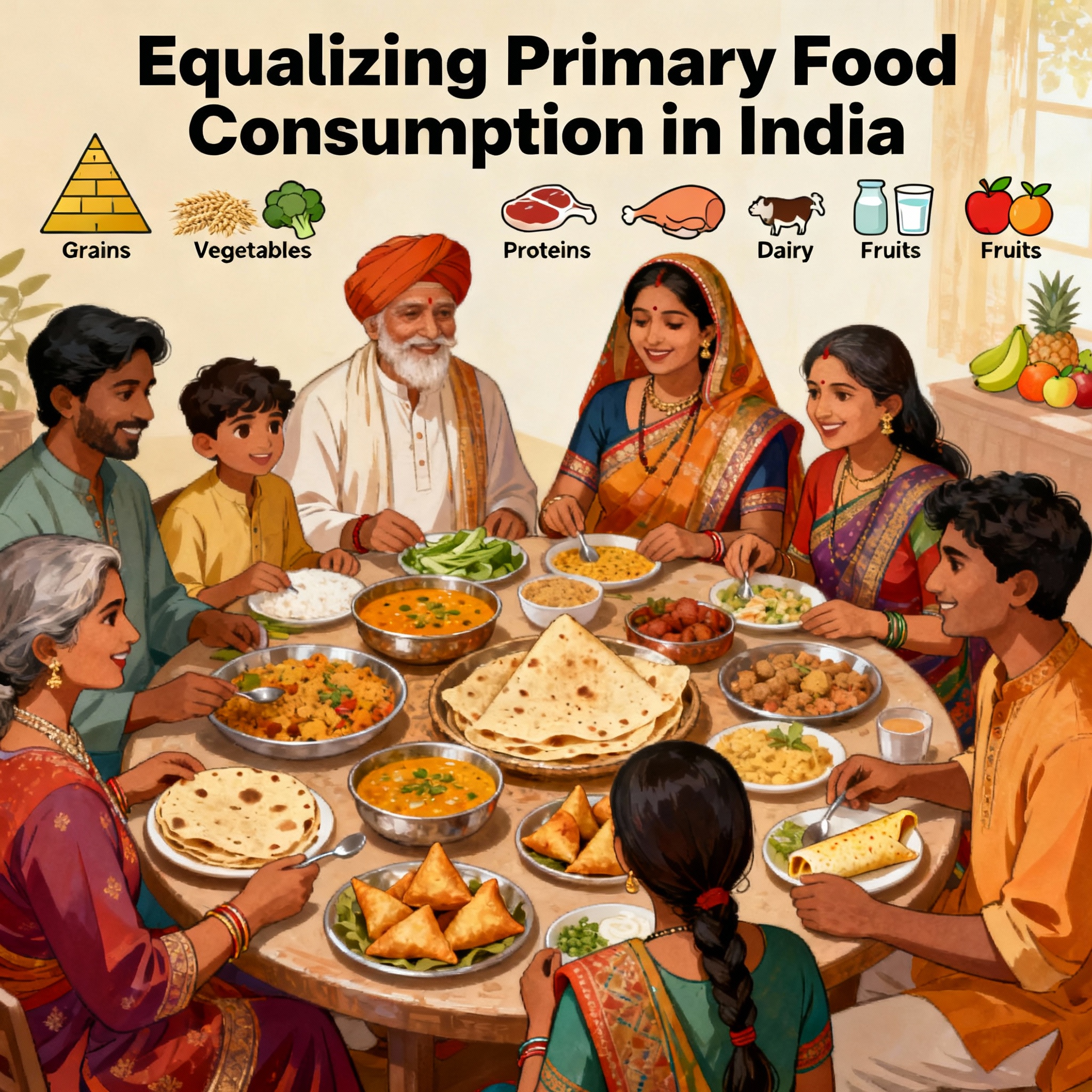
- The ‘thali meal’ includes cereals, pulses, vegetables, and proteins: a balanced nutritional unit beyond mere calorie intake.
- This metric targets households unable to afford a balanced meal for better poverty identification.
- Reveals “hidden poverty” from protein deficits missed by income-only measures.
- Supports linking subsidies to nutritional goals like anemia reduction.
Effectiveness of the Public Distribution System (PDS)
- PDS covers 88% households with subsidized cereals, reducing inflation and aiding rural poor.
- Rural coverage is higher than urban; urban poor have limited full access.
- High cereal subsidy efficiency vs. low coverage for pulses, limiting overall nutrition.
- Leakages and over-dependency on cereals exacerbate malnutrition.
Why Cereals Are Not Enough ?
- Cereals provide 70-80% of calories but only 20-30% of protein intake.
- 60% of rural people consume less than recommended pulses amount.
- Poor households prioritize cereals due to cost, leading to protein deficiency.
- This imbalance links to anemia and child stunting.
Policy Path: Equalizing Food Consumption Through Pulses
- Expand PDS subsidies for pulses at 50% below market price, targeting bottom 40%.
- Allocate 20% PDS quota to pulses/millets with strong audit mechanisms.
- Procure pulses from farmers cooperatives lowering cost & boosting income.
- Integrate pulses with school meal schemes like PM-POSHAN reaching millions.
- Use Aadhaar-based digital tracking to ensure subsidy equity.
Conclusion
- NSS poverty decline contrasts with persistent nutritional inequities.
- ‘Thali meal’ approach refocuses poverty on balanced nutrition, not just calories.
- PDS diversification towards pulses can curb hidden malnutrition and promote equity.
- Decisive policy reforms can align India with sustainable development goals and end food deprivation by 2030.
2. U.S. visas of Indian executives for smuggling ingredients used in fentanyl
GS Paper 2 (International Relations and Governance),
GS Paper 3 (Internal Security and Disaster Management)
Context: On September 18, 2025, the U.S. Embassy in New Delhi revoked and denied visas for certain Indian business executives and their families due to alleged involvement in trafficking fentanyl precursors.
- This follows U.S. charges against two Indian companies for smuggling fentanyl ingredients into the U.S. earlier in 2025.
- Part of the Trump Administration’s intensified campaign against synthetic narcotics, with cooperation from the Indian government to control precursor flow.
Background
- In January 2025, two Indian companies—Raxuter Chemicals and Athos Chemicals—were indicted for smuggling fentanyl precursor chemicals to the U.S., with key executives arrested.
- These companies used international mail and fraudulent declarations to evade detection.
- India was named by the U.S. among major countries under narcotics scrutiny, signaling increased vigilance.
- Visa revocations are part of enforcement using U.S. immigration laws to disrupt trafficking networks.
What is Fentanyl?
- Fentanyl is a synthetic opioid painkiller, 50-100 times stronger than morphine, used medically under strict regulation.
- Illicit fentanyl is often mixed with other drugs, making it undetectable and highly risky for users.
Risks and Health Effects
- High overdose risk causing respiratory failure, coma, or death even in small amounts.
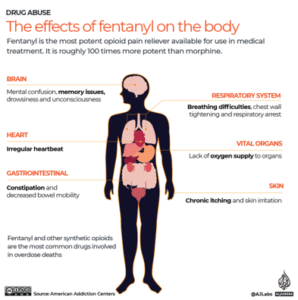
- Short-term: drowsiness, confusion, nausea, slowed breathing; long-term: addiction and severe CNS depression.
- Accidental exposure, especially to children, can be fatal.
Scale of the Crisis
- Over 106,000 annual overdose deaths in the U.S. (2023), with about 70% involving synthetic opioids like fentanyl.
- Overdose death rates doubled between 2015 and 2023, especially affecting rural and low-income communities.
- Naloxone usage and emergency responses surged due to the crisis.
Causes of Addiction
- Often begins with legitimate medical prescriptions but progresses due to rapid tolerance and transition to illicit opioids.
- Addiction fueled by easy access, mental health issues, economic despair, and low-cost availability (~$1 per dose).
Global Dimensions
- Primary precursor sources include China and India, with production shifting due to regulation changes.
- Precursors often diverted via complex international trafficking routes before final fentanyl manufacture in countries like Mexico.
- Fentanyl misuse is a growing problem in Europe, Canada, and worldwide, with over 500,000 annual opioid deaths globally.
Impact on U.S Policy
- The Trump Administration implemented visa bans, tariffs, and stronger border security to disrupt fentanyl supply chains.
- Cooperation with countries like India aims to reduce precursor trafficking but challenges remain due to enforcement gaps.
- Criticism exists over cuts in prevention and recovery funding, risking sustained successes.
Conclusion: The visa action against Indian executives highlights the global scale of the fentanyl crisis.
- Synthetic opioids pose severe health risks requiring combined enforcement, treatment expansion, and international cooperation.
3. How the Deepseek-R1 AI model was taught to teach itself to reason
GS 3: Science and Technology — Artificial Intelligence, Machine Learning, and Advanced Technologies.
Context: DeepSeek-R1 is gaining attention as the first AI to self-learn reasoning without human-annotated data. By teaching itself to reflect and verify, it achieved a leap in performance on the AIME exam, raising accuracy from 15.6% to 86.7% and surpassing top human averages. This marks a major step toward autonomous, self-learning AI.
Why is DeepSeek-R1 Important?
- First AI model to teach itself reasoning without human-provided examples.
- Improved accuracy on math problems from 15.6% to 86.7%, surpassing top students’ average.
- Demonstrated reflection and verification, human-like reasoning traits.
What is Reinforcement Learning (RL)?
- A trial-and-error learning method where models get rewards for correct answers.
- DeepSeek-R1 was rewarded only for correct final answers, not steps.
- Resulted in adaptive reasoning that adjusts thinking time for complexity.
How Did DeepSeek-R1 Achieve Self-Reasoning?
- DeepSeek-R1 began its learning in the R1-Zero phase by solving math and coding problems, expressing reasoning in <think> tags and answers in <answer> tags.
- It learned via trial and error: incorrect reasoning paths were penalized while correct ones were reinforced.
- The model then developed self-reflection abilities, using prompts like “wait” or “let’s try again” to review and improve its answers independently.
What Were the Major Successes?
- Improved math problem-solving from 15.6% to 77.9%, then 86.7% post fine-tuning on AIME.
- Achieved 25% better general knowledge accuracy and 17% better instruction following.
- Adapted reasoning length to task difficulty for efficiency.
- Enhanced language readability, safety, and alignment.
Limitations and Risks
- Reinforcement learning consumes high energy.
- Creative tasks still require human-labelled data for reward models.
- Reflection capability risks generating unsafe or manipulative content.
- Strong safeguards needed to prevent misuse.
Why This Matters for AI’s Future ?
- Reduces reliance on costly human-labelled data.
- Opens potential for AI creativity and understanding through incentive-based learning.
- Marks shift from learning by example to learning by exploration.
- Has wide implications across education, governance, ethics, and AI applications.
Conclusion: DeepSeek-R1 marks a milestone in AI evolution by enabling machine reasoning via reinforcement learning alone. Challenges the belief that human-labelled data is essential. Poses new challenges around creativity, autonomy, safety, and ethics requiring oversight in AI deployment.
4. World’s top 10 happiest cities in 2025:
Why in News?
- The 2025 Happy City Index ranks the world’s happiest cities using 82 indicators across six themes.
- The report gained attention post-COP29, with Copenhagen topping for environment and citizen engagement.
- A new “Health” category was added, reflecting COVID-19 impacts on public health priorities.
- No Indian cities ranked, sparking debates on urban governance and pollution challenges versus Asian peers like Singapore.
What Makes a City Happy?
- Cities evaluated on six themes: Citizens, Governance, Environment, Economy, Health, and Mobility.
- Factors include infrastructure, work-life balance, and eco-friendly initiatives promoting well-being.
- Rankings split into Gold (top 31), Silver (32-100), and Bronze (101-200) tiers.
- Nordic cities excel due to balanced policies and strong social safety nets.
Top 10 Happiest Cities in 2025
| Rank | City, Country | Score | Key Strengths |
| 1 | Copenhagen, Denmark | 1039 | Environment, Citizens |
| 2 | Zurich, Switzerland | 993 | Citizens, Governance |
| 3 | Singapore | 979 | Citizens, Health |
| 4 | Aarhus, Denmark | 958 | Citizens, Governance |
| 5 | Antwerp, Belgium | 956 | Citizens, Governance |
| 6 | Seoul, South Korea | 942 | Citizens, Governance |
| 7 | Stockholm, Sweden | 941 | Citizens, Environment |
| 8 | Taipei, Taiwan | 936 | Governance, Environment |
| 9 | Munich, Germany | 931 | Citizens, Health |
| 10 | Rotterdam, Netherlands | 920 | Environment, Health |
European Dominance and Asian Presence
- Europe claims 7 top 10 spots, including Copenhagen and Aarhus from Denmark.
- Asian cities: Singapore (#3), Seoul (#6), and Taipei (#8), known for governance and health.
- US, UK, and China cities absent in top 10; highest ranks: New York (#17), London (#31), Beijing (#54).
India’s Position
- No Indian city in top 200 due to governance, pollution, and health service issues.
- Challenges include air pollution, inequality, and infrastructure deficits in cities like Mumbai and Delhi.
- Opportunity for sustainable urban development aligned with India’s Smart Cities Mission.
Key Takeaways
- The index stresses holistic well-being beyond just economic growth.
- Gold-tier cities balance all well-being factors effectively.
- Calls for policies fostering inclusive happiness and sustainable urban planning globally.
5. Global Innovation Index (GII)
Why in the News?
The World Intellectual Property Organization (WIPO) has released the Global Innovation Index (GII) 2025.
About the Global Innovation Index (GII):
- Annual ranking of 139 economies based on their innovation capacity and success.
- Published jointly by Cornell University, INSEAD, and WIPO.
- First published in 2007.
- Evaluates innovation using 80+ metrics across 7 pillars.
Structure of GII:
- Innovation Input Sub-Index: Includes institutions, human capital and research, infrastructure, market sophistication, business sophistication.
- Innovation Output Sub-Index: Covers knowledge and technology outputs, creative outputs.
Purpose:
- Helps governments assess how effectively R&D, education, and infrastructure translate into innovation outcomes.
Key Highlights of GII 2025:
- Global R&D growth slowed to 2.9% in 2024 and projected at 2.3% in 2025, the lowest since 2010 financial crisis.
- Top ranking countries: Switzerland (1st), Sweden (2nd), United States (3rd), followed by South Korea, Singapore, UK, Finland, Netherlands, Denmark, and China (10th).
- China leads in knowledge and technology outputs, patent filings, and ranks 2nd in R&D expenditure.
- Europe dominates with 15 of the top 25 economies; Southeast, East Asia, and Oceania region has 6 in the top 25.
India’s Performance:
- Ranked 38th globally with an approximate score of 40.5.
- Top among lower-middle-income countries and in the Central & Southern Asia region.
- Strengths: Knowledge and technology outputs (22nd), market sophistication, human capital, and research.
- Weaknesses: Business sophistication, infrastructure, and institutions lag behind.
6. NCST FORMS PANEL TO LOOK INTO DUTIES GIVEN IN 2005
GS-II (Polity, Governance, Social Justice) – highlights institutional reforms for vulnerable sections.
Context: On September 18, 2025, NCST formed a special internal committee to examine eight additional duties assigned in 2005.
- This marks the first structured effort in over 20 years to address those responsibilities.
- The committee aims to prepare a report by the financial year-end, possibly including field visits and consultant support.
- The move responds to past criticisms about NCST’s resource constraints limiting its effectiveness.
Background: What is NCST?
|
2005 Notification: Expansion of NCST Role
- The Ministry of Tribal Affairs issued a notification assigning eight additional duties, including:
- Protecting ownership of minor forest produce.
- Ensuring tribal rights over water and mineral resources.
- Preventing land alienation.
- Full implementation of the Panchayats (Extension to Scheduled Areas) Act (PESA), 1996.
- Developing livelihood strategies.
- Evaluating rehabilitation programs for tribals displaced by development projects.
- Enhancing tribal participation in forest conservation.
- Reducing and eliminating shifting cultivation practices.
Problems Till Now
- The 2005 NCST report cited serious staff and fund shortages, hindering duties execution.
- Subsequent reports lacked mention or progress on these duties.
- NCST lacks independence, prosecutorial powers, and timely report submissions.
- Resource constraints limit field investigations and preventive roles.
What’s New in 2025?
- NCST created a special committee of 11 members divided into 3 sub-committees:
- Sub-committee 1 (Jatothu Hussain): Livelihood strategies, ownership of forest produce, minerals, and water.
- Sub-committee 2 (Asha Lakra): Land alienation and rehabilitation for displaced tribals.
- Sub-committee 3 (Nirupam Chakma): PESA implementation, forest conservation, and shifting cultivation elimination.
- Plans include field visits and engaging consultants if necessary.
Why This is Significant?
- Addresses long-pending tribal rights issues like land alienation, resource ownership.
- PESA implementation, crucial for ST empowerment and governance in scheduled areas.
- Enhances NCST’s advisory role in socio-economic development, potentially influencing policies on forest rights (FRA 2006 linkage) and displacement.
- Timely amid rising tribal concerns, such as illegal land grabs (e.g., Asha Lakra’s report on Jharkhand), and could lead to better enforcement of safeguards.
Challenges
- Persistent shortages of staff and funds may impede comprehensive reporting.
- Lack of binding powers leads to implementation gaps.
- Delays, coordination issues with states, and political influence affect effectiveness.
- Data inadequacies and overlapping roles with other bodies complicate governance.
7. U.S to revoke waiver on Chabahar port sanctions
GS-II (IR): U.S. sanctions, multi-alignment challenges, U.S.-India-Iran relations, QUAD/I2U2 contexts.
GS-III (Economy): Trade corridors, sanctions impact, regional infrastructure strategies.
Context: On September 18, 2025, the U.S. State Department announced revocation of India’s waiver on sanctions regarding the Chabahar port in Iran, effective September 29, 2025.
- This decision represents an escalation of U.S. sanctions pressure on Iran, disrupting India’s strategic regional connectivity plans.
- It follows recent talks signaling U.S.-India trade rapprochement but highlights tensions in other bilateral and regional issues.
What is Chabahar Port?
- Chabahar is a strategic port in southeastern Iran, developed jointly by India and Iran to enhance trade connectivity.
- It serves as an alternative trade route for India, bypassing Pakistan, to access Afghanistan and Central Asia.
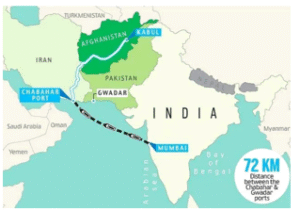
- The port is crucial for fostering regional economic integration and reducing reliance on contentious routes.
Background of the US Waiver
- In 2018, the U.S. had provided India a special waiver exempting its activities in Chabahar from sanctions imposed on Iran.
- The waiver was intended to support India’s efforts in regional connectivity and counterbalance China-Pakistan influence.
- It allowed India to develop the Shahid Beheshti terminal and operate despite broader US sanctions on Iran.
What Happened Now in 2025
- President Trump’s executive order on February 5, 2025, mandated a review of all Iran sanctions waivers.
- The State Department revoked the Chabahar waiver, effective September 29, citing changed circumstances like Taliban’s control in Afghanistan and port revenues funding Iran’s proxies.
- Indian firms involved risk sanctions including asset freezes and transaction bans.
Impact on India:
Economic Loss: Risks ₹200 crore already invested of a ₹400 crore allocation in port development.
- $120 million worth of equipment investment at stake.
- Disrupts trade worth $1-2 billion annually via the International North-South Transport Corridor (INSTC).
- Includes Afghan exports and Indian exports to Eurasia.
- Possibility of 25% U.S. tariffs on Indian goods used as leverage.
Diplomatic Tensions: Strains the U.S.-India strategic partnership, including QUAD cooperation.
- Complicates India-Iran relations, e.g., delaying $500 million funding releases for Chabahar.
- Reminiscent of 2018-19 U.S. demands for reduced Iranian oil imports.
- Tests the effectiveness of India’s ‘neighbourhood first’ diplomacy under the Modi government.
Connectivity Plans Hit: Jeopardizes the INSTC and Chabahar’s role as an alternative in the India-Middle East-Europe Corridor (IMEC).
- Hampers access to around 800 million consumers in Central Asia.
- Risks undoing recent gains like a 43% rise in vessel traffic and 34% growth in container traffic (2023-24).
- Delays India’s goals of regional integration and trade expansion.
Geopolitical Shift: Strengthens China’s Belt and Road Initiative dominance via Gwadar port, which is 170 km from Chabahar.
- Weakens India’s influence in Afghanistan, especially post-Taliban takeover.
- Shifts regional power balance in favour of Pakistan.
- Undermines India’s strategy to encircle China through regional partnerships.
Why is the U.S. Doing This?
- The U.S. action aligns with Trump’s “maximum pressure” campaign to isolate Iran and prevent its nuclear weapons development.
- It targets Iran’s support for proxy groups like Houthis and Hezbollah that threaten U.S. allies such as Israel and Saudi Arabia.
- Revenues from Chabahar port are viewed as funding Iran’s “axis of resistance” and ballistic missile programs.
- The Taliban’s 2021 takeover of Afghanistan reduced the initial humanitarian rationale for the Chabahar waiver.
- The revocation is part of a broader review of Obama-Biden-era sanctions waivers aimed at reimposing maximum economic pressure.
- It signals pressure on India to align away from the Iran-Russia axis, especially regarding oil imports amid the Ukraine conflict.
India’s Options Ahead
- Diplomatic talks with U.S. for renewed waivers or carve-outs.
- Diversify investments to Bandar Abbas, Duqm, and enhance Bay of Bengal corridors.
- Strengthen INSTC trilaterally with Iran, Armenia; leverage BRICS/SCO diplomacy.
- Strategically hedge by discreetly sustaining Chabahar ops, deepen Russia/Central Asia ties.
- Balance multi-alignment between U.S. partnerships and Eurasian outreach.